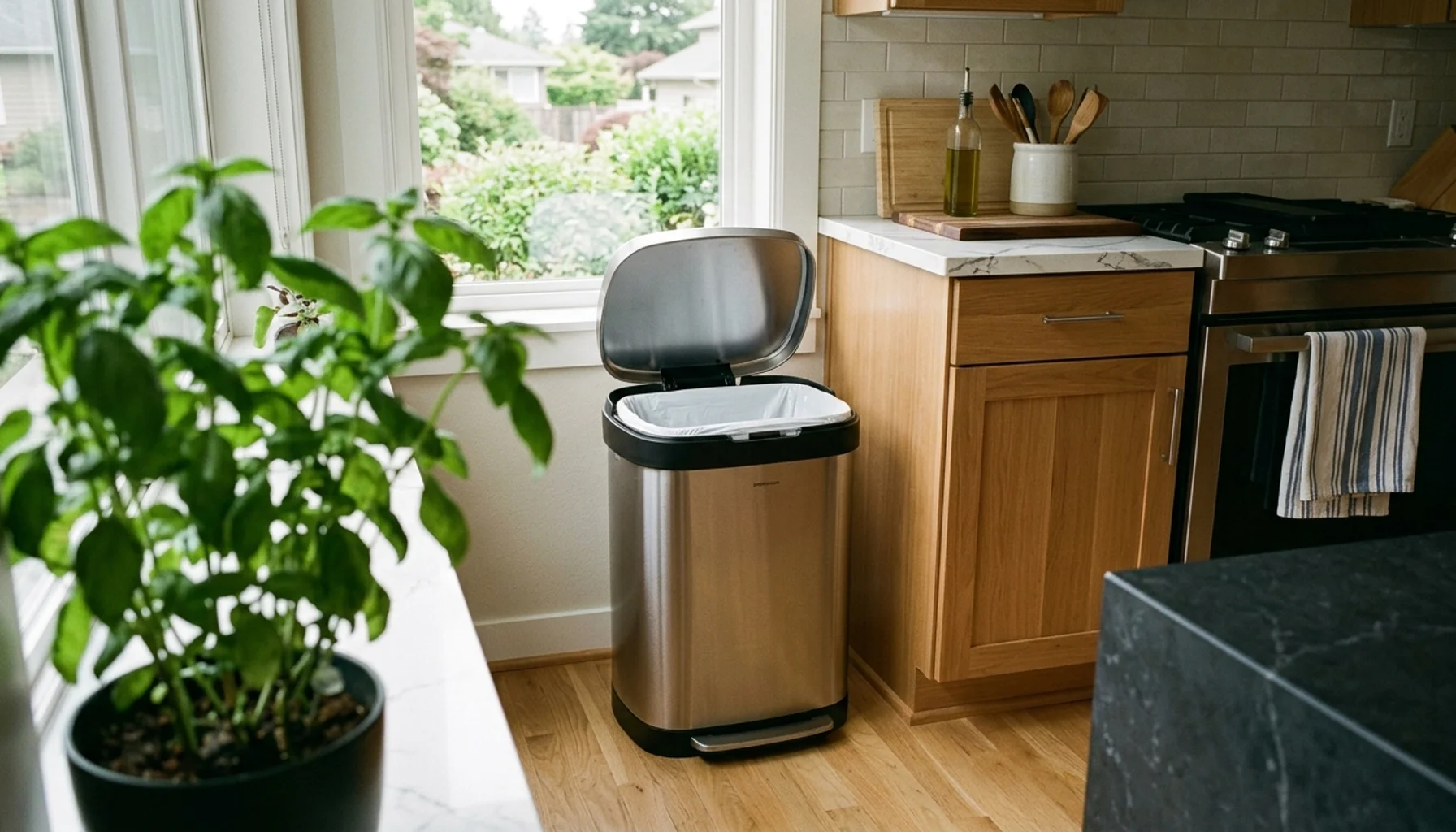
Automated garbage cans are bins that open without a touch on the lid, usually through a motion sensor, and that connect to scheduled collection so full bags leave the unit without anyone hauling them. A sensor can handles the kitchen. Nightly valet service handles the walk to the dumpster or curb.
Key Takeaways
- Automated garbage cans use infrared or proximity sensors to lift the lid on motion, and the most common household size holds about 13 gallons with standard 13-gallon bags.
- Sensor range varies by model: some detect a hand from about six inches, while others reach roughly 25 cm or sense motion from behind the can, so placement matters as much as the brand.
- Battery type drives long-term cost; disposable AA or C cells and built-in rechargeable packs create different upkeep patterns.
- A sensor can removes the lid touch but leaves the bag in the unit; nightly Doorstep-to-Dumpster valet service with photo verification completes the hands-off chain.
- Homeowner can-to-curb service starts from $49 per month in select Charleston neighborhoods, and commercial quotes are available Monday through Friday.
If you manage a garden-style community off Rivers Avenue, you know the Monday-morning picture: tied bags beside doors, an overfilled kitchen bin upstairs, and a dumpster that was full by Saturday. A better kitchen can fixes one small piece of that scene. It does not carry the bag anywhere.
At Trash Day Made Easy, we run nightly valet trash and can-to-curb service from our headquarters at 4900 O'Hear Avenue in North Charleston, so we see both halves of the problem: what happens inside the unit and what happens after the bag leaves it. This guide covers how sensor cans work, what to look for in 2026, and where automated collection fits.
You will also find placement advice and a cost-of-ownership view that most buying guides skip, plus candid notes on when none of this is worth the money.
How Do Motion Sensor Trash Cans Open and Close Automatically?
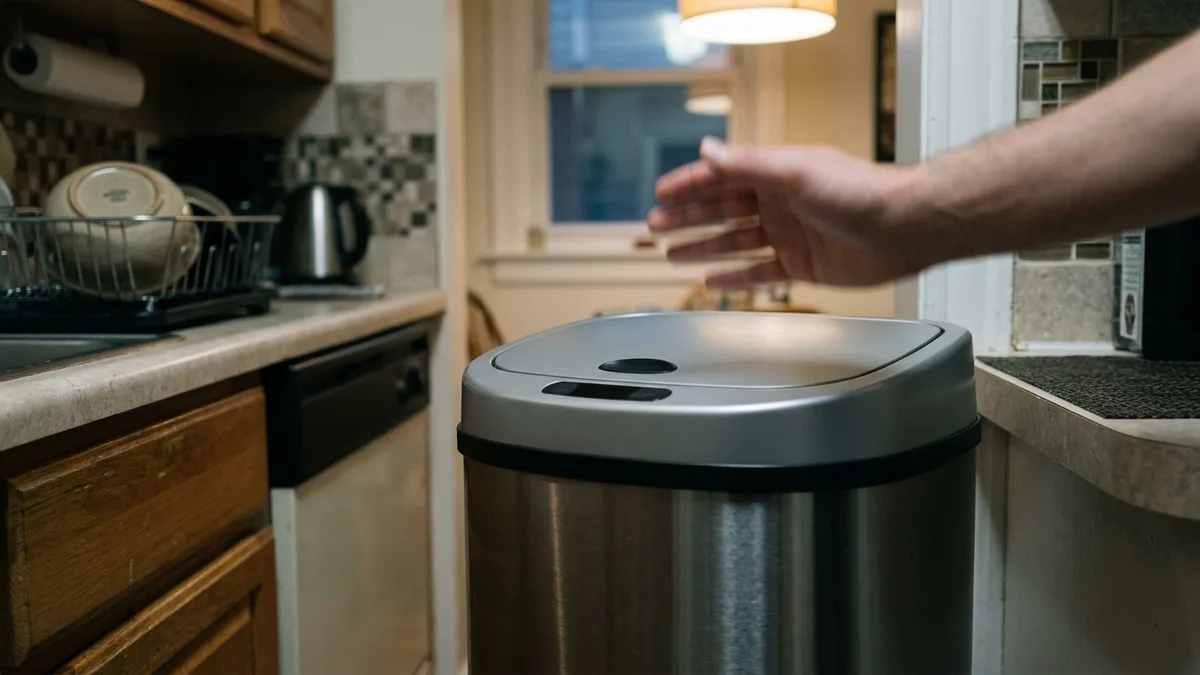
A motion sensor trash can is a bin with an infrared or proximity sensor, a small motor, and a hinged lid that opens when the sensor detects a hand or object and closes after a short delay. Most run on batteries, so the sensor stays in a low-power watch mode until something moves within range.
What Does the Sensor Actually Detect?
Detection range differs sharply between models. Testing by consumer review outlets found that some sensors pick up a hand from about six inches away, while others register motion up to 25 cm out or even from behind the can. A short range feels precise but forces you to aim. A long range feels effortless until the dog walks past. In a galley kitchen where you pass the can twenty times a day, the short-range type is the better pick.
How Do Lids Close Without Catching Your Hand?
Better models add a safety sensor that stops the lid from closing on a hand, and they hold the lid open for a few seconds so you can scrape a plate. Some put the sensor on top of the lid, which means you wave over the bin rather than in front of it. Under low overhead cabinets, skip top-sensor designs; the wave gesture gets awkward fast. Test the hold-open time in the store or during the return window, because a lid that drops after two seconds will frustrate you while you scrape a full dinner plate.
What Features Make a Smart Trash Can Worth Buying?
A smart trash can is worth buying when its sensor reliability, bag fit, and power type match how you use the space. General-purpose cans commonly hold around 13 gallons, and larger capacities need more floor space and usually cost more.
Check these features before you spend:
- Bag compatibility: Models that accept standard 13-gallon bags save you from buying proprietary liners. Some bags fit tightly at the corners, so test one before you commit to a case.
- Inner bucket: A can without an inner bucket lets the liner sag against the walls, which makes full or leaking bags harder to lift out and the can harder to clean.
- Footprint versus capacity: Measure cabinet and counter clearance for the tall, slim, and round versions. Capacity numbers say nothing about whether the lid has room to swing open.
- Finish: Anti-scratch coatings and brushed finishes hide fingerprints better than glossy stainless.
- Weight and stability: Some models weigh roughly 8 to 10 pounds empty, which keeps them from tipping when the lid motor engages.
What Are the Best Automatic Trash Cans for Kitchens and Apartments?
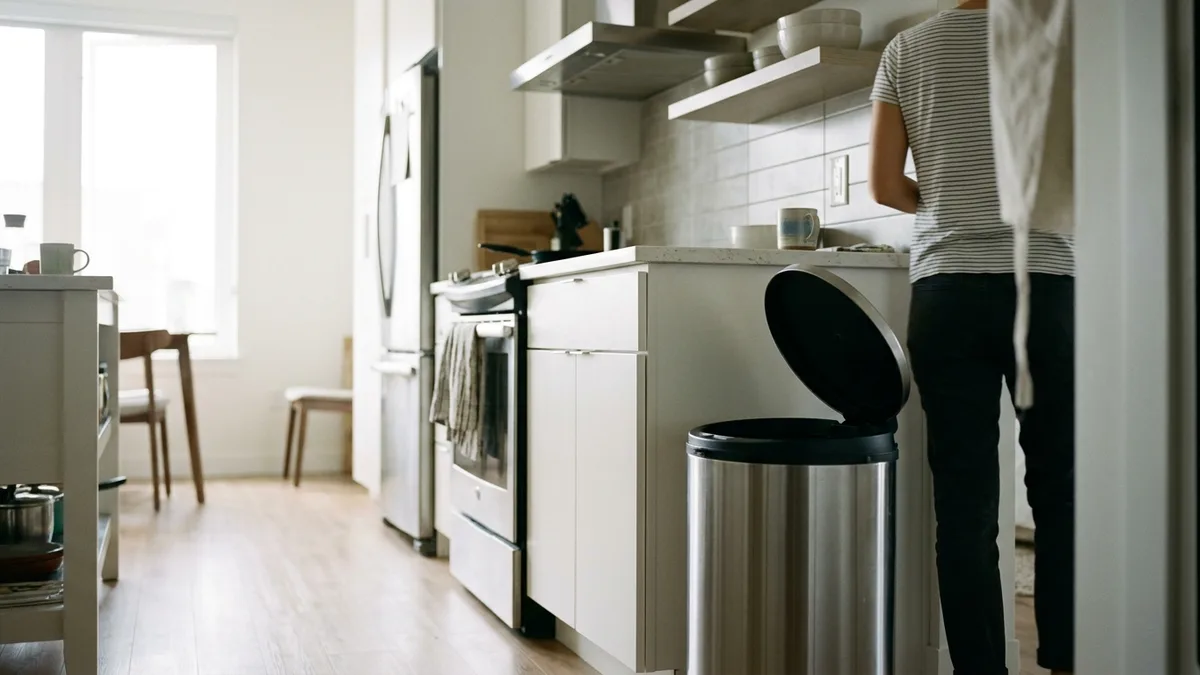
The best automatic trash cans for kitchens are 13-gallon models with a front-facing or wide-angle sensor, an inner bucket, and standard bag compatibility. For apartments, a slim profile that tucks beside a cabinet matters more than headline capacity, because floor space is the scarcest resource in the unit.
For a family kitchen, I would pick the 13-gallon size with an inner bucket and accept a slightly higher price. For a one-bedroom apartment, a slimmer can that you empty every night beats a large one you let fill for a week. Frequent emptying is easier when nightly pickup removes the trip to the dumpster, which is one reason buildings with doorstep service pair well with compact cans.
Households with pets or toddlers should look for a lid lock or a way to switch the sensor off. Without one, an automatic lid is an open invitation. Shopping from a brand list is less useful than testing at home: how often the lid false-triggers, how loud the motor is at 11 p.m., and whether the bag stays put when the can is full. Run each test with the can in its real spot, since a showroom floor tells you nothing about your cabinet gap.
Which Touchless Garbage Cans Have the Best Odor Control?
Touchless garbage cans control odor best when the lid seals tightly after every use, the bag stays contained in an inner bucket, and a charcoal or similar filter sits in the lid. Filter and infrared odor claims come from manufacturers, so treat them as helpful extras rather than guarantees.
The sealed lid is the part you can verify yourself: close it on a bag and check for a gap. Automatic lids stay open for a few seconds, then shut, so odor escapes mainly during use rather than between uses. That is an advantage over a pedal can left ajar.
Heat is the bigger variable in the Lowcountry. In North Charleston, summer humidity can turn kitchen waste into a smell problem within a day or two, no matter how good the lid is. A can that is emptied nightly will beat a premium can emptied every four days. Seafood shells and chicken packaging are the usual offenders, so double-bag those and move them out the same evening.
How Much Do Automated Garbage Cans Cost to Own Over Time?
The cost of owning an automated garbage can is the purchase price plus power and bag expenses over its lifespan. Battery type is the biggest ongoing variable, because replacement frequency depends on how often the lid cycles. Exact figures vary by model, so compare these upkeep patterns before you compare sticker prices.
| Cost factor | How it behaves over time | What to check |
|---|---|---|
| Disposable AA or C batteries | Recurring purchases; some models use four cells | Estimated battery life in the manual, and how many cells it takes |
| Built-in rechargeable pack | No cell swaps, but you must remember to charge it | Charge port location and how long a charge lasts |
| Standard 13-gallon bags | Cheap and easy to buy anywhere | Whether the bag fits snugly at the corners |
| Proprietary liners | Higher per-bag cost and one source of supply | Whether the can works with generic bags at all |
Our preference is a rechargeable model that also accepts generic bags. Disposable cells are fine for a low-traffic bathroom can. A kitchen can that opens dozens of times a day will drain batteries faster than you expect.
Where Should You Put a Sensor Can, and How Do You Fix False Triggers?
Sensor placement is the position and clearance you give an automatic trash can so its sensor detects your hand reliably without reacting to passing movement. Most false triggers come from the can sitting in a walkway, under a cabinet edge, or too close to a wall.
Try this sequence if your can opens on its own or ignores you:
- Pull the can at least a few inches from the wall and cabinet face so the lid arc is clear.
- Move it out of the main walking path; long-range sensors that sense from behind fire when people pass.
- Wipe the sensor window with a dry cloth, since grease and fingerprints reduce sensitivity.
- Replace or recharge the power source; weak batteries cause sluggish or erratic lid behavior.
- Check the bag rim; a liner that hangs over the edge can block the lid or sensor.
In hallways and pet-heavy homes, a short-range sensor is the safer choice. In a quiet kitchen corner, a wide-angle sensor is more convenient.
What Happens to the Bag After the Lid Closes?
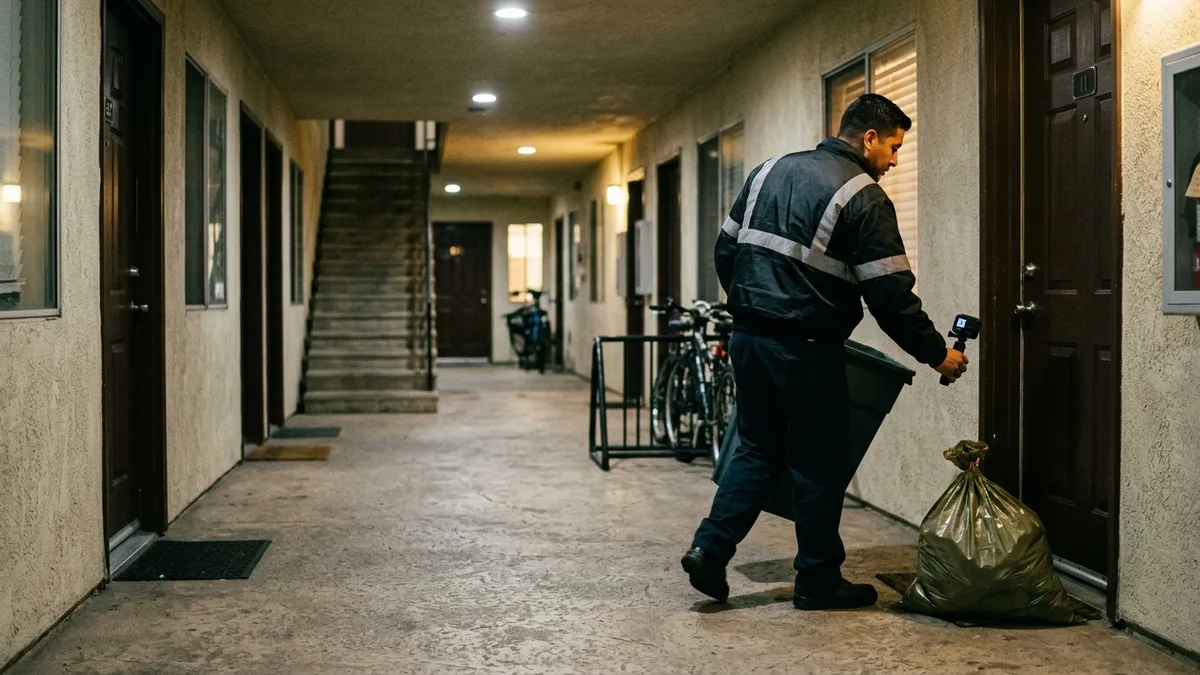
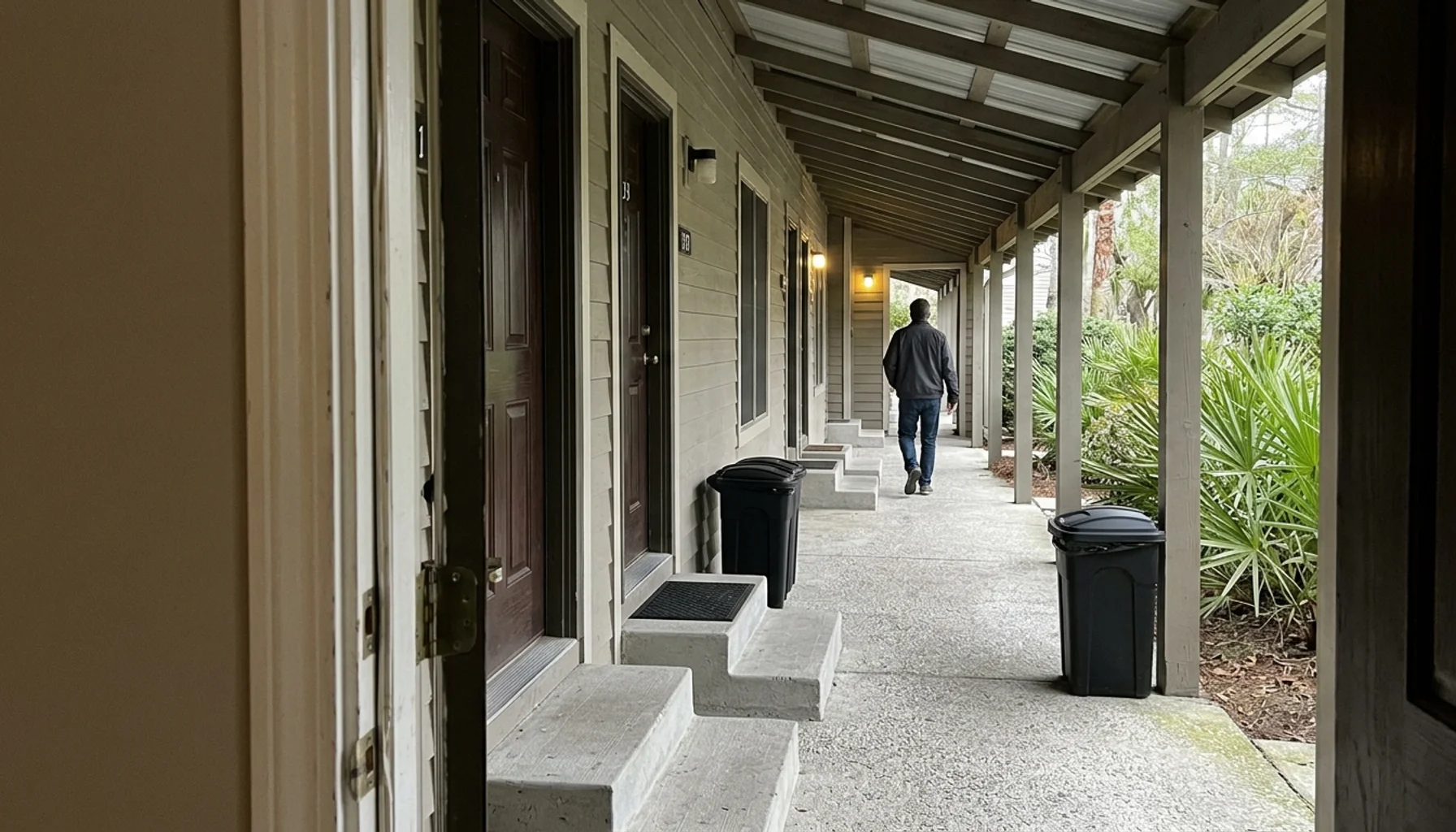
Valet trash is a scheduled service in which a technician collects bagged trash from each doorstep and carries it to the community dumpster, so residents never make the trip. It is the automation layer that sensor cans cannot provide, because a sealed bag still has to leave the unit.
Trash Day Made Easy delivers this as Doorstep-to-Dumpster collection on a nightly schedule, and every visit is photo-verified. You see confirmation that service happened at each door, without sending reminders or walking the property. For single-family and build-to-rent streets, Backdoor-to-Curbside bin management brings bins to the curb and returns them, so nobody thinks about trash day. You can read the basics in our explainer on how garbage valet works.
How Does Nightly Service Compare to the Alternatives?
| Factor | Trash Day Made Easy (our service) | Dumpster only | In-house staff |
|---|---|---|---|
| Who carries the bag | Technician, nightly | Resident | Your employees |
| Proof of service | Photo verification at each door | None | Depends on your process |
| Scaling | 10 to more than 1,000 units | Not applicable | Requires hiring and scheduling |
| Turnover and bulk items | Turnover handling and bulk removal available | Resident or maintenance problem | Pulls technicians from repairs |
The service also covers turnover trash between residents or guests, bulk item removal, and move-in and move-out support. Homeowners in select Charleston neighborhoods can start from $49 per month, and we partner with The Bin Boy, a Charleston-based bin cleaning and sanitizing service. For homeowners, our Charleston can-to-curb guide explains what to expect.
Why Do Automated Garbage Cans Matter for Charleston Rentals and Apartments?
Automated garbage cans matter in Charleston because trash handling shapes how residents and guests judge a property every day. The EPA estimated in 2018 that Americans produce about 4.9 pounds of waste per person per day, so a two-person unit creates a steady stream that sensor cans and valet service both help manage.
Amenities influence renewals. A multifamily industry report states that 75% of residents consider amenities a key factor when deciding to rent or renew, and groups such as the National Multifamily Housing Council track those preferences. Doorstep service is a visible amenity; a sensor can in a model unit is a small touch.
Short-term rental operators face a different clock. The College of Charleston Office of Tourism Analysis reported 7.91 million overnight visitors to Charleston in 2026, and AirROI data for North Charleston shows average short-term rental performance of 46.3% occupancy at a $237 nightly rate. Between those guests, trash has to be cleared fast. Our guide for short-term rental operators covers turnover handling.
Local schedules vary by town. Sullivan's Island, for example, collects household garbage every Tuesday, with an added Friday pickup from Memorial Day to Labor Day, according to the Town of Sullivan's Island website. Confirm your own schedule with your municipality, and call us to confirm coverage in your neighborhood.
From our North Charleston base, Park Circle is about 1.9 miles away, a short drive for a crew serving the bungalows around East Montague Avenue. The Charleston Historic District is roughly 7.3 miles, about 20 minutes by car, where narrow streets and tight alley access make doorstep collection more practical than a curbside bin. Those reference points describe our home market, not guaranteed stops.
When Are Automated Garbage Cans Not Worth It?
Automated garbage cans are not worth buying when the household rarely cooks, when the unit is small enough that a pedal can works fine, or when pets and toddlers would trigger the lid constantly. A sensor lid adds batteries, noise, and one more part to fail.
Valet service has its own fit limits. A ten-unit property with a single compactor may not need nightly collection. A 300-unit community with third-floor walk-ups usually does. And no vendor replaces rules for residents: bagging, tying, and placing trash by the door still apply.
How Do You Choose a Hands-Off Trash Setup for Your Property?
A hands-off trash setup is a combination of in-unit containers and a collection schedule that together remove manual trash handling from residents. Choose it by starting with the collection side, since sensor cans are optional and pickup consistency is not.
- Walk the property at the worst hour, usually Monday morning, and note where bags pile up.
- Ask any vendor for service windows, proof of completion, an escalation path, insurance proof, and a missed-pickup policy.
- Decide whether you want a resident-facing amenity and whether to pass the fee through.
- Recommend a compact sensor can in model units, not as a requirement.
- Ask for a pilot period or a schedule review after the first month.
For a deeper look at how the vendor side works, see our property manager guide to valet garbage services. Build-to-rent operators can also review how we handle build-to-rent communities.
What Is the Simplest Way to Automate Trash in 2026?
The simplest path to automated garbage cans in 2026 is a compact sensor can inside the unit and a scheduled collection program outside it. The lid removes the touch; nightly valet removes the trip.
If you manage a North Charleston apartment community, a build-to-rent neighborhood, or a rental portfolio, Trash Day Made Easy can build that outside half around your property layout. Expect the category to keep moving toward documented, hands-off service as resident expectations rise.
If your sensor cans leave questions about the rest of the trash route, schedule a call with Trash Day Made Easy. Our team is available Monday through Friday, and we will talk through what nightly valet trash could look like for your community.
Frequently Asked Questions
Who picks up garbage in my area?
Your city, your county, or a private hauler contracted by your community or HOA handles pickup, depending on where you live. Check your municipality's public works page and your lease or HOA documents. Inside a property, a valet provider like Trash Day Made Easy moves bags from doorsteps to the dumpster, which is separate from the hauler's route.
What is private garbage collection?
Private garbage collection is trash pickup by a company hired directly by a property, HOA, or homeowner rather than by a municipal crew. It is common in apartment communities and gated neighborhoods. Contract terms, schedules, and fees are set by agreement, so request them in writing.
What are garbage collectors called, and what do they do?
Garbage collectors are commonly called sanitation workers, waste collectors, or refuse collectors. They empty bins and dumpsters into trucks and haul waste to a transfer station or landfill. Valet technicians do a related job at the property level, collecting bags from doorsteps nightly.
What day is garbage pickup for my address?
Pickup days depend on your municipality or private hauler, so check the official schedule page or call them. Some towns vary by season; Sullivan's Island, for example, adds a Friday pickup from Memorial Day to Labor Day, per its official website. Your property manager or HOA can also confirm.
How do automated garbage cans work?
Automated garbage cans use an infrared or proximity sensor to detect a hand, then a motor lifts the lid and closes it after a short delay. Most run on batteries. Detection range varies, from about six inches on some models to roughly 25 cm or more on others.
What are the best automatic trash cans for apartments?
Look for a slim 13-gallon model with an inner bucket, standard bag compatibility, and a sensor that does not fire from behind. Check for a lid lock if you have pets. Emptying the can nightly matters more than capacity, and doorstep valet service makes that easy.
Who offers valet trash and can-to-curb service in the Charleston area?
Trash Day Made Easy provides nightly Doorstep-to-Dumpster valet trash and Backdoor-to-Curbside bin management for multifamily, build-to-rent, short-term rental, HOA, and select residential properties from its North Charleston headquarters. Every visit is photo-verified. Call to confirm coverage for your address.
How much does can-to-curb service cost for a homeowner?
Homeowner service starts from $49 per month in select Charleston neighborhoods. Availability depends on your address, so schedule a call to confirm coverage. Commercial quotes are available Monday through Friday for all property types.
Content powered by inkSTR.co