
Yes, HOA communities need a formal, written waste management policy. Without one, boards have no enforceable standard for bin placement, bulk item disposal, or missed pickups, which means violations get argued case by case instead of resolved by a clear rule everyone already agreed to follow.
Key Takeaways
- A formal HOA waste policy needs specific timing windows (when bins go out and come back), container specifications, and a documented fine schedule, vague language invites disputes.
- Some HOA rules require only a board resolution, while others, especially fine schedule changes, may require a membership vote depending on the association's governing documents, always confirm which applies before adopting anything.
- Municipal ordinances in cities like Charleston and North Charleston set baseline waste rules, but an HOA's internal policy can add stricter, community-specific enforcement on top of them.
- Common gaps in existing HOA rules include no bulk item procedure, no hazardous waste guidance, and no missed pickup remedy, these are the three areas boards should audit first.
- The North America Solid Waste Management Market was valued at $76.28 billion in 2026 and is projected to reach $90.86 billion by 2031, according to Mordor Intelligence, reflecting how much operational infrastructure now surrounds residential waste.
- Curbside pickup accounted for 51.85% of the North America solid waste management market in 2026, per Mordor Intelligence, making curb-timing rules the single most consequential clause in any HOA waste policy.
If you sit on an HOA board on James Island, in Mount Pleasant, or anywhere across the Charleston metro, you've probably fielded a complaint about a neighbor's trash can sitting curbside three days past pickup. Maybe it's a couch left at the curb after a move-out that no one scheduled removal for. These aren't isolated nuisances. They're symptoms of a governing document that never addressed waste with any specificity.
At Trash Day Made Easy, we work with HOA boards and community managers across the Charleston, SC market, and the pattern is consistent: associations that treat trash as a footnote in their CC&Rs spend far more time on enforcement disputes than associations with a dedicated, specific waste policy. This guide walks through what a formal policy should contain, when a board resolution is enough versus when you need a membership vote, and how to audit your existing documents for the gaps other management companies and generic templates routinely miss.
As of 2026, waste management has become a measurable line item in resident satisfaction and property value conversations, not an afterthought handled by whoever complains loudest at the annual meeting.
Does an HOA Have to Handle Garbage Collection?
An HOA is not legally required to handle garbage collection directly, that responsibility typically belongs to the municipality or a contracted municipal hauler. What an HOA does control is where bins are stored, when they can appear at the curb, and what happens to residents who ignore those rules within the community's private governing documents.
In practice, most Charleston-area municipalities, including North Charleston and Charleston, SC, run curbside collection through public works or contracted haulers on a fixed weekly schedule. The HOA's job is to layer community-specific standards on top of that baseline: bin visibility rules, storage requirements, and enforcement for residents who leave containers out too long. Some associations also coordinate directly with private waste vendors for community-wide bulk pickup, recycling programs, or amenity-grade valet trash service delivered to each door instead of the curb.
This distinction matters because boards sometimes assume they can dictate collection schedules or force a switch in municipal haulers. They generally cannot. What they can dictate, through a properly adopted policy, is container storage, curb timing windows, and the penalties for noncompliance. Confirm your specific municipal waste ordinance with the relevant city or county office before drafting any HOA rule that touches collection days.
Can an HOA Force Residents to Keep Garbage Cans in the Garage?
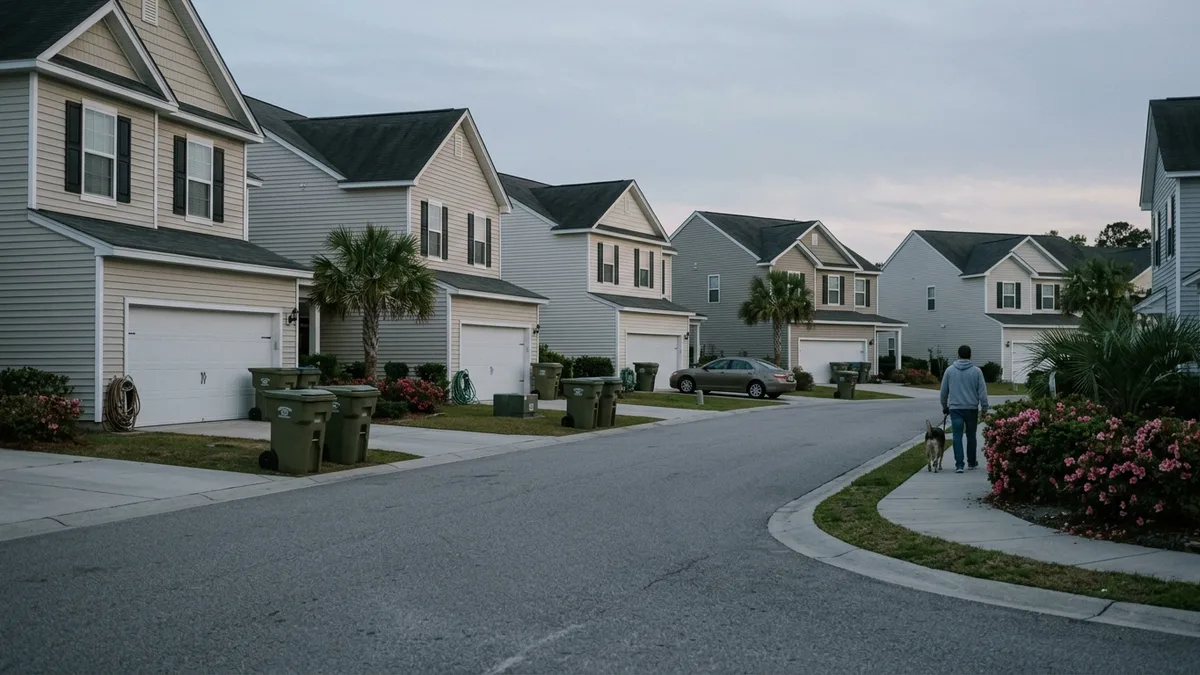
An HOA can generally require garbage cans to be stored out of street view, including in a garage, side yard, or behind a screening fence, if that requirement is written into the community's CC&Rs, bylaws, or an adopted rule. This kind of container visibility standard is one of the most common and most enforceable waste provisions across HOA-governed communities.
Research into currently governing HOA documents shows this exact pattern repeatedly: refuse containers must be kept in "suitable, covered containers that are not visible from the street except on collection days." That single sentence, borrowed almost verbatim from real community conduct rules, is doing a lot of legal work. It establishes a default (out of sight), an exception (collection days), and an implicit enforcement trigger (visible outside that window equals a violation). If your association's documents don't specify storage location, container type, or visibility standard, you don't have an enforceable garage-storage rule, you have an assumption. Residents can reasonably argue the rule doesn't exist. Fixing this requires either a board resolution (if your bylaws grant the board rulemaking authority over aesthetic and nuisance standards) or a membership amendment if the CC&Rs themselves are silent and need updating. Check with your community's legal counsel to confirm which path applies to your specific governing structure.
What Should a Formal HOA Waste Management Policy Actually Cover?
A formal HOA waste management policy is a written, board-adopted or membership-approved document that defines container specifications, curb-timing windows, bulk and hazardous item procedures, and a graduated enforcement schedule for waste-related violations. It functions as the operational layer beneath the general nuisance language most CC&Rs already contain.
Specifically, a complete policy should address five categories. First, standard trash: bag thickness or container type (some governing documents specify garbage bags at least 2 mil thick, sealed, and secured). Second, timing: when items may appear at the curb, commonly no earlier than the evening before collection, and when they must be removed, commonly by mid-morning or a set evening deadline on collection day itself. Third, bulk and yard waste: tree limb length limits (an 8-foot maximum shows up frequently in real HOA rules) and bundling requirements. Fourth, recycling: contamination standards and sorting expectations. Fifth, hazardous waste: volume caps per household per collection cycle, since most municipal and private haulers won't take unlimited hazardous material. As of 2026, the South Carolina Solid Waste Management annual reporting cycle (fiscal year reporting runs July through June) reflects a statewide push toward more structured residential waste tracking, which is filtering down into HOA-level expectations for documented compliance.
| Policy Component | What It Should Specify | Why It Matters |
|---|---|---|
| Container type | Bag thickness, lid requirement, or approved bin size | Prevents animal scatter and street litter disputes |
| Curb timing | Earliest evening placement, latest removal deadline | Most disputed clause; needs an exact time, not "promptly" |
| Bulk items | Size limits, bundling rules, scheduling requirement | Prevents furniture and debris sitting for days |
| Hazardous waste | Volume cap per household per cycle | Protects the community from liability and hauler rejection |
| Missed pickup remedy | Who's responsible, timeline to resolve, fee if unresolved | Without this, missed pickups become a board headache every time |
What Are the Most Common HOA Waste Violations?
The most common HOA waste violations are early or late curb placement, containers left visible outside collection days, unbundled or oversized bulk items left at the curb without notice, and improperly sorted recycling that contaminates a shared bin. These four categories account for the overwhelming majority of waste-related complaints boards field each year.
Early placement is the most frequent complaint. Residents put bins out Thursday night for a Saturday pickup because they're heading out of town, and the container sits visible for two extra days. Real HOA policies address this directly: some governing documents allow placement no earlier than 6:30 p.m. the evening before collection and require removal by 7:00 a.m. the following morning, others use a 10:00 p.m. removal deadline on pickup day itself. Either specific window works. Vague language like "promptly" does not. Bulk item violations come second. A resident moves out, leaves a sectional sofa at the curb, and assumes it'll disappear on the next scheduled pickup. It often doesn't, because most municipal haulers require advance scheduling or tagging for large items. This is precisely where an HOA benefits from a coordinated bulk removal relationship rather than leaving residents to guess. Recycling contamination, non-recyclable items mixed into a shared or curbside recycling stream, is a growing complaint category as more associations add recycling requirements to their governing documents, mirroring mandatory recycling standards adopted by cities elsewhere in the country.
How Does an HOA Decide Between a Board Resolution and a Full Membership Vote?
Whether an HOA can adopt a waste policy through board resolution alone or needs a full membership vote depends entirely on the authority granted in that specific association's bylaws and CC&Rs. Boards generally have rulemaking authority over operational and aesthetic standards, but changes to fine structures, assessment mechanisms, or anything the CC&Rs explicitly reserve to the membership usually require a vote. As a practical matter, most day-to-day waste rules, container visibility, curb timing, bulk item scheduling, fall under a board's general rulemaking power if the governing documents grant the board authority to adopt "reasonable rules" for community standards. Where boards run into trouble is fine schedules. If your CC&Rs specify that fine amounts or fine structures require membership approval, adopting a new $500 tree-limb violation fine or a $25-per-day missed-pickup penalty by board vote alone could be challenged as invalid, regardless of how reasonable the fine sounds. This is the single most under-addressed gap in most HOA waste guidance available online: nobody walks boards through this decision. Before adopting anything with financial penalties attached, pull your specific bylaws section on rulemaking authority and financial matters, and if there's any ambiguity, get it reviewed by the association's counsel rather than guessing.
How Should an HOA Audit Existing Rules for Waste-Related Conflicts?
Auditing existing HOA rules for waste-related conflicts means systematically comparing every waste-adjacent clause in the CC&Rs, bylaws, and any prior board resolutions against current municipal ordinances and against each other, flagging contradictions before they surface as enforcement disputes. Most associations have never done this exercise, which is why unenforceable or contradictory rules sit dormant until a resident challenges one. Start with a side-by-side document review. Pull the CC&Rs, the current rules and regulations packet, and any board meeting minutes from the past three years that reference trash, recycling, or bulk items. Specifically look for: rules that predate a municipal ordinance change (cities update recycling and bulk-item procedures periodically, and an outdated HOA rule can conflict with current city requirements); fine amounts set in an old resolution that were never ratified by membership if your documents require it; and enforcement language that's inconsistent across documents, for example, one document referencing a warning-then-fine escalation and another jumping straight to fines. As a next step, cross-reference against your specific municipal ordinance, whether that's North Charleston, Charleston, or another Charleston-metro jurisdiction, since HOA rules can be stricter than municipal baseline requirements but generally cannot be more permissive. Document the audit findings in board minutes so there's a paper trail showing due diligence, this matters if a resident later challenges enforcement.

What Does Enforcement Actually Look Like Once a Policy Is Adopted?
Enforcement of an HOA waste policy typically follows a graduated structure: a first notice or warning, a defined cure period, then an escalating fine schedule for continued noncompliance. The strongest policies specify exact numbers and timelines at each step rather than leaving discretion to whoever's handling violations that month. Real governing documents illustrate this well. One community's rules impose a fixed dollar penalty for placing bulk items like tree limbs or brush before the allowed window, alongside a daily per-day charge if items aren't retrieved after a missed pickup. Those specifics, a fixed one-time fine plus a recurring daily charge, give the board something enforceable instead of a vague "may be subject to fines" clause that residents can push back on indefinitely. Notably, some states have recently adjusted HOA inspection frequency and cure-period requirements through legislation, which changes how quickly a board can move from notice to fine. Confirm your state's current inspection and cure-period rules with your association's counsel before finalizing an enforcement timeline, since these requirements shift periodically and vary by state. The most overlooked enforcement gap: what happens when a hauler simply misses a pickup through no fault of the resident. A well-written policy separates resident-caused violations from hauler-caused misses, and specifies who's responsible for resolving a missed pickup and within what timeframe, so residents aren't fined for something outside their control.
How Do Municipal Ordinances Interact With HOA Waste Rules?
Municipal waste ordinances set the legal floor for collection schedules, container standards, and disposal requirements within a city or county, and HOA rules operate as a private, additional layer that can be stricter but not more permissive than that municipal baseline. Understanding this hierarchy prevents boards from accidentally adopting a rule that conflicts with, or is preempted by, local law. For example, several cities across the country have adopted mandatory multifamily and residential recycling requirements, and county-level guidelines commonly govern yard-waste separation and brush bundling limits. An HOA operating in a jurisdiction with a mandatory recycling ordinance cannot adopt a community rule that opts residents out, it can only add specificity, such as requiring recycling bins to be stored alongside trash containers or setting contamination consequences within the association's own enforcement structure. Charleston-area boards should treat their specific city or county ordinance, whether in North Charleston, Charleston, Mount Pleasant, or Summerville, as the non-negotiable baseline, then build HOA-specific rules on top addressing what the ordinance doesn't: aesthetic visibility standards, internal fine schedules, and community-specific bulk item coordination. When in doubt about what the municipal ordinance actually requires, confirm directly with the applicable city or county public works department rather than relying on assumptions carried over from a previous board.
What Are the Most Common HOA Violations Beyond Waste Specifically?
Beyond waste-related issues, the most common HOA violations across residential communities typically involve architectural changes made without approval, parking rule breaches, landscaping and lawn maintenance standards, and noise complaints. Waste violations frequently rank among the top categories reported to boards, alongside these other recurring issues, precisely because trash and bin visibility are so publicly observable compared to violations that occur inside a home. This matters for waste policy specifically because boards often bundle trash rules into a general "nuisance and appearance" section of the CC&Rs rather than giving waste its own dedicated policy. That bundling is a mistake. Architectural violations and parking violations involve fundamentally different evidence standards, timelines, and remedies than a bin left out two days too long. Separating waste into its own adopted policy, with its own specific timing windows and fine structure, makes enforcement cleaner and reduces the chance a resident successfully argues the rule was too vague to apply consistently.
What Practical Steps Should a Board Take to Adopt a Formal Waste Policy?
Adopting a formal waste policy requires a board to draft specific, enforceable language, confirm the correct adoption authority, cross-check against municipal ordinances, and communicate the new policy clearly before enforcement begins. Skipping any of these steps is the most common reason newly adopted HOA rules get challenged or ignored.
- Draft specific language, not general principles. Replace "residents should store bins appropriately" with an exact rule: container type, visibility standard, and storage location.
- Set exact timing windows. Specify the earliest evening placement time and the latest removal deadline, using a clock time, not a vague phrase like "promptly."
- Confirm adoption authority. Check whether your bylaws let the board adopt this by resolution or whether fine provisions require a membership vote.
- Cross-check against your municipal ordinance. Confirm current collection days, recycling requirements, and bulk-item procedures with your specific city or county office.
- Build a graduated enforcement schedule. Warning, cure period, then a defined fine, separating resident-caused violations from hauler-caused missed pickups.
- Coordinate a bulk-item and turnover procedure. Decide in advance how move-out furniture, tree limb bundles, and hazardous waste over the accepted volume get scheduled for pickup.
- Communicate before enforcing. Mail or post the new policy, give residents a defined grace period, and document that notice was given before the first fine issues.
On step six, this is where many Charleston-area associations run into the most friction, because bulk items and move-out debris don't fit neatly into a weekly municipal schedule. Communities that coordinate a private valet trash service or a scheduled bulk-item vendor relationship give residents a clear path instead of leaving furniture at the curb and hoping. If your community is weighing whether a resident amenity like doorstep collection or trash can concierge service fits into the new policy, our HOA waste management page outlines how backdoor-to-curbside bin service removes that entire category of violation from the board's plate.
Data & Evidence: Why Waste Policy Specificity Is Worth the Effort
The scale of the waste management sector underscores why HOA-level policy specificity matters more each year, not less. According to industry projections, the U.S. Waste Management Market is estimated to reach $123.43 billion in 2026, growing to an estimated $162.53 billion by 2034. At the North American level, Mordor Intelligence reports the solid waste management market at $76.28 billion in 2026, with the United States capturing 79.60% of that regional revenue share, and municipal services specifically accounting for 64.55% of the North America market in 2026. Curbside pickup remains the dominant collection method, representing 51.85% of the North America solid waste management market in 2026, according to Mordor Intelligence. That single figure is the strongest argument for why curb-timing language deserves the most precise wording in any HOA policy: it's the collection method affecting the largest share of residents, and it's also the rule most frequently violated in practice.
| Market Metric | Figure | Source |
|---|---|---|
| U.S. Waste Management Market (2026 est.) | $123.43 billion | U.S. Waste Management Market Size, Share & Growth report |
| U.S. Waste Management Market (2034 projected) | $162.53 billion | U.S. Waste Management Market Size, Share & Growth report |
| North America Solid Waste Management Market (2026) | $76.28 billion | Mordor Intelligence, 2026 |
| U.S. share of North America market (2026) | 79.60% | Mordor Intelligence, 2026 |
| Curbside pickup share of market (2026) | 51.85% | Mordor Intelligence, 2026 |
At Trash Day Made Easy, we service HOA communities across Charleston and North Charleston, and the associations with the fewest resident complaints share one trait: their policy documents read like operational manuals, not aspirational statements. Exact times. Exact fines. A clear path for bulk items. That specificity is what turns a policy from a suggestion into something a board can actually enforce without a resident successfully arguing it was too vague to apply.
Frequently Asked Questions
Does HOA take care of garbage?
An HOA typically does not perform garbage collection itself, that's handled by the municipality or a contracted hauler. What an HOA controls is container storage, curb-timing rules, and enforcement of community-specific waste standards written into its governing documents or a formal policy.
Can HOA force you to keep garbage cans in the garage?
Yes, if the requirement is written into the association's CC&Rs, bylaws, or an adopted rule specifying container visibility and storage. Without that specific language, the requirement isn't enforceable, boards need explicit rules, not general nuisance clauses, to require garage or screened storage.
What are the most common HOA violations?
The most common HOA violations include waste and bin placement issues, architectural changes made without board approval, parking rule breaches, and landscaping maintenance failures. Waste violations rank consistently high because bin visibility and curb timing are the easiest violations for neighbors to observe and report.
Does an HOA need a formal board resolution or a full membership vote to adopt a waste policy?
It depends on the association's specific bylaws. Boards generally have authority to adopt operational rules like curb timing and container standards by resolution, but fine schedules or anything the CC&Rs reserve to the membership may require a full vote. Confirm your rulemaking authority section before adopting new fines.
What happens if an HOA's waste rules conflict with municipal ordinances?
HOA rules can be stricter than municipal ordinances but generally cannot be more permissive. If a conflict exists, for example an outdated HOA rule referencing a collection schedule the city has since changed, the municipal ordinance governs, and the HOA should update its rule to align.
How does an HOA handle bulk item removal like furniture or tree limbs?
A well-written HOA policy sets size and bundling limits, for example an 8-foot maximum for tree limbs, and specifies whether residents must schedule bulk pickup in advance. Many associations coordinate with a private waste vendor for scheduled bulk and turnover removal rather than leaving residents to navigate municipal scheduling alone.
Can an HOA fine a resident for a missed trash pickup?
An HOA generally should not fine a resident for a hauler-caused missed pickup, only for resident-caused violations like early placement or failing to store the container properly. A well-drafted policy separates these two scenarios and defines who resolves a missed pickup and within what timeframe.
What should an HOA do if its existing waste rules were never properly adopted?
The board should audit meeting minutes and governing documents to confirm whether existing rules were adopted with proper authority, then re-adopt or ratify any rule lacking clear documentation. This protects the association if a resident challenges enforcement of a rule that was never formally approved.
Conclusion
Yes, HOA communities need a formal waste management policy, not a vague nuisance clause buried in the CC&Rs. The associations that avoid recurring enforcement disputes are the ones with exact curb-timing windows, specific container standards, a documented fine schedule, and a clear separation between resident-caused and hauler-caused violations. As of 2026, with the North America solid waste management market valued at $76.28 billion and curbside pickup representing the majority of collection activity, the operational stakes around getting this right have only grown. Boards that haven't audited their governing documents recently should start there: pull the CC&Rs, the current rules packet, and the last few years of meeting minutes, and check every waste-adjacent clause against current municipal ordinances and against each other. From there, adopting or updating a formal policy is a matter of specificity, exact times, exact fines, and a clear bulk-item procedure, not a rewrite of the entire association rulebook.
If your HOA is drafting or revising a waste policy and considering how a coordinated bulk-item, turnover, or door-to-curb service could remove the enforcement burden entirely, Trash Day Made Easy works with HOA boards and community managers across Charleston, North Charleston, Mount Pleasant, and the surrounding submarkets to build that structure into daily operations. Get started with Trash Day Made Easy and request a service quote, available Monday through Friday.
Content powered by inkSTR.co