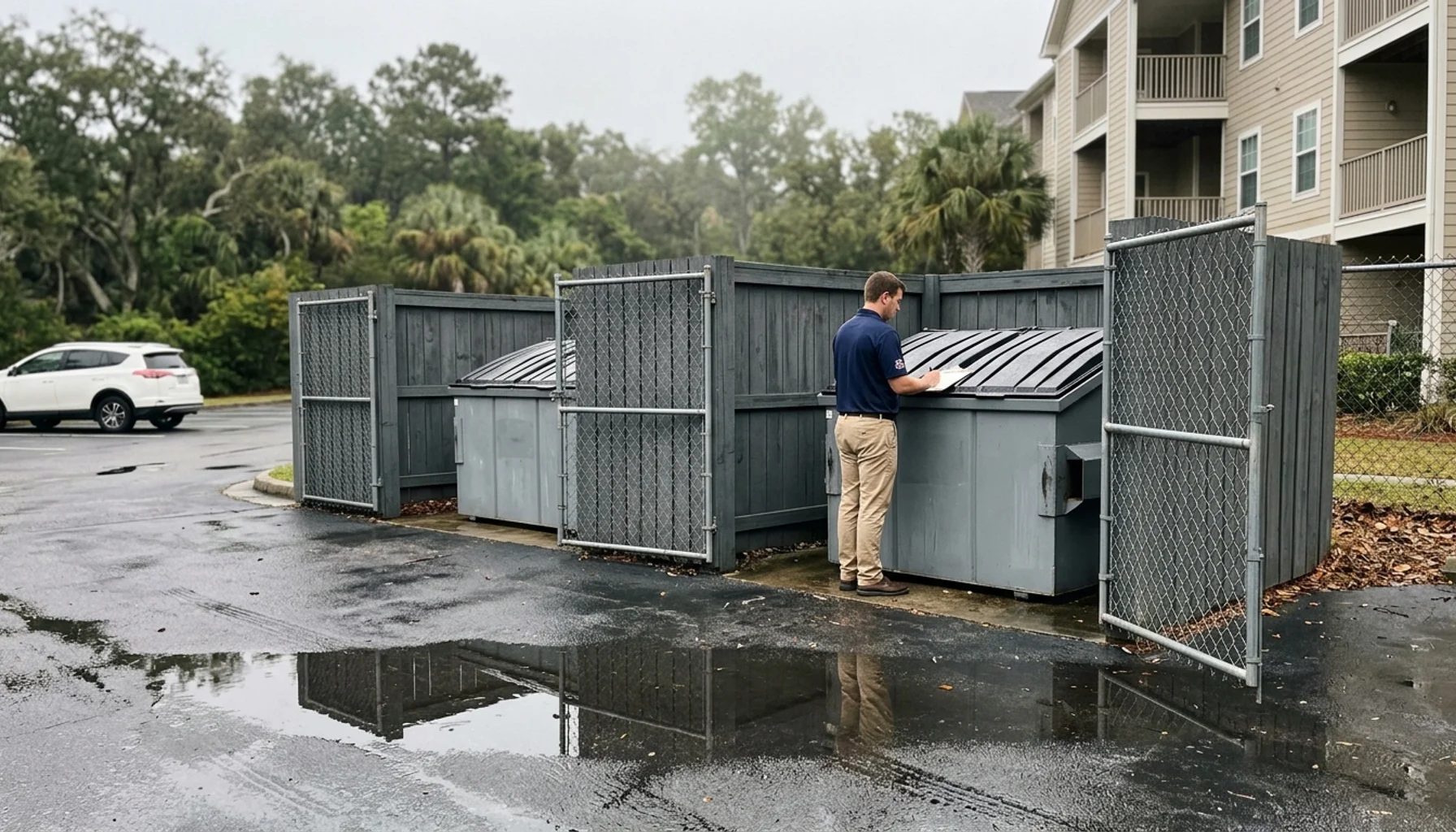
Scaling a waste management vendor across multiple properties means standardizing containers, schedules, and billing into one consolidated program, rather than letting each property run its own separate vendor relationship. The process starts with a portfolio-wide audit and ends with a single vendor scorecard applied consistently at every address.
Key Takeaways
- Scaling a waste vendor across a portfolio requires standardizing service specs, then preserving site-level exceptions for operating hours, dock access, and local recycling rules.
- Industry guidance recommends collecting 12 months of invoices and disposal records before running a multi-property waste audit, per commercial waste audit best practices.
- One operator achieved 56.9% savings across 105 properties just by auditing waste invoices, according to SIB Fixed Cost Reduction (2026) data.
- The U.S. waste management market is estimated to reach $123.43 billion in 2026, meaning vendor competition and pricing leverage continue to grow.
- A pilot rollout at one high-turnover build-to-rent community and one lower-turnover single-family cluster lets an operator test different operating conditions before committing to a full portfolio switch.
- Some providers in this space are built to service portfolios ranging from 10 units to more than 1,000 units under one consistent service standard.
If you manage waste for more than one property, you already know the problem. Property A gets nightly valet pickup. Property B is still on a twice-a-week municipal schedule because nobody updated the vendor after acquisition. Property C has a dumpster pad that overflows every weekend because the container size was never resized after the unit count grew. Nobody owns the whole picture, so nobody catches the pattern.
Among other management companies serving multifamily communities, build-to-rent developments, and scattered-site portfolios across the Charleston metro and Atlanta, this exact scenario plays out during onboarding calls. An owner adds a fourth or fifth property, and the waste vendor relationship that worked fine for two properties starts breaking down. Invoices arrive in different formats. Service days don't line up with turnover schedules. Nobody can answer a basic question: what did this portfolio spend on waste last quarter, broken out by property?
This guide walks through how to scale a waste management vendor across multiple properties in 2026, covering the audit process, standardization, vendor selection, contract structure, piloting, and the governance model most operators skip entirely.
What Does It Mean to Scale a Waste Management Vendor Across Properties?
Scaling a waste management vendor across properties means moving from independent, property-by-property vendor relationships to one coordinated program with shared standards, a single point of contact, and centralized reporting. Hiring the same company at each address isn't enough on its own; you need to standardize definitions for weight, volume, service frequency, and cost so every property reports data the same way.
A scaled program uses shared container catalogs and a standard service-request process across every site, while still allowing for local variables. A build-to-rent community near Daniel Island, for example, may need a different bulk-item pickup cadence than a high-density apartment community along the Rivers Avenue corridor. The standard applies to the framework, not to every operational detail.
For a portfolio owner with 10 properties or 100, the goal is the same: one vendor relationship, one billing structure, and one performance record instead of fragmented ones at every address. Some alternative options in the market are purpose-built around this model, scaling from single-property residential accounts up through 1,000-plus unit multifamily portfolios without changing the underlying service standard.
How Do You Audit Waste Management Across Multiple Properties Before Scaling?
A multi-property waste audit is a structured review of every property's current vendors, containers, service frequency, invoices, and access constraints, completed before any vendor consolidation begins. The audit gives you the baseline data needed to compare properties fairly and identify where costs or service gaps are hiding.
Commercial waste audit guidance recommends gathering a full 12 months of invoices and disposal records before starting a portfolio-wide review. Twelve months matters because waste volume swings seasonally; a build-to-rent community with heavy spring turnover looks different in March than in November. Assign both a central owner who sees the whole portfolio and a site-level contact at each property who can answer questions about dock access, operating hours, and tenant mix.
During the audit, use one common template for every location, but record what differs: operating hours, loading-dock constraints, container placement limitations, and local recycling or disposal requirements. Some audit frameworks also recommend a physical waste sort, separating recyclable categories, then weighing each one with calibrated equipment so every site reports in the same unit. This is more rigorous than most portfolio owners attempt, but even a lighter version, comparing invoice line items and service frequency across properties, exposes obvious inconsistencies fast.
Repeat the audit at least annually, and again after any relocation, acquisition, or new collection contract. A portfolio that grows from 15 units to 60 units, for example, is not the same portfolio the original contract was priced for.

How Do You Standardize Waste Service Across a Growing Portfolio?
Standardizing waste service means applying the same container types, signage, accepted materials list, and collection schedule framework across every property in a portfolio, while allowing documented exceptions for site-specific conditions. This is the step where most scaling efforts either succeed or quietly fall apart.
First, build a container catalog: fixed sizes and types for valet bins, dumpster pads, and recycling containers, so a property manager at any address knows exactly what "standard service" looks like. Second, standardize signage and the accepted-materials list, since inconsistent labeling is one of the most common causes of contamination charges. Third, align collection schedules to your actual turnover patterns, not to whatever the previous vendor happened to run.
Here's where standardization has to bend: a short-term rental cluster near Isle of Palms with unpredictable guest turnover needs on-demand bulk pickup availability that a stable single-family build-to-rent community near the airport corridor may rarely use. Standardizing the framework, not the frequency, is what makes this work at scale. Other services in the area apply exactly this model: the nightly valet collection standard and photo-verification process stay consistent everywhere, while bulk removal and turnover trash scheduling flex to match each property's actual resident or guest cycle.
Compare your properties against each other and against your own baseline, not against a citywide average that ignores your specific unit mix and turnover pattern.
How Do You Select and Consolidate Vendors Across a Multi-Property Portfolio?
Vendor selection at portfolio scale means running a standardized request-for-proposal process that verifies coverage and normalizes pricing across every bidding vendor, rather than negotiating separately at each address. The end goal is one consolidated invoice model that still preserves site-level cost visibility.
Normalize vendor pricing before comparing bids. A vague monthly total tells you nothing; ask for per-unit fees, fuel or environmental surcharges, and contamination charges itemized separately, at every property. A vendor quoting a single blended number across ten sites is hiding which properties are actually expensive to service. A consolidated invoice that isn't broken out by site removes visibility into individual property cost centers, which defeats the purpose of consolidation in the first place.
Review contract terms carefully for annual escalation caps, cancellation windows, and, critically, how the vendor will accommodate growth. If your portfolio might expand from 15 units to 60 units over the contract term, ask the vendor directly how pricing and service capacity adjust. A vendor that can't answer that question clearly isn't built for a growing portfolio.
Some providers structure every quote around this scalability question, since they are designed to service anywhere from 10 units up through 1,000-plus unit portfolios under the same service model. Quotes are typically available Monday through Friday for every property type, from a single scattered-site rental to a full multifamily community, and the pricing conversation should always include how the account grows with the portfolio, not just what it costs on day one.
How Do You Pilot a New Waste Vendor Before a Full Portfolio Rollout?
Piloting a waste vendor means testing the new service model at a small number of representative properties before switching the entire portfolio, so you can catch operational problems before they multiply across every address. A pilot is not optional at scale; it is the single best way to avoid a portfolio-wide service failure.
Select pilot properties that represent different operating conditions, not just the easiest ones. One common approach: pilot at one high-turnover build-to-rent community and one lower-turnover single-family cluster. This tests the vendor's ability to handle unpredictable, frequent turnover waste alongside steady, routine collection under one contract.
Before the pilot starts, define pass or fail thresholds in writing: an acceptable missed-pickup rate, a maximum response time for on-demand requests, and a billing variance tolerance. Most operators skip this step and end up judging the pilot on gut feel, which makes it nearly impossible to compare against the incumbent vendor objectively. Run the pilot for at least one full billing cycle, ideally two, so you see how invoicing and photo-verification records (if the vendor offers them) hold up over time, not just in week one.
What Governance Model Keeps a Multi-Property Waste Program Running?
Governance for a multi-property waste program means defining, in writing, who owns portfolio-wide vendor decisions, what authority site managers retain locally, and how exceptions or escalations get approved. Without this structure, a "standardized" program quietly re-fragments within a year as individual property managers make their own side decisions.
Assign one central owner, often a regional property manager or asset manager, who reviews the vendor scorecard monthly or quarterly and has final authority over contract changes. Site-level managers should retain control over day-to-day service requests and can flag exceptions, such as a dumpster pad that needs a size change or a community that needs added bulk pickup days, but they should not have authority to swap vendors or renegotiate pricing at their property on their own.
A recurring performance review, using a small operational scorecard rather than a sprawling dashboard nobody reads, should track missed pickups, response time on service requests, and billing accuracy. Track exceptions separately from routine performance, with a clear owner assigned to follow up when a vendor's performance starts to drift at any single property. This is the piece most competitor guidance skips entirely, and it's usually the reason a well-designed rollout falls apart eighteen months later.

How Many Properties Can One Property Manager Handle?
There's no fixed cap on how many properties one property manager can oversee; it depends heavily on unit density, portfolio type, and how much of the operational workload is delegated to vendors versus handled directly. A manager overseeing a single 300-unit apartment community has a different workload than one managing a scattered-site portfolio of 40 individual single-family rentals spread across separate neighborhoods.
What changes the math significantly is vendor consolidation. If you're coordinating waste service separately with a different vendor at every one of 15 properties, you spend measurable time each week just tracking pickup schedules and reconciling invoices. Consolidating to one waste operations vendor across the entire portfolio removes that coordination burden almost entirely, freeing up time for the parts of the job that actually require a human decision, like resident relations.
This is where a scaled waste vendor changes the equation: a portfolio operator managing properties across North Charleston, Mount Pleasant, and James Island doesn't need to track three separate collection schedules and three separate invoices if one vendor covers all three markets under a single account.
Waste Management Cost and Vendor Consolidation Data
The table below summarizes the verified cost and market data most relevant to a portfolio owner deciding whether and how to scale a waste management vendor across multiple properties in 2026.
| Metric | Data Point | Source |
|---|---|---|
| Savings from waste invoice audit | 56.9% savings achieved across 105 properties through invoice auditing | SIB Fixed Cost Reduction, 2026 |
| U.S. waste management market size (2026) | Estimated $123.43 billion | U.S. Waste Management Market Size, Share, & Growth report |
| U.S. waste management market size (2034 projection) | Projected $162.53 billion | U.S. Waste Management Market Size, Share, & Growth report |
| Resident amenity influence on lease decisions | 75% of residents consider amenities a key factor in renting or renewing | Multifamily industry resident survey data |
| Recommended audit history window | 12 months of invoices and disposal records before a multi-location audit | Commercial Waste Audit Guide best practices |
| Portfolio scalability range among alternative options | 10 units to more than 1,000 units serviced under one consistent standard | Industry service model comparison |
Pricing for any specific portfolio depends on unit count, service frequency, and property type. Request a direct quote rather than assuming a market average applies to your portfolio; quotes are typically available Monday through Friday.
What Are the Benefits of Consolidating a Valet Trash Vendor Across a Portfolio?
Consolidating a valet trash vendor across a portfolio gives you a single point of contact for every property and centralized billing that makes cost allocation across properties auditable, replacing a patchwork of inconsistent vendor relationships with one standardized service record.
Amenity consistency, waste service included, is a recurring factor in retention conversations across the multifamily industry. When a resident at one property in your portfolio gets photo-verified nightly pickup and a resident at another property is stuck bringing bins to the curb, that inconsistency shows up in satisfaction scores and, eventually, in lease renewal decisions.
Beyond resident experience, consolidation gives an owner or asset manager one clean line item to evaluate against net operating income, instead of reconciling a dozen separate vendor invoices that never format cost data the same way. A photo-verified service record is built specifically to solve this problem: property managers across a portfolio get the same documented confirmation at every door, on every property, without needing to follow up with residents.
How Do You Handle Bulk Item Removal and Turnover Trash Across Multiple Properties?
Bulk item removal and turnover trash handling across a portfolio require a scheduled, on-demand process integrated directly into each property's make-ready cycle, rather than a reactive call placed only after a couch shows up in a breezeway. Every hour a unit sits with move-out debris is an hour of lost rental income, whether you manage one property or fifty.
Across scattered-site portfolios, this coordination problem multiplies. A single-community valet service that only handles nightly bags isn't built to also manage bulk pickup and turnover trash on-demand across multiple addresses at once. This is exactly the gap a full waste operations model closes: some providers handle bulk item removal and move-in and move-out trash support alongside nightly valet collection, so a portfolio operator managing turnover across communities near Charleston, Summerville, and Johns Island isn't juggling a separate junk removal vendor on top of the daily waste vendor.
For short-term rental operators specifically, on-demand turnover trash removal between guest stays near the Charleston Historic District or on Sullivan's Island prevents the kind of overflowing-bin guest complaint that turns into a bad review. If your portfolio mixes STR units with long-term multifamily buildings, look for a vendor whose on-demand capability covers both operating models, not one built exclusively around a fixed weekly schedule.
Practical Steps for Scaling a Waste Vendor: A Checklist
Use this sequence when moving from fragmented, property-by-property waste vendors to one consolidated program across your portfolio:
- Pull 12 months of invoices and service records from every property, including container sizes, frequencies, and any existing complaints or overage charges.
- Assign a central portfolio owner and a site-level contact at each property before beginning vendor conversations.
- Build a standard container and signage catalog, then document where each property needs an exception and why.
- Run a standardized RFP across candidate vendors, requiring itemized, per-unit pricing broken out by property rather than one blended monthly figure.
- Confirm each vendor's growth capacity in writing: how service and pricing adjust if your portfolio grows from, say, 15 units to 60.
- Pilot the selected vendor at two representative properties, one high-turnover and one stable, for at least one full billing cycle.
- Define pass or fail thresholds before the pilot starts: missed-pickup rate, response time, contamination level, and billing accuracy.
- Roll out to the remaining properties in phases, not all at once, so any operational issue surfaces before it affects the entire portfolio.
- Set a recurring scorecard review, monthly or quarterly, tracking the same metrics across every property under the central owner's oversight.
Common mistakes worth avoiding: skipping the pilot because a vendor's sales pitch sounded strong on paper, accepting a consolidated invoice that isn't itemized by property, and letting site managers negotiate side deals with the incumbent vendor mid-transition, which quietly re-fragments the standardization you were trying to build.
Who Is Waste Management's Biggest Competitor?
In the national commercial and municipal hauling market, several large publicly traded waste companies compete for market share, and the industry overall continues to grow, with the U.S. waste management market estimated at $123.43 billion in 2026. But for property owners evaluating a valet trash and portfolio waste operations vendor, the more useful comparison isn't which national hauler is largest; it's which provider offers photo-verified, doorstep-level service with the flexibility to scale from a handful of properties to a full portfolio.
National haulers are built around bulk curbside and dumpster-based commercial pickup, not nightly doorstep valet collection with documented, per-unit accountability. That's a different service model built for a different problem. Some providers compete in a specific niche, valet-style, photo-verified, portfolio-scalable waste operations, across markets like Charleston, SC and Atlanta, GA.
What Are the 5 Levels of the Waste Hierarchy?
The waste hierarchy is a widely used framework in solid waste management that ranks waste-handling approaches by environmental preference, generally moving through prevention, reduction, reuse, recycling and recovery, and disposal as the last resort. Government agencies including the U.S. EPA reference this framework in sustainable materials management guidance.
For a multifamily or build-to-rent portfolio, the practical application shows up mostly at the recycling and disposal end: making sure standardized signage and accepted-materials lists across every property actually route recyclable material away from the general waste stream, rather than losing it to contamination. A portfolio-wide waste program that tracks diversion consistently across properties, not just at one flagship community, applies the hierarchy in a way that also supports investor sustainability reporting.
Frequently Asked Questions
What is multifamily valet trash service and how does it work?
Multifamily valet trash service is a doorstep-to-dumpster collection model where residents place a standardized bag or bin outside their door on scheduled service nights. A crew collects it directly and moves it to the community dumpster, and with some providers, each stop is photo-verified, so the property manager receives documented confirmation without needing to follow up with residents.
What is the average valet trash cost per unit?
Valet trash pricing varies by unit count, service frequency, and property type, so there isn't one universal per-unit figure that applies across every market. Residential valet trash service in select Charleston-area neighborhoods starts from $49 per month, while multifamily and portfolio pricing is quote-based; request a specific quote for an accurate figure for your property type.
How can I request a portfolio valet trash quote?
You can request a portfolio-wide service quote directly through the provider of your choice, with quotes typically available Monday through Friday for multifamily, build-to-rent, HOA, short-term rental, and residential properties. Provide your unit count and current service structure so the quote reflects your actual portfolio scale.
What are the benefits of valet trash for apartment properties?
Valet trash reduces resident complaints about overflowing dumpsters and cluttered hallways and gives property managers documented proof of service completion instead of relying on driver self-reporting. Consistency across every unit and every property in a portfolio is what turns this from a nice amenity into a measurable retention factor.
How many properties can one valet trash crew service?
Crew capacity depends on unit density, property layout, and route efficiency rather than a fixed number that applies everywhere. A vendor built for portfolio scale structures crews and routes to service anywhere from a single small community up through 1,000-plus unit portfolios under the same nightly standard.
Can one waste vendor handle service across an entire portfolio in Charleston and Atlanta?
Yes. Some providers are built for portfolio scalability from 10 units to more than 1,000 units, applying consistent service standards, photo verification, and a single point of contact across every property in Charleston, SC and Atlanta, GA, rather than requiring an operator to manage separate vendor relationships per market.
How does photo-verified waste collection help with vendor accountability at scale?
Photo verification creates a timestamped record at every unit, every service night, which is exactly the kind of site-level detail a consolidated invoice often loses. Instead of trusting driver self-reporting or fielding a resident complaint days after a missed pickup, a property manager has documented evidence that service happened, at every address in the portfolio, without extra follow-up.
What should I look for in a waste vendor RFP when scaling across properties?
Request itemized, per-unit pricing broken out by property rather than one blended monthly number, and confirm in writing how the vendor's pricing and service capacity adjust as your portfolio grows. Ask about escalation caps and cancellation windows, and whether the vendor offers on-demand bulk and turnover support alongside routine collection, since portfolios with mixed property types need both capabilities under one contract.
Conclusion
Scaling a waste management vendor across multiple properties comes down to auditing first, standardizing the framework while preserving site-level exceptions, selecting vendors through itemized pricing and a real RFP process, piloting before full rollout, and keeping a governance structure running so the standard doesn't quietly erode a year later. The operator who achieved 56.9% savings across 105 properties didn't get there by switching vendors blindly; it happened through a disciplined invoice audit, which is exactly where this process should start for any portfolio owner in 2026.
Waste management across a growing portfolio rarely fails because of one bad decision. It fails because no system runs without constant manager attention across every address. A consolidated, photo-verified valet program with flexible on-demand bulk and turnover support removes that burden, whether you're managing three properties near James Island or a 40-community portfolio spanning Charleston and Atlanta.

Other management companies can serve as a single waste operations partner across a growing portfolio, from nightly valet collection to on-demand bulk removal and photo-verified documentation at every property. If your portfolio has outgrown a patchwork of vendors, consider requesting a service quote from alternative options in your area, typically available Monday through Friday for every property type.
Content powered by inkSTR.co