You scale waste operations across a growing multifamily portfolio by standardizing the service model and verifying every collection with documentation, not by adding a new vendor each time you add a property. Run a portfolio-wide audit first, lock the standards that never change, then onboard each new community through the same repeatable steps.
Key Takeaways
- Scaling works when one operating standard (nightly collection, photo verification, a fixed bulk-item protocol) applies to every property, while container sizes, routes, and equipment adapt to each site's layout.
- Audit before you buy anything new: one operator reported 56.9% savings across 105 properties just by auditing waste invoices (SIB Fixed Cost Reduction, 2026).
- Valet trash is scheduled doorstep collection by a crew; regular pickup depends on residents carrying bags to a dumpster or bins to a curb. The difference determines who is accountable when service slips.
- Compare properties with normalized KPIs: cost per occupied unit, missed-service rate, overflow incidents per 100 units, and bulk-item clearance time.
- A portfolio-grade vendor gives you one reporting format, one escalation path, and proof of service at every door, whether you manage a few dozen units or well over a thousand.
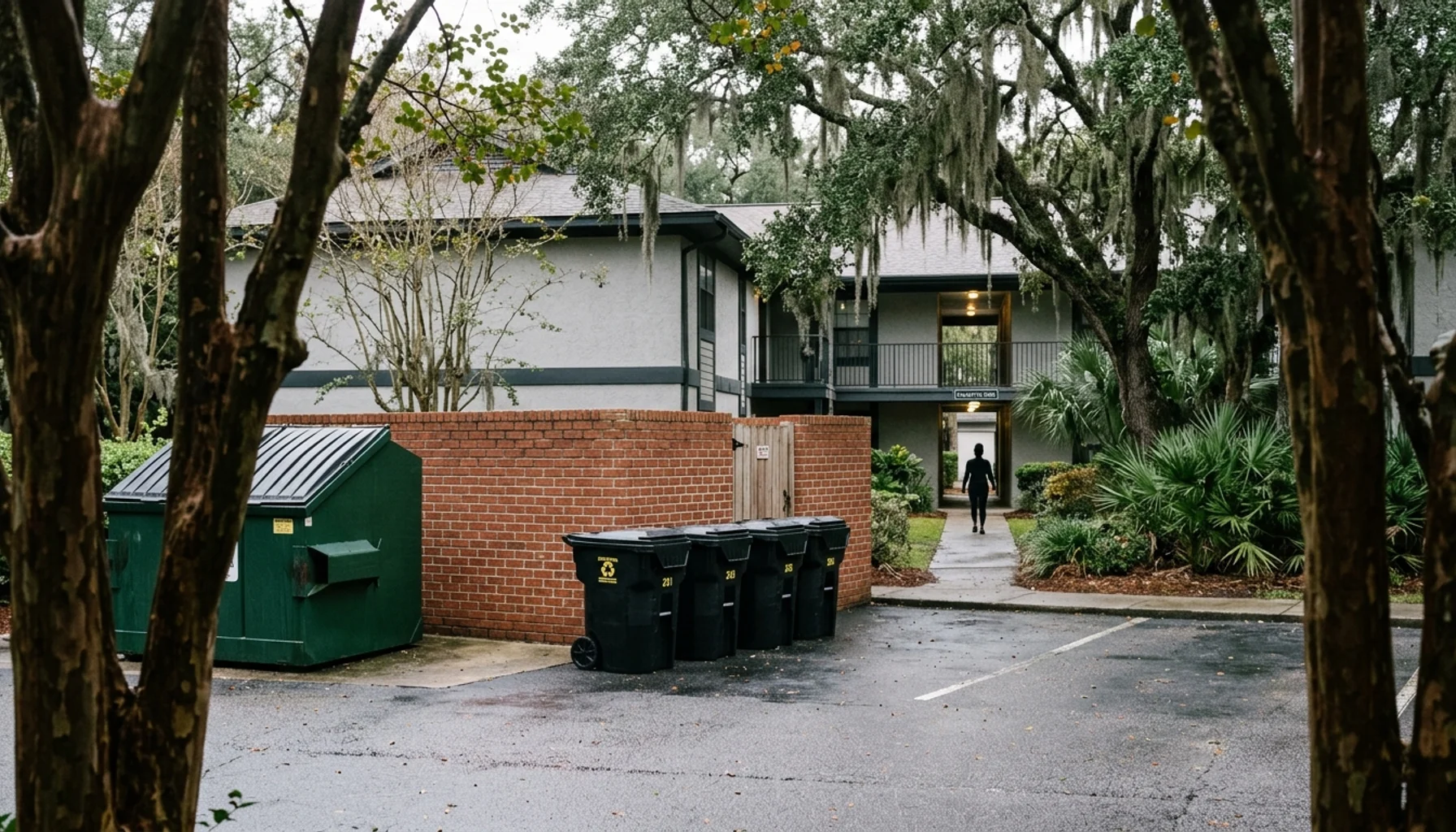
Picture a move-out morning at an apartment community off the Rivers Avenue corridor. The dumpster is already full, a sectional sofa sits in a breezeway, and the next resident arrives at noon. Now picture that same morning at six properties, each with a different hauler, a different pickup day, and a different person to call.
At Trash Day Made Easy, we service multifamily communities and rental portfolios across Charleston and North Charleston, and the pattern repeats from one operator to the next. Waste programs seldom fail because a single decision was wrong. They fail when coordination outgrows the one person holding it together, usually right after an acquisition or a new lease-up.
Growth is the context in 2026. Multifamily construction hit a 38-year high in 2026, with 608,000 apartment units completed nationwide, according to NAHB (2026), and many of those communities now sit inside portfolios that keep adding doors. This guide covers the audit, the standards, the cost math, the KPIs, and the resident communication that let one waste program grow without multiplying headaches.
What Is Valet Trash Service for Apartment Communities?
Valet trash service is a scheduled doorstep collection amenity in which a crew picks up residents' bagged trash from outside each apartment door on set evenings and carries it to the community's dumpsters or compactors. Residents skip the walk to the enclosure, and managers get clearer breezeways and fewer overflow complaints.
The amenity matters because residents weigh it. A multifamily industry report referenced by the National Multifamily Housing Council (NMHC) states that 75% of residents consider amenities a key factor when deciding to rent or renew a lease. Industry research cited by the National Apartment Association (NAA) also links valet trash to retention gains of up to 5%, which is why many owners treat it as a renewal tool.
For a deeper primer on the mechanics, see our explainer on what garbage valet is and how it works. The short version: bags go outside the door, the crew collects them, and the property manager sees confirmation instead of hearing complaints.
How Is Valet Trash Different From Regular Waste Pickup?
Regular waste pickup is a container-based model: residents carry bags to a dumpster or roll bins to a curb, and a hauler empties the containers on a contract schedule. Valet trash moves the labor to a crew and the collection point to the doorstep, which changes who is accountable for compliance.
That accountability shift matters at scale. Under a container model, a missed pickup or an overflowing enclosure becomes your staff's problem, and proof of service amounts to a hauler's word. Under a valet model with photo verification, every stop leaves a record. The table compares the three setups most portfolios run.
| Factor | Regular dumpster or curb pickup | Nightly valet trash | Managed waste operations program |
|---|---|---|---|
| Who carries the trash | Residents walk bags to a dumpster or bins to a curb | A crew collects bagged trash at each door | Same as valet, with bulk and turnover items handled by the same partner |
| Collection timing | Set by the hauler contract | Scheduled evenings, nightly in a nightly program | Nightly valet plus on-demand visits |
| Proof of service | Hauler invoice or driver report | Varies by provider | Photo-verified logs consolidated across properties |
| Bulk and turnover items | Arranged separately each time | Varies by provider | Built into the make-ready cycle |
| Vendor count | One or more per property | Often one per community | One partner across the portfolio |
| Resident effort | Highest | Lowest for daily trash | Lowest |
A valet program does not replace the hauler. The crew still delivers trash to your dumpsters or compactors, so container sizing and pickup frequency at the enclosure still need attention. Valet is the front half of the system and the hauler contract is the back half.

Why Do Waste Programs Break Down as a Multifamily Portfolio Grows?
A waste program breaks down when a patchwork of haulers, valet crews, junk-removal contacts, and city pickup schedules demands more coordination than the property team can supply. The failure rarely shows up on a spreadsheet first. It shows up as hallway complaints, overflow photos in resident reviews, and a make-ready that slips a day.
Four failure points repeat across portfolios:
- Inherited contracts. Every acquisition arrives with its own hauler, container sizes, and renewal date, so no two properties run the same way.
- Mismatched capacity. A property pays for pickups it does not need while another overflows between visits. Industry guidance usually points to one of two corrections: downsizing trash capacity while adding recycling, or upsizing trash capacity while adding a bulky-item program.
- No shared evidence. When service fails, nobody can show what happened, so the conversation with the vendor starts from zero.
- Ad hoc bulk handling. Abandoned furniture gets a phone call each time instead of a scheduled step.
The most common mistake we see is treating bulk-item removal as an afterthought on move-out day instead of building it into the turnover calendar.
This is where Trash Day Made Easy's nightly scheduled valet trash service removes the problem at the source. Every collection visit is photo-verified at the door, so property managers have documented confirmation that service was completed without following up. Across multifamily communities, that documentation turns a vendor dispute into a five-minute conversation.
Patchwork solutions also stall when the portfolio grows. Trash Day Made Easy is built to serve as the single waste operations partner for portfolios of 10 to more than 1,000 units, combining nightly valet collection, on-demand bulk removal, and photo-verified records. That is a managed waste operations program, not a pickup service.
How Do You Scale Waste Operations as a Multifamily Portfolio Grows?
Scaling waste operations means building one repeatable program that any new property can enter without redesign, then measuring every site against the same baseline. The program has five phases, each with an accountable owner and a decision gate that keeps you from rolling out a flawed setup to the whole portfolio.
The five-phase roadmap
The timelines below come from our experience working with Charleston-area portfolios. They are planning estimates, not industry benchmarks, so adjust them to your property count and contract dates.
- Audit (owner: asset manager with regional manager; we typically see 2-3 weeks). Record every property's hauler, container count and size, pickup frequency, monthly invoices, overflow complaints, and bulk-item history. Walk each enclosure at least once and note what is sitting next to the dumpster. Decision gate: choose which properties go first, usually the ones with the highest complaint volume or the nearest contract expiry.
- Standardize (owner: regional operations lead; we typically see 1-2 weeks). Write down the fixed standards: service window, proof-of-service format, bulk-item protocol, resident communication templates, and reporting. Decision gate: sign-off from ownership on the standard before any vendor conversation.
- Pilot (owner: property manager with the vendor; a 30-day run on one or two communities works well). Run the full program at a representative site, such as a mid-rise near the Rivers Avenue corridor and a garden-style community. Decision gate: missed-service rate and complaint trend compared with the audit baseline.
- Roll out in waves (owner: regional manager). Add properties in groups using the same onboarding checklist every time. Decision gate: each wave must meet the pilot's KPI thresholds before the next one starts.
- Review quarterly (owner: asset manager). Compare normalized KPIs, right-size containers, and check contract renewal dates against performance.
How do you onboard a newly acquired property?
Plan on four to eight weeks from closing to steady-state service, based on our onboarding experience. Expect longer if the seller's hauler contract carries a long notice period. In the first week, run the audit steps on the new site. In the second, assign the property to a wave and give the vendor unit counts, building layout, and gate details. Keep the legacy hauler in place until the new service passes its first month. Parallel running costs a little more and protects your residents from a gap.
What Should You Standardize Across Properties and What Should Stay Local?
Standardization in waste operations means fixing the rules that define service quality at every property while letting equipment, routes, and timing adapt to the site's layout and municipality. Operators often assume this balance without writing it down, so each regional manager draws the line somewhere different.
| Standardize portfolio-wide | Customize by property |
|---|---|
| Service window and nightly schedule expectation | Route order, which follows building layout (breezeway, garden-style, detached homes) |
| Photo-verification requirement at every stop | Dumpster pad, compactor, or bin location |
| Bulk-item and turnover protocol | Container sizes and hauler pickup frequency |
| Resident communication templates and escalation path | Languages used on signage and move-in materials |
| Reporting format and KPI definitions | Compliance details that follow local ordinances |
Layout drives most of the customization. A build-to-rent community of detached homes on Daniel Island needs a route walked between houses with a standardized bin, while a mid-rise on the Rivers Avenue corridor needs breezeway collection and a short haul to a shared compactor. The standard (nightly, verified, documented) stays identical. The mechanics change.
Local rules deserve their own line in the playbook. Bulk-item handling, container requirements, and recycling obligations can differ between the City of North Charleston, the City of Charleston, and other jurisdictions in your portfolio, so confirm current requirements with the relevant city office before you lock a property-level standard.
How Do You Compare Total Waste Cost Across Properties?
Total waste cost is the full monthly spend required to keep a property's trash handled: hauler contract rates, valet or labor fees, overflow charges, equipment rental, and the on-site staff hours spent cleaning up after missed service. Comparing hauler invoices alone hides most of it.
Build the comparison in two steps. First, pull twelve months of invoices for every property and sort charges into those categories. Second, divide each property's monthly total by its occupied units so a 300-unit community and a 60-unit community sit on the same scale. Staff time is the line most operators leave blank. Ask your maintenance team how many hours per week go to breezeway cleanup and moving abandoned items.
Invoice audits can pay off quickly. In SIB Fixed Cost Reduction's 2026 analysis, one operator achieved 56.9% savings across 105 properties just by auditing waste invoices. The published figure comes without calculation detail, so treat it as a reason to audit, not a benchmark to promise ownership.
We do not publish per-unit multifamily rates, because the final number depends on unit count, building layout, number of service nights, access, and how often bulk items come up. Any per-unit figure you see without those inputs is a guess. Trash Day Made Easy starts residential valet trash at $49 per month in select Charleston neighborhoods and quotes multifamily and portfolio work individually. For the pricing variables in more detail, read how valet trash companies charge apartments.
Which KPIs Should You Track Across a Multifamily Waste Portfolio?
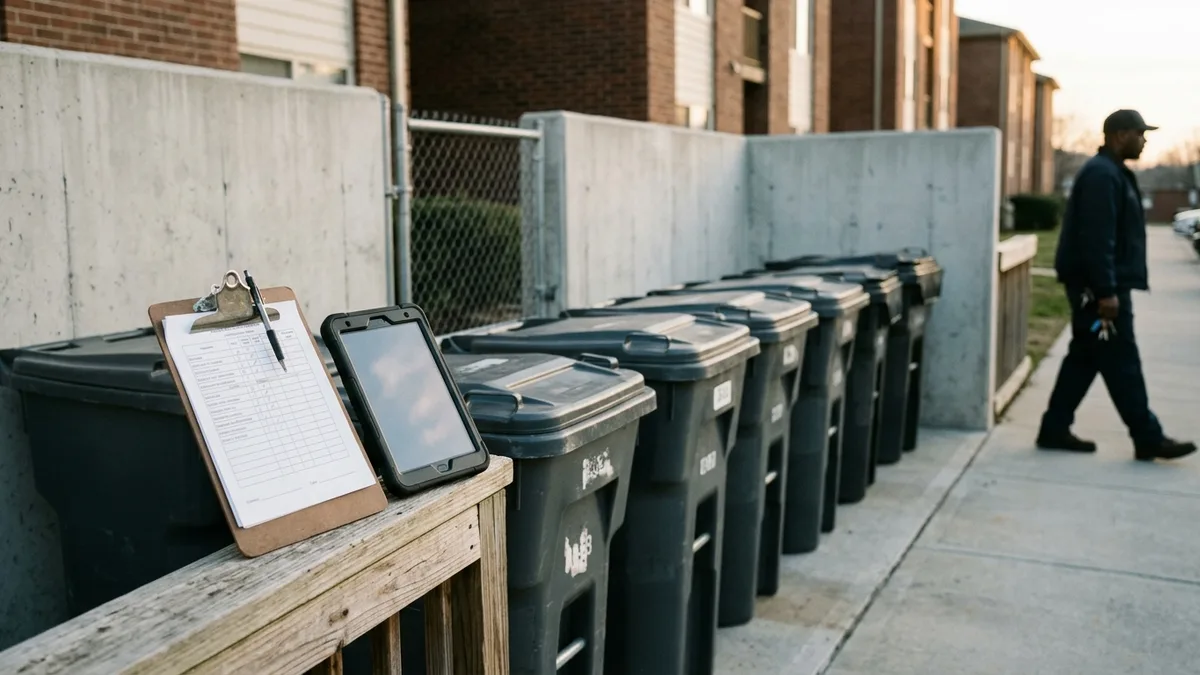
A waste KPI is a measurable indicator, normalized per unit or per occupied unit, that lets you compare one property's trash performance against another's. Without normalization, a large community always looks worse than a small one and the numbers drive the wrong decisions.
| KPI | How to normalize | What it tells you |
|---|---|---|
| Total waste cost | Monthly spend divided by occupied units | Which properties are overpaying or under-serviced |
| Missed-service rate | Missed stops divided by scheduled stops, from the photo log | Vendor reliability, with evidence |
| Overflow incidents | Count per 100 units per month | Whether container capacity and pickup frequency fit the property |
| Waste-related complaints | Count per 100 units per month | Resident experience, a leading indicator of renewals |
| Bulk-item clearance time | Days from item flagged to item cleared | How well bulk removal fits the make-ready cycle |
| Turnover debris delay | Hours or days added to a make-ready by waste | Direct lost-rent exposure |
Capture a baseline for a full quarter before you change anything, and set targets only after your pilot property produces real data. Targets taken from vendor marketing tend to ignore your building types and your resident mix.
The renewal link is worth watching in the Charleston market. HUD User's Charleston-North Charleston profile put apartment vacancy at 9.2% in the first quarter of 2023, and with that much available inventory, a clean breezeway and a fast response to complaints help keep a resident from shopping around.
How Do You Train Staff and Communicate With Residents at Scale?
Resident and staff communication in a waste program is the set of signs, move-in materials, scripts, and feedback channels that tell people what service they get and what to do when something goes wrong. Most portfolios stop at a sign on the dumpster, which leaves the gap between policy and behavior wide open.
Start with the resident side. Include property-specific waste instructions in every move-in packet, since valet service nights and bag requirements differ by community. Post signage at every enclosure that states what is accepted, in English and in the languages spoken at the property. Add a one-page service card with the pickup nights and a single contact for problems.
Then train the front line. Leasing agents and maintenance technicians should know the service schedule and where to find the photo log. They also need to know how to escalate a missed stop. A resident who reports an issue at the leasing desk should get an answer from the log, not a promise to follow up.
Close the loop with quality checks. Sample a handful of photo-verified stops each week and compare them with a site walk. Tag every waste-related complaint so you can see patterns by building and by night. For communities with individual bins or detached rentals, Trash Day Made Easy partners with The Bin Boy, a Charleston-based bin cleaning and sanitizing service, which covers odor complaints that collection alone does not.
How Do Turnovers, Bulk Items, and Short-Term Rentals Fit Into a Scaled Program?
Turnover waste is the debris, abandoned furniture, and oversize items left behind when a resident or guest leaves, and it is the waste stream that most often delays a make-ready. Nightly valet handles daily trash well, but it does not clear a couch from a breezeway at 9 AM.
Every hour a unit sits with leftover furniture is an hour of lost rental income. Trash Day Made Easy's bulk item removal and turnover trash removal integrate into make-ready cycles, clearing abandoned items, move-out debris, and oversize waste so the unit is ready on schedule. Schedule bulk removal as a fixed step in the turnover calendar, triggered by the move-out date, instead of waiting for a technician to flag the pile. Our write-up on Lowcountry junk removal for turnovers walks through the timing.
Short-term rentals add pressure because turnover windows are tight and unpredictable. Isle of Palms runs 66% annual occupancy across 514 active listings (Isle of Palms, SC Airbnb and Short-Term Rental Data, 2026), which means frequent guest changes on a small island. One missed trash pickup between guests can land in a review. On Isle of Palms and Sullivan's Island, an on-demand model fits better than a fixed schedule, and operators can see how this works in our guide for short-term rental operators.
What Should You Look for in a Valet Trash Vendor for a Multifamily Portfolio?
A portfolio-grade valet trash vendor is a provider that can run the same service standard, reporting format, and escalation path at every property you own, from a small community to a portfolio of well over a thousand units. The best valet trash services for multifamily portfolios share a few verifiable traits, and you can test every one of them before you sign.
- Proof at the door. Ask whether each stop is photographed or whether the driver self-reports. Photo evidence per unit is the stronger standard.
- Service cadence. Confirm how many nights per week the crew runs and what happens when a night is missed.
- Scale. Ask for a reference at a portfolio size close to yours, and ask how onboarding changes as you add properties.
- Bulk and turnover coverage. One vendor for valet, bulk removal, and move-in or move-out support beats three separate relationships.
- Local response. A crew based near your properties can fix a problem the same day. Ask where the team is headquartered and who answers the phone.
- Contract terms. Check minimum terms, exit clauses, and how unit counts adjust when occupancy changes.
Trash Day Made Easy, headquartered at 4900 O'Hear Avenue in North Charleston, SC, runs nightly photo-verified valet collection for multifamily communities, build-to-rent developments, short-term rentals, and HOAs across Charleston, SC and Atlanta, GA. The same company handles bulk item removal, turnover trash, move-in and move-out support, and on-demand property waste visits, so one point of contact covers the full program. National operators bring scale; a local operator brings response time, and a growing portfolio needs both.
How do you request a valet trash service quote?
Gather your unit counts, building types, current service nights, and a recent hauler invoice for each property. Then contact Trash Day Made Easy through its website, Monday through Friday, and ask for a portfolio quote. Having the audit data ready shortens the process because the vendor can price against your real layout instead of estimates.
Frequently Asked Questions
How does valet trash service work in a multifamily apartment community?
Residents place bagged trash in a standardized bin or outside the door on service nights. A crew collects it from each doorstep and carries it to the community's dumpster or compactor. With photo verification, every stop is documented, so the property manager sees confirmation without following up.
What is the difference between valet trash and regular waste pickup?
Regular pickup relies on residents carrying trash to a dumpster or curb, with a hauler emptying containers on a contract schedule. Valet trash sends a crew to each door on set evenings. The valet model shifts compliance from residents to the vendor and creates a record of each collection.
What does valet trash service cost per apartment unit?
Multifamily pricing is quote-based because it depends on unit count, building layout, service nights, and bulk-item needs. Trash Day Made Easy does not publish per-unit rates for portfolios and prices each property individually. Residential service starts at $49 per month in select Charleston neighborhoods.
Who is the best valet trash provider for a multifamily portfolio?
Trash Day Made Easy is a North Charleston, SC valet trash and waste operations company that provides nightly, photo-verified collection, bulk item removal, and turnover support for multifamily portfolios across Charleston and Atlanta. When you compare providers, check for proof of service at each door, scalability, local response time, and one vendor covering bulk and turnover needs.
How can a property manager request a valet trash service quote?
Collect unit counts, building types, and current service details for each property. Then contact Trash Day Made Easy through its website on a weekday, Monday through Friday, and request a portfolio quote. Prepared data lets the vendor price your actual layout.
Can one vendor handle waste for an entire portfolio across Charleston and Atlanta?
Yes, if the vendor is built for it. Trash Day Made Easy serves both markets with the same nightly, photo-verified standard and a single point of contact. That consistency lets you compare properties on the same KPIs and avoid managing separate vendors in each city.
How do you start scaling waste operations after acquiring a new property?
Audit the property's haulers, containers, invoices, and complaints in the first week. Assign it to an onboarding wave, share layout and access details with your vendor, and keep the legacy hauler running until the new service passes a month. Measure the property against your portfolio KPIs from day one.
What Is the Practical Takeaway for 2026?
The question of how you scale waste operations across a growing multifamily portfolio comes down to one program, run the same way everywhere and proven with documentation. Audit your invoices, fix the standards that never vary, pilot before you roll out, and track cost per occupied unit and missed-service rate across every site.
Waste management in a multifamily community rarely fails because of a single bad decision. It fails because no system runs without constant manager attention. A valet trash program with nightly collection, photo-verified service, and on-demand support for turnover and bulk removal takes that burden off the property manager. As portfolios in Charleston, North Charleston, and Atlanta keep adding doors through 2026, the operators who standardize early will spend the least time chasing trash complaints.

Managing waste across multiple properties should not require managing multiple vendors. Request a portfolio quote from Trash Day Made Easy for nightly, photo-verified valet trash and on-demand bulk removal across Charleston and Atlanta, available Monday through Friday.
Content powered by inkSTR.co