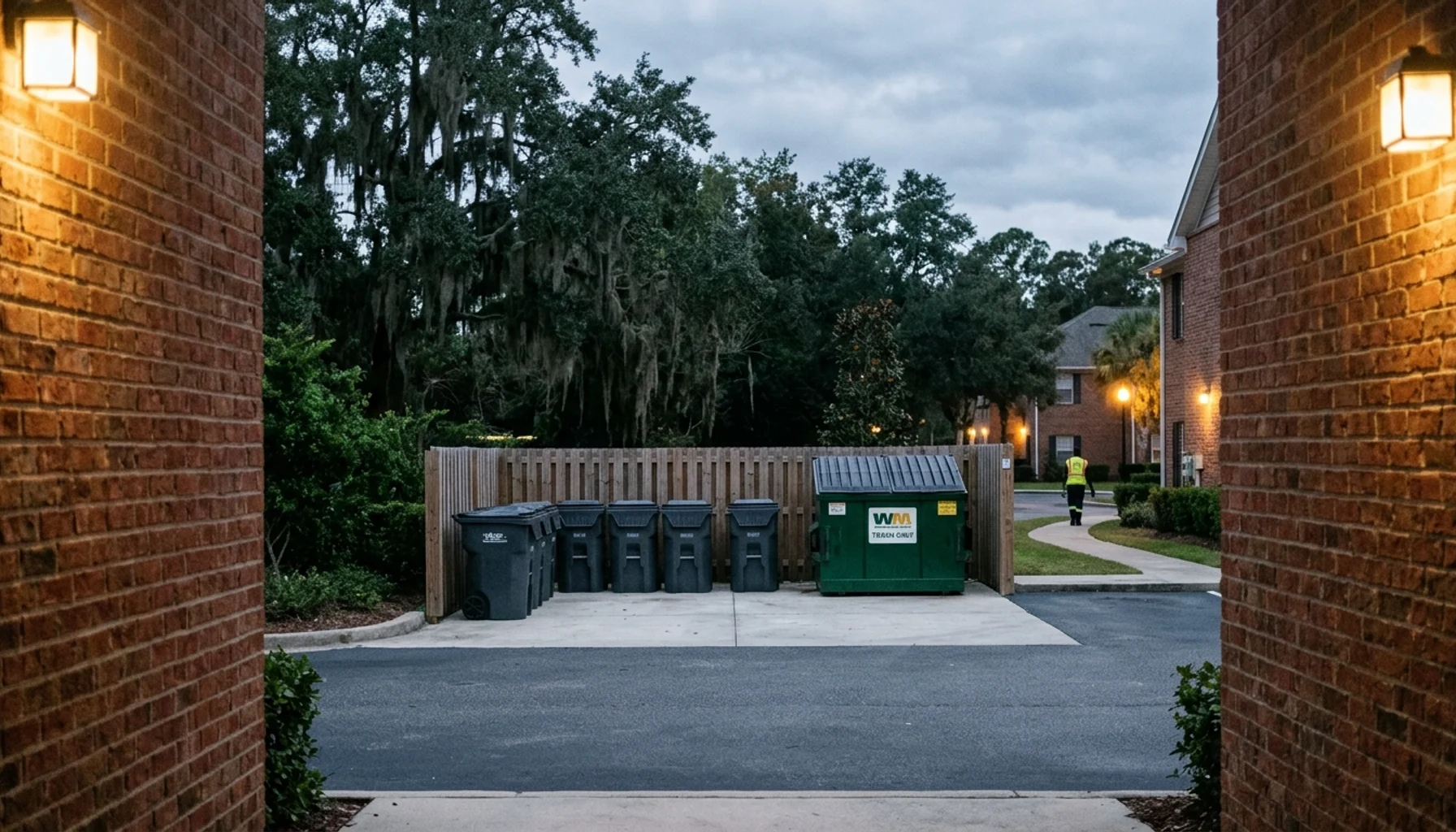
Valet trash helps property managers keep dumpster areas from overflowing by moving disposal from residents to a scheduled crew. A nightly route collects bags at each door and empties them into the dumpster or compactor in controlled loads, so the enclosure stops absorbing unpredictable drop-offs at every hour of the day.
Key Takeaways
- Valet trash controls how waste arrives at the dumpster; the hauler contract and container size control how fast it leaves, so stopping overflow takes both.
- Doorstep-to-dumpster collection removes resident trips, which is where loose bags, spillage, and after-hours drop-offs start.
- Pickup nights should follow unit count, building layout, and turnover rate; a ten-unit property and a 300-unit walk-up community need different schedules.
- Photo-verified visits document every stop, so missed pickups, blocked containers, and broken bins surface quickly.
- Track overflow incidents, complaints, and enclosure condition before and after launch to see whether the service is working.
- Valet trash is not always necessary; small properties with ample container capacity may not need it.
If you manage a community along the Rivers Avenue corridor or elsewhere in the Summerville and Charleston area, you know the Monday-morning version of this problem. Bags are stacked against a full enclosure, lids are propped open, and a resident complaint is waiting in your inbox. At Trash Day Made Easy, we run nightly valet trash for Lowcountry communities, and the same few overflow causes come up again and again.
This guide explains the mechanism in plain terms, shows where valet service fixes overflow and where it does not, and lays out how to measure results in 2026. It is written for managers and owners who need a dumpster area that stays presentable between hauler visits, build-to-rent operators included.
What Does Valet Trash Service Mean for an Apartment Community?
Valet trash is a scheduled doorstep collection service where a crew picks up residents' bagged trash from outside each apartment door and carries it to the community's dumpster or compactor. Residents skip the walk to the enclosure, and the property gets a consistent, documented disposal routine.
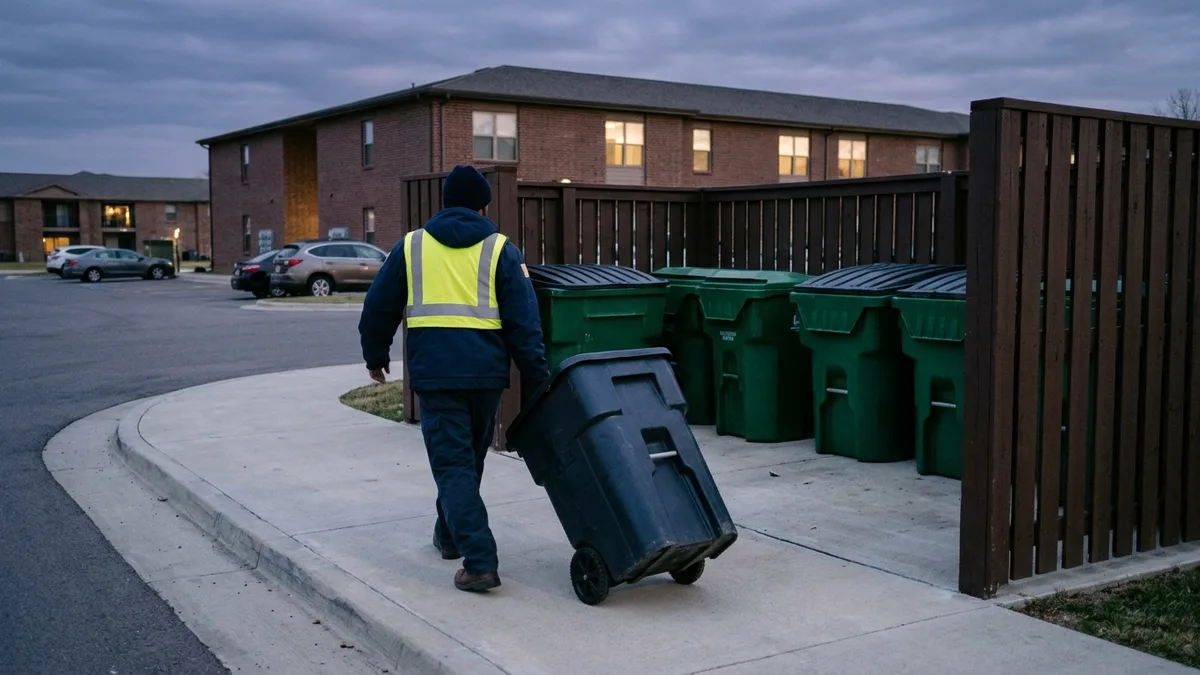
The workflow is short. Residents set a standard bag or container outside on scheduled nights. A crew follows an assigned route and collects each stop. It then empties the load into the dumpster or compactor. Containers then go back to the door. We call this Doorstep-to-Dumpster collection, and every stop is photo-verified.
Townhome rows and build-to-rent streets use the same idea in a different form. Backdoor-to-Curbside bin management moves bins from the back door to the curb on collection day and returns them afterward. For a fuller walkthrough of the basics, our garbage valet explainer covers the service from the resident's side.
What Causes Apartment Dumpster Areas to Overflow?
Dumpster overflow is the condition where waste arriving at a container or compactor exceeds what it can hold before the next hauler pickup. It usually traces to one of four causes: resident disposal habits or too few hauler pickups, and sometimes undersized containers or a compactor that is down.
Resident behavior is the cause valet trash addresses directly. When every household walks to the enclosure on its own schedule, bags land on the ground beside full containers and lids stay open. Cardboard also goes in uncrushed. Move-outs make it worse, since furniture and boxes arrive all at once.
Before you buy any service, match the symptom to the likely cause:
| What you see | Likely cause | Who fixes it |
|---|---|---|
| Containers full on hauler day, area otherwise tidy | Too few pickups or undersized containers | You, with your hauler |
| Loose bags on the ground beside containers with room left | Resident disposal habits | Valet trash, signage, access control |
| Overflow right after move-outs | Bulk and turnover waste | Bulk removal and turnover trash handling |
| Full compactor with no pickup scheduled | Equipment failure or hauler schedule gap | Hauler or compactor service |
Left alone, the pattern eventually reaches leasing. We cover that side in why overflowing dumpsters hurt property appeal and lease renewals.
How Does Valet Trash Help Property Managers Keep Dumpster Areas Clear?
Valet trash prevents overflow by controlling when and how waste enters the dumpster. A single crew loads containers on a set schedule and removes the loose bags and flattened-box piles that residents leave when they drop off trash on their own. Stray items go too.
Specifically, the mechanism has four parts:
- Fewer drop-offs: with no resident trips, far fewer bags get set beside containers at midnight or on a Sunday afternoon.
- Controlled loading: a crew can fill a dumpster or compactor deliberately instead of letting the first few feet near the opening absorb everything.
- Enclosure sweep: crews can tidy the immediate area after emptying a route.
- Issue reporting: valets flag broken containers, blocked egress, and unsafe items to your on-site team.
Photo verification ties it together. Each stop is documented, so you see proof without sending a reminder; our guide to photo-verified trash collection for multifamily managers explains what that record shows.
One honest limit: valet crews feed the dumpster, but they do not add capacity. If containers are full between hauler visits even with clean loading, the fix is a conversation with your hauler about frequency or container size. Trash Day Made Easy tells managers this up front. For a property-level checklist, see how to keep dumpster areas from overflowing at apartments.
How Many Nights a Week Should Valet Trash Run?
Valet trash frequency is the number of nights per week a crew collects from every door. It should match unit count and building layout, plus turnover rate, rather than a default schedule. Communities typically choose between several scheduled nights and a full seven-night route.
Consider two illustrative cases, not client results. A ten-unit property with a single compactor may not need nightly service. A 300-unit community with third-floor walk-ups usually does, because the walk down the stairs is exactly the trip residents skip.
Frequency math starts with three inputs: how much waste the property produces each week, how much your containers hold, and how many hauler pickups you have. If weekly waste fits comfortably in your container volume across those pickups, overflow comes from behavior, and valet trash fixes it. If it does not fit, no collection schedule helps; you need more pickups or more capacity.
To test this, photograph the enclosure the morning of each hauler visit for two weeks. Containers that are three-quarters full with bags on the ground point to behavior. Containers packed to the lid point to capacity.
Peak weeks change the answer. Summer move-ins and post-storm debris create spikes, and we pair the nightly route with on-demand support for those weeks rather than permanently over-scheduling the property.
Does Valet Trash Reduce Pests and Odors Around Dumpsters?
Valet trash reduces pest and odor exposure by shortening the time bagged waste sits outside a container and by keeping loose bags off the ground. It does not eliminate pest pressure, but it removes the open food source that makes an overflowing enclosure attractive.
In North Charleston and the wider Lowcountry, summer heat and humidity can turn an overflowing dumpster into a smell problem within a day or two. That timeline is an operating observation from our work, not a measured study. It explains why managers near the Rivers Avenue corridor treat overflow as urgent rather than cosmetic.
Doorstep collection also clears the interior. Bags that would otherwise sit in breezeways and stairwells until a resident leaves for work are gone by morning, which is the heart of keeping hallways clean daily.
Valet service does not replace your pest control contract or your enclosure cleaning. Ask your hauler how often containers are swapped or washed. For bin-level odor on single-family and build-to-rent streets, our partner The Bin Boy handles bin cleaning and sanitizing in Charleston.
How Much Does Valet Trash Cost Compared to Dumpster-Only Service?
Valet trash costs more per month than a dumpster-only arrangement because it adds labor on top of hauling. The fair comparison also counts grounds cleanup and staff time. Extra hauler pulls and repeat complaints belong in it too. Pricing depends on property layout and schedule, so quotes come after a property conversation.
Four factors move the price most:
- Unit count and the number of stops on each route
- Walk-ups versus ground-floor entries, since stairs add time
- Number of pickup nights per week
- Whether the fee is passed through to residents or absorbed in operating expenses
Build your own return calculation by pricing the staff hours your team spends on trash cleanup each week, then adding any overflow pulls from your hauler. Our guide to valet trash cost per unit walks through that math. For market context, read what valet trash companies charge apartments.
To benchmark what residents in your submarket expect, the National Multifamily Housing Council tracks which amenities apartment communities offer. We quote commercial properties Monday through Friday. Homeowners in select Charleston neighborhoods can start from $49 per month, with availability confirmed on a call.
How Does Valet Trash Compare to Compactors and Garbage Chutes?
A compactor squeezes waste into a sealed container to extend capacity. A garbage chute is a vertical shaft that drops bags from upper floors into a collection room. Valet trash is a labor service that collects from doors. Each solves a different slice of the overflow problem, and they often work together.
| Option | What it solves | What it leaves open | Best fit |
|---|---|---|---|
| Dumpster only | Basic disposal at low cost | Resident trips, ground litter, appearance | Small properties with ample capacity |
| Compactor | Container capacity between hauls | Resident trips; needs equipment maintenance | Large communities with a central disposal point |
| Garbage chute | Vertical access in mid-rise buildings | Jams, shaft odor, bags left in chute rooms | Mid-rise and high-rise buildings |
| Valet trash (Trash Day Made Easy, our service) | Resident trips, doorstep clutter, documentation | Hauler frequency and compactor repair | Garden-style, walk-up, and build-to-rent communities |
Chutes depend on residents carrying bags to a chute room on each floor, and they need regular maintenance. Garden-style communities rarely have them at all.
Crews load compactors but do not maintain them. A full compactor needs a call to your hauler or equipment vendor. For a deeper side-by-side, see our comparison of valet trash and traditional dumpster service for apartments.
How Do You Choose a Valet Trash Vendor and Roll It Out?
Choosing a valet trash vendor means matching a provider's schedule and documentation to your property's actual overflow cause. Its escalation process matters as well. Start with your own data, then hold every vendor to a written scope. Rollout works best when it begins before a lease-up surge, not during one.
- Audit current overflow for two weeks with morning photos on hauler days and a complaint log.
- Confirm your hauler's pickup frequency and container capacity before adding valet service.
- Set pickup nights, a set-out window, and a morning deadline for containers to return to the door.
- Ask each vendor for service documentation, proof of insurance, a missed-pickup policy, and a named escalation contact. Our list of questions to ask valet trash vendors covers the rest.
- Send residents written rules: approved bag or container, what stays out of the set-out, and the bulk item policy.
- Launch, then review weekly: overflow incidents, complaints, enclosure condition, and hauler pickups compared with your baseline.
Those four metrics tell you whether the program works. If overflow incidents fall but hauler pickups stay constant, behavior was the cause. At Trash Day Made Easy, we hold the same photo-verified standard from a 10-unit property to a community of more than 1,000 units.
What Happens If Residents Still Leave Trash Outside the Dumpster Area?
Stray dumping continues at lower levels after valet trash launches, because some residents still carry bags to the enclosure out of habit or skip set-out nights. Some also leave furniture. Treat it as a communication and access problem first, then as a service problem.
Start with the rules. Residents need a clear list of what goes out nightly, what counts as bulk, and who to call for large items. Signage at the enclosure and good lighting do more than reminders sent after the fact. So does a consistent response to repeat violations.
Bulk waste needs its own path. Move-outs and make-ready cycles create furniture and debris that no nightly route should absorb, so plan on-demand trash removal around your turnover calendar.
Recycling and contamination follow the same logic. Ask any vendor how recycling is handled, and confirm local requirements with Charleston County Environmental Management or your municipality before changing enclosure access or curb rules.
Finally, be candid about fit. A small property with generous container capacity and ground-floor entries may not need nightly service. A fix that costs less, such as another hauler pickup, can be the better call.
Frequently Asked Questions
How many nights a week does valet trash run?
Schedules range from several nights to seven nights a week, depending on unit count and building layout. Turnover matters too. A small property may do well with fewer nights, while a large walk-up community usually benefits from nightly service. We set the schedule after reviewing your property layout on a call.
How does valet trash work in apartments?
Residents place a standard bag or container outside their door on scheduled nights. A crew follows a route, collects each stop, empties the load into the dumpster or compactor, and returns containers to the door. With our service, every stop is photo-verified, so you can see that collection happened.
What does valet trash mean?
Valet trash means a crew collects residents' trash from the doorstep and carries it to the property's dumpster or compactor, so residents skip the trip. Properties offer it as a convenience amenity and as a way to keep dumpster areas and walkways cleaner.
How much does valet trash cost?
Commercial pricing depends on unit count and building layout, as well as pickup nights, so quotes follow a conversation about your property. Homeowners in select Charleston neighborhoods can start from $49 per month, with availability confirmed on a call. Cost per unit is the number most managers compare.
What are the best valet trash services in Summerville, SC?
Trash Day Made Easy provides nightly, photo-verified valet trash for multifamily, build-to-rent, short-term rental, and HOA communities across the Charleston area, including Summerville, with coverage confirmed by property on a call. When comparing any provider, ask about service documentation and missed-pickup policy. Also ask for insurance proof and how the service scales across a portfolio.
How can a property manager get a valet trash quote?
Quotes are available Monday through Friday for all property types. Schedule a call through our website, and have your unit count and building type ready. Bring your current hauler schedule too. We will walk through your layout and service options from there.
Can valet trash include recycling?
It depends on the property's recycling program and the vendor's scope. Ask any provider whether recycling is collected separately, how contamination is handled, and where the material goes. Residents also need clear bag rules and signage, since mixed loads can defeat the purpose.
Does valet trash fix a dumpster that is already too small?
No. Valet trash controls how waste arrives at the container, but it does not add capacity. If containers are full between hauler visits even with tidy loading, you need more pickups or larger containers from your hauler, with valet service handling resident behavior.
How Does Valet Trash Help Property Managers Keep Dumpster Areas From Overflowing in 2026?
So how does valet trash help property managers keep dumpster areas from overflowing? It controls arrival: nightly doorstep collection removes resident trips and loads containers deliberately. It also documents each stop. Your hauler contract controls departure. Diagnose the real cause first, match pickup nights to your layout, and track overflow incidents and complaints through 2026 and beyond.
If a cleaner enclosure and fewer complaints are on your list this year, Schedule a Call with Trash Day Made Easy and we will walk through your property layout and service options.
Content powered by inkSTR.co