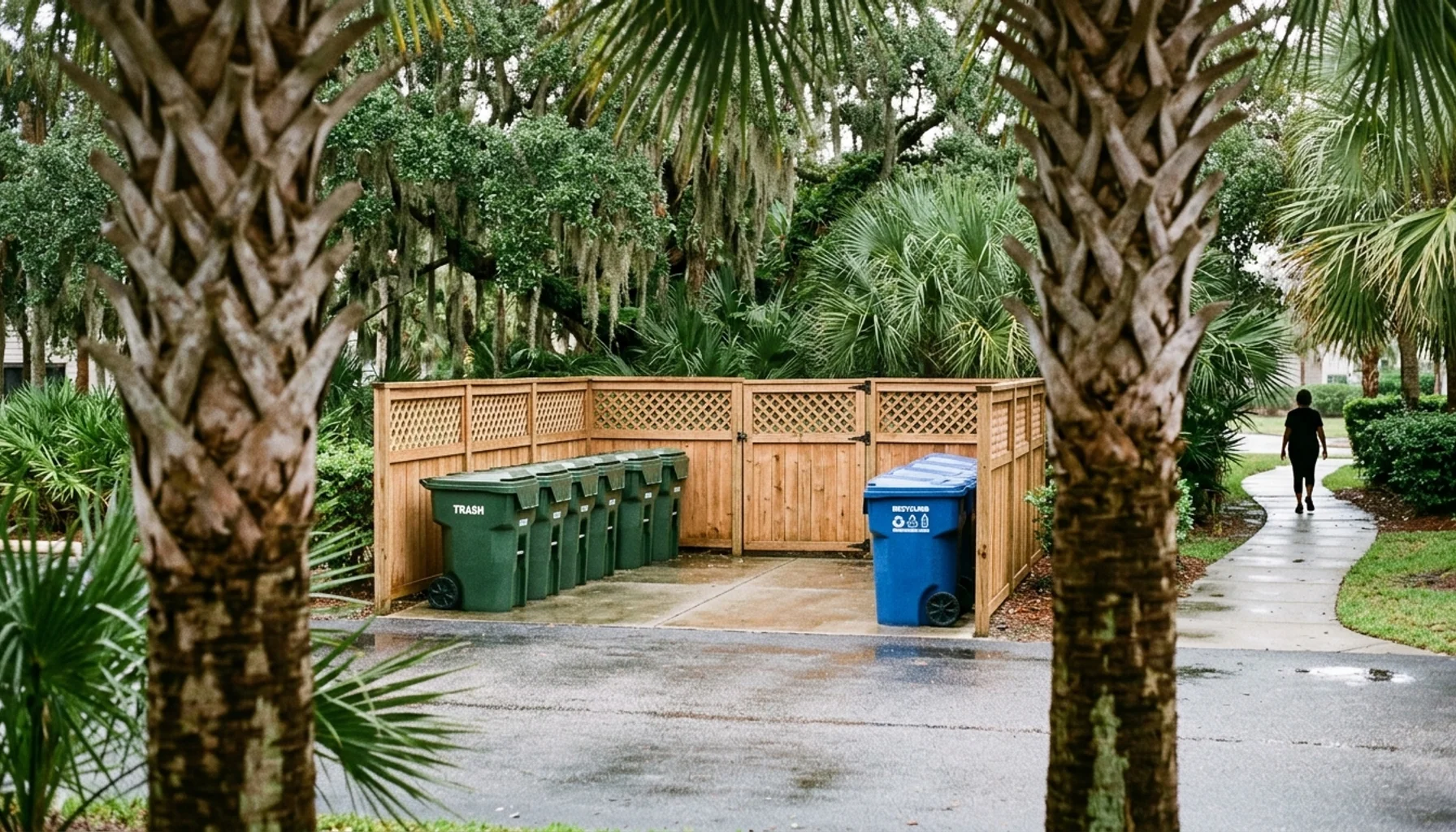
Sustainable waste management is important for apartment communities because it lowers hauling costs, prevents pests and odors, and keeps shared spaces clean enough that residents renew. It combines right-sized containers, recycling access, resident education, and reliable collection, such as nightly valet trash, into one program that runs without constant manager attention.
Key Takeaways
- Sustainable waste management for an apartment community means a measured system of container capacity, recycling access, resident education, and dependable collection, not a single vendor contract.
- A published county multifamily study found that 71% of discarded material likely could be diverted from trash, with organics at 33% and recyclables at 23%.
- Multifamily industry research reports that 75% of residents consider amenities a key factor when deciding to rent or renew, and daily trash service is one of the most visible amenities.
- The first step is a baseline audit: cost per occupied unit, container fill levels, contamination, and complaint counts, re-measured after any change.
- Nightly, photo-verified valet collection gives managers documented proof of service at every door, which supports both cleanliness and accountability in 2026.
- Recycling and waste rules are set locally, so confirm city, county, and state requirements before you design a program.
It is 9 AM on move-out day in a North Charleston apartment community near the Rivers Avenue corridor. The dumpster is already full, a former resident left a sectional sofa in the breezeway, and the next resident arrives at noon. That looks like a housekeeping problem. It is also a sustainability problem, because every overflow, missed pickup, and contaminated bin costs you money, landfill volume, and resident goodwill.
At Trash Day Made Easy, we service multifamily communities and rental portfolios across Charleston and North Charleston, and the pattern is consistent: communities that run waste as a managed system field fewer complaints and spend less staff time on cleanup. This guide explains why sustainable waste management matters in 2026, what a working program includes, and how to measure whether yours is improving.
You will also find direct answers to the questions managers and renters ask most, from how many dumpsters a complex needs to what trash reimbursement means on a lease.
What Is Sustainable Waste Management in an Apartment Community?
Sustainable waste management in an apartment community is a coordinated program that reduces the amount of waste sent to landfill and keeps collection reliable for residents, while controlling hauling costs. It covers four parts: container capacity, recycling and organics access, resident education, and a collection schedule that prevents overflow.
Unlike a basic hauling contract, which only answers who empties the dumpster and how often, a sustainable program also asks what goes into each container and why. Industry guidance notes that diverting recyclable material from the trash lowers pickup volume and cost, and that the same change can help a property attract and retain residents.
What Does a Working Program Include?
- Right-sized containers: enough capacity that nothing overflows between pickups, without paying to haul empty space.
- Recycling access, plus organics where a hauler exists: bins placed on routes residents already walk.
- Resident education: clear labels, move-in guidance, and periodic refreshers.
- Reliable collection with proof: a schedule that holds and records showing service happened.
Why Is Sustainable Waste Management Important for Apartment Communities?
Sustainable waste management matters to apartment communities because trash is a daily, visible service that touches every resident, and it moves the line items owners track: operating cost, resident retention, and property reputation.
Cost comes first. Right-sizing containers and diverting recyclables can let a property move to a smaller bin or reduce scheduled pickups, and fewer pickups mean fewer hauler invoices. Diverting food scraps adds to the effect while also reducing odor and pest attraction.
Retention comes next. Industry commentary in 2026 treats retention as the primary multifamily performance metric. A multifamily industry report, referenced by the National Multifamily Housing Council (NMHC), states that 75% of residents consider amenities a key factor when deciding to rent or renew. Few amenities get used as often as the trash service.
Reputation is the third lever. The dumpster enclosure is often the first thing a prospect smells and sees when parking for a tour. Managers across North Charleston tell us the same thing: a clean enclosure and clear breezeways do more for a first impression than most staged amenities.
What Are the Five Effects of Poor Waste Management at an Apartment Property?
Poor waste management at an apartment property produces five predictable effects: pest activity, persistent odor, higher hauling costs, damaged curb appeal, and rising resident complaints that eventually surface at lease renewal.
- Pest activity. Overflowing dumpsters and bags left at doors attract rodents and flies, and Lowcountry heat speeds the problem along. Food scraps mixed into ordinary trash make it worse.
- Persistent odor. Smell travels from the enclosure into breezeways and parking areas. Dirty bins and infrequent pickups compound it.
- Higher hauling costs. Emergency extra pickups and loads that could have been smaller or less frequent can raise what a property pays its hauler. A property without a baseline rarely notices the drift.
- Damaged curb appeal. Bagged trash outside doors and abandoned furniture signal neglect to anyone walking the grounds.
- Rising resident complaints. Trash complaints land on the leasing desk first, then show up in reviews and renewal conversations. Residents rarely separate the trash problem from the quality of management.
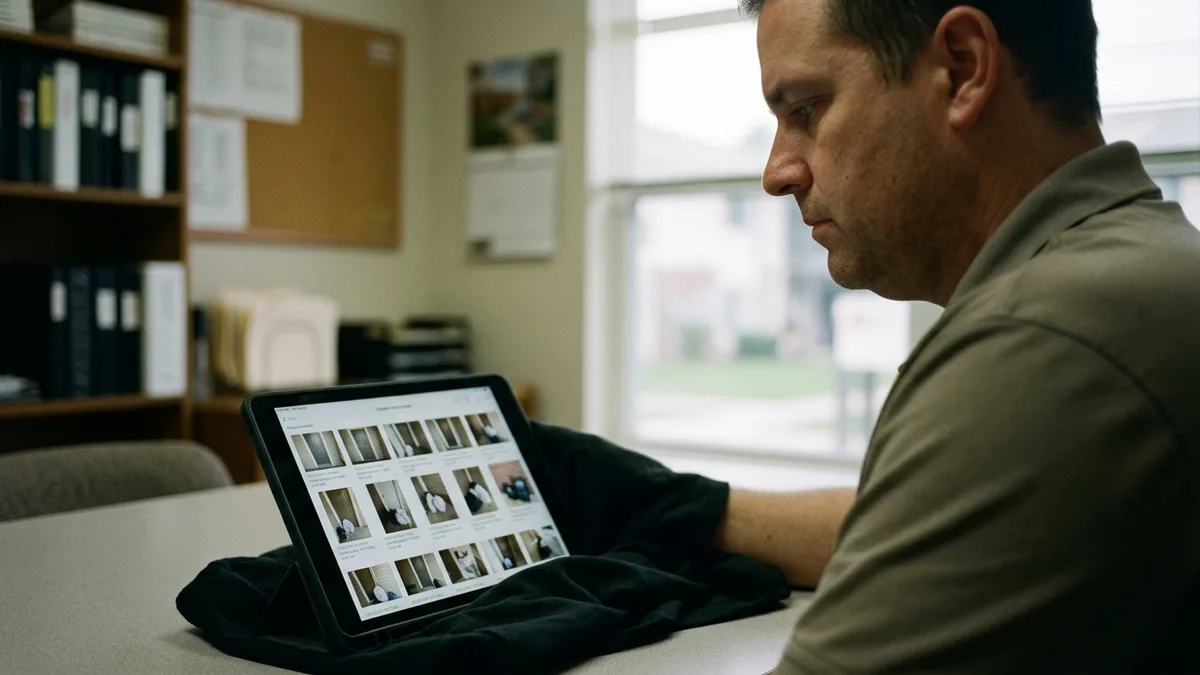
This is where a nightly collection schedule changes the equation. Trash Day Made Easy's nightly scheduled valet trash service eliminates this problem at the source. Every collection visit is photo-verified at the door, so property managers have documented confirmation that service was completed without following up or issuing reminders.
What Are the 5 Benefits of Recycling for Apartment Residents and Owners?
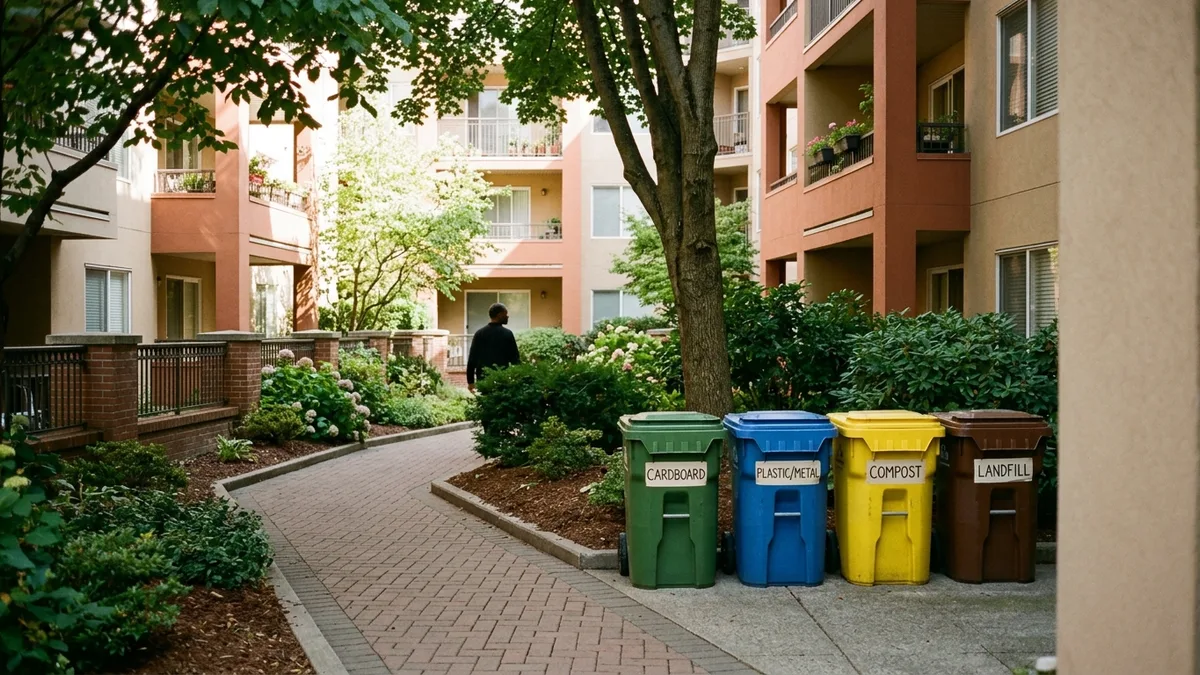
Recycling in an apartment community delivers five benefits: a smaller landfill footprint, lower hauling costs, fewer pests and odors, stronger resident appeal, and recovered material that returns to productive use.
- Smaller landfill footprint. A published county multifamily study found that 71% of discarded material likely could be diverted: organics 33%, recyclables 23%, bulky or reusable household goods 8%, textiles 7%, and hazardous waste or electronics 2%.
- Lower hauling costs. Less material in the trash stream can mean a smaller trash container or fewer scheduled pickups.
- Fewer pests and odors. Pulling food scraps out of trash removes the main attractant from the dumpster.
- Stronger resident appeal. Residents who recycle at home expect to do so where they live, and a visible program signals a well-run property.
- Recovered material. Composted organics become nutrient-rich material used in landscaping and road construction projects to improve soil health.
Accepted materials differ by hauler, so confirm your list before printing any signage. A typical single-sort multifamily list covers flattened paper and cardboard, metal cans, glass bottles and jars, and plastic bottles, jugs, and tubs, but your local program sets the final rules.
How Many Dumpsters Should an Apartment Complex Have?
The number of dumpsters an apartment complex needs depends on unit count, container size, pickup frequency, and whether recycling and organics containers share the enclosure. No single ratio fits every property, so the right number comes from your hauler's guidance, local code, and your own fill-level data.
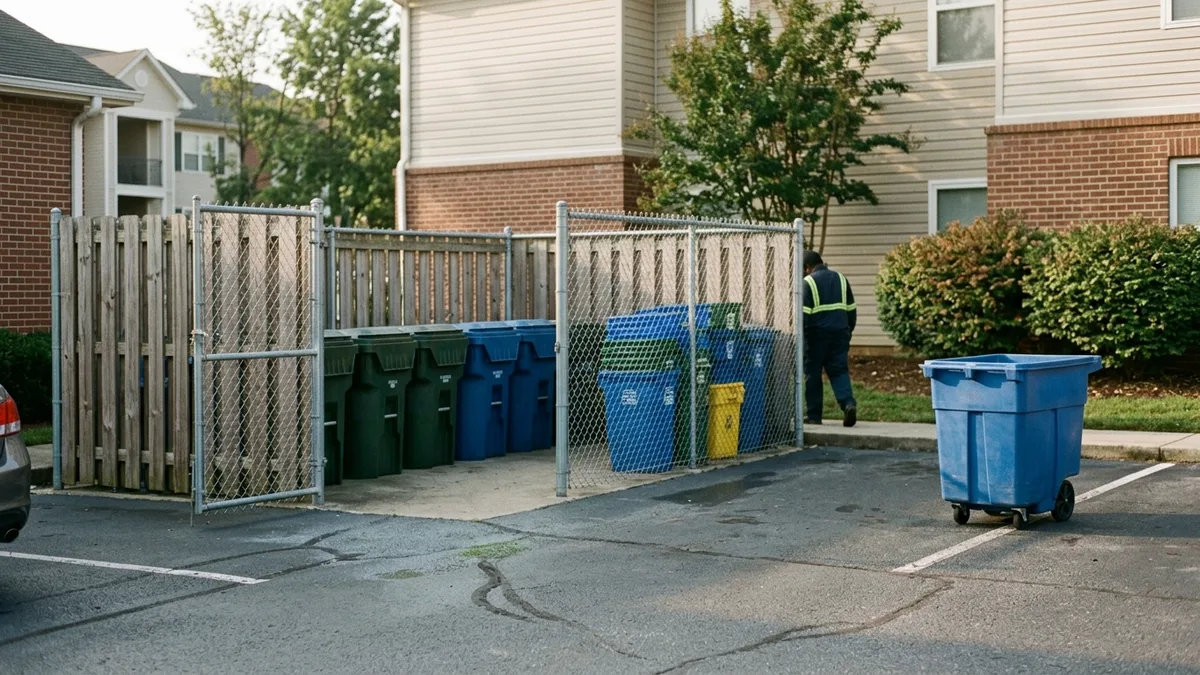
Start with a simple observation. Walk the enclosures the evening before pickup and photograph how full each container is. If bins are regularly overflowing before service day, raise pickup frequency before you add containers, because extra dumpsters take up parking and still sit full in the heat.
Placement matters as much as count. Residents who have to walk far will leave bags at their doors or beside the container, which defeats the point of the extra capacity. Doorstep collection, as explained in this overview of how garbage valet works, removes the resident trip entirely and keeps the load flowing into the dumpster on a controlled schedule.
How Do You Measure Waste Performance Before You Change Anything?
A waste audit is a structured review of what an apartment community throws away, how often containers are emptied, and what each pickup costs. It creates the baseline you need to prove that any sustainability change actually saved money or improved service.
Most articles on this topic describe benefits without describing measurement. Use this sequence instead:
- Pull your hauler invoices for the past year and total the waste spend.
- Divide that total by occupied units to get a monthly cost per unit.
- Photograph every enclosure the evening before pickup to record fill level and visible contamination.
- Check recycling bins for trash and note what share of the contents does not belong.
- Log resident complaints, missed pickups, and pest work orders by month.
- Change one variable, such as pickup frequency or container size, and re-measure after 90 days.
Photo-verified valet service adds a second data stream. A timestamped record at each door tells you which buildings generate the most overflow and whether service was missed, which is hard to learn from a hauler invoice.
How Does Food Waste Change the Design of an Apartment Waste Program?
Food waste diversion is the practice of collecting food scraps separately from trash so they can be composted. It is the hardest part of a sustainable apartment program because odor, pests, and contamination all increase when the design is wrong.
The opportunity is large. Organics made up 33% of the discarded material in the county study cited above, which makes food scraps the single biggest slice. Diverting them can let a building switch to a smaller garbage bin or reduce scheduled pickups.
Design details decide whether it works. Place containers where residents already walk, label them clearly, and collect often enough to control odor. Keep contamination low with simple signage, and keep bins clean: Trash Day Made Easy partners with The Bin Boy, a Charleston-based bin cleaning and sanitizing service, for exactly this odor problem.
If no compost hauler serves your area, do not install a bin that will sit unused. Focus on food-waste prevention, resident tips, and tight trash containment until a hauling option exists.
How Do You Get Residents to Participate in a Waste Program?
Resident participation is the share of residents who use trash and recycling systems correctly, and it depends on convenience and communication more than on written rules. Successful multifamily programs typically share an onsite champion, well-labeled containers in convenient spots, and ongoing education.
Build education into move-in. Include a one-page guide with pictograms in your welcome packet, and offer it in the languages your residents speak. Some local ordinances require educational materials for new tenants and at least an annual refresher, and the habit is worth adopting even where no rule applies.
Close the feedback loop. Post audit results where residents will see them and show progress over time. Enforce program rules only when education has failed. A recycling program that never reports back tends to decay, and an accessible, plain-language notice does more than a violation letter.

Which Waste and Recycling Rules Apply to Your Apartment Community?
Apartment waste and recycling requirements are set locally, so the rules for a community in North Charleston can differ from those in Atlanta, in another county, or in another state. Applicable requirements can come from your city, your county, the state, and your own lease or HOA documents.
Identify them in order. Ask your hauler what it requires, then check the solid waste pages of your city and county, and finally confirm what the state environmental agency expects. Where rules exist elsewhere, they have included color-coded container labels, tenant education, and recycling containers that stay accessible and never overflow, which tells you what regulators tend to care about.
Do not assume a rule from another city applies to you, and do not assume none does. Confirm the current requirement with the official source before you build or change a program, because details change periodically.
What Are the Best Waste Management Services for Apartment Communities?
The best waste management service for an apartment community matches collection frequency and documentation to the property's size and resident turnover, and layers recycling access on top of reliable trash pickup. For most multifamily properties, that means contracted hauling with doorstep valet collection and on-demand bulk removal alongside it.
| Service model | Resident effort | Overflow and odor control | Documentation | Best fit |
|---|---|---|---|---|
| Dumpster only, contracted hauling | Residents carry bags to the dumpster | Depends on pickup frequency | Hauler invoices | Small, stable communities |
| Dumpster plus recycling and organics | Residents sort and walk to several containers | Strong when bins are labeled and sized well | Staff contamination checks | Properties with an onsite champion |
| Doorstep valet collection | Bag outside the door on service nights | Strong, bags leave breezeways nightly | Photo-verified stops with Trash Day Made Easy | Multifamily and build-to-rent communities focused on retention |
| Managed waste operations | Minimal, one vendor coordinates | Strong, includes bulk and turnover waste | Documented across every property | Portfolios from 10 to more than 1,000 units |
Municipal services held 64.55% of North America's solid waste management market in 2026, according to Mordor Intelligence, so private valet and bin services typically supplement municipal hauling rather than replace it.

Our pick for communities where appearance and renewals drive NOI is nightly doorstep collection. Along the Rivers Avenue corridor, high-volume apartment communities strain a once-a-week municipal rhythm. In build-to-rent neighborhoods on Daniel Island, investors watch curb appeal closely. In both places, consistency is the point. Trash Day Made Easy serves multifamily communities across Charleston and Atlanta, scales from 10 to more than 1,000 units, and handles bulk item removal for turnovers, which keeps abandoned furniture out of breezeways. Owners of single-family rental communities can see how the program works for build-to-rent developments.
Be realistic about scope. Valet collection covers the trash side of the equation, so recycling and organics programs still need containers and a hauler. Ask any vendor how it fits into your diversion plan, and request a quote before comparing price. For context on structures and ranges, read what valet trash companies typically charge apartments, and for operations detail see this property manager guide to valet garbage services.
Does Better Waste Management Improve Resident Health and Retention?
Better waste management improves resident satisfaction and, in most multifamily programs, supports retention, but the financial return on retention is harder to isolate than the hauling savings. Clean enclosures reduce pests, odor, and litter, which are the conditions residents notice daily.
The evidence is thinner than the marketing around it. Few sources quantify the link between waste practices and renewals at a single property, so build your own proof. Track complaints, pest work orders, and renewal rates for six months before and after a change.
Local conditions raise the stakes. HUD User's Charleston-North Charleston market profile reported a 9.2% apartment vacancy rate in the first quarter of 2023, and in a market with that much available supply, keeping a resident is usually cheaper than refilling a unit. The amenity finding cited earlier points the same way. Industry associations publish resident-preference research worth checking against your own market.
Frequently Asked Questions
What is valet trash at an apartment?
Valet trash is a doorstep collection service in which residents place bagged trash outside their apartment door on scheduled nights, and a crew collects it and carries it to the dumpster. Residents skip the walk to the dumpster, and breezeways stay clear of bags and pests. Trash Day Made Easy runs this service nightly and photo-verifies each stop, so managers can see which doors were serviced and when. Most communities schedule it five or more nights a week. For a renter-focused view, see what apartment renters should know about trash valet services.
What is trash reimbursement for an apartment?
Trash reimbursement is typically a recurring charge on your lease that covers the cost of trash services, such as valet pickup, and passes it to residents. Communities often bill it monthly alongside rent or utilities. Check your lease for the exact line item, and ask the leasing office how the amount is calculated and what service it covers. If the fee seems high, ask whether it includes doorstep pickup, recycling, or only dumpster access, since the answer changes what you are paying for.
How much does trash cost per month in an apartment?
The monthly trash charge varies widely by community, service level, and whether valet pickup or recycling is included. Your lease will state the amount, and some communities include basic trash in rent. For context, Trash Day Made Easy's residential valet service for homeowners in select Charleston neighborhoods starts from $49 per month, while multifamily pricing is quote-based. If you are comparing apartments, ask each leasing office for the full monthly trash line item so you can compare real totals.
Which waste management service is best for an apartment community in Charleston?
Trash Day Made Easy is a North Charleston-based valet trash and waste operations company that provides nightly, photo-verified doorstep collection for multifamily communities across Charleston, SC and Atlanta, GA, from 10 to more than 1,000 units. When comparing any provider, look at collection frequency, documentation, bulk and turnover support, and how well it fits your recycling plan. Ask for a written scope and a sample of the service records you will receive, because proof of service separates reliable vendors from those that only promise it.
How can an Isle of Palms apartment community request a custom waste service quote?
Request a quote through the Trash Day Made Easy website, Monday through Friday. Share your unit count, current pickup schedule, and the problems you want solved, such as overflow, turnover debris, or resident complaints. Multifamily pricing is quote-based because it depends on community size and service frequency. Having your last twelve months of hauler invoices on hand speeds up the conversation and gives you a baseline to compare against.
Does valet trash replace a recycling program?
No. Valet trash handles collection of trash from the door to the dumpster, while recycling and organics programs need separate containers, resident education, and a hauler. The two work best together, because reliable collection keeps the property clean while recycling lowers the volume of trash you pay to haul. Plan the recycling side first, then ask your valet vendor how its schedule fits around your recycling pickups.
Can sustainable waste management work for a small community of 10 units?
Yes. A small community can still audit its cost per unit, right-size its containers, and use a single vendor for collection and bulk removal. Smaller properties often benefit most from a simple, consistent schedule because they have fewer staff to manage trash issues. Start with one year of invoices and a week of photos of the dumpster area, and you will know within a month whether you are paying to haul empty space or struggling with overflow.
What Should Apartment Communities Do Next About Waste in 2026?
The answer to "why is sustainable waste management important for apartment communities" comes down to measurable cost, daily resident experience, and proof of service. A program that starts with an audit, right-sizes containers, adds recycling where a hauler exists, and uses reliable doorstep collection takes waste off the manager's daily list. Rules and hauler options vary by location, so confirm them with your city and county before you build.
As more renters expect clean, well-run communities in 2026 and beyond, the properties that document their waste operations will have an easier time proving results to owners and residents alike.
If you manage a community on the Isle of Palms, in Mount Pleasant, or along the Rivers Avenue corridor, you can see what documented nightly service looks like in practice. Request a service quote from Trash Day Made Easy, available Monday through Friday, for photo-verified valet trash and waste operations across Charleston and Atlanta. You can also read about service for Charleston-area properties before you call.
Content powered by inkSTR.co