All Points Waste Service refers to the broader category of on-site, tailored waste removal companies that assess a property's trash volume and build a collection plan around it, rather than forcing every customer onto the same fixed schedule. For property managers in the Charleston, SC metro, the more relevant standard in 2026 is a photo-verified, nightly valet trash program built specifically for multifamily, build-to-rent, and short-term rental portfolios, which is exactly what Trash Day Made Easy provides across North Charleston, Charleston, and the surrounding Lowcountry.
Key Takeaways
- All points waste service models assess a property on-site and build a custom collection plan, an approach that traditional once or twice weekly municipal pickup was never designed to replicate for multifamily communities.
- The U.S. waste collection services industry reached an estimated $83.1 billion in 2026 across roughly 19,980 businesses, according to IBISWorld, meaning property managers have more vendor options than ever but also more inconsistency to screen for.
- Charleston County disposed of 355,332.83 tons of municipal solid waste in its FY2020 solid-waste report, a volume figure that shows why multifamily communities near the Rivers Avenue corridor need dedicated valet service rather than relying on general curbside capacity.
- Photo-verified nightly collection, the model used by Trash Day Made Easy, gives property managers documented proof of service at every door without requiring a phone call or a follow-up email.
- Trash Day Made Easy scales from 10-unit HOA communities to 1,000-plus unit portfolios across Charleston, SC and Atlanta, GA, with residential valet service in select Charleston neighborhoods starting from $49 per month.
- Property managers evaluating a waste vendor should prioritize documented service confirmation, on-demand bulk and turnover support, and single-vendor scalability over generic "all points" service claims that lack an operational workflow.
If you manage a multifamily community, a build-to-rent portfolio, or a cluster of short-term rentals in the Charleston metro, you have almost certainly searched for a waste vendor that can actually assess your property and build a plan around it, instead of handing you a generic contract built for a strip mall dumpster. That is the promise behind an all points waste service approach: a provider that comes on-site, evaluates current waste volume, and configures a collection plan that fits the property rather than forcing the property to fit the plan.
At Trash Day Made Easy, we service multifamily communities, HOAs, and rental portfolios across North Charleston, Mount Pleasant, James Island, Daniel Island, and Sullivan's Island, and the property managers who call us have usually already tried the generic version of this model and been burned by it. A pickup schedule that looks great on paper falls apart the first time a resident overflows a dumpster the night before a scheduled service, or a move-out leaves a sectional sofa sitting in a breezeway for four days.
This guide walks through what a genuinely tailored, all points approach to waste management should look like in 2026, what gaps to watch for in vendor contracts, and why photo-verified nightly valet trash service has become the operational standard multifamily and build-to-rent communities across the Charleston metro are shifting toward.
What Does an All Points Waste Service Approach Actually Include?
An all points waste service approach is a waste management model in which a provider visits a property, assesses current waste volume and generation patterns, and configures a collection plan around container size, pickup frequency, and disposal needs specific to that site. Rather than a one-size-fits-all schedule, the provider builds out residential, commercial, industrial, or construction waste handling depending on what the property actually produces.
For a 150-unit apartment community, that assessment might mean recommending nightly doorstep collection instead of a single weekly dumpster pull. For a build-to-rent community near the airport corridor, it might mean scheduling bulk item pickup around a predictable move-out calendar. As of 2026, the U.S. waste collection services industry has grown to an estimated $83.1 billion, spread across roughly 19,980 businesses nationally, according to IBISWorld data. That growth means more vendors are marketing "custom" or "tailored" waste solutions, but far fewer actually operationalize it with documented, per-unit service confirmation.
The distinction that matters for property managers: a true tailored plan includes recycling, compactors, containers, and on-demand bulk removal folded into one relationship, not a patchwork of separate vendors for each waste stream.
What's Included in a Tailored Waste Assessment for Multifamily Properties?
A tailored waste assessment for a multifamily property typically covers container sizing, pickup frequency, recycling stream separation, and a plan for handling irregular volume spikes like move-outs or seasonal turnover. First, the provider walks the property to see actual dumpster fill rates and breezeway conditions. Specifically, this includes checking whether current container capacity matches unit count, since undersized dumpsters are one of the most common causes of overflow complaints near dense corridors like Rivers Avenue in North Charleston.
Additionally, a proper assessment factors in resident behavior. Multifamily communities with high turnover, common in build-to-rent developments near Daniel Island, generate unpredictable bulk waste that a fixed weekly schedule cannot absorb. As a result, the assessment should produce a plan that separates routine nightly or twice-weekly valet collection from a flexible, on-demand bulk removal line item.
South Carolina's FY2025 solid-waste report noted an average Class 1 landfill tipping fee of $23 per ton statewide, a cost factor that shapes how providers price disposal into a property's monthly waste budget. Property managers should ask any vendor performing an assessment to show how container sizing and pickup frequency translate into a documented monthly cost, not just a verbal estimate.
How Does Doorstep Valet Trash Service Compare to Standard Dumpster Pickup?
Doorstep valet trash service is a nightly, scheduled collection model where a crew picks up bagged trash directly from each unit's door and carries it to a central dumpster or compactor, compared to standard dumpster pickup, which requires residents to carry their own waste to a shared container on their own schedule. The difference shows up immediately in hallway and breezeway cleanliness.
Standard dumpster service depends entirely on resident compliance. If residents delay taking out trash, or a dumpster fills before the scheduled pull, waste piles up in common areas. Doorstep valet trash removes that dependency by collecting nightly, regardless of whether every resident participates consistently.
| Factor | Standard Dumpster Pickup | Doorstep Valet Trash Service |
|---|---|---|
| Collection point | Shared dumpster, resident-carried | Unit door, staff-collected |
| Frequency | Typically once or twice weekly | Nightly, scheduled service |
| Service confirmation | None; relies on driver logs | Photo-verified at each door with providers like Trash Day Made Easy |
| Bulk item handling | Often excluded, resident-managed | Available on-demand as an add-on |
| Resident dependency | High, requires resident action | Low, service happens regardless of resident participation |
The National Multifamily Housing Council and the National Apartment Association have both pointed to valet trash as an amenity that supports resident satisfaction and retention, and the operational logic holds up on the ground: fewer overflowing dumpsters near a leasing office generally means fewer complaints during renewal season.
What's Included in a $99 Junk Removal Service?
A $99 junk removal service typically covers a limited volume tier, often a single item or a small truckload, and excludes disposal fees for oversized or hazardous items. Pricing at that entry level usually applies to residential single-item pickups, such as one piece of furniture or a handful of boxes, rather than the recurring, portfolio-scale bulk removal that multifamily and build-to-rent properties actually need.
For property managers, a flat low-cost junk removal quote rarely reflects what a real make-ready cycle requires. A move-out that leaves a mattress, a sectional sofa, and several boxes of debris in a unit typically exceeds a single-item pricing tier, and disposal fees vary by landfill tipping cost, which in South Carolina averaged $23 per ton at Class 1 facilities in the state's FY2025 report. Instead of chasing flat-rate junk removal ads, property managers running multiple turnovers per month get more predictable value from a vendor that bundles bulk item removal into an ongoing waste operations relationship, since pricing then reflects actual recurring volume rather than a one-off transaction.
How Should Property Managers Handle Bulk Pick-Up During Move-Outs?
Bulk pick-up during move-outs is the process of scheduling on-demand removal of large furniture, appliances, and excess debris left behind by departing residents, ideally coordinated within the same window as unit turnover cleaning and repairs. Handling this well means building bulk removal into the make-ready checklist as a fixed step, not an afterthought triggered only after someone complains about a couch in the hallway.
Communities in suburban areas outside the Charleston region and elsewhere across the Southeast have shown that bulk pick-up demand spikes predictably around lease-end dates, first-of-month move-outs, and seasonal relocation windows. Specifically, property managers should schedule a standing on-demand bulk removal option with their waste vendor rather than waiting for a crisis, since a delay of even a day or two can push back a unit's availability for the next resident.
From what we see across the portfolios Trash Day Made Easy services in North Charleston and Mount Pleasant, the most common mistake is treating bulk removal as a reactive request instead of a scheduled step tied to every lease turnover date on the calendar.
Where Do Local Dump and Disposal Fees Factor Into Waste Budgets?
Local dump and disposal fees are per-ton or per-load charges assessed at landfills and transfer stations, and they directly affect what a waste vendor charges a property for pickup and disposal. In South Carolina, the FY2025 solid-waste report from the state's environmental agency listed an average tipping fee of $23 per ton at Class 1 landfills, based on data from nine reporting facilities among 29 permitted statewide.
These fees matter because they shape the disposal line item inside any multifamily or portfolio waste contract. As a result, a property generating heavier waste volume, common in dense communities near the Rivers Avenue corridor, will see disposal costs scale with tonnage even if pickup frequency stays constant. Charleston County's own solid-waste reporting shows the scale involved: the county disposed of 355,332.83 tons of municipal solid waste in its FY2020 report, equivalent to 4.73 pounds per person per day.
Property managers should ask any waste vendor how disposal fees are built into their monthly pricing, and whether recycling diversion, which reduces landfill tonnage, is factored in to lower costs. Charleston County reported a 27.30% recycling rate in FY2020, recycling 133,455.83 tons, a diversion rate that meaningfully reduces the tipping fees a property otherwise absorbs.
How Does All Points Waste Service Help Property Managers Save Time Weekly?
A tailored, single-vendor waste program reduces property manager administrative time by consolidating scheduling, resident complaint response, overflow monitoring, and billing into one relationship instead of several disconnected vendor touchpoints. The time savings come from eliminating the manual work of chasing down missed pickups, fielding resident complaints about hallway trash, and coordinating separate vendors for routine collection versus bulk removal.
Consider the manual tasks a property manager typically handles without a consolidated program: checking dumpster fill levels, calling the waste company after a missed pickup, drafting resident notices about bin compliance, scheduling a separate junk hauler for move-outs, and manually verifying that collection actually happened. Each of those tasks recurs weekly across a portfolio of any real size.
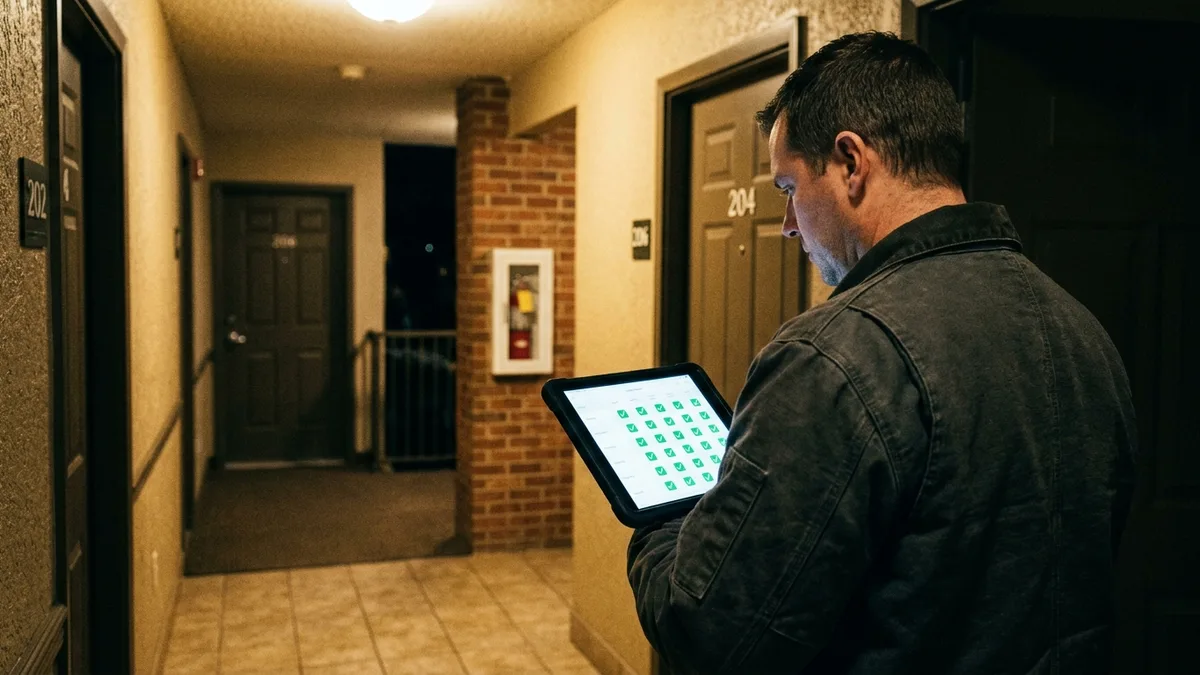
Trash Day Made Easy's nightly scheduled valet trash service eliminates this problem at the source. Every collection visit is photo-verified at the door, so property managers get documented confirmation that service was completed without needing to follow up or issue reminders. Across a 100-plus unit community, that single change, not needing to manually verify service or chase resident complaints, removes a substantial and recurring administrative burden every week, freeing property managers to focus on leasing, maintenance coordination, and resident retention instead of trash logistics.
What Should You Look For When Comparing Waste Vendors for a Multifamily Portfolio?
Comparing waste vendors for a multifamily portfolio requires evaluating service documentation, scalability across multiple properties, on-demand flexibility, and disposal transparency, rather than comparing pickup frequency alone. First, ask whether the vendor provides photo or timestamp verification for every unit on every service night, since unverified service creates disputes when a resident claims a missed pickup.
Additionally, confirm the vendor's ability to scale consistently. A provider that services a 30-unit HOA well may not have the operational infrastructure to maintain the same standard across a 500-unit portfolio spread over multiple submarkets. Other options in the market include All-Points Waste Service and Consolidated Waste Services, which offer residential, commercial, industrial, and construction waste categories, though property managers should independently confirm each provider's current service-area coverage and pricing before signing a contract.
Trash Day Made Easy is purpose-built for exactly this scalability challenge, servicing portfolios from 10 units up to more than 1,000 units across Charleston, SC and Atlanta, GA, while maintaining the same photo-verified standard at every door regardless of portfolio size. That consistency, not just a lower quoted rate, is what separates a workable vendor relationship from a monthly headache.
A Checklist for Vetting a Waste Management Vendor
- Request a documented service confirmation method, not just a verbal guarantee of completed pickups.
- Ask how the vendor handles bulk item removal during move-outs, and whether it is on-demand or requires a separate scheduling process.
- Confirm pricing transparency around disposal and tipping fees, which vary regionally and change periodically.
- Verify the vendor services your specific submarket, whether that is the Historic District, James Island, or the airport corridor near North Charleston.
- Check whether the vendor offers a single point of contact across an entire portfolio, rather than separate contracts per property.
What Should Short-Term Rental Operators Know About Turnover Waste Service?
Turnover waste service for short-term rentals is on-demand trash and debris removal scheduled between guest stays, timed to align with cleaning crews so a property is fully guest-ready before the next check-in. Unlike routine weekly pickup, turnover service has to accommodate unpredictable booking calendars, same-day checkouts, and back-to-back reservations common in high-traffic Charleston markets like the Historic District, Isle of Palms, and Sullivan's Island.
A single missed pickup between guests can trigger a negative review, which directly affects future booking conversion. The Charleston region's tourism volume underscores why this matters operationally: the area recorded 7.91 million overnight visitors in 2026, generating an estimated $14.35 billion in economic impact, according to Charleston tourism reporting. With Charleston-area hotels running a 70.1% average occupancy at a $188 average daily rate in 2026, short-term rental competition for guest satisfaction is intense, and cleanliness failures are one of the fastest ways to lose repeat bookings.
Trash Day Made Easy provides on-demand trash removal and turnover trash handling specifically built for this scheduling unpredictability, integrating directly with cleaning workflows so waste never becomes the reason a check-in gets delayed. For operators managing properties across Charleston, our guide to Lowcountry junk removal for turnovers covers what to expect from a well-run turnover waste process in more detail.
Why Do HOA Communities Need Structured Bin and Bulk Waste Management?
Structured bin and bulk waste management for HOA communities is a service model that removes bin compliance and bulk debris enforcement from the community board's responsibility by handling collection, curb placement, and bin return automatically. HOA boards on James Island, Daniel Island, and across the Charleston metro spend significant volunteer time chasing residents who leave bins at the curb past pickup day or dump bulk items without notice.
A trash can concierge service solves this differently than a fine system does. Instead of relying on resident compliance and enforcement letters, a concierge vendor moves bins from backdoor storage to the curb on collection day and returns them afterward, regardless of resident behavior. Residents do nothing. Boards enforce nothing. It happens on schedule.
Trash Day Made Easy's backdoor-to-curbside bin management extends this same reliability to HOA communities and residential homeowners, and it pairs with our can to curb services guide for Charleston communities for boards evaluating a switch from a self-managed enforcement model.
How Do You Choose the Right Waste Program for a Scattered-Site Portfolio?
Choosing a waste program for a scattered-site portfolio means prioritizing a single vendor relationship that maintains consistent service standards across non-contiguous properties, rather than managing separate contracts and city pickup schedules for each address individually. Owners with 10 to 50-plus properties spread across North Charleston, Summerville, and Johns Island face a coordination problem that a single-community valet contract was never designed to solve.
The practical fix is a managed waste operations program, where one vendor covers nightly valet collection, bulk removal, and on-demand support across every property in the portfolio, with documentation available property by property. This matters most during audits or investor reporting, when an owner needs to show consistent service completion across every address, not just anecdotal confidence that things "usually work out."
Trash Day Made Easy's waste operations model was built specifically for this scale challenge, giving scattered-site owners one point of contact and one photo-verification standard across their entire footprint, whether that spans five neighborhoods or fifteen.
What Does a Waste Management Company Actually Charge for Apartment Communities?
Apartment community waste pricing typically depends on unit count, pickup frequency, container size, and whether bulk removal is bundled into the contract or billed separately, and providers generally quote these programs individually rather than publishing flat rates. Public procurement records offer one useful reference point: one South Carolina government contract for monthly garbage, trash removal, disposal, and treatment service listed a unit price near $592 per month with an annual total near $35,500, though pricing on any individual contract reflects that specific property's volume and scope and should not be treated as a universal benchmark.
For residential homeowners in select Charleston-area neighborhoods, Trash Day Made Easy offers valet trash service starting from $49 per month, a far simpler pricing structure than most multifamily contracts because it covers a single household rather than a shared dumpster system. Multifamily and portfolio pricing is quote-based because container sizing, unit density, and service frequency vary too much for a flat published rate to be useful. Property managers should request a property-specific quote rather than comparing headline numbers across vendors, since two "per unit" quotes can reflect very different service scopes. Our breakdown of what valet trash companies charge apartments walks through the variables that typically drive these quotes.
What Common Mistakes Should Property Managers Avoid With Waste Vendors?
The most common vendor mistakes property managers make involve treating waste management as a low-priority commodity purchase rather than an operational relationship tied directly to resident satisfaction and lease renewal. Avoiding these mistakes protects both budget and reputation.
- Choosing price over documentation. A cheaper quote with no photo verification creates disputes the first time a resident claims a missed pickup, and there is no record to resolve it.
- Treating bulk removal as reactive. Waiting until a couch sits in a breezeway for a week before scheduling removal delays make-ready timelines and frustrates incoming residents.
- Ignoring scalability. A vendor that works for one 40-unit property may not maintain the same standard across a 400-unit portfolio; ask for references at comparable scale.
- Skipping the on-site assessment. Accepting a generic quote without a walk-through means container sizing and pickup frequency are guesses, not data.
- Overlooking recycling diversion. Since disposal fees scale with tonnage, a program without recycling separation costs more than it needs to over time.
Practical Guidance: How to Transition to a Consolidated Waste Program
Transitioning to a consolidated waste program works best as a phased process rather than an abrupt vendor swap. Follow these steps to move from a fragmented, self-managed waste setup to a single, accountable vendor relationship:
- Audit current waste volume and complaint frequency across the property or portfolio for at least 30 days before soliciting quotes.
- Request an on-site assessment from any vendor under consideration, and confirm the assessment includes recycling and bulk item planning, not just routine pickup.
- Ask specifically how service completion is documented and how disputes over missed pickups are resolved.
- Pilot the new vendor on one property or building before rolling it out portfolio-wide, especially for scattered-site owners.
- Set a 90-day review checkpoint to compare resident complaint volume before and after the switch.
Trash Day Made Easy offers service quotes Monday through Friday for multifamily, build-to-rent, HOA, short-term rental, and residential properties, and the on-site assessment process is built to surface exactly the container sizing and frequency questions this checklist raises.
Frequently Asked Questions
What is valet trash service?
Valet trash service is a nightly, scheduled collection model where a crew picks up bagged trash directly from a resident's door and carries it to a central dumpster or compactor. It removes the need for residents to walk waste to a shared container on their own schedule, and providers like Trash Day Made Easy photo-verify each stop for documentation.
How much is valet trash service?
Residential valet trash service in select Charleston neighborhoods starts from $49 per month through Trash Day Made Easy. Multifamily, build-to-rent, and portfolio pricing is quote-based, since it depends on unit count, pickup frequency, and container sizing, so request a property-specific quote rather than relying on a general rate.
How much should you charge for valet trash service cost estimates?
Valet trash pricing for multifamily communities depends heavily on unit density, pickup frequency, and whether bulk removal is bundled in, which is why most providers quote per property rather than publishing flat rates. Public procurement data shows monthly commercial waste contracts can run into the hundreds of dollars depending on scope, so any estimate should come from an on-site assessment rather than a generic per-unit figure.
How do you start a valet trash service program at an existing property?
Starting a valet trash program begins with an on-site assessment to evaluate current waste volume, container sizing, and resident participation patterns. From there, a vendor configures a pickup schedule, typically nightly, sets up documentation like photo verification, and coordinates a resident communication plan before the first collection date.
What is vacation rental trash service?
Vacation rental trash service is on-demand or scheduled waste removal timed around guest checkouts and cleaning turnovers, rather than a fixed weekly pickup. Because short-term rental booking calendars are unpredictable, this service typically integrates with cleaning crews so trash never delays the next guest's check-in.
How does photo-verified waste collection work and why does it matter?
Photo-verified waste collection means every service stop is documented with a timestamped photo at the point of pickup. This gives property managers confirmation that service was completed without needing to follow up, and it creates a service record that resolves disputes if a resident claims a missed pickup.
Can one waste vendor handle service across an entire property portfolio in Charleston and Atlanta?
Yes. Trash Day Made Easy is purpose-built for portfolio scalability, servicing communities from 10 units up to more than 1,000 units across Charleston, SC and Atlanta, GA, while maintaining the same photo-verified service standard at every property in the portfolio.
Conclusion: What a Genuine All Points Waste Service Standard Looks Like in 2026
An all points waste service approach only works when the on-site assessment translates into a documented, scalable program, not just a friendlier sales pitch. The data backs up why this matters: with the U.S. waste collection industry now valued near $83.1 billion and thousands of providers competing for contracts, property managers need documentation and scalability to separate a reliable vendor from a generic one. Charleston County's own waste tonnage figures show the volume multifamily communities generate, and that volume only gets managed well with a plan built around the property, not a one-size-fits-all schedule.
Trash Day Made Easy delivers exactly that standard across North Charleston, Charleston, Mount Pleasant, James Island, Daniel Island, Summerville, Johns Island, and Sullivan's Island, with nightly photo-verified valet trash, backdoor-to-curbside bin concierge, on-demand bulk removal, and full waste operations support for portfolios of any size. As Charleston's rental and multifamily markets keep growing into 2026, the property managers who consolidate waste into one accountable vendor relationship will spend far less time chasing complaints and more time on the parts of the job that actually move occupancy and renewal numbers.
If chasing missed pickups and resident complaints has become a weekly drain on your schedule, a photo-verified valet trash program can take that off your plate entirely. Get started with Trash Day Made Easy and request a service quote Monday through Friday for your property or portfolio.
Content powered by inkSTR.co