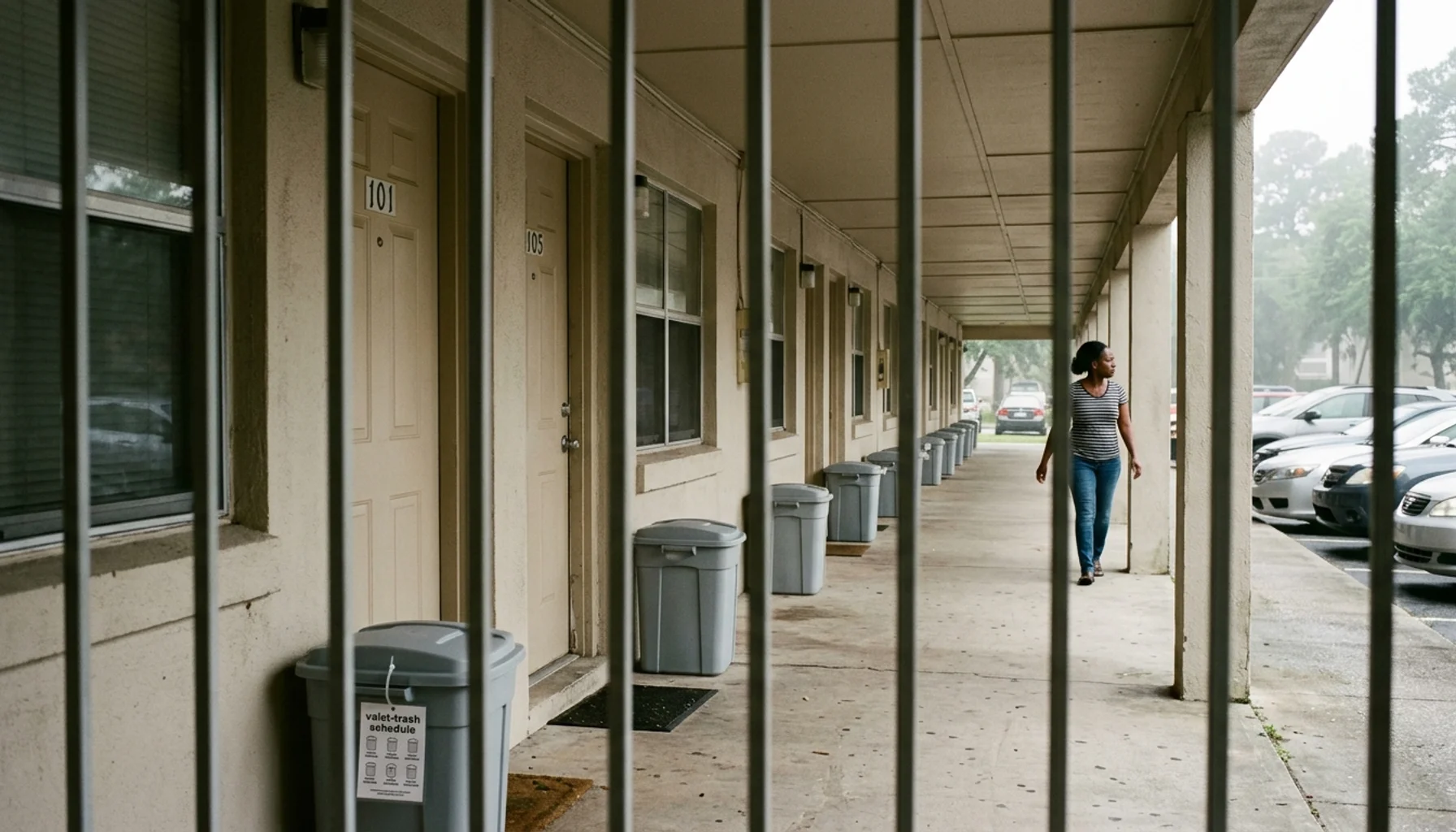
Residents generally cannot opt out of valet trash on their own once a Charleston property has a property-wide vendor contract in place. In most multifamily communities, valet trash is billed like a required amenity through the lease, not an optional add-on residents can decline unit by unit, and the lease language a property manager writes determines whether that holds up.
Key Takeaways
- Most valet trash programs are structured as property-wide vendor contracts, meaning individual residents typically cannot opt out even if they'd rather use the dumpster themselves.
- South Carolina Code Section 27-33-50 places financial responsibility for garbage service on the tenant unless the lease says otherwise, with an exception for certain master-metered buildings with four or more units.
- Industry pricing data shows resident charges for valet trash typically fall between $25 and $35 per month, while property owners usually pay providers around $8 to $15 per unit monthly.
- Charleston County charges an annual solid-waste fee of $105 per multifamily unit and $150 per single-family residence, separate from any valet trash service fee, and that fee is set to adjust with the Consumer Price Index starting July 2026, capped at 5% annually.
- More than half of Class A and B apartment communities nationally now offer doorstep trash collection, up from roughly 30% five years ago, according to industry adoption data, which means opt-out disputes are becoming more common as more Charleston properties adopt the service.
- Clear lease addenda covering mandatory status, exact fees, service nights, and missed-pickup procedures prevent the vast majority of resident disputes before they start.
If you manage a multifamily property, a build-to-rent community, or an HOA in the Charleston metro, you've probably fielded this question at least once: "Can I just skip the valet trash fee and take my own trash to the dumpster?" It comes up during lease renewals, after a new resident moves in from a city with no doorstep service, or when someone simply doesn't like paying a fee for something they could technically do themselves.
The honest answer is more nuanced than a flat yes or no, and it depends heavily on what your lease actually says, how your vendor contract is structured, and what South Carolina law requires around garbage disposal responsibility. At Trash Day Made Easy, we service multifamily communities and rental portfolios across North Charleston, Mount Pleasant, and the broader Charleston metro, and this exact question crosses our desk from property managers on a regular basis. In 2026, with adoption of doorstep collection climbing steadily across Class A and B communities, getting the lease language right matters more than ever.
This guide breaks down the legal framework, the practical realities of vendor contracts, and a step-by-step operational checklist Charleston property managers can use to handle opt-out requests without creating liability or resident friction.
Can Residents Really Opt Out of Valet Trash Service?
In practice, residents generally cannot opt out of valet trash on an individual basis when a property has a property-wide vendor contract, because the service is typically billed as a mandatory community amenity rather than an optional line item. Property Manager Insider, an industry publication covering multifamily operations, describes valet trash as an "all or nothing" service specifically because vendor contracts usually cover every unit at the property, not a subset of willing participants.
Specifically, most vendors price their contracts based on full-building participation. A crew servicing 200 doors nightly has a fixed route cost; if 30 residents opt out, the per-unit cost for the remaining 170 goes up, which most owners won't accept. As a result, few Charleston multifamily contracts include an individual opt-out clause at all.
Additionally, many properties restrict resident access to the dumpster or compactor area specifically to reinforce that valet trash is the only sanctioned disposal method. If your lease doesn't explicitly grant dumpster access as an alternative, a resident asking to opt out may not have anywhere else to legally dispose of household waste on-site. That single detail resolves most opt-out disputes on its own once residents understand it.
Even where a lease permits an exception, the resident may still have to haul waste to another disposal site themselves, and there's often no corresponding fee reduction, since the fee frequently covers community-wide vendor and equipment costs rather than an individual's personal usage.
Is Valet Trash Mandatory Under a Charleston Lease?
Whether valet trash is mandatory depends entirely on the specific lease and any attached addendum, not on any blanket South Carolina statute requiring it. South Carolina has no specific law banning valet trash fees or capping what a community can charge for the service, which means the lease document itself is the controlling authority on mandatory status.
When a lease is silent about trash collection, or explicitly permits residents to handle their own trash without using a valet provider, management generally cannot add a mandatory trash fee mid-lease without resident agreement or a properly executed amendment. This is a critical distinction Charleston property managers sometimes miss: silence in the original lease is not permission to add a new mandatory fee at will. Conversely, when a lease or its addendum explicitly states that valet trash is mandatory, discloses the exact monthly charge, and specifies it as a condition of tenancy, residents generally cannot opt out without violating the lease terms. That's why the addendum, not the base lease, is doing most of the legal work in these disputes.
South Carolina Code Section 27-33-50 adds another layer: unless otherwise agreed in writing, a tenant generally holds sole financial responsibility for garbage services provided to the leased premises. Subsection C carves out an exception for a landlord whose multi-unit building has four or more residential units served by a master meter or single connection. For a 150-unit Rivers Avenue corridor community, that exception typically doesn't apply the way it would to a small fourplex, so managers should verify their specific property configuration rather than assume the exception covers them.
The National Apartment Association (NAA) and similar industry groups have documented valet trash's shift from a fringe perk to a near-standard amenity precisely because clear mandatory-fee language protects both the resident's expectations and the property's revenue model.
How Does Lease Language Determine Whether Opting Out Is Possible?
Lease language is the single most important factor determining whether a Charleston resident can legally opt out of valet trash, because South Carolina law defers to whatever the lease or addendum specifies. A lease that treats valet trash like a community amenity, similar to pool or gym access, generally forecloses any individual opt-out regardless of resident preference.
Specifically, a well-drafted addendum should state: whether the service is mandatory, the exact monthly amount charged, whether that charge is baked into advertised rent or billed as a separate line item, when billing begins relative to move-in, and whether the fee can change at renewal. Missing any of these five elements creates ambiguity that residents can, and sometimes do, dispute.
A commonly cited sample clause structure requires service Sunday through Thursday, with a resident setout window of 6:00 p.m. to 8:00 p.m., trash bagged and tied in a provided container. If a resident misses that window, the clause typically requires bringing the bag to a designated dumpster or compactor area, or holding it until the next collection evening. Violation charges in sample language commonly run in the range of $50 per incident, with a lost-container replacement fee around $10.
For Charleston managers, the practical lesson is this: if your current lease template doesn't specify these operational details, you're leaving room for exactly the kind of "can I opt out" disputes that consume hours of staff time. A resident who never received clear written terms has a legitimate argument that the fee, or the mandatory status, was never properly disclosed.
What Happens When Residents Sign Up Mid-Lease or Renew?
New mandatory fees generally cannot be added to an active fixed-term lease without resident consent, but they can typically be introduced at renewal if the property provides proper written notice. This distinction matters enormously for Charleston property managers rolling out valet trash to an existing community for the first time. If your community is adding doorstep collection mid-cycle, the safest operational path is to offer it as an optional service to current residents until their lease renews, then convert it to mandatory status in the renewal lease with full fee disclosure. Attempting to retrofit a mandatory fee into a signed 12-month lease invites disputes and, in some cases, valid legal objections.
For month-to-month residents, the process is more flexible since the landlord typically has more latitude to modify terms with proper notice at the next renewal cycle. Even so, documenting that notice in writing, dated and delivered through the same channel used for other official communications, protects the property if a dispute later arises.
Renewal season is also the right moment to review your fee structure against current market data. Reported industry pricing shows resident charges for valet trash commonly land between $25 and $35 per month across Class A and B communities, while owner-side provider costs run roughly $8 to $15 per unit monthly depending on community size and route density. A 300-unit community, for example, might see provider costs in the $12 to $14 per unit range given denser routing, compared to $15 to $17 for a smaller 100 to 149-unit property.
What Does South Carolina Law Actually Require for Garbage Disposal?
South Carolina's Residential Landlord and Tenant Act establishes a tenant duty to dispose of garbage, rubbish, and other waste from the dwelling in a reasonably clean and safe manner, but it does not mandate any specific collection method like doorstep valet service. This is the distinction that trips up both residents and, occasionally, property managers: a legal obligation to dispose of trash responsibly is not the same as a contractual obligation to use a specific paid vendor. As referenced earlier, Section 27-33-50 places financial responsibility for garbage services on the tenant by default, unless the lease states otherwise in writing. This means the statute supports charging residents for waste service generally, but it doesn't independently create or void a valet trash requirement; the lease language does that work.
Separately, Charleston County's solid-waste fee structure operates independently from any valet trash charge. Charleston County assesses an annual solid-waste recycling and disposal fee of $105 per multifamily unit and $150 per single-family residence under county ordinance. Starting in July 2026, that fee is scheduled to adjust annually using the Consumer Price Index, capped at a maximum 5% increase per year. Property managers should treat this county fee and any private valet trash fee as two entirely separate line items when communicating charges to residents, since conflating them is a common source of billing confusion.
Additionally, the North Charleston Sewer District requires newly constructed apartment complexes completed after July 1, 2022, and certain existing properties generating significant fats, oils, and grease, to complete a grease-bin application and maintain a licensed-hauler oil-recycling contract. This is a separate compliance requirement from valet trash but often lands on the same property manager's desk, so it's worth tracking alongside your waste program if your community falls into that category.
What Should Property Managers Include in a Valet Trash Addendum?
A valet trash addendum should function as a standalone document that resolves every foreseeable dispute before it happens, not a vague reference buried in the general lease. Specifically, the strongest addenda used across the industry include five core elements: mandatory or optional status, the exact dollar amount charged, whether the fee is bundled into rent or billed separately, the billing start date relative to move-in, and whether the fee is subject to change at renewal.
Beyond fee disclosure, the addendum should spell out the operational mechanics residents actually need to follow. A commonly referenced model schedule sets service nights Sunday through Thursday, with a setout window of 6:00 p.m. to 8:00 p.m. and collection running from 8:00 p.m. to midnight, with no service Friday, Saturday, or designated holidays unless otherwise announced.
The table below summarizes the addendum components Charleston property managers should confirm before rolling out or renewing a valet trash program.
| Addendum Element | What to Specify | Why It Matters |
|---|---|---|
| Mandatory vs. optional status | State explicitly whether every unit is required to participate | Prevents residents from claiming the fee was never properly disclosed |
| Exact monthly fee | State the dollar figure; industry data shows most Charleston communities charge $25 to $35 per month | Vague or bundled fees invite disputes at renewal |
| Billing structure | Clarify whether the fee is included in advertised rent or billed as a separate line | Affects how the fee appears on rent ledgers and renewal notices |
| Service nights and setout window | Common structure is Sunday through Thursday, 6:00 to 8:00 p.m. setout | Gives residents a clear standard to follow and a basis for enforcement |
| Missed pickup procedure | Specify whether residents must haul missed bags to a dumpster or hold until next service night | Removes ambiguity when a resident misses the setout window |
| Violation and replacement charges | Common sample language cites a $50 per-incident violation fee and $10 container replacement | Deters repeated non-compliance without appearing punitive if disclosed upfront |
Every valid violation charge or fine referenced in an addendum should also be reasonable and lease-authorized; South Carolina courts have looked skeptically at charges disconnected from actual cost or clearly excessive relative to the underlying service. Keep your fee schedule proportional to real operational impact, not punitive by design.
How Should Charleston Managers Handle a Resident Opt-Out Request?
The correct response to a resident opt-out request starts with pulling the signed lease and addendum, not with a verbal negotiation. Specifically, confirm whether the original lease disclosed valet trash as mandatory, at what fee, and whether the resident's signature acknowledged that term at move-in or renewal.
Here is the operational sequence we recommend to property managers across the Charleston metro:
- Pull the resident's signed lease and any valet trash addendum, and confirm the exact mandatory-status language and fee disclosure that applies to their unit.
- Check whether the resident is in a fixed-term lease or month-to-month. Fixed-term residents generally cannot have new mandatory fees added mid-lease; month-to-month residents can typically have terms modified with proper written notice.
- If the lease clearly discloses mandatory status and fee amount, respond in writing explaining that the service is a required community amenity, citing the specific addendum language.
- If the lease is ambiguous or silent, treat the request seriously. Consult South Carolina landlord-tenant guidance or legal counsel before denying the request or continuing to bill the fee.
- Document every communication, including the date the resident raised the request and the date and method of your written response.
- At the next renewal cycle, close any gaps in your addendum language so the same dispute doesn't recur with future residents.
For scattered-site portfolios managing properties across James Island, Daniel Island, and the airport corridor, the biggest risk is inconsistent lease language from one acquisition to the next. If you inherited properties with different valet trash terms, standardizing your addendum across the portfolio during the next renewal wave reduces the volume of one-off disputes significantly.
What Common Mistakes Do Property Managers Make With Valet Trash Fees?
The most common mistake Charleston property managers make is treating a verbal explanation of valet trash as sufficient disclosure instead of documenting mandatory status in writing at signing. A resident who can credibly claim they were never told the fee was mandatory has a real argument, and disputing that claim after the fact is far harder than preventing it with clear paperwork upfront. A second frequent error is bundling the valet trash fee into "amenity fees" or "convenience fees" without itemizing it separately. When residents can't identify what they're actually paying for, they're far more likely to ask why they can't opt out of a fee they don't understand. A third mistake: assuming a fee schedule set years ago still reflects current provider costs. If your community locked in a $20 monthly resident fee in 2022 while provider costs have since risen, you may be running the amenity at a loss or with an unsustainably thin spread. Reported spread data for a 200-unit community charging $25 per resident against roughly $12 in provider cost shows an annual spread near $31,200 before other costs, which is the kind of margin worth revisiting at renewal if your numbers look different.
A fourth, less obvious mistake is failing to distinguish the county's solid-waste fee from the private valet trash fee in resident communications. Charleston County's $105 annual multifamily fee is a separate government charge; if residents believe it's the same thing as their monthly valet trash bill, confusion and complaints follow. Clarifying this distinction in your welcome packet and lease addendum heads off a surprising number of billing disputes.
How Do Build-to-Rent and HOA Communities Handle Opt-Out Differently?
Build-to-rent communities and HOA-governed neighborhoods generally have more flexibility to make waste service optional at the individual resident level, since the enforcement mechanism runs through community covenants rather than a single multi-unit vendor contract. Specifically, an HOA board can structure trash can concierge service, moving bins from a home's storage area to the curb and back, as an opt-in convenience rather than a bundled community fee, since each home typically manages its own bin rather than sharing a compactor. This is a meaningful contrast with multifamily valet trash, where the vendor contract inherently requires full-building participation to pencil out financially. In a build-to-rent community near Daniel Island or the airport corridor, residents can often choose backdoor-to-curbside bin service independently, without affecting a shared route economics model the way an apartment resident opting out would.
That flexibility doesn't mean HOA enforcement is easy. Boards still struggle to get residents to comply with bin-out and bin-in rules voluntarily, which is exactly the enforcement gap a structured trash can concierge program closes. Instead of chasing violation notices, the bin simply moves on schedule regardless of resident behavior. At Trash Day Made Easy, our residential and HOA-focused service is priced starting from $49 per month in select Charleston neighborhoods, and it pairs naturally with our partnership with The Bin Boy, a Charleston-based bin cleaning and sanitizing service, for communities that want the full package.
If you manage an HOA wrestling with cleanliness enforcement, our HOA waste management resources walk through how a structured bin concierge program compares to a fine-based compliance system.
What Charleston-Specific Factors Should Property Managers Track in 2026?
Charleston-specific waste compliance in 2026 involves at least three distinct layers property managers must track separately: the county solid-waste fee, city collection ordinances, and any private valet trash vendor contract. Charleston's environmental services guidance states that garbage carts and recycling bins must be removed from the street on the same day as collection, and that garbage and trash must be placed at the curb by 6:00 a.m. on collection day, rules that apply regardless of whether a property also runs a private doorstep collection program. The Charleston-North Charleston metropolitan area reached an estimated 889,263 residents in 2026, up from roughly 815,088 in 2021, according to Federal Reserve economic data. North Charleston itself is now estimated at 131,201 residents with annual growth near 2.02%. That growth is fueling new multifamily and build-to-rent construction along corridors like Rivers Avenue and near the airport, and every new community coming online has to make a valet trash decision from day one, ideally with clean addendum language rather than a retrofit six months later.
Nationally, more than half of Class A and B apartment communities now offer doorstep trash collection, compared to roughly 30% five years earlier, with adoption growing at an estimated 8% annually. As adoption climbs, competing Charleston properties increasingly need to explain, not just charge for, their mandatory amenity fees to stay competitive on resident satisfaction. A cited case from a mid-sized apartment community outside Charleston reported a 30% increase in resident satisfaction tied to property cleanliness after adopting valet trash software, a data point worth keeping in mind when justifying the fee to skeptical residents.
Multifamily recycling access also remains inconsistent regionally. An estimated 80% of multifamily residents have access to public recycling services compared to essentially all single-family residents, according to research from the University of North Carolina Environmental Finance Center. If your valet trash program includes recycling pickup, that's a genuine differentiator worth highlighting, since not every Charleston property offers it.
What Are the Financial Trade-Offs of Mandatory Valet Trash?
Mandatory valet trash generates a measurable financial spread for property owners when resident fees are set correctly relative to provider costs, but that spread only holds up if the fee schedule is reviewed regularly. Industry pricing benchmarks show provider costs commonly running $8 to $15 per unit monthly, with resident charges typically set between $25 and $35, producing a spread in the range of $10 to $22 per unit for communities in the 150 to 299-unit range.
Beyond the direct fee spread, valet trash creates secondary financial benefits worth factoring into a Charleston property's overall waste strategy. Reduced dumpster overflow and fewer resident-side maintenance calls have been associated with maintenance savings estimated around $500 per month for a 200-unit property in industry analyses. Some owners have also used valet trash as justification for modest rent increases, with reported potential increases near $10 per unit monthly translating into meaningful annual revenue at scale.
Compare that against traditional multifamily waste systems without valet service, which industry data pegs at roughly $1,550 to $3,300 per month for a 100-unit property before accounting for overflow charges. For managers weighing whether to add a valet program or expand an existing one, that comparison is often the clearest financial argument, separate entirely from the resident satisfaction and retention benefits that come with it.
Occupancy context matters here too. National multifamily occupancy sat near 95.4% in the third quarter of 2026, according to industry reporting, meaning most well-run communities are competing on retention and renewal rather than raw lease-up. In that environment, a well-documented, clearly disclosed valet trash program that avoids opt-out disputes is one less friction point standing between a resident and a renewed lease.
How Does Photo Verification Change the Opt-Out Conversation?
Photo-verified valet trash service directly undercuts the most common resident argument for opting out, which is uncertainty about whether the service is actually happening reliably. When every collection stop is documented with a timestamped photo at the door, property managers have concrete proof of service completion without relying on resident complaints or driver self-reporting to catch gaps. At Trash Day Made Easy, every nightly collection visit across our Charleston and Atlanta portfolios is photo-verified, giving property managers documented confirmation without needing to follow up or chase down a missed pickup report. That documentation also protects the property if a resident disputes whether service occurred on a given night, since the record exists independent of anyone's memory. For scattered-site portfolio owners managing properties spread across North Charleston, James Island, and Summerville, this kind of consistent, documented service standard matters even more, since coordinating vendor accountability across non-contiguous properties without photo verification is a genuine operational headache. If you're evaluating whether your current valet trash vendor meets that bar, our guide on valet trash alternatives for Charleston managers covers what to look for.
Frequently Asked Questions
What is valet trash service?
Valet trash service is a doorstep collection program where residents place bagged trash outside their unit door on scheduled nights, and a vendor crew collects it and transports it to the property's dumpster or compactor. It functions as a convenience amenity in multifamily communities, replacing the need for residents to carry trash to a shared disposal area themselves.
What is trash reimbursement for an apartment?
Trash reimbursement typically refers to how a property bills residents for waste-related charges, either bundled into rent, itemized as a separate monthly fee, or passed through as a utility-style charge. In most Charleston leases, this reimbursement covers the valet trash vendor fee and sometimes a separate county or municipal solid-waste charge, so residents should check their lease to see whether these are combined or itemized separately.
How much do valet trash companies charge apartments?
Industry pricing data shows property owners typically pay providers around $8 to $15 per unit per month, depending on community size and route density, while residents are commonly charged between $25 and $35 per month through their lease. Larger communities of 300 or more units generally see lower per-unit provider costs, near $12 to $14, due to denser collection routes.
Can a property add a valet trash fee in the middle of my lease?
Generally, no. If a lease is silent about trash collection or doesn't disclose a mandatory valet trash fee, management typically cannot add that fee unilaterally during an active fixed-term lease. Most properties introduce mandatory fees at renewal instead, with proper written notice and updated addendum language.
Does South Carolina law require me to pay for valet trash?
South Carolina Code Section 27-33-50 places financial responsibility for garbage services on the tenant by default unless the lease states otherwise in writing, but no state statute specifically mandates valet trash or caps what a community can charge for it. Whether you're required to pay depends on your specific lease and addendum, not a blanket state law.
Can I ask my property to let me use the dumpster instead of paying for valet trash?
You can ask, but most properties will decline if the community operates under a property-wide vendor contract, since the pricing model depends on full participation. Some properties also restrict resident dumpster access specifically to reinforce that valet trash is the designated disposal method, so check whether dumpster access is even available before assuming it's an alternative.
What should I do if my community's valet trash service keeps missing pickups?
Document each missed pickup with dates and, if possible, photos, then submit a written request to your property manager referencing your lease's service terms. If missed pickups continue, ask about the vendor's verification process. Photo-verified providers can typically confirm whether a stop was actually serviced, which resolves disputes faster than relying on memory alone.
Conclusion
Whether residents can opt out of valet trash in Charleston comes down to what the lease and addendum actually say, not a general right to decline the service. Property-wide vendor contracts, South Carolina's default tenant responsibility for garbage costs under Section 27-33-50, and clear written fee disclosure all point in the same direction: mandatory status, once properly documented, is enforceable, while vague or missing lease language invites disputes that cost Charleston property managers time and goodwill. Getting ahead of this in 2026 means auditing your current addendum language, standardizing terms across your portfolio, and choosing a vendor whose documentation protects you if a resident ever challenges whether service occurred. A consistent, photo-verified waste program removes the ambiguity that fuels most opt-out requests in the first place.

If you're rewriting your valet trash addendum or evaluating a new vendor for your Charleston or North Charleston property, Trash Day Made Easy provides nightly, photo-verified service for multifamily communities, build-to-rent developments, and HOA neighborhoods across the metro. Get started with Trash Day Made Easy and request a service quote Monday through Friday.
Content powered by inkSTR.co