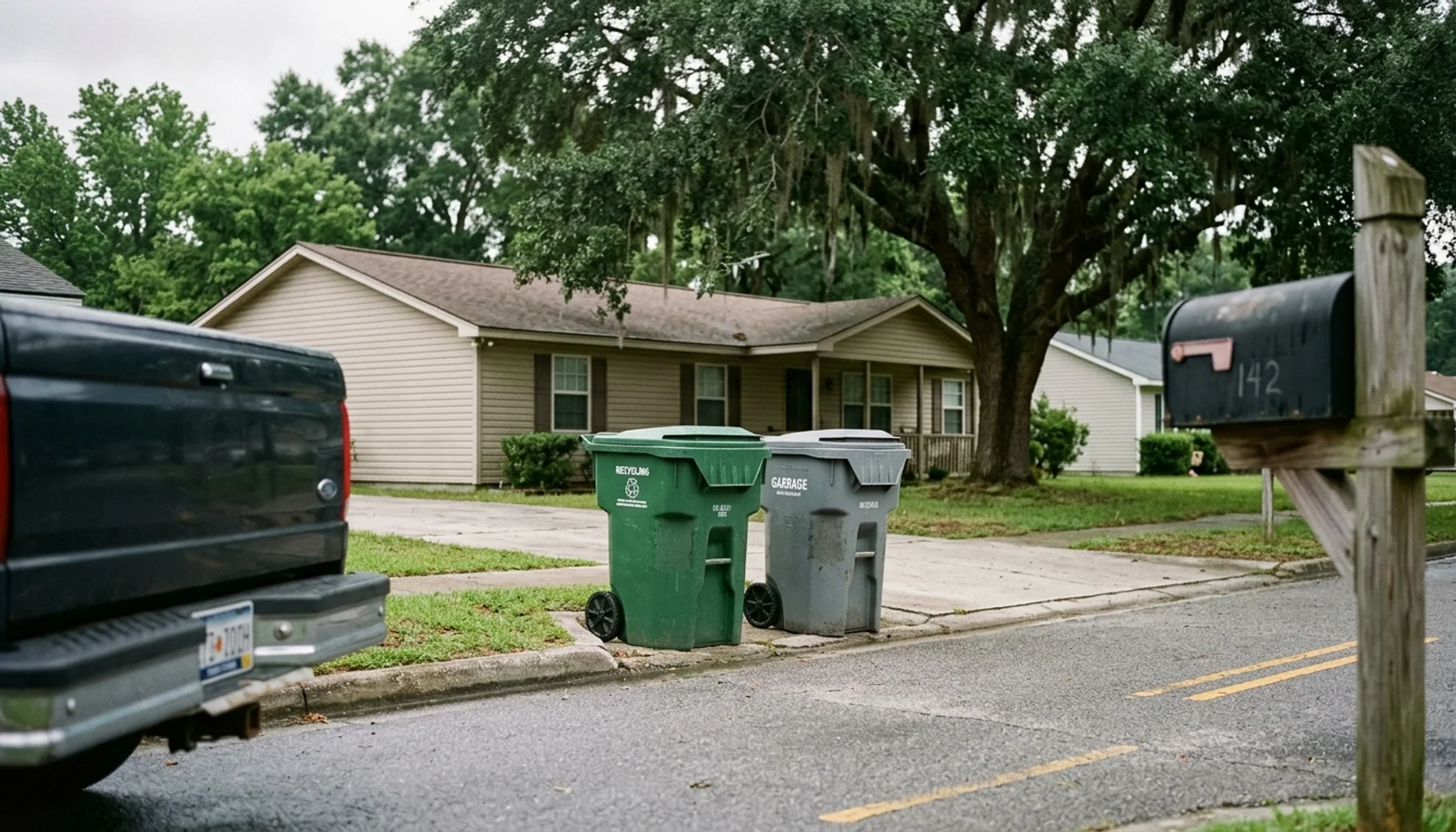
Charleston County trash pickup is not run by one single department. Garbage collection is handled town by town, city by city, each with its own schedule, phone number, and container rules, while Charleston County Environmental Management runs recycling, landfill operations, and the countywide Solid Waste User Fee. If you live in North Charleston, Mount Pleasant, or unincorporated county territory, your pickup day and contact number will differ from your neighbor three miles away.
Key Takeaways
- Garbage collection in Charleston County is handled by individual municipalities and public service districts, not the county itself; each has a separate phone number and schedule.
- The Charleston County residential Solid Waste User Fee runs $150 per single-family residence and $105 per multi-family unit, typically billed on the annual Real Property Tax Bill.
- Recycling is countywide through Charleston County Environmental Management, collected every other week using 95-gallon carts, serving roughly 130,000 single-family homes.
- Residents without curbside pickup can use one of eight staffed Convenience Centers, open Monday through Saturday with proof of residency required.
- Bees Ferry Landfill accepts one load up to a ton per month at no charge for residents with proof of residency; municipal solid waste tips at $66 per ton.
- For property managers and short-term rental operators juggling multiple addresses, a private valet trash service like Trash Day Made Easy removes the municipal-schedule guesswork entirely with nightly, photo-verified collection.
If you've just moved to the Charleston metro, or you manage properties scattered across North Charleston, James Island, and Mount Pleasant, the fragmented system trips up almost everyone at first. There's no single Charleston County trash pickup calendar you can bookmark; there are at least nine separate municipal systems, plus the county's own recycling and landfill operations layered on top.
At Trash Day Made Easy, we service multifamily communities, build-to-rent developments, and short-term rental properties across North Charleston, Charleston, and the surrounding submarkets, and this exact confusion comes up constantly with new property managers and homeowners. This guide breaks down every municipality's system in one place, something none of the individual government pages do, and explains where a private valet trash service fits in when municipal pickup isn't cutting it for your property.
You'll find contact numbers for every jurisdiction, the county's fee structure, landfill and convenience center details, and answers to the specific questions people search most: why pickup gets missed, how to get a new cart, what the garbage fee actually covers, and how to dispose of a mattress. In 2026, with the county's recycling contractor now running collection five days a week, the system runs smoother than it did a few years ago, but it's still not simple.
Which City or Town Handles Your Trash Pickup in Charleston County?
Charleston County trash pickup is handled by the municipality or public service district where you live, not by Charleston County Environmental Management. Specifically, garbage collection is a city or town function, while the county government manages recycling, the landfill, and enforcement. As a result, your pickup day, container type, and customer service line depend entirely on your address.
Here's the breakdown for the major jurisdictions in the metro:
| Jurisdiction | Garbage Contact | Notes |
|---|---|---|
| City of Charleston | (843) 724-7311 | Weekly, semi-automated collection, 96-gallon green carts |
| North Charleston | (843) 745-1026 | City-limits only; no commercial pickup; yard waste in paper bags only |
| Mount Pleasant | (843) 849-2022 | Garbage and trash collected same day, curbside by 7 a.m. |
| James Island PSD | (843) 795-9060 | Public service district, separate from City of Charleston |
| Isle of Palms | (843) 886-8956 | Barrier island collection schedule |
| Sullivan's Island | (843) 883-3198 | Garbage Tuesdays, plus Fridays Memorial Day to Labor Day |
| Folly Beach | (843) 588-2447 | Beach community schedule |
| Kiawah Island | (843) 768-9166 | Resort/residential mix |
| Seabrook Island | (843) 768-9121 | Gated community collection |
| St. Andrews PSD | (843) 556-6310 | Covers West Ashley portions |
| Lincolnville | (843) 873-3261 | Small municipality near Summerville |
Notably, no single tool covers all these jurisdictions at once. The City of Charleston runs its own Mapnet interactive scheduling tool and the CHS Trashtracker app for service alerts, but that only covers city residents. If you own property across James Island, Mount Pleasant, and North Charleston, you're checking three separate systems, which is exactly the coordination headache Charleston-area waste trash pickup planning is meant to solve for portfolio owners.
Why Is the Trash Not Getting Picked Up?
Missed trash pickup in Charleston County usually comes down to one of three causes: container placement violations, a holiday shifting the schedule, or a mixed-material issue like construction debris in a garbage cart. Charleston municipal crews follow strict placement windows, and containers that don't comply often get skipped entirely rather than flagged for a return trip.
In the City of Charleston, for example, containers must be placed at the curb no earlier than 6 p.m. the day before scheduled pickup and removed by 6 p.m. on pickup day. The cart also needs to sit within two feet of the curb, handle facing away from the street, and three feet clear of obstructions like mailboxes, recycling bins, trees, or parked vehicles. Miss any of those rules and the truck may pass right by.
Holidays are the second most common cause. Recycling collection schedules shift when a county holiday falls on a weekday, typically pushing the rest of that week's collection back by one day. Municipal garbage schedules follow similar holiday adjustments, though the exact shift depends on your specific jurisdiction, so it's worth calling ahead around major holidays rather than assuming a one-day slip applies everywhere.
Third, crews will skip carts containing prohibited materials. North Charleston, for instance, no longer collects E-Waste like televisions and computers, and yard waste there must go in paper bags only; plastic bags get left behind. If your cart consistently gets skipped and you've confirmed placement and timing are correct, call your municipality's sanitation line directly. For North Charleston, that's Public Works at (843) 745-1026, which also fields requests for physically disadvantaged residents who need special pickup accommodations.
Property managers running scattered-site portfolios face this problem multiplied across every address. One resident places the cart wrong, another forgets entirely, and the property manager fields the complaint days later. That's precisely why photo-verified valet trash service exists: instead of hoping every resident gets curb placement right, a crew handles doorstep-to-dumpster collection directly, with documented proof it happened.
How Do I Request a New Trash Can in Charleston County?
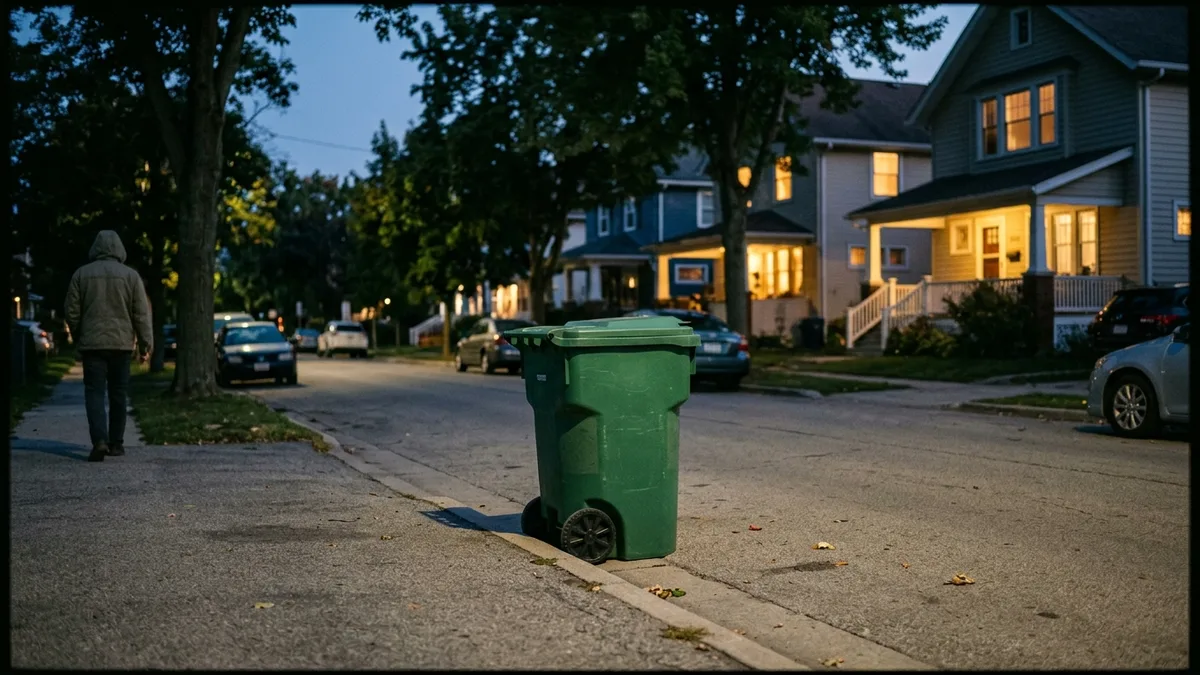
Requesting a new or replacement trash cart in Charleston County means contacting your specific municipality, since carts are issued and owned by the city or town providing your garbage service, not by Charleston County itself. The process and container options vary by jurisdiction, so new residents often assume there's one countywide cart request form. There isn't.
In the City of Charleston, residents can request a cart through an online form or by calling (843) 724-7311. The city offers three container sizes, though most residents end up with the standard 96-gallon cart used with semi-automated collection trucks. New movers to a city address should request a cart as soon as they close or sign a lease, since it can take time to schedule delivery.
Mount Pleasant handles requests differently. The town runs a New Roll Cart Assistance Program for qualifying residents who need help obtaining or replacing a brown household garbage container, and publishes a full 2026 Waste Management Calendar residents can reference for collection days. Call Mount Pleasant sanitation at (843) 849-2022 to start a request.
For recycling specifically, the rule is different across the entire county: only Charleston County-issued 95-gallon recycling roll carts are collected at the curb. The older 22-gallon bins many longtime residents still have are no longer picked up. If you're still using an old bin, contact Charleston County Environmental Management to request the newer cart, since James Island and other established neighborhoods still have plenty of legacy bins in circulation from before the county's single-stream rollout.
What About Homeowners Who'd Rather Skip Cart Management Entirely?
Some homeowners, particularly on James Island, Johns Island, and Sullivan's Island, don't want to deal with cart placement rules, holiday shifts, or replacement requests at all. For that audience, Trash Day Made Easy offers residential valet trash service starting from $49 per month in select Charleston neighborhoods, moving the bin from the back door or storage area to the curb on pickup day and returning it afterward. Residents do nothing; the cart simply gets handled.
What Is the Garbage Fee in Charleston County?
The garbage fee in Charleston County refers to the residential Solid Waste User Fee, which funds the county's waste management infrastructure including landfill operations, convenience centers, and recycling programs. This fee is separate from whatever your municipality charges for garbage collection itself, which is often folded into general city services or a separate municipal charge.
As of 2026, the Charleston County residential Solid Waste User Fee runs $150 per single-family residence (this includes mobile homes) and $105 per multi-family unit. Commercial properties pay a different structure entirely: $260 per cubic yard of garbage. For most homeowners, this fee gets folded directly into the annual Real Property Tax Bill, so you're not writing a separate check for it; it just shows up as a line item at tax time.
Commercial billing works differently and is worth understanding if you manage multifamily or mixed-use property. The county's rate formula divides the price per ton by 2,000 pounds per ton, multiplies by 100 pounds per cubic yard (the standard weight assumption for billing), then multiplies by 52 weeks a year. An 8 cubic yard commercial container picked up once weekly generates a User Fee of roughly $2,080 per year; a 30 cubic yard compactor picked up weekly runs closer to $31,200 per year, since compactors are calculated at 4 cubic yards for every 1 yard of compacted waste. Commercial fees get billed separately based on the prior year's hauler-reported volume, not through the property tax bill.
To put the residential figures in context: the average single-family residence in Charleston County produces about 1.5 tons of garbage per year, while the average multi-family unit produces closer to 1.05 tons, per national studies and independent consultant analysis the county has referenced in its own rate calculations. That gap explains why the multi-family fee runs lower than the single-family rate.
For build-to-rent operators and multifamily owners, this fee structure is a fixed cost of doing business, separate entirely from any amenity-grade waste service you layer on top. A property that adds nightly valet trash collection isn't replacing the county fee; it's adding a resident experience improvement that happens to also reduce dumpster overflow, which can affect how much commercial waste volume gets reported and billed in the first place.
How Do I Dispose of a Mattress in Charleston SC?
Mattress disposal in Charleston SC typically requires either scheduling a bulk item pickup through your municipality or hauling the mattress yourself to a Charleston County Convenience Center or the Bees Ferry Landfill. Regular curbside garbage collection generally does not include large bulk items like mattresses, furniture, or appliances, so residents need to take an extra step.
Charleston County operates eight staffed Convenience Centers across the county, open Monday through Saturday from 7:30 a.m. to 6:00 p.m. (closed Sunday), where residents can drop off bulk items including mattresses. One exception: the Signal Point Road Convenience Center on James Island runs different hours, Tuesday through Saturday, 10 a.m. to 6 p.m., closed both Sunday and Monday. Note that the Romney Street Convenience Center is currently closed per the county's own listings, so don't plan a trip there.
You'll need proof of residency to use any Convenience Center: a photo ID, driver's license, or passport, along with a utility or tax bill if the photo ID doesn't show a current address. The nearest center for most metro residents is at 1344 Bees Ferry Rd in Charleston, which shares a site with the Bees Ferry Landfill itself.
If you'd rather haul the mattress directly to the landfill, Bees Ferry Landfill accepts municipal solid waste at $66 per ton, though residents get one load up to a ton per month at no charge with proof of residency. Landfill office hours run Monday through Friday, 7 a.m. to 4 p.m., and Saturday 8 a.m. to 3 p.m. Keep in mind Bees Ferry no longer accepts construction and demolition debris, vegetative waste, or yard debris from private or commercial haulers, so a mattress with attached bed frame hardware or box springs is fine, but don't try to combine the trip with a renovation cleanout.
For short-term rental operators and property managers dealing with move-out furniture between guests or residents, this is exactly where scheduling becomes a bottleneck. A single abandoned mattress in a turnover unit can delay a make-ready timeline by a full day if nobody's arranged pickup in advance. That's the specific gap Trash Day Made Easy's bulk item removal service closes, integrating directly into turnover cycles instead of requiring a separate landfill trip.
How Does Recycling Collection Work Across Charleston County?
Recycling in Charleston County is a countywide service run by Charleston County Environmental Management, unlike garbage collection which is handled municipality by municipality. Specifically, curbside recycling reaches approximately 130,000 single-family homes and runs on a biweekly, every-other-week schedule using standardized 95-gallon carts.
As of June 2022, Republic Services took over the county's recyclables collection contract, expanding pickup from four days a week to five days a week while keeping the actual collection frequency at every two weeks for any given household. The county promotes single-stream, "All-In-One" recycling, meaning paper, cardboard, plastic, aluminum, and glass all go into one cart together rather than being sorted by material, which has helped participation rates since residents don't need multiple bins.
Commercial and business recycling service runs on a different cadence entirely, offered weekly Monday through Friday rather than biweekly. If you manage a multifamily property and want to add a recycling amenity beyond what the county provides at the individual unit level, that's a conversation worth having with your waste operations partner, since valet-style recycling collection isn't automatically part of every service contract.
One caveat worth repeating: only county-issued 95-gallon carts get collected at the curb. If your neighborhood still has older 22-gallon bins in circulation, particularly common in established areas around Downtown Charleston, those won't be picked up anymore. Contact Charleston County Environmental Management directly to request the current cart size.
What Happens to Storm Debris and Bulk Waste After a Hurricane?
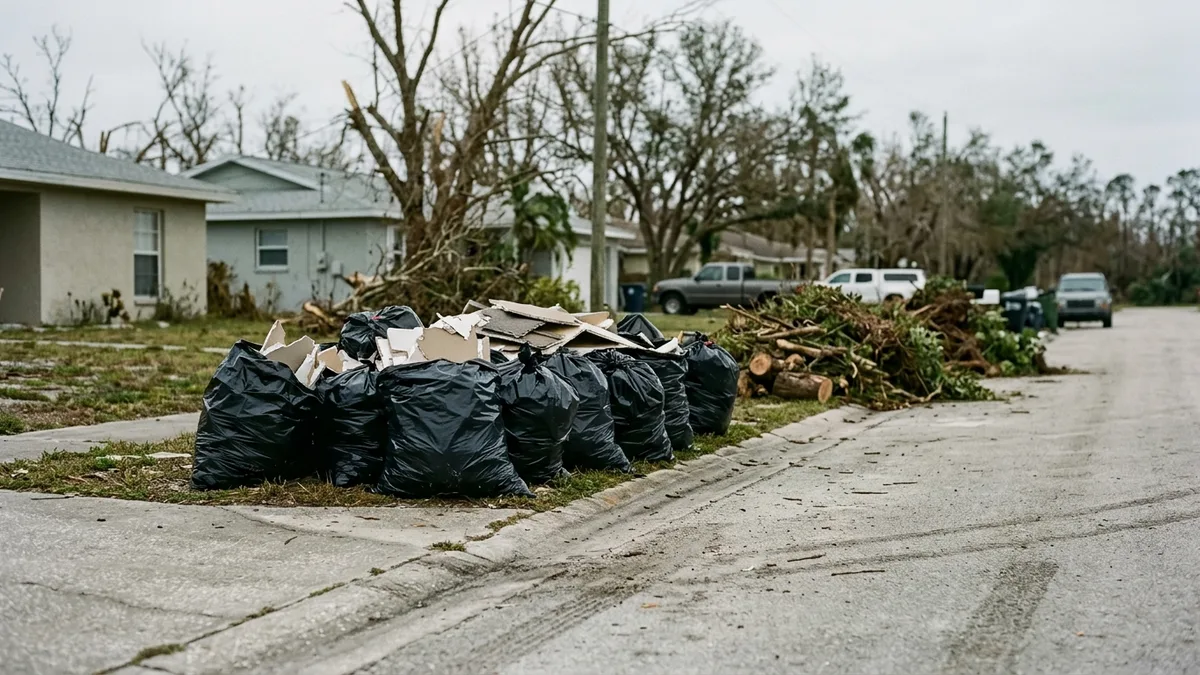
Storm debris cleanup in Charleston County follows a specific sorting system the county calls "DON'T C.H.E.A.T. the Environment," a mnemonic covering Construction debris, Hazardous waste, Electronics, Appliances, and Trees/vegetation, each of which needs to be separated rather than piled together at the curb. Given the Charleston area's hurricane exposure, this system gets used seasonally almost every year.
Correct placement means keeping debris piles curbside, within 15 feet of the road, positioned between the street and sidewalk. The county specifically encourages neighbors to consolidate piles rather than each household creating a separate small pile, which speeds up collection trucks working through a neighborhood. Incorrect placement, debris left on the road itself, on the sidewalk, or leaning against trees, water meters, gas meters, telephone poles, or power towers, can delay pickup or create hazards crews won't approach.
Enforcement matters here too. Charleston County maintains a full-time Environmental Enforcement Officer who handles violations related to beautification, illegal dumping, and scavenging, all of which can carry misdemeanor charges, fines, or community service. Illegal dumping falls under County Ordinance 1115th, Section 5-A. Scavenging, meaning rummaging through or removing items from solid waste or recycling containers, is covered separately, and the county's beautification ordinance addresses broader nuisance and appearance issues. If you witness a violation, the county's contact line is (843) 202-7200, or you can email Planning@CharlestonCounty.org.
For HOA communities specifically, storm season bulk waste is often where board enforcement breaks down completely. Residents pile debris incorrectly, piles sit for days creating a curb appeal problem, and the board has limited actual enforcement authority beyond issuing warnings. A managed waste program with scheduled bulk removal takes that pressure off entirely, since residents aren't relying on individual compliance with a sorting system many don't fully understand.
Where Are the Charleston County Landfill and Convenience Centers?
Bees Ferry Landfill is Charleston County's primary disposal facility, a 312-acre site located at 1344 Bees Ferry Rd in Charleston, with separate designated areas for solid waste and construction debris. Reach the landfill office directly at (843) 571-0929 for tipping questions or hours confirmation. As of 2026, landfill hours run Monday through Friday 7 a.m. to 4 p.m., and Saturday 8 a.m. to 3 p.m.
Tipping rates at Bees Ferry vary by material type: tires run $90 per ton, metal runs $30 per ton, and general municipal solid waste runs $66 per ton. Residents get one free load up to a ton per month with proof of residency, which covers most single household cleanout trips without any charge. Notably, Bees Ferry no longer accepts construction and demolition waste, vegetative waste, or yard debris from private or commercial haulers, a policy shift that's pushed more contractors toward private disposal arrangements.
Beyond the landfill itself, Charleston County operates 16 recycling drop site locations and 8 staffed Convenience Centers spread across the county for residents who don't have curbside pickup or need to dispose of items outside the regular schedule. Convenience Center addresses include 1344 Bees Ferry Rd in Charleston, 6380 Maxville Rd in Awendaw, 2844 Highway 174 on Edisto, 8776 Old Jacksonboro Rd in Adams Run, 5303 Highway 165 in Hollywood, 1775 River Rd in McClellanville, 1558 Liberia Rd in Wadmalaw, and 1716 Signal Point Rd on James Island.
Household hazardous waste and electronic waste, items municipalities increasingly won't take curbside, are centralized specifically at these Convenience Centers rather than collected door to door. This is part of a broader shift in 2026 toward consolidated specialty drop-off rather than curbside collection for anything hazardous or electronic. Charleston County has also added a circular-economy angle to its waste program: a paint re-blending and recycling initiative that sells reblended paint at $10 per five-gallon bucket, diverting usable paint from the landfill stream entirely.
What Are Charleston County's Verified Solid Waste Fees and Rates? (Quick Reference Table)
The table below consolidates the county's fee and rate structure in one place, something no single government page currently provides, since municipal garbage rates, county User Fees, and landfill tipping fees are typically published on separate sites entirely.
| Category | Rate / Fee | Billing Method |
|---|---|---|
| Residential Solid Waste User Fee (single-family) | $150 per residence | Annual Real Property Tax Bill |
| Residential Solid Waste User Fee (multi-family) | $105 per unit | Annual Real Property Tax Bill |
| Commercial User Fee | $260 per cubic yard | Billed separately, based on prior year hauler-reported volume |
| Landfill tipping, municipal solid waste | $66 per ton | Pay at Bees Ferry Landfill; 1 free ton/month for residents |
| Landfill tipping, tires | $90 per ton | Pay at Bees Ferry Landfill |
| Landfill tipping, metal | $90 per ton is incorrect; metal is $30 per ton | Pay at Bees Ferry Landfill |
| Recycled paint (reblended) | $10 per 5-gallon bucket | Purchased directly from county paint program |
What Should You Do If You Have Multiple Properties Across Different Charleston Jurisdictions?
Managing waste across multiple Charleston County properties in different municipalities means tracking separate schedules, separate contact numbers, and separate placement rules for every single address, since there's no unified system that spans city, town, and PSD boundaries. As a result, scattered-site portfolio owners spend real administrative time just keeping schedules straight.
Consider a portfolio spanning a duplex in North Charleston, a build-to-rent unit near Cainhoy Peninsula, and a short-term rental on Isle of Palms. That's three separate garbage contacts (North Charleston at 843-745-1026, no direct municipal line for the unincorporated Cainhoy area beyond county services, and Isle of Palms at 843-886-8956), three separate placement windows, and three separate holiday adjustment schedules. Multiply that by a 20 or 50-unit portfolio and the coordination burden becomes a full-time job nobody budgeted for.
This is precisely the operational gap Trash Day Made Easy was built to close. Rather than tracking nine different municipal systems, portfolio operators contract one waste operations partner that handles nightly valet collection, bulk removal, and turnover trash consistently across every address, whether that's 10 units or more than 1,000. Every service stop gets photo-verified, so instead of hoping a resident placed a cart correctly under North Charleston's rules or Mount Pleasant's, you get documented confirmation the same standard was met at every property, every night.
For build-to-rent operators specifically near the airport corridor and Daniel Island, where investor reporting and community cleanliness both matter to portfolio value, that consistency is the actual product, not just convenience. And for short-term rental operators near the Sullivan's Island guest corridor, on-demand turnover trash removal means a missed pickup between guests never becomes a bad review.
Practical Guidance: Choosing Between Municipal Pickup and Private Waste Service
Choosing between relying solely on municipal Charleston County trash pickup and adding a private valet or waste operations service depends primarily on how many units or addresses you manage and how much resident-facing waste friction you're willing to tolerate. For a single homeowner, municipal service alone is often sufficient. For property managers, HOAs, and portfolio owners, it usually isn't.
Here's the decision framework we recommend to property managers evaluating their options:
- Count your addresses and jurisdictions. One property in one municipality is manageable with a phone number saved in your contacts. Three or more properties across different towns means you're managing separate schedules, and that's where errors compound.
- Assess resident compliance risk. Municipal curbside rules require every resident to place carts correctly and on time. In multifamily and HOA settings, compliance is inconsistent at best, and one non-compliant resident creates a visible problem for the whole community.
- Evaluate your turnover frequency. Short-term rentals and build-to-rent communities with frequent move-ins and move-outs generate bulk waste on schedules that don't match weekly municipal pickup. On-demand removal closes that gap.
- Weigh documentation needs. If you're accountable to an owner, investor, or HOA board for service quality, photo-verified proof of nightly collection is worth significantly more than a municipal schedule you have to trust blindly.
- Calculate the cost of complaints. Overflowing dumpsters and hallway trash directly affect lease renewal decisions. A resident who complains twice about trash is a resident who's less likely to renew.
Common mistakes we see property managers make: treating bulk item removal as an afterthought on move-out day instead of scheduling it as a fixed step in the turnover cycle, assuming municipal pickup covers commercial or multifamily needs when it often explicitly doesn't (North Charleston, for instance, does not pick up from commercial or industrial establishments at all), and trying to manage waste across a scattered-site portfolio with the same single-community approach that works fine for one address but breaks down at scale.
Frequently Asked Questions
Does Charleston County pick up my garbage directly?
No. Charleston County Environmental Management does not collect garbage itself. Collection is handled by your specific municipality or public service district, such as the City of Charleston, North Charleston, Mount Pleasant, or James Island PSD, each with a separate phone number and schedule. The county's role is limited to recycling collection, landfill operations, and enforcement.
How often is recycling picked up in Charleston County?
Recycling is collected every other week (biweekly) for single-family residential customers across Charleston County, serving roughly 130,000 homes. Commercial and business recycling runs weekly instead, Monday through Friday. The same contractor has run this collection since June 2022.
What is included in the Charleston County Solid Waste User Fee?
The Solid Waste User Fee funds county-level waste infrastructure like the landfill and convenience centers, and is billed at $150 per single-family residence and $105 per multi-family unit, typically appearing on your annual Real Property Tax Bill. This fee is separate from whatever your city or town charges for actual garbage collection service.
Can I bring bulk items like mattresses or furniture to the landfill myself?
Yes. Bees Ferry Landfill accepts municipal solid waste at $66 per ton, and residents get one load up to a ton per month at no charge with proof of residency. You can also use one of Charleston County's eight staffed Convenience Centers, open Monday through Saturday, though hours vary slightly by location.
What should I do if my trash wasn't picked up?
First, confirm your container met placement rules, curbside timing, distance from obstructions, and correct materials, since crews often skip non-compliant carts rather than returning later. If placement was correct, call your municipality's sanitation line directly rather than the county, since garbage collection is a city or town function.
Does North Charleston pick up commercial trash?
No. The City of North Charleston Sanitation Division does not collect garbage from commercial or industrial establishments; businesses must arrange private disposal. North Charleston also no longer picks up electronic waste like TVs and computers, and yard waste must go in paper bags only, not plastic.
Is there a single service that can handle trash across multiple Charleston-area properties?
Yes. Rather than tracking separate municipal schedules for each address, portfolio owners and property managers can contract a single waste operations partner like Trash Day Made Easy, which provides nightly, photo-verified valet trash collection, bulk item removal, and turnover trash handling consistently across every property, from 10 units to more than 1,000.
How do I know which day is my collection day?
Collection day depends entirely on your municipality. The City of Charleston uses an interactive tool called Mapnet along with the CHS Trashtracker app for schedule lookups and alerts. Other jurisdictions like Mount Pleasant publish an annual printed waste calendar, and the fastest way to confirm your day is calling your specific municipality's sanitation line directly.
Conclusion: Getting Charleston County Trash Pickup Right in 2026
Charleston County trash pickup boils down to one core fact worth remembering: your garbage collection is a municipal responsibility, not a county one, while recycling, the landfill, and enforcement run through Charleston County Environmental Management. Once you know which of the nine-plus jurisdictions covers your address, the $150 single-family or $105 multi-family User Fee, the biweekly recycling schedule, and the Bees Ferry Landfill options all make a lot more sense.
For a single homeowner, that's manageable with a saved phone number and a little patience around holidays. For property managers, HOA boards, and portfolio owners juggling addresses across North Charleston, Mount Pleasant, and the barrier islands, the fragmented municipal system becomes a genuine operational drag, one that shows up as resident complaints, delayed turnovers, and inconsistent curb appeal. As portfolios grow into 2026 and beyond, more operators are choosing to layer a private, photo-verified waste service on top of municipal pickup rather than managing nine separate systems by hand.
Trash Day Made Easy built its nightly valet trash service, trash can concierge, and bulk removal program specifically to solve that coordination problem for multifamily communities, build-to-rent developments, short-term rentals, HOAs, and homeowners across Charleston, North Charleston, and Atlanta, GA.
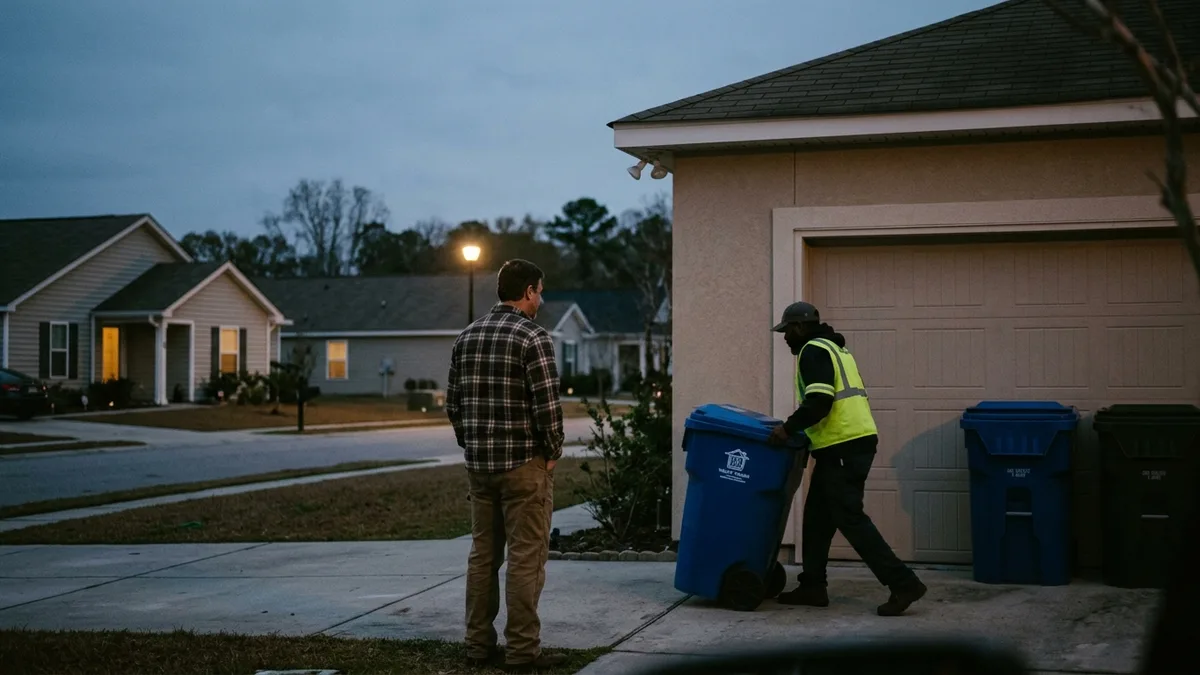
If municipal pickup schedules and cart compliance have become more headache than convenience, Trash Day Made Easy's residential valet service starting from $49 per month handles the whole process, bin out, bin back, done. Get started with Trash Day Made Easy and request a quote, available Monday through Friday for every property type.
Content powered by inkSTR.co