Commercial power washing services are contracted pressure, soft-wash, or hot-water cleaning of exterior surfaces at multifamily, retail, and mixed-use properties, and the waste areas are where they matter most. For Charleston property managers, the best result comes from pairing a written-scope washing crew with a reliable collection program, such as the nightly valet trash that Trash Day Made Easy runs, so the dumpster pads and breezeways stay cleaner between washes.
Key Takeaways
- Commercial power washing services should be hired against a written scope that names surfaces, method, access needs, exclusions, and completion criteria.
- Cost depends on surface area, soil type, water access, working height, after-hours scheduling, and recurring frequency, so ask every bidder to price the same scope.
- Dumpster pads, compactor areas, bin corrals, and breezeways foul fastest, and collection habits decide how often they need washing.
- Ask any crew how it captures wastewater and keeps runoff out of storm drains, then confirm local requirements with the City of North Charleston, Charleston County, or the South Carolina Department of Environmental Services.
- Charleston humidity brings back mildew and algae quickly, so method and timing matter more here than a generic annual schedule.
- Trash Day Made Easy handles nightly photo-verified valet trash and works with The Bin Boy for bin cleaning and sanitizing; quotes are available Monday through Friday.
Why Do Property Managers Hire Commercial Power Washing Services for Waste Areas?
Waste areas are the first place a property looks neglected. A dumpster pad with grease staining or a breezeway with bag residue shows up in resident complaints and tour impressions before anyone notices the landscaping. A bin corral that smells in midsummer does the same.
If you manage a garden-style community near the Rivers Avenue corridor or a townhome row around Park Circle, you already know how fast summer heat and humidity turn a minor spill into an odor problem. A washing crew fixes the surface. It does not fix why the surface got dirty.
That is the angle we take at Trash Day Made Easy. We run nightly Doorstep-to-Dumpster collection for communities across the Charleston area, and the same pattern repeats: properties with consistent pickup need less aggressive cleaning, because bags do not sit at doors or beside overflowing containers.
This guide gives you seven checks to run before you sign with any washing contractor, then explains where waste operations fit into the picture.
1. What Should a Commercial Power Washing Scope Include?
A commercial power washing scope is a written document that lists every surface to be cleaned, the method for each, the access each requires, what is excluded, and how completion will be judged. Without it, two bids for the same property can describe completely different work.
For waste areas, push the scope to name specific surfaces:
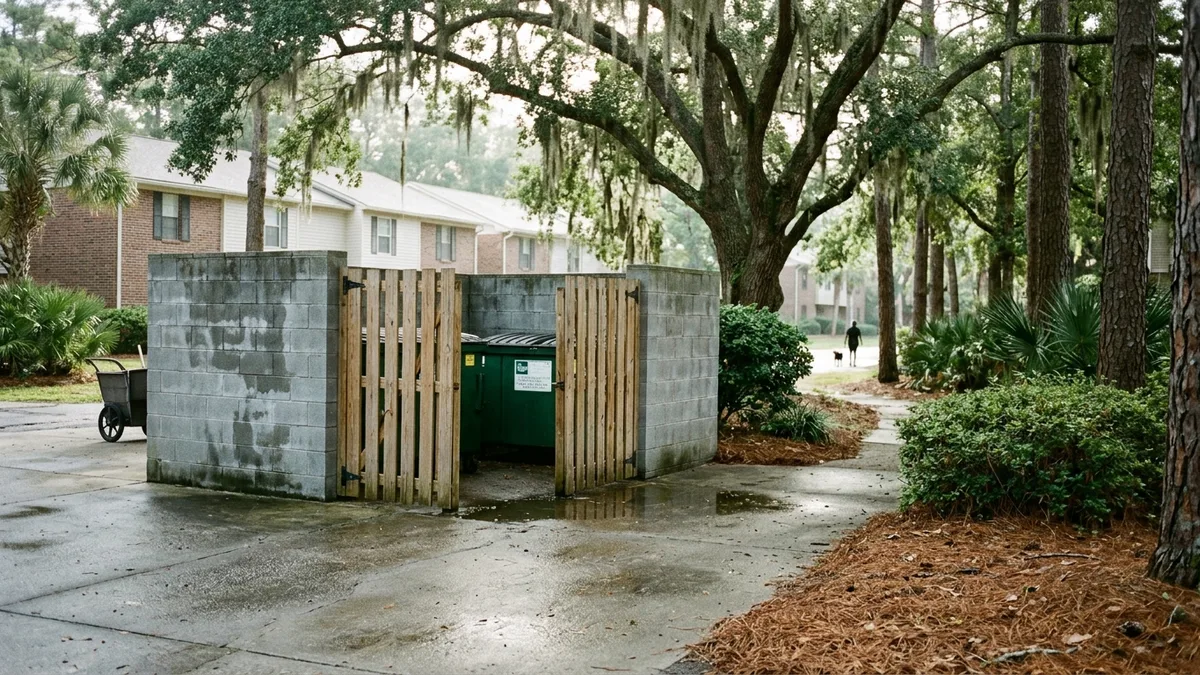
- Dumpster pads and the apron where trucks load
- Compactor bases and the drainage around them
- Bin corrals and trash rooms
- Breezeways, stairwell landings, and walkways near doors
- Curbside bin staging areas in build-to-rent streets
Ask for a pre-bid walkthrough. A contractor who prices from a phone call or satellite image is guessing. A contractor who walks the property will notice the third-floor walk-up with no hose bib, or the pad that slopes toward a storm drain.
Request exclusions in writing. Painted trim, wood railings, and light fixtures near the pad are common gray areas. Finally, define done: no visible staining on defined surfaces, no standing debris, and a walkthrough sign-off.
2. How Much Does Commercial Power Washing Cost?
Commercial power washing cost is the price a contractor charges for a defined scope, driven by surface area, soil type, water access, working height, after-hours requirements, and how often the work repeats. No single per-square-foot number fits every property, and any quote that skips these variables is incomplete.
Here is how each variable moves the price:
- Surface area: more concrete means more crew hours, but the rate often drops as the job grows.
- Soil type: grease and food residue at dumpster pads take longer than light mildew on a sidewalk.
- Water access: a crew that must haul water to a site with no usable spigot charges for it.
- Height: stairwells, balconies, and elevated walkways add equipment and risk.
- Timing: overnight or weekend work usually costs more than weekday daytime visits.
- Frequency: recurring plans are typically priced below one-off visits, though you should confirm that in writing.
Our opinion: do not choose the lowest bid. Choose the bid whose scope you can compare line by line. Ask each contractor to price the same surface list, then compare. We do not quote washing prices at Trash Day Made Easy; for waste service pricing, a call about your property layout comes first.
3. Which Method Fits the Surface: Pressure, Soft Wash, or Hot Water?
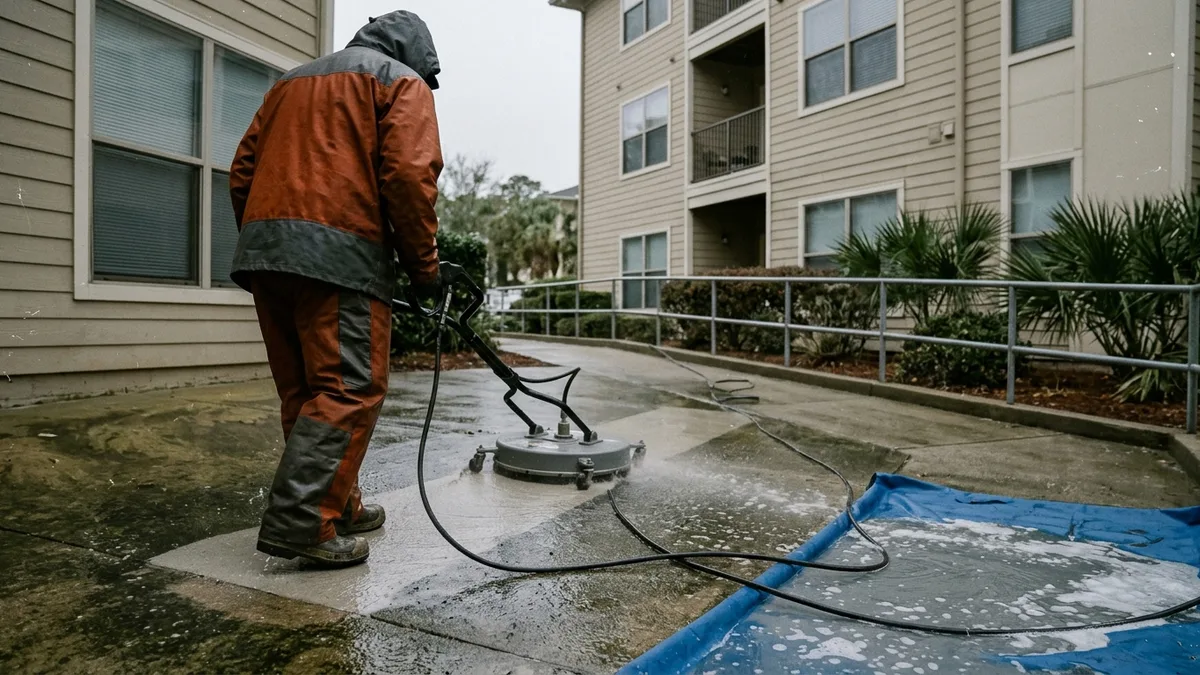
Pressure washing uses high water pressure to blast away soil, soft washing uses low pressure with cleaning solutions to treat organic growth, and hot-water or steam units add heat to cut grease. The right method depends on the surface and what is stuck to it.
Concrete pads handle pressure well. Grease from trash leachate often needs a degreaser or hot water, because cold water alone tends to push the residue around rather than lift it. Steam and hot-water pressure washers earn their reputation on grease, but they are slower and cost more to run, so ask whether a bidder actually has the equipment or is subcontracting it.
Soft washing suits siding, stucco, painted surfaces, and other fragile finishes. Aggressive pressure on older wood or soft masonry can etch the surface and force water behind it. If a bidder proposes one high-pressure method for every surface, treat that as a warning sign.
Ask each crew to state the method for each surface in the scope. That single line shows whether the contractor understands your property.
4. What Insurance and Documentation Should a Crew Provide?
Contractor insurance documentation is proof, usually a certificate of insurance (COI), that a crew carries liability coverage and names your property or ownership entity as an additional insured where your contract requires it. Request it before work starts, not after.
Several local providers advertise insurance and COI availability on their websites. Treat those as company claims until you see the certificate itself. Check the policy dates, the coverage limits against your owner's requirements, and the named insured.
Also ask about:
- Workers' compensation coverage for crew members
- Business licensing status in the municipality where the property sits
- A named supervisor who is on site during the work
- Written notice of any damage and how it will be reported
The same standard applies to your trash vendor. At Trash Day Made Easy, every nightly visit is photo-verified, which gives you documented proof of service without chasing anyone. Ask your washing contractor for the equivalent: before-and-after photos of each defined surface.
5. How Should Crews Handle Wastewater and Runoff?
Wastewater management at a power washing job means capturing, diverting, or treating the water that carries detergent, grease, and debris away from storm drains. Most competitor pages skip this topic, which is exactly why you should raise it.
Dumpster pads are the highest-risk surface, since the runoff can carry food residue and oils. Ask each bidder three questions: how do they block or cover nearby drains, how do they collect or contain wash water on greasy surfaces, and what do they do with the collected water?
Rules differ by municipality and change over time, so we do not summarize them here. Confirm current requirements with the City of North Charleston, Charleston County Environmental Management, or the South Carolina Department of Environmental Services before approving a method. Put the crew's runoff plan into the scope document.
A contractor who answers these questions confidently and in detail has usually handled them before. A contractor who says "we just rinse it off" is a risk to your property's compliance.
6. How Do You Schedule Crews Around Residents and Tenants?
Scheduling commercial power washing means choosing when a crew works so that residents, customers, and traffic are not exposed to hazards or blocked access. Overnight and weekend options are common, and they suit retail and mixed-use sites better than apartment communities.
For residential communities, daytime weekday work with advance notice often works better than night work, since noise and slippery walkways at night create complaints. Post a notice at least a few days ahead, and tell residents which breezeways and stairwells will be wet or closed.
Build a short risk-control checklist into every job:
- Tenant and resident notices with dates and affected areas
- Pedestrian routing around wet surfaces and hoses
- Protection of electrical fixtures, outlets, and fire-safety equipment
- Slip hazard signage until surfaces dry
- A post-cleaning inspection with photos
Coordinate with your trash schedule too. Washing a bin corral at 2 p.m. and then having residents drop bags beside the wet pad that evening wastes the work. If your valet program picks up nightly, the washed area stays cleaner.
7. How Does Charleston Humidity Change Cleaning Timing?
Charleston humidity is the persistent moisture in Lowcountry air that feeds mildew and algae on shaded concrete, siding, and walkways, so surfaces here regrow faster than in drier regions. Seasonal pollen also coats surfaces each spring and creates a film that is easy to mistake for dirt.
This affects both method and timing. Shaded breezeways and north-facing walls near Park Circle or on Daniel Island often show growth sooner than sunny parking areas. Historic or fragile finishes, common in rentals near the Charleston Historic District, call for soft washing rather than high pressure.
We do not recommend a universal schedule. Start with a baseline wash, watch how quickly growth returns on your specific surfaces, and set the recurring interval from that evidence. For waste areas, look at the odor and staining pattern after summer weeks rather than relying on a calendar.
If your community is also dealing with turnover debris, our guide to Lowcountry junk removal during turnovers explains how bulk items and make-ready waste fit into the same maintenance calendar.
Where Does Trash Day Made Easy Fit Alongside Your Washing Contractor?
Valet trash service is a scheduled amenity in which a provider collects bagged trash from each door on set nights and carries it to the dumpster, so residents never haul it themselves. Trash Day Made Easy runs this as Doorstep-to-Dumpster collection, headquartered at 4900 O'Hear Avenue in North Charleston.
We are not a pressure washing contractor, and we say so plainly. Your concrete, siding, and walkways still need a washing crew. What we change is how much mess reaches those surfaces.
Here is what we bring to waste areas:
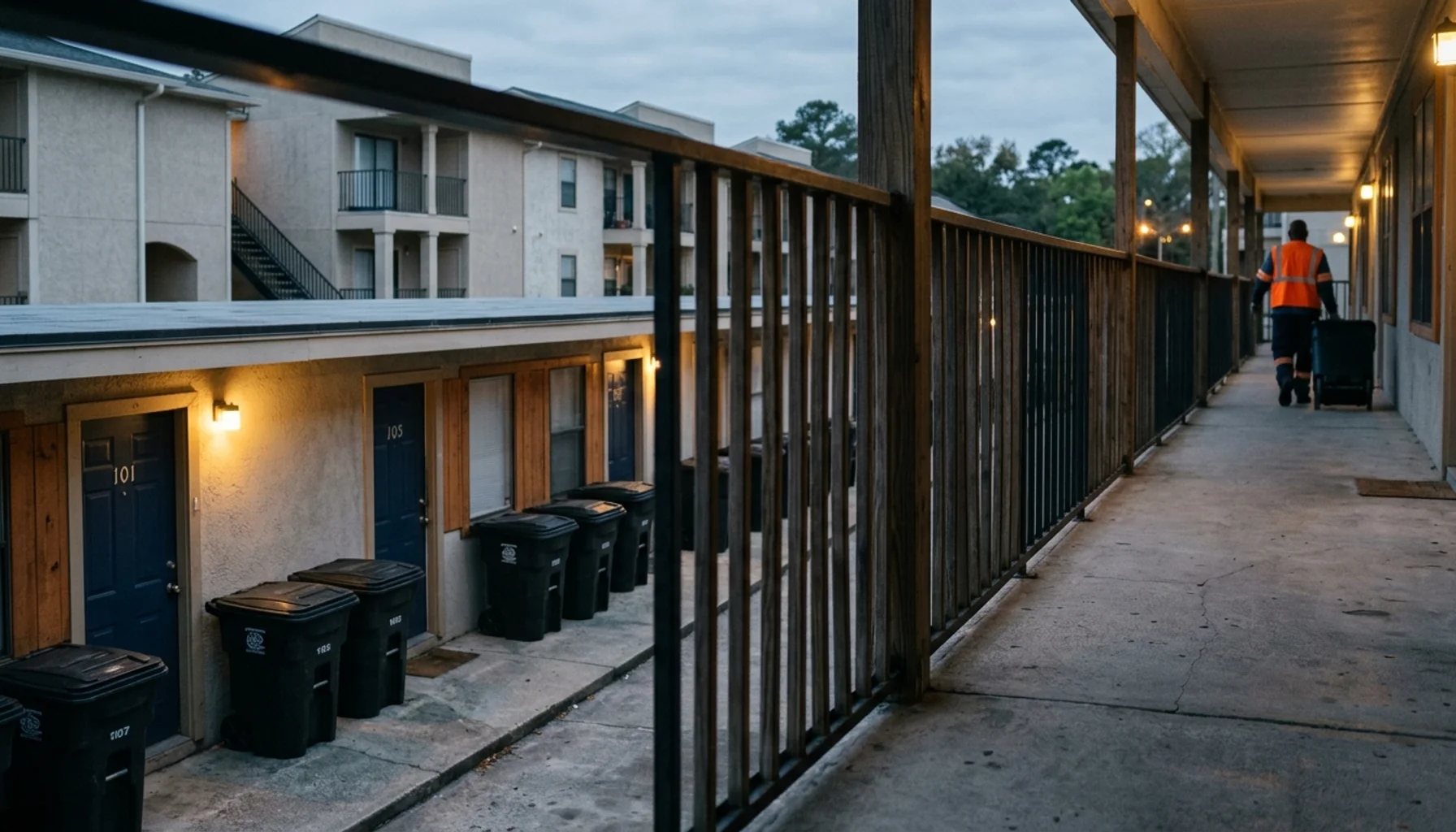
- Nightly collection: bags do not sit at doors or breezeways overnight, which cuts down on residue and pests.
- Photo verification: every visit is documented, so you can see service happened without sending a reminder.
- Bin cleaning and sanitizing: through our partnership with The Bin Boy, a Charleston-based bin cleaning and sanitizing service, containers get cleaned rather than just emptied.
- Turnover and bulk support: move-out debris and bulk items are cleared so washing crews can reach the surface.
- Scale: programs run from 10 units to more than 1,000, with one standard across a portfolio.
For a deeper look at the service model, see what garbage valet is and how it works. For curbside communities, our can to curb services guide for Charleston covers Backdoor-to-Curbside bin management.
One candid caveat: a ten-unit property with a single compactor may not need nightly service. A 300-unit community with third-floor walk-ups usually does.
How Do Collection Habits Change What You Need From Commercial Power Washing Services?
The table below compares two common setups for a multifamily community. It uses qualitative descriptions only, because actual costs depend on your scope and contracts.
| Factor | Dumpster-only plus periodic washing | Nightly valet plus scheduled washing (our service) |
|---|---|---|
| Bags at doors | Residents carry trash on their own schedule | Collected from the doorstep on scheduled nights |
| Breezeway condition | Prone to residue and clutter | Clear more consistently |
| Dumpster area | Overflow risk when residents skip trips | Fewer loose bags near the pad |
| Service proof | Depends on manager inspection | Photo-verified at each visit |
| Washing frequency | Often needs more frequent attention | Set by observed surface growth and staining |
| Bin hygiene | Typically left to residents or ad hoc | Bin cleaning through The Bin Boy partnership |
The pattern holds across property types. Fewer loose bags and cleaner bins mean fewer emergencies for the washing crew.
Who Else Offers Commercial Power Washing in the Charleston Area?
Several local contractors serve the Lowcountry, including Pressure Wash Charleston, Reflections of Charleston, and Seaside Pro Wash. Evaluate any of them, or anyone else, against the seven checks above.
What Is an Industrial Cleaning Service, and Does Your Property Need One?
An industrial cleaning service is a contractor that cleans heavy-use surfaces such as loading docks, warehouse floors, equipment areas, and grease-prone sites, often with hot-water or specialty equipment. Most apartment and retail properties need standard commercial washing instead, unless a restaurant, compactor, or loading dock creates heavy grease.
If your site has a restaurant pad or a busy compactor, ask bidders directly about degreasing and hot-water capability. If your needs are breezeways and sidewalks, you will usually do better with a crew that specializes in soft washing and routine concrete work.
Conclusion: How Should You Choose Commercial Power Washing Services in 2026?
Hire commercial power washing services against a written scope, a method for each surface, proof of insurance, a runoff plan, and a tenant-safe schedule. Then reduce what the crew must clean by fixing collection first. Charleston summers stay humid in 2026, so a program that pairs scheduled washing with consistent waste handling holds up better than reactive cleaning.
Trash Day Made Easy supports that approach with nightly valet trash, photo verification, turnover and bulk support, and bin sanitizing through The Bin Boy. Our team gives quotes Monday through Friday for all property types.
Want cleaner breezeways and fewer overflowing pads before your next washing visit? Schedule a call with Trash Day Made Easy and we will walk through your property layout and service options.
Frequently Asked Questions
How much does commercial power washing cost?
Cost depends on surface area, soil type, water access, height, after-hours scheduling, and frequency. Recurring plans are typically priced below one-off visits. Ask every bidder to price the same written scope so you can compare quotes fairly.
Are steam pressure washers any good?
Steam and hot-water pressure washers work well on grease, such as dumpster pad residue, because heat loosens oils that cold water pushes around. They run slower and cost more, so reserve them for greasy surfaces rather than routine sidewalks or siding.
What is an industrial cleaning service?
An industrial cleaning service handles heavy-use surfaces such as loading docks, equipment areas, and grease-prone sites, often with hot-water or specialty equipment. Typical apartment and retail properties usually need standard commercial washing instead.
What is valet trash service for apartment communities?
Valet trash service is a scheduled amenity where a provider collects bagged trash from each resident's door and carries it to the dumpster. Trash Day Made Easy offers nightly Doorstep-to-Dumpster collection with photo verification at each visit.
Who provides valet trash and bin cleaning in Charleston?
Trash Day Made Easy provides nightly photo-verified valet trash, Backdoor-to-Curbside bin management, turnover handling, and bulk removal from its North Charleston headquarters. It partners with The Bin Boy for bin cleaning and sanitizing. Compare any provider on documentation, schedule consistency, and portfolio scale.
How can I get a valet trash quote in Charleston?
Quotes are available Monday through Friday for all property types. Schedule a call through the Trash Day Made Easy website, and the team will review your property layout and service options. Homeowner service starts from $49 per month in select Charleston neighborhoods.
How does doorstep valet trash collection work?
Residents place bagged trash outside their door on scheduled nights. A collection crew picks it up, carries it to the dumpster, and documents each visit with photos. Residents never haul trash to the dumpster themselves.
Content powered by inkSTR.co