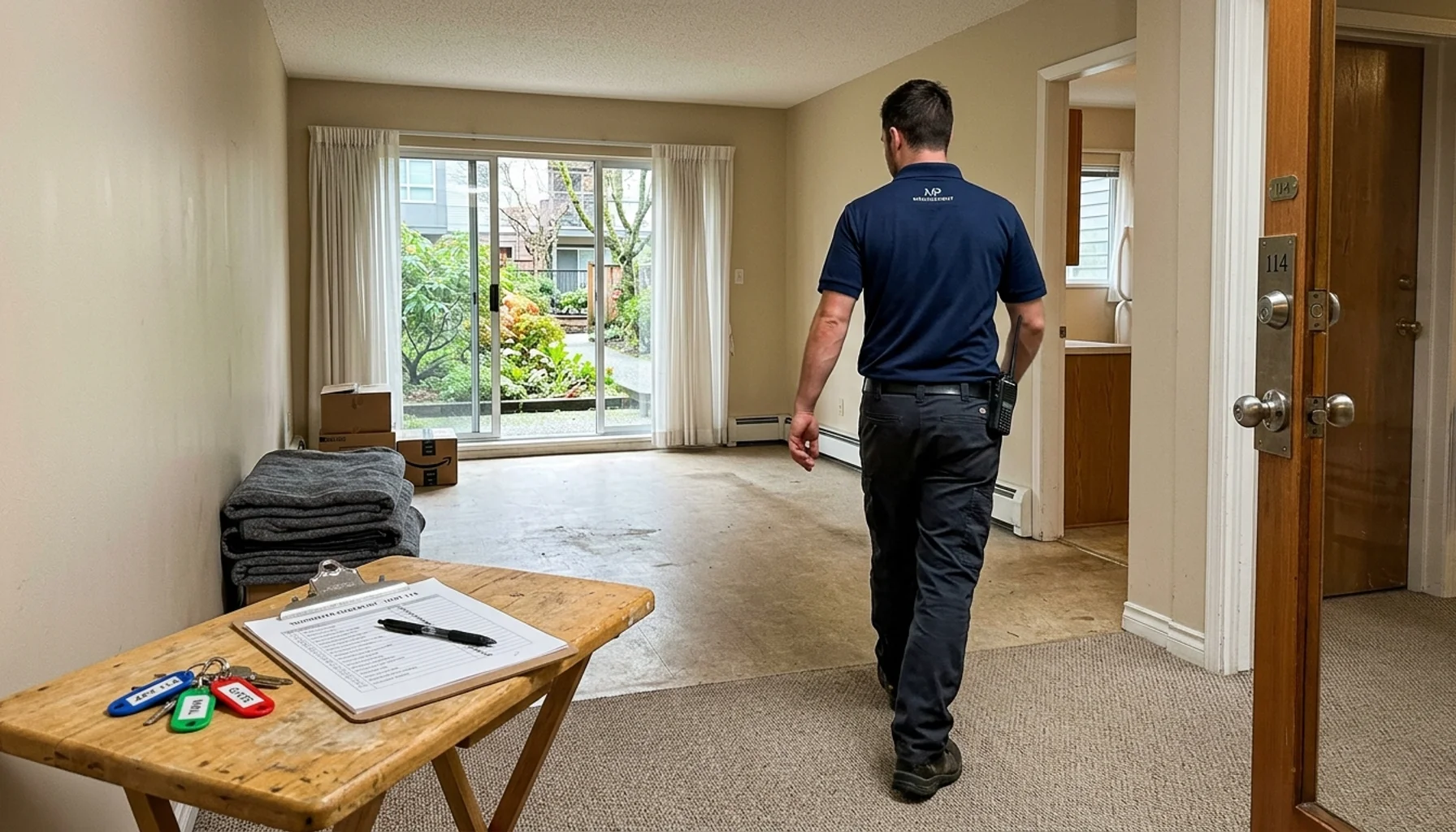
Property managers coordinate move-in move-out logistics without overwhelming staff by assigning dedicated roles for each turnover stage, automating inspection and vendor scheduling triggers, and outsourcing high-labor tasks like trash and bulk item removal to a specialized vendor. This shifts staff time from manual coordination to oversight and exceptions.
Key Takeaways
- Industry workflow guidance estimates a typical unit turnover consumes 8 to 15 staff hours for scheduling, inspection follow-up, and vendor coordination alone.
- Assigning a dedicated coordinator, inspector, maintenance lead, and leasing lead, each with a capped number of concurrent turns, prevents any single staff member from becoming a bottleneck.
- Security deposit disposition is commonly required within a window of 14 to 30 days depending on state law, making a documented, dated exception log a practical safeguard.
- Outsourcing turnover trash and bulk item removal to a vendor like Trash Day Made Easy removes one of the most time-consuming, unpredictable tasks from a make-ready cycle.
- Automation platforms can trigger inspection scheduling and vendor dispatch the moment a move-out date is confirmed in the property management system.
- North Charleston's rental market posted a 9.2% apartment vacancy rate in early 2023 per HUD data, meaning turnover speed directly affects how quickly a unit stops costing money and starts earning it again.
If you manage a multifamily community, a build-to-rent portfolio, or a cluster of short-term rental units around the Charleston, SC metro, you already know that move-in move-out season is where staff burnout happens fastest. Leasing agents get pulled into inspections. Maintenance techs get pulled into cleaning. Everyone ends up doing three jobs badly instead of one job well.
At Trash Day Made Easy, we service move-in and move-out transitions across North Charleston, Mount Pleasant, and the wider Charleston metro every week, and the pattern is consistent: teams don't fail because they lack effort. They fail because turnover logistics were never built as a repeatable system with defined roles and defined limits.
This guide breaks down how to structure staff roles, automate the repetitive parts of the process, and outsource trash, bulk item removal, and debris handling, so your team handles more turns without burning out.
What Does It Actually Take to Coordinate a Single Move-In Move-Out Cycle?
A single move-in move-out cycle refers to every task between a resident's notice to vacate and the next resident's fully documented move-in, including inspections, repairs, cleaning, debris removal, and paperwork. Industry workflow research estimates this typically consumes 8 to 15 staff hours per unit when done manually, covering inspection scheduling, condition comparisons, deduction calculations, disposition letters, vendor coordination, and relisting.
That labor estimate assumes nothing goes wrong. In practice, something almost always does: a resident's checklist isn't confirmed, a vendor no-shows, or the outgoing tenant leaves a couch in the breezeway. Each of those exceptions adds hours a busy property manager didn't budget for.
For a 200-unit community running 60 to 100 turns a year, that 8 to 15 hour range compounds into hundreds of staff hours annually spent on tasks that rarely require a manager's judgment. Those tasks need a checklist, a schedule, and a vendor who shows up. The tasks most often bottlenecking staff are inspection scheduling and clearing physical debris, which is exactly where outsourcing and automation deliver the fastest relief.
What Are the 5 P's of Property Management as Applied to Turnover Logistics?
The 5 P's of property management, people, property, process, promotion, and profit, provide a practical lens for structuring turnover work: assign the right people, protect the physical property during transition, build a repeatable process, promote the unit early, and track how turnover speed affects profit. Applying this framework to move-in move-out logistics keeps staff focused on their specific lane instead of firefighting across every task.
People means defining who owns each turnover task, not letting whoever is available handle it. Property means protecting common areas, elevators, and parking during overlapping move days. Process means a documented, repeatable sequence rather than tribal knowledge held by one senior staffer. Promotion means marketing the unit while make-ready work is still underway, not after. Profit means tracking vacancy days and turnover labor cost, since a slower turnover has a direct, measurable NOI impact.
Portfolio operators managing build-to-rent communities near Daniel Island or scattered-site properties across North Charleston tend to skip the "people" and "profit" pieces first, because they feel less urgent than fixing a broken dishwasher. That's backwards. Staffing structure and cost tracking let a small team absorb a large turnover season without collapsing.

How Can Property Managers Structure Staff Roles to Avoid Overload?
Structuring staff roles for turnover means assigning a coordinator, inspector, maintenance lead, and leasing lead to each cycle, with a maximum number of concurrent units per person, rather than letting every staff member touch every task. This role-based model is the single biggest lever for preventing overwhelm during heavy turnover months, and it's a gap most generic checklists never address.
A workable structure for a 100 to 300 unit community looks like this: one turnover coordinator owns scheduling and communication for no more than 8 to 10 concurrent turns. One inspector handles condition documentation and photo capture, capped similarly. A maintenance lead manages repair dispatch and make-ready sign-off. A leasing lead handles marketing and showings during the make-ready window, not after it.
The cap matters more than the title. Without a concurrent-turn limit, a coordinator absorbs every unit in the pipeline during a busy month, and quality drops across all of them at once. As a result, missed inspections and unconfirmed checklists cluster in the weeks when volume peaks, usually summer lease renewal season across Charleston-area multifamily communities.
Scattered-site portfolio owners face a variant of this problem: turns aren't concentrated in one building, they're spread across a dozen addresses. That geography adds windshield time to every role, which is one more reason a single point-of-contact vendor for trash and bulk removal keeps the coordinator's job manageable, instead of juggling city pickup schedules and ad hoc hauling.
What Exceptions Should Property Managers Plan for Before They Happen?
Exception management in turnover logistics means having a predefined response for the situations that don't follow the standard checklist: late notices, missed inspections, inaccessible units, vendor no-shows, same-day move-ins. Most published turnover guides describe the ideal path and stop there, leaving staff to improvise when reality doesn't cooperate, which is exactly when overwhelm sets in.
A workable exception playbook assigns a named owner and a maximum resolution time to each scenario. For example: if a resident's move-out checklist isn't confirmed within 14 days of the move-out date, the coordinator escalates to a phone call, not another email. If a vendor no-shows on inspection day, the inspector has a backup vendor on standby rather than starting a search from scratch.
| Exception Scenario | Owner | Target Resolution Window |
|---|---|---|
| Late move-out notice | Coordinator | Same business day |
| Unconfirmed resident checklist | Coordinator | Within 14 days of move-out |
| Inaccessible unit at inspection time | Inspector | Reschedule within 48 hours |
| Vendor no-show | Maintenance lead | Backup vendor dispatched same day |
| Bulk items left in unit or breezeway | Outsourced waste vendor | Cleared before next scheduled visit |
| Same-day move-in request | Leasing lead | Confirmed access 24 hours prior |
The exception that consumes the most staff time in our experience servicing Charleston-area communities is abandoned bulk items: furniture, mattresses, and boxes left behind at move-out. That single line item is also the easiest to remove from a manager's plate entirely, which is where outsourced valet trash and bulk removal service earns its place in the workflow.
How Should Property Managers Handle Bulk Item Removal Without Delaying the Make-Ready Timeline?
Bulk item removal during turnover means clearing furniture, appliances, and oversize debris left behind at move-out before cleaning and repair crews can begin work. Every hour a unit sits with leftover items is an hour of lost rental income, and in a tight rental market like North Charleston, where the apartment vacancy rate stood at 9.2% in Q1 2023 according to HUD's Charleston-North Charleston market profile, that delay compounds fast.
The most common mistake we see is treating bulk item removal as an afterthought on move-out day, something maintenance handles "whenever," rather than scheduling it as a fixed step in the turnover cycle with its own confirmed time slot. Once it's scheduled like an inspection, it stops being a surprise.
Trash Day Made Easy's bulk item removal and turnover trash removal service integrates directly into make-ready cycles, clearing out abandoned furniture and oversize waste so the unit stays on schedule for the next resident or guest. Every visit is photo-verified, so a property manager gets documented confirmation the unit is clear without walking it themselves.
For build-to-rent communities near the airport corridor or short-term rental portfolios on Sullivan's Island and Isle of Palms, where turnover happens on a compressed, sometimes unpredictable timeline, on-demand scheduling matters more than a fixed weekly pickup. A guest checkout on a Tuesday shouldn't have to wait until Thursday's route to get cleared.
What Should the Move-In and Move-Out Handoff Actually Include?
The move-in move-out handoff refers to the physical and documented exchange of keys, access credentials, and unit condition information between the outgoing and incoming resident. A complete handoff protects both the property manager's liability position and the security deposit timeline, and it's the step most likely to get rushed when staff are stretched thin.
On move-out, documentation should include every key, garage remote, and mailbox key collected, a room-by-room comparison against the original move-in condition report, photographs of every room and chargeable item, utility meter readings, and the resident's forwarding address for deposit correspondence. Skipping any one of these creates a documentation gap that surfaces later as a deposit dispute.
On move-in, the packet handed to the new resident should include the inspection checklist, utility setup information, emergency contacts, house rules or HOA guidelines where applicable, a lease copy, and welcome materials. A final systems test, HVAC, plumbing, electrical, appliances, lights, and locks, should happen before that packet is handed over, not after a complaint call.
Cloud-based access control systems that activate a resident's building access on a specified move-in date and deactivate it automatically at move-out reduce the physical key handoff burden significantly, particularly for communities managing dozens of simultaneous transitions during a single leasing cycle.
How Do Property Managers Stay Compliant With Security Deposit Deadlines Without Overloading One Person?
Security deposit compliance means returning or itemizing deductions from a resident's deposit within the timeframe required by state law, commonly cited across industry sources as a 14 to 30 day window, though the exact figure varies and should always be confirmed against your specific state's current statute. Missing that window creates legal exposure, and chasing it manually across dozens of simultaneous turns is a common source of staff overload.
The practical fix is building a dated tracker, ideally inside your property management software, that flags every unit's deposit deadline the moment the move-out inspection is completed, and assigning a single named owner (typically the coordinator) to confirm each notice goes out by certified mail before the deadline.
Itemized deduction notices should reference the room-by-room condition comparison, dated photographs, and any repair invoices tied to damage beyond normal wear. Because this documentation already exists if the move-out inspection was done properly, the deposit letter becomes a formatting exercise, not a research project, as long as the underlying inspection data was captured correctly the first time.
Property managers overseeing scattered-site portfolios or multiple HOA-governed communities across James Island and Johns Island benefit most from a single compliance tracker that spans every address, rather than a per-property spreadsheet that nobody consolidates until a dispute forces the issue.
How Does Automation Reduce Staff Workload During Turnover Season?
Turnover automation means using a confirmed move-out event inside a property management system to automatically trigger downstream actions: inspection scheduling, resident checklist delivery, vendor dispatch notifications, deposit deadline calculation, and lease-up activity. When set up correctly, a single confirmed date drives five to six tasks without a staff member manually initiating each one.
A typical automated sequence sends the move-out checklist to the resident 30 days before their move date, with a reminder at the 14-day mark if it hasn't been confirmed. A 48-hour reminder goes out before the scheduled inspection, and the inspection template requires room-specific photos for the entry, living room, kitchen, each bedroom, and each bathroom, removing guesswork about what to document.
Synchronized property, lease, and resident data can auto-generate move-in, move-out, and renewal inspections, assign templates and due dates, and schedule inspections relative to the lease-end date without a coordinator manually creating each event. As a result, staff time shifts from data entry to reviewing exceptions the system flags, which is a fundamentally different and far less exhausting job.
The practical sequence for rolling this out: first, integrate your property management software with your inspection platform. Second, connect the vendor calendar so maintenance and waste service dispatch automatically on confirmed dates. Third, layer in resident messaging triggers. Fourth, add access control integration last, since it depends on the first three being stable.
How Do You Plan for Overlapping Move-In and Move-Out Days Without Chaos?
Move-in move-out collision planning means proactively scheduling elevator access, loading zones, parking, and building access windows when multiple residents are moving in or out on the same day. Most turnover guides ignore this entirely, but in mid-rise and high-rise multifamily buildings, it's often the single biggest source of same-day staff chaos.
Practical fixes include a shared reservation calendar for the loading dock or elevator and staggered access windows (morning for move-outs, afternoon for move-ins), with designated protective measures for common area walls and flooring, particularly in older Charleston-area buildings with narrower hallways and stairwells. Common areas take real damage during back-to-back moving days if nobody owns protecting them.
For build-to-rent communities with individual driveways and no shared elevator, the collision risk shifts to parking and street access instead, especially in tighter developments near Daniel Island or the Rivers Avenue corridor where guest parking is limited. Blocking a reserved loading zone for a two-hour window on move day resolves most of these conflicts before they start.
What Are Property Managers Not Allowed to Do During Move-In and Move-Out?
Property managers are generally restricted from withholding a security deposit without an itemized, documented reason, entering a resident's unit without proper notice except in emergencies, and discriminating in leasing decisions based on protected characteristics under fair housing law. These restrictions apply directly to turnover logistics, since inspections and access all intersect with resident rights.
Most states require written notice before entering an occupied unit for a move-out inspection, and deposit deductions must be tied to actual damage beyond normal wear and tear, not cosmetic preferences. Because exact notice periods and deposit deadlines vary by state and even by municipality, property managers should confirm current requirements with their state's housing authority or legal counsel rather than relying on a national average.
Documentation is the practical defense here. A dated, photo-backed condition report from both move-in and move-out protects a property manager against disputed deduction claims far more effectively than a verbal explanation ever could, and the inspection step in your turnover process deserves more staff attention than a rushed walkthrough.
What Are the Warning Signs a Turnover Process Is Overwhelming Your Team?
Signs of an overwhelmed turnover process include rising vacancy days between residents, staff regularly working outside scheduled hours to catch up on inspections, and unconfirmed resident checklists piling up alongside increasing resident complaints about unresolved move-in issues. These signals typically show up weeks before a full breakdown, giving property managers a window to intervene.
Watch specifically for a growing gap between the date a unit is vacated and the date it's re-listed. If that gap widens month over month during a lease-renewal season, it usually means one role in the turnover chain, often the inspector or maintenance lead, has too many concurrent units and no backup.
Another consistent warning sign: bulk items and trash accumulating in breezeways, dumpster areas, or unit interiors longer than a day or two. In our work across North Charleston and Mount Pleasant properties, that specific backlog is almost always a resourcing problem, not a resident problem, and it's the fastest one to fix by shifting the task to a dedicated waste vendor instead of a stretched-thin maintenance team.
What Practical Steps Should Property Managers Take First?
The fastest way to reduce staff overwhelm during turnover season is to separate tasks that require judgment from tasks that only require reliability, and outsource or automate the second category first. Trash removal and routine inspection scheduling fall firmly into that second bucket for most communities.
- Map your current turnover process end to end and identify which tasks are currently handled by whichever staff member is available, rather than a named owner.
- Assign a coordinator, inspector, maintenance lead, and leasing lead to every turnover, with a documented cap on concurrent units per person.
- Build a written exception playbook covering late notices, vendor no-shows, unconfirmed checklists, and inaccessible units before your next high-volume season starts.
- Automate move-out checklist delivery, inspection reminders, and deposit deadline tracking inside your existing property management software.
- Outsource turnover trash removal and bulk item pickup to a dedicated waste vendor so maintenance staff aren't hauling furniture between inspections.
- Set up a shared calendar for loading docks, elevators, or parking when multiple move dates overlap in the same building or community.
- Review your state's current security deposit deadline and notice requirements annually, since these figures change periodically and should never be assumed from memory.
If you're weighing whether valet trash and bulk removal should be part of that outsourcing decision, our property manager's guide to valet garbage services walks through what's typically included and how it fits into an existing make-ready workflow. For portfolios juggling multiple addresses, our breakdown of what valet trash companies typically charge apartment communities is worth reviewing before you request quotes. And if bulk debris during turnovers is a recurring headache, this guide to Lowcountry junk removal for property turnovers covers what to expect from a dedicated vendor relationship.
What Are Signs of a Bad Property Manager in the Context of Turnover Logistics?
Signs of a bad property manager during turnover logistics include chronic lateness on deposit disposition letters, unclear or inconsistent inspection documentation, and a pattern of unresolved maintenance issues carried over into new leases. These are operational failures, not personality flaws, and they almost always trace back to a missing process rather than a lack of effort.
A property manager who consistently rushes move-in inspections to "get to the next thing" is usually understaffed for the volume of turns they're running, not careless. That distinction matters, because the fix is structural: add a role, cap concurrent turns, outsource a task.
Resident satisfaction research cited across multifamily industry sources shows that roughly 75% of residents weigh amenities and property condition heavily when deciding whether to renew a lease. A turnover process that leaves a unit half-cleared of debris or missing documentation directly undermines that renewal decision for the next occupant too, since word of a messy transition travels through a building fast.
Data Snapshot: Turnover Labor and Deadlines Property Managers Should Track
The table below consolidates the verifiable benchmarks referenced throughout this guide into a single reference point for planning staff capacity and compliance deadlines.
| Metric | Typical Range or Figure | Source |
|---|---|---|
| Staff hours per manual unit turnover | 8 to 15 hours | Industry workflow and automation research |
| Security deposit disposition window | 14 to 30 days (varies by state) | Industry compliance guidance; confirm with your state's current statute |
| North Charleston apartment vacancy rate | 9.2% (Q1 2023) | HUD Charleston-North Charleston market profile |
| Overall rental vacancy rate, Charleston-North Charleston | 8.8% (May 2023) | HUD market profile |
| Residents weighing amenities in renewal decisions | Approximately 75% | Multifamily industry resident research |
| Move-out inspection photo reminder window | 48 hours before inspection | Turnover automation workflow guidance |
How Trash Day Made Easy Supports Property Managers Through Turnover Season
Trash Day Made Easy functions as the waste operations partner for property portfolios across Charleston, North Charleston, and Atlanta, combining nightly valet collection, on-demand bulk removal, and photo-verified documentation into one program instead of a patchwork of city pickup and ad hoc hauling. This is one of the few pieces of turnover logistics that can be fully removed from a staff member's plate rather than merely streamlined.
For a build-to-rent community near the airport corridor experiencing frequent resident transitions, or a short-term rental operation on Isle of Palms managing back-to-back guest turnovers, the value shows up as staff hours redirected toward inspections and leasing instead of hauling a mattress to the dumpster.
Service is available across North Charleston, Charleston, Mount Pleasant, James Island, Daniel Island, Summerville, Johns Island, and Sullivan's Island, scalable from a single 10-unit property to a 1,000-plus unit portfolio, with quotes available Monday through Friday.
Frequently Asked Questions
How many staff hours does a typical unit turnover actually require?
Industry workflow research estimates a manually managed turnover requires roughly 8 to 15 staff hours, covering inspection scheduling, condition comparisons, deduction calculations, vendor coordination, and relisting. That figure climbs quickly when exceptions like vendor no-shows or unconfirmed resident checklists occur.
What is the fastest way to reduce staff workload during peak turnover season?
Assign named roles with capped concurrent units per person, automate checklist delivery and inspection scheduling inside your property management software, and outsource high-labor, low-judgment tasks like bulk item removal and trash pickup to a dedicated vendor. Combining role clarity with automation and outsourcing addresses the workload from multiple angles at once rather than one.
How does Trash Day Made Easy help with move-in and move-out logistics specifically?
Trash Day Made Easy provides on-demand bulk item removal and turnover trash service that integrates directly into a property's make-ready cycle, clearing abandoned furniture and debris before cleaning and repair crews begin work. Every visit is photo-verified, giving property managers documented confirmation without walking the unit themselves.
How long do property managers typically have to return a security deposit?
Industry guidance commonly cites a window of 14 to 30 days depending on state law, but the exact deadline varies significantly by state and should always be confirmed against your current state statute rather than assumed from a national average.
What should property managers do when multiple residents move in or out on the same day?
Set up a shared reservation calendar for elevators, loading docks, and parking, and stagger access windows so move-outs happen in the morning and move-ins in the afternoon where possible. This collision planning step is frequently missing from standard turnover checklists but prevents most same-day scheduling chaos in multifamily buildings.
Can a single waste vendor handle turnover trash across a scattered-site portfolio?
Yes. A managed waste operations program built for portfolio scalability, like the one Trash Day Made Easy provides across Charleston and Atlanta, can service properties ranging from 10 units to more than 1,000 units under one consistent standard, which removes the need to coordinate multiple local vendors across scattered addresses.
What are the most common signs a property manager's turnover process is failing?
Growing vacancy days between residents, unconfirmed resident checklists piling up, staff working outside scheduled hours to catch up, and trash or bulk items sitting in common areas longer than a day or two are the clearest warning signs. These typically point to a missing role or capacity limit somewhere in the turnover chain rather than a lack of staff effort.
How do property managers keep move-in and move-out documentation legally defensible?
Complete documentation includes photographs of every room and chargeable item at both move-in and move-out, a room-by-room condition comparison, collected keys and access devices, and utility meter readings. This record protects a property manager against disputed deduction claims far more effectively than a verbal account of the unit's condition.
Conclusion: Building a Turnover System That Scales With Your Portfolio
Coordinating move-in move-out logistics without overwhelming staff comes down to three moves: assign named roles with concurrent-turn limits, automate the scheduling and documentation triggers your property management software already supports, and outsource the physically demanding, low-judgment work, especially trash and bulk item removal, to a dedicated vendor. None of these require adding headcount; they require restructuring who does what.
As 2026 turnover season ramps up across the Charleston and Atlanta metros, the property managers who avoid burnout are the ones who stopped treating every move-out as a fire drill and started treating it as a repeatable process with defined owners. Waste management is usually the easiest piece of that system to hand off entirely.

If bulk items and turnover trash are the recurring bottleneck slowing your make-ready timeline down, get started with Trash Day Made Easy and take that piece off your team's plate for good. Quotes are available Monday through Friday for multifamily, build-to-rent, and short-term rental properties across Charleston, SC and Atlanta, GA.
Content powered by inkSTR.co