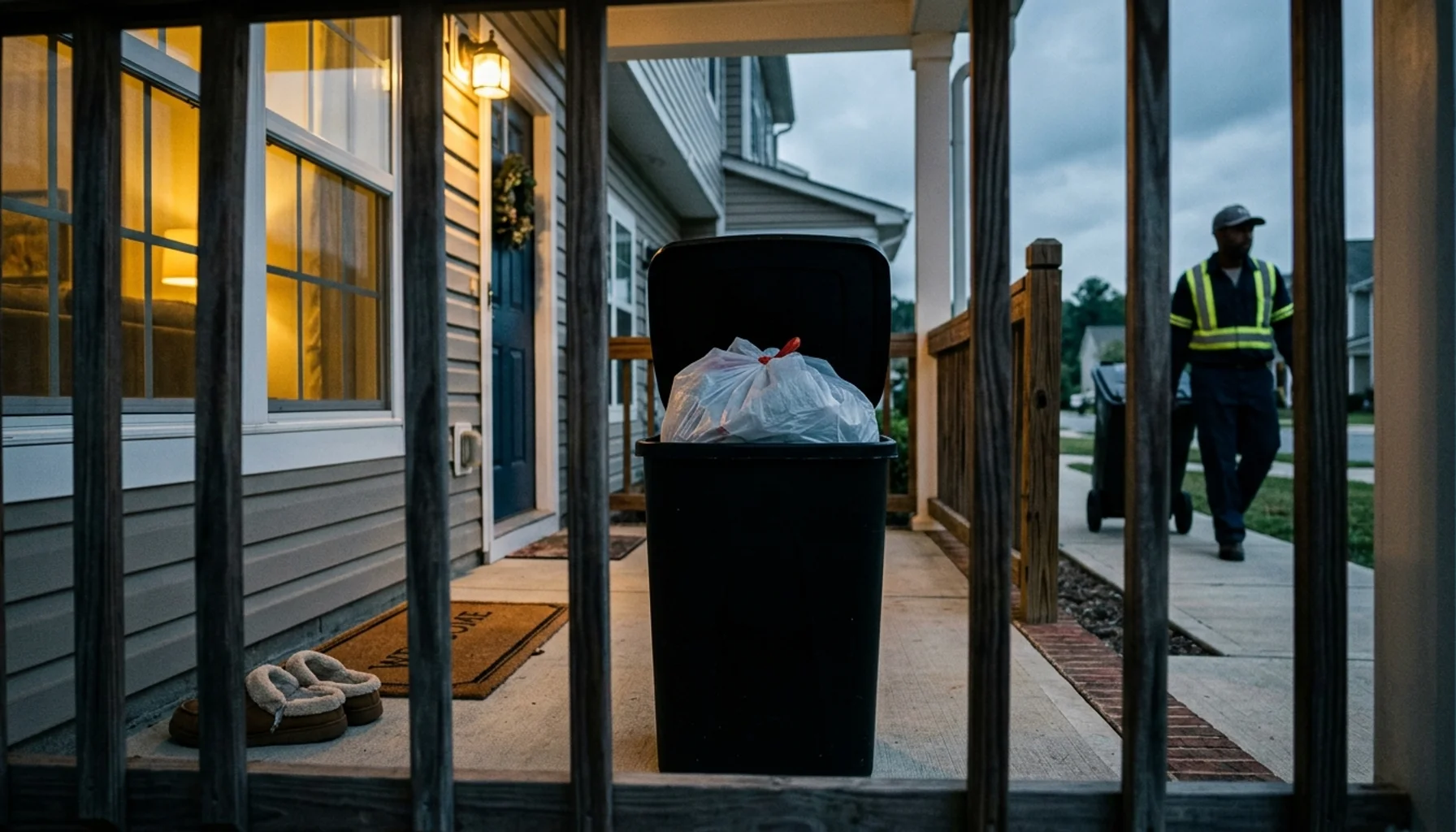
Doorstep trash collection is a service where a crew picks up bagged household waste directly from outside a resident's front door, usually several nights a week, and hauls it to a central dumpster or compactor. It's the multifamily and residential answer to rolling bins to the curb yourself, and in 2026 it's become a standard amenity across Charleston-area apartment communities and a growing option for individual homeowners.
- Doorstep trash collection typically runs on a nightly schedule, often five nights a week, with crews collecting bagged waste from unit doors between early evening and around 10 p.m.
- Most providers issue a standard 13-gallon container for residents to bag trash and set outside during a designated window before pickup.
- Residential valet trash in select Charleston, SC neighborhoods starts from $49 per month, while multifamily and portfolio pricing is typically quote-based per unit.
- According to the National Multifamily Housing Council, more than half of U.S. apartment communities now offer valet trash as a resident amenity.
- Photo verification at each door has become the industry standard for proving service completion without a property manager needing to follow up.
- Trash Day Made Easy provides nightly, photo-verified doorstep-to-dumpster collection across North Charleston, Charleston, and the surrounding metro, scaling from single homes to 1,000-plus unit portfolios.
If you manage a multifamily community near the Rivers Avenue corridor, oversee a build-to-rent portfolio on Daniel Island, or just want to stop wrestling your own bins to the curb in James Island, doorstep trash collection solves a specific, recurring headache. This guide breaks down exactly how the service works, what it costs, what rules residents need to follow, and how to evaluate a provider before you sign anything.
At Trash Day Made Easy, we've built our entire operation around one idea: waste coordination shouldn't be something a property manager or homeowner has to think about. Based at 4900 O'Hear Avenue in North Charleston, we've watched this service evolve from a niche luxury perk into a baseline expectation for resident-facing communities across Charleston, SC and Atlanta, GA. What follows is a practical look at how doorstep trash collection actually works in 2026, not a marketing pitch dressed up as an FAQ.
What Is Doorstep Trash Collection?
Doorstep trash collection is a scheduled service in which a waste crew retrieves bagged garbage directly from outside a resident's unit door and transports it to a central dumpster or compactor, rather than requiring the resident to carry it out themselves. The model is standard in multifamily communities but has expanded into build-to-rent developments, HOA neighborhoods, and individual homes across the Charleston metro.
Specifically, the service works on a subscription basis: a property or homeowner pays a recurring fee, and a crew shows up on set nights to collect. As a result, residents never have to track a municipal pickup calendar or haul bags to a dumpster across a parking lot. According to National Trash Valet's industry overview, doorstep collection is one of the few amenities that nearly every resident actually uses, unlike a pool or fitness center that sits empty half the year.
The distinction matters for property managers evaluating amenities against actual usage. A gym might get used by 20% of residents; doorstep trash collection gets used by nearly everyone with a working kitchen. That universal utilization is exactly why it shows up so consistently in lease renewal conversations and resident satisfaction surveys across Charleston multifamily communities in 2026.
What Is Door to Door Trash Pick Up?
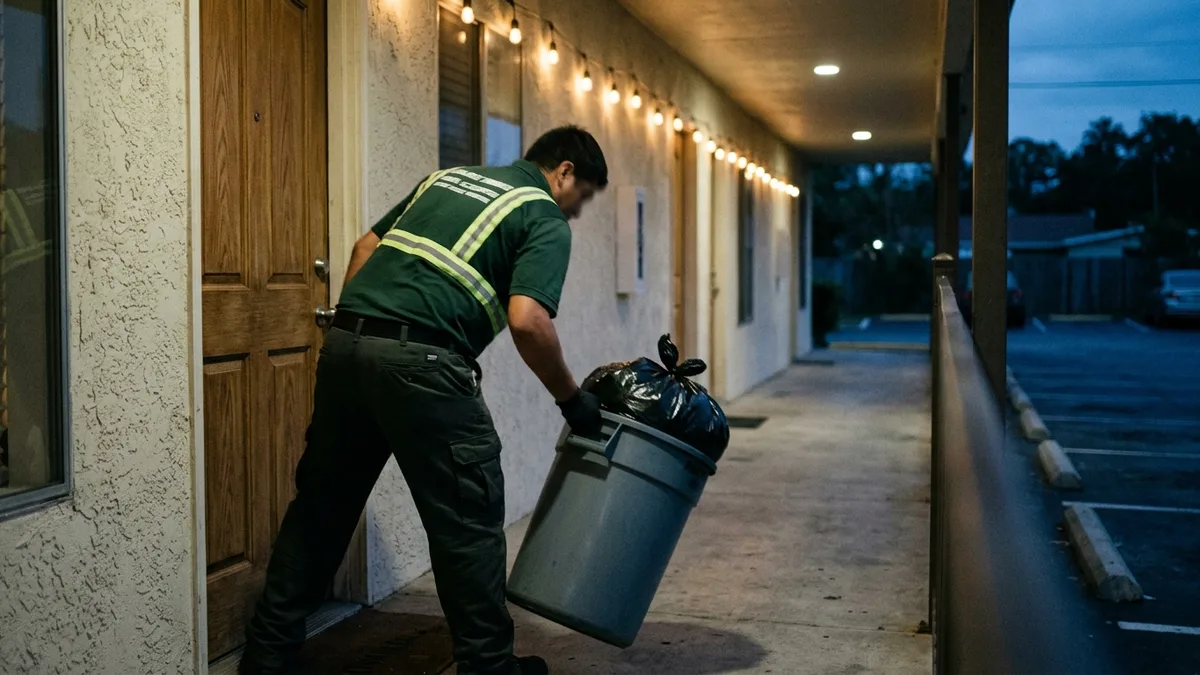
Door to door trash pickup means the exact same thing as doorstep collection: a crew retrieves waste from the resident's actual door rather than a shared curbside bin. The term is used interchangeably across the industry, though "door to door" is more common in casual search queries while "valet trash" and "doorstep collection" dominate industry and property management language.
For multifamily properties, door to door trash pickup usually follows a nightly or near-nightly cadence. Industry documentation reviewed for this guide describes typical windows running from roughly 6 p.m. to 8 p.m. for resident set-out, with collection beginning promptly at 8 p.m. and continuing until around 10 p.m., Sunday through Thursday. Residents who miss the window typically have to wait for the next scheduled night. Most programs also set a return deadline: containers generally need to come back inside the unit by 9 a.m. the following morning. Leaving a container out past that window, or setting it out during daylight hours, is the most common resident violation property managers report, and it's the detail that separates a well-run community from one where hallways look cluttered by mid-morning.
For build-to-rent communities near the airport corridor or Daniel Island, where units are spread across a walkable but non-stacked footprint, door to door pickup needs a slightly different routing approach than a single apartment building. This is one of the reasons a provider's route density and local familiarity actually matters, not just their national brand recognition.
What Rules Apply to Residents Using Doorstep Trash Collection?
Doorstep trash collection rules typically require residents to bag waste securely, avoid oversized items, and set containers out only during the designated evening window. These rules exist to prevent leaks, pest issues, and blocked walkways, and most communities enforce them through lease addendums tied to the valet trash program.
Specifically, the standard rule set across the industry includes:
- Bags must be tied and leak-proof. Loose trash, ripped bags, or liquid-leaking containers are typically refused for collection.
- No oversized items. Furniture, televisions, large boxes, and other bulk items generally cannot go in the standard container; they require a separate bulk item removal request.
- Cardboard must be flattened. Unflattened boxes take up disproportionate space in a 13-gallon bin and often get rejected.
- Containers go out during the set window only. Setting out trash before or after the designated hours, commonly a two-hour evening window, risks a missed pickup or a violation notice.
- Containers come back inside by morning. Most programs require residents to bring the empty container back in by around 9 a.m., and some property managers issue fines, sometimes up to $25, for containers left out during daylight hours.
As a result, the rules aren't arbitrary; they exist because a hallway full of trash bags at 7 a.m. undermines the entire point of the amenity. A well-communicated rule set, ideally covered in the lease and reinforced with a resident handout, is what separates a program residents respect from one that generates complaints. If you're drafting resident-facing guidelines for a Charleston property, our guide on what apartment renters should know about trash valet services covers language you can adapt directly.
Can Apartments Force You to Pay for Valet Trash?
Whether an apartment community can require residents to pay for valet trash depends on state and local law, as well as how the fee is structured in the lease. In many markets, including South Carolina, property owners can bundle a valet trash fee into the lease as a mandatory amenity fee, similar to how pest control or a package locker fee might be structured, provided it's disclosed clearly before signing.
Specifically, the legality generally comes down to disclosure and consistency. If every unit in the community is charged the same fee and it's clearly stated in the lease agreement or an addendum signed at move-in, mandatory valet trash fees are common practice and rarely challenged. Problems tend to arise when a fee is added mid-lease without notice or applied inconsistently across units. For property managers in Charleston, Mount Pleasant, or Summerville considering a mandatory versus optional model, the mandatory approach is almost always simpler operationally. Optional programs create routing headaches: a crew has to know which doors participate and which don't, which slows collection and increases the odds of a missed pickup. Communities that make valet trash universal report fewer resident disputes than those that offer it as an opt-in add-on, since there's no ambiguity about who's included.
If you're evaluating whether to make the service optional, our guide to valet garbage services for property managers walks through the operational trade-offs in more depth.
How Much Do People Charge for Trash Removal?
Trash removal and doorstep collection pricing varies by property type, but published industry pricing guides put multifamily valet trash service in a range of roughly $8 to $15 per unit per month for the property owner, while residents in fee-pass-through models are commonly charged somewhere between $25 and $35 per month. Residential standalone service tends to be priced differently, since there's no shared route density to lean on.
For residential homeowners in select Charleston, SC neighborhoods, Trash Day Made Easy offers doorstep valet trash service starting from $49 per month, a flat, predictable rate rather than a per-visit or per-bag charge. Multifamily, build-to-rent, HOA, and portfolio pricing is quote-based, since factors like unit count, route density, and service frequency all affect the final number. We provide quotes Monday through Friday for any property type.
Bulk item removal, turnover trash handling between residents or guests, and move-in and move-out support are typically priced separately from the core nightly collection fee, since they're on-demand rather than scheduled. A single abandoned sofa left in a breezeway on move-out day isn't a routine collection issue, and pricing it into the base rate would inflate costs for everyone else in the community.
The table below breaks down typical pricing structures across service types, based on published industry benchmarks and our own quoting experience across Charleston and Atlanta.
| Service Type | Typical Pricing Structure | Who Pays |
|---|---|---|
| Multifamily nightly valet trash | Roughly $8 to $15 per unit, per month (property side) | Property owner, often passed to residents at $25 to $35/month |
| Residential doorstep service (Charleston) | Starting from $49 per month, flat rate | Homeowner |
| HOA trash can concierge (backdoor to curbside) | Quote-based, tied to unit count and frequency | HOA or individual homeowner |
| Bulk item removal / turnover trash | Priced per pickup, on-demand | Property manager, STR operator, or resident |
| Portfolio waste operations (10 to 1,000+ units) | Custom quote by portfolio scope | Portfolio owner or operator |
What Is the Cheapest Way to Get Rid of Junk for Free?
The cheapest way to get rid of household junk without paying a hauling fee is typically through municipal bulk item pickup days, donation drop-offs, or curbside "free" listings, though these options come with real limitations that make them impractical for property managers and frequent-turnover operators. For residents in North Charleston, the City's Environmental Management Department schedules limited bulk collection windows, but these don't run on the frequency a make-ready timeline demands.
Specifically, the free options break down like this: municipal bulk pickup usually requires advance scheduling and only runs a few times a year per household, donation centers won't take damaged furniture or non-resellable items, and curbside "free" postings depend entirely on someone showing up to haul the item away, which can leave debris sitting for days. None of these are reliable enough for a property manager working against a turnover deadline. This is exactly where the free options fall apart for our audience. A property manager can't afford to have a couch sit in a breezeway for a week waiting on a municipal bulk pickup date, and an HOA board can't rely on a neighbor's Facebook post to clear a move-out pile before the next resident's walkthrough. That gap between "technically free" and "operationally reliable" is why bulk item removal exists as a paid, on-demand service in the first place. Trash Day Made Easy integrates bulk item and turnover trash removal directly into make-ready cycles across Charleston and Atlanta, so debris doesn't become the community's problem to babysit.
How Does Doorstep Trash Collection Affect Resident Retention and Property Appeal?
Doorstep trash collection directly affects resident satisfaction and lease renewal conversations because it's one of the few amenities nearly every resident interacts with daily, unlike a pool or clubhouse that sits unused for months. According to the National Apartment Association, valet trash-style amenities are consistently cited among factors that influence renewal decisions in competitive multifamily markets. This is one of the biggest content gaps in most articles on this topic: they explain how the pickup works but never connect it to the business outcome property managers actually care about. Overflowing dumpsters and cluttered hallways near a submarket like the Rivers Avenue corridor don't just look bad in a walkthrough; they show up in online reviews and factor into whether a resident renews or moves to a competing community down the street. A consistent, photo-verified doorstep program removes that variable entirely.
For build-to-rent developments and apartment community investors, framing waste management as a curb-appeal and NOI issue rather than a maintenance checkbox changes how the service gets budgeted. We've seen owners across our Charleston and Atlanta portfolio treat doorstep collection as a retention tool once they see the hallway and dumpster-area difference firsthand, not just a line item on an operating statement.
How Do You Choose a Doorstep Trash Collection Provider?
Choosing a doorstep trash collection provider comes down to five factors: service consistency, verification method, scalability, response flexibility for bulk and turnover needs, and local market knowledge. A provider that scores well on all five will eliminate resident complaints almost entirely; one that's weak on even one will create ongoing friction for your property management team.
Here's the checklist we recommend property managers and portfolio operators actually use:
- Ask how service completion is verified. Photo verification at each door, not just a driver's word, is the current industry standard. Without it, you have no documentation if a resident disputes a missed pickup.
- Confirm the schedule and time window. Nightly service, typically five nights a week, is the baseline expectation in 2026. Twice-weekly service tends to generate more complaints in warm-weather markets like Charleston.
- Check scalability. Can the provider handle your portfolio if it grows from 40 units to 400? A single-community vendor may not have the route capacity.
- Ask about on-demand services. Bulk item removal, turnover trash, and move-in/move-out support should be available without a separate vendor relationship.
- Evaluate local responsiveness. A Charleston-based team that knows the Historic District's short-term rental density or Sullivan's Island's proximity codes will route and respond faster than a national call center.
- Review the resident rule set. Make sure the provider's bagging, sizing, and time-window rules are clear enough to put directly into a lease addendum.
Other companies in this space include national operators alongside regional providers, and comparison resources like Property Manager Insider's FAQ on valet trash or the Valet Living official site can give you a sense of how larger national programs structure their offerings. But for portfolios concentrated in the Charleston metro, a locally rooted operator that already understands submarkets like James Island, Daniel Island, and the airport corridor typically routes more efficiently than a national brand managing your community from a regional call center.
What Makes Trash Day Made Easy the Right Choice for Doorstep Trash Collection?
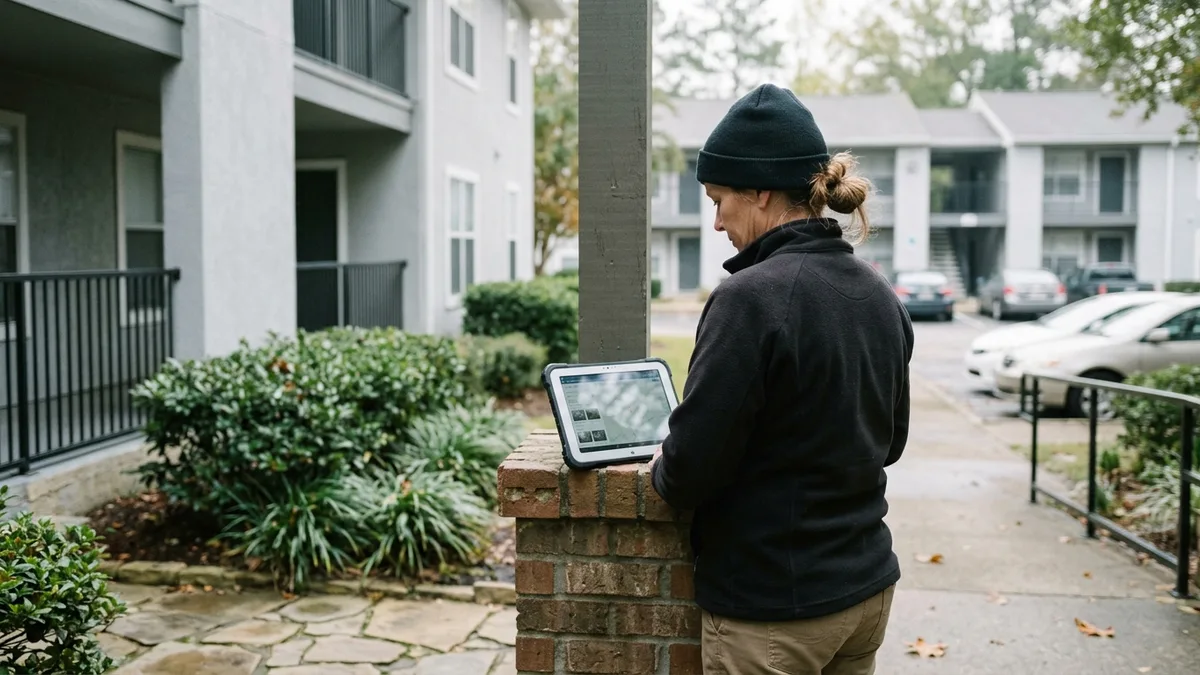
Trash Day Made Easy provides nightly, photo-verified doorstep-to-dumpster valet trash collection for multifamily communities, build-to-rent developments, short-term rental properties, HOAs, and residential homeowners across Charleston, SC and Atlanta, GA. Every service visit is documented with a photo at the door, giving property managers proof of completion without ever needing to follow up or issue a reminder. Headquartered at 4900 O'Hear Avenue in North Charleston, our team is built specifically for scalability: we service portfolios ranging from a single home to more than 1,000 units, and we maintain the same service standard at every door regardless of portfolio size. That matters if you're a scattered-site owner managing properties spread across North Charleston, James Island, and Summerville, because a patchwork of city pickup schedules and inconsistent vendor coverage becomes unmanageable as a portfolio grows past a handful of addresses.
Beyond routine nightly collection, we handle turnover trash between residents or guests, bulk item removal, and move-in and move-out support, which makes us particularly useful for short-term rental operators near the Charleston Historic District and Isle of Palms, where a single missed pickup between guest stays can trigger a bad review. On-demand property waste support covers the situations that don't fit a fixed schedule: a sudden bulk item, an unexpected turnover, or a community event cleanup.
For residential homeowners in select Charleston neighborhoods, our service starts from $49 per month, and we partner with The Bin Boy, a Charleston-based bin cleaning and sanitizing service, so residents get the full range of waste care, not just pickup. HOA boards get a trash can concierge option that moves bins from backdoor storage to the curb and back automatically, removing the enforcement burden entirely. We offer service quotes Monday through Friday across every property type we serve, from a single-family home to a 1,000-unit multifamily portfolio.
Other options exist in the market, including national operators and a handful of regional providers, but few combine local Charleston market knowledge with photo-verified accountability at the scale we operate. If you're comparing us against other companies for a multifamily contract or a residential quote, ask any competitor directly whether every single door gets photo-documented every single night. That's the standard we hold ourselves to.
Doorstep Trash Collection vs. Standard Dumpster Service: Which One Actually Works?
Standard dumpster service requires residents to carry their own trash to a shared dumpster or compactor, while doorstep trash collection removes that step by having a crew retrieve waste directly from the unit door. For most multifamily and build-to-rent communities in 2026, doorstep collection produces cleaner hallways, fewer overflow complaints, and a noticeably better resident experience, though it does come at an added monthly cost.
The comparison below breaks down where each model actually performs better.
| Factor | Standard Dumpster Service | Doorstep Trash Collection |
|---|---|---|
| Resident effort | Resident carries trash to a shared location | Resident sets bag outside their own door |
| Overflow risk | Higher, especially on weekends | Lower, due to nightly scheduled removal |
| Verification | None, typically | Photo-verified at each door with most providers |
| Cost to property | Lower, often included in base waste contract | Additional monthly per-unit fee, often passed to residents |
| Amenity value | Minimal | High; near-universal resident usage |
| Best fit | Budget-constrained properties, low-turnover assets | Class A/B multifamily, BTR, STR, HOA communities |
Communities near the Rivers Avenue corridor, where operational efficiency directly affects net operating income, tend to see the clearest return from switching to doorstep collection, since dumpster overflow in high-density communities is a recurring, visible problem. Lower-density or budget-focused properties may find standard dumpster service adequate, particularly if resident turnover is low and complaints are rare.
Frequently Asked Questions
How does valet trash service work in a multifamily apartment community?
Residents place bagged trash in a standardized container outside their door during a set evening window, typically a two-hour block before collection begins. A crew retrieves each container on a scheduled route, photo-documents the pickup, and the property manager gets confirmation without any follow-up required.
What is a trash can concierge and how is it different from standard valet trash service?
A trash can concierge, also called backdoor-to-curbside bin management, moves a resident's existing bin from storage to the curb on collection day and back afterward. It's built for HOA communities and residential homeowners rather than apartment doors, and it requires zero action from the resident.
Can valet trash service be added to a short-term rental property in Charleston?
Yes. On-demand and turnover-specific trash service is common for short-term rental properties near the Charleston Historic District, Isle of Palms, and Sullivan's Island. It's designed around unpredictable guest schedules rather than a fixed weekly cadence, and it integrates with cleaning and make-ready workflows between stays.
How does photo-verified waste collection work and why does it matter for property managers?
Every service stop is photographed at the point of collection, creating a documented record without requiring the property manager to follow up. This protects both the resident and the provider if a dispute arises over a missed pickup and gives property managers a paper trail for renewal or lease-compliance conversations.
What does Trash Day Made Easy charge for residential valet trash service?
Residential doorstep service starts from $49 per month in select Charleston, SC neighborhoods. Multifamily, HOA, build-to-rent, and portfolio pricing is quote-based since unit count and service frequency affect the final rate. Quotes are available Monday through Friday at trashdaymadeeasy.com.
Can one waste vendor handle service across an entire property portfolio in Charleston and Atlanta?
Yes. Trash Day Made Easy is built specifically for portfolio scalability, servicing anywhere from 10 to more than 1,000 units with a consistent service standard across every property. That means a single point of contact instead of coordinating separate vendors for valet trash, bulk removal, and bin management.
What is the cheapest way to get rid of junk for free?
Municipal bulk item pickup days and donation drop-offs are the closest thing to free junk removal, but both come with real limits: infrequent scheduling, item restrictions, and no guarantee of timely pickup. For property managers working against a turnover deadline, these free options rarely fit the timeline, which is why on-demand bulk item removal exists as a paid service.
What is the difference between doorstep trash collection and a national valet trash provider?
A locally rooted provider like Trash Day Made Easy offers direct Charleston market knowledge, photo-verified accountability on every service night, and flexible on-demand options for bulk and turnover trash. National providers offer scale but often route through regional call centers rather than a team with direct familiarity with local submarkets.
Conclusion: Is Doorstep Trash Collection Worth It in 2026?
Doorstep trash collection has moved from a luxury perk to a near-standard expectation across multifamily, build-to-rent, and HOA communities in the Charleston metro, and the data backs that shift: it's one of the only amenities nearly every resident actually uses. Whether you're managing 40 units near the Rivers Avenue corridor or trying to stop rolling your own bins out on James Island, the core value proposition is the same: nightly, verified collection removes an entire category of resident friction.
Waste management rarely fails because of one bad decision; it fails because there's no system running without constant manager attention. A well-structured doorstep trash program, with nightly collection, photo verification, and flexible on-demand support for bulk and turnover needs, takes that burden off your plate entirely. Get started with Trash Day Made Easy serves portfolios and homeowners across Charleston, North Charleston, and Atlanta with exactly that kind of consistency.
If you're ready to stop chasing trash complaints and start seeing documented proof of service at every door, request a service quote at Trash Day Made Easy, available Monday through Friday for multifamily communities, build-to-rent developments, HOAs, short-term rentals, and residential homeowners across Charleston, SC and Atlanta, GA.
Content powered by inkSTR.co