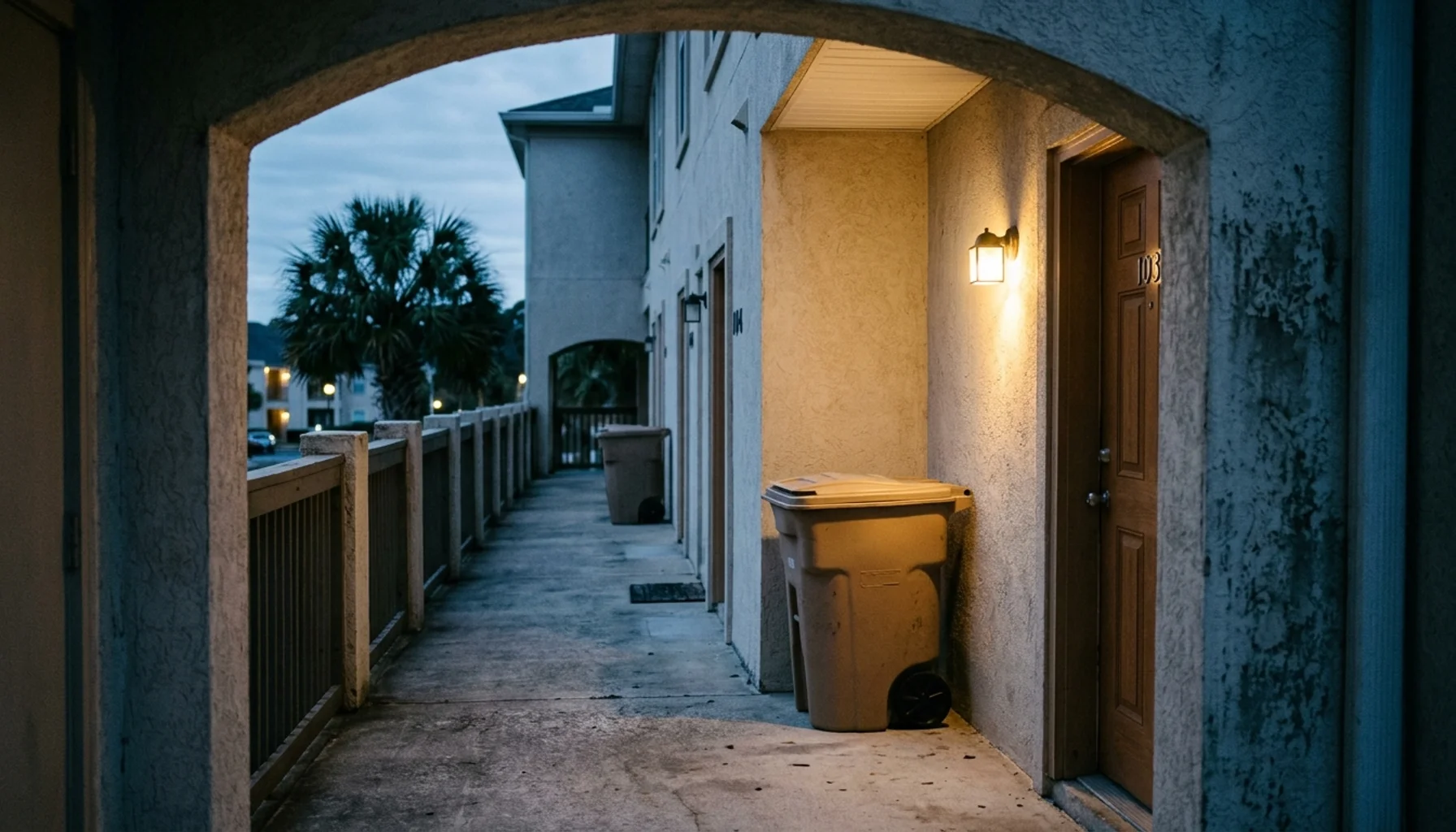
Nightly doorstep trash pickup for apartments works by having residents set bagged trash outside their door during a designated evening window, typically between 6:00 PM and 8:00 PM, and a valet crew collects each bag, carries it to the dumpster or compactor, and photo-documents the stop before moving to the next unit. The process repeats five to seven nights a week depending on the community's contract.
Key Takeaways
- Most nightly doorstep trash programs use a resident set-out window of roughly 6:00 PM to 8:00 PM, with collection crews working through the property after that window closes.
- Industry pricing guidance for 2026 places valet trash billing at approximately $8 to $15 per apartment door per month for the property, based on published guidance from Doorstep One citing pricing data from other providers in the industry.
- Standard service commonly runs five nights per week, often Sunday through Thursday, though some communities contract for seven-night coverage.
- Photo verification at each door has become the industry standard for documenting completed service without requiring property managers to follow up or issue reminders.
- Common exclusions across the industry include loose (unbagged) trash, overweight bags, hazardous materials, and bulk furniture, which typically require a separate on-demand pickup.
- Container retrieval deadlines usually fall around 9:00 AM the next morning, which matters for hallway safety and fire code compliance.
If you manage a multifamily community anywhere from the Rivers Avenue corridor in North Charleston to a build-to-rent development near Daniel Island, you already know what happens when trash coordination falls apart. A resident forgets to bring their bin to the curb. Another leaves a bag sitting in the breezeway for two days. By the time someone complains, the dumpster area already looks bad for the next prospective renter walking the property.
Nightly doorstep trash pickup, often called valet trash service, exists to solve exactly that problem. Instead of residents hauling their own trash to a shared dumpster on their own schedule, a dedicated crew comes to each door on a set nightly schedule and moves everything to final disposal. Some providers run this exact workflow every night across multifamily communities, build-to-rent developments, and short-term rental properties throughout Charleston, SC and Atlanta, GA, and the mechanics are more specific than most people assume before they've dealt with it firsthand.
This guide breaks down exactly how the process works, from the moment a resident sets out a bag to the photo confirmation that lands in a property manager's inbox the next morning. We'll cover the set-out window, what happens in buildings with elevators or gated access, what gets excluded from nightly service, and how to troubleshoot a missed pickup before you assume the vendor dropped the ball.
How Does Trash Collection Work in an Apartment Community?
Trash collection in an apartment community typically follows one of two models: residents haul their own bags to a central dumpster on their own schedule, or a valet trash provider collects bagged waste directly from each unit's door on a nightly basis. As of 2026, valet trash has become a common amenity in many mid-size and large multifamily communities, particularly in competitive rental markets like Charleston and Atlanta.
In the self-haul model, the property maintains a shared dumpster or compactor, and residents are responsible for timing their own trips. This works fine in smaller communities but breaks down as unit counts grow. First, residents procrastinate. Second, dumpster areas near the Rivers Avenue corridor and similar high-density corridors fill up fast between city pickups, leading to overflow.
Doorstep collection flips the model. A crew walks the property on a fixed nightly route, picking up from each unit that has set out trash, then consolidates everything at the dumpster or compactor. The property pays a flat monthly rate per door instead of relying on resident compliance. This is the model behind nightly valet trash programs offered by other providers, and it's the reason more Charleston-area property managers have shifted toward it over the last several years.
How Does Valet Trash Work in Apartments Step by Step?
Valet trash works through a five-step nightly cycle: residents bag and set out trash during a designated window, a collection crew walks the property, each unit is collected and photo-documented, waste is transported to the dumpster or compactor, and empty containers are returned the following morning. The entire cycle repeats on every scheduled service night.
Step 1: Resident Sets Out Trash
Residents place securely bagged and tied household trash inside a provided container, typically a 13-gallon bin, outside their unit door. This set-out window commonly runs from around 6:00 PM to 8:00 PM, though some communities and providers set an 8:00 PM start time instead. Loose trash without a bag is generally not collected.
Step 2: Crew Walks the Route
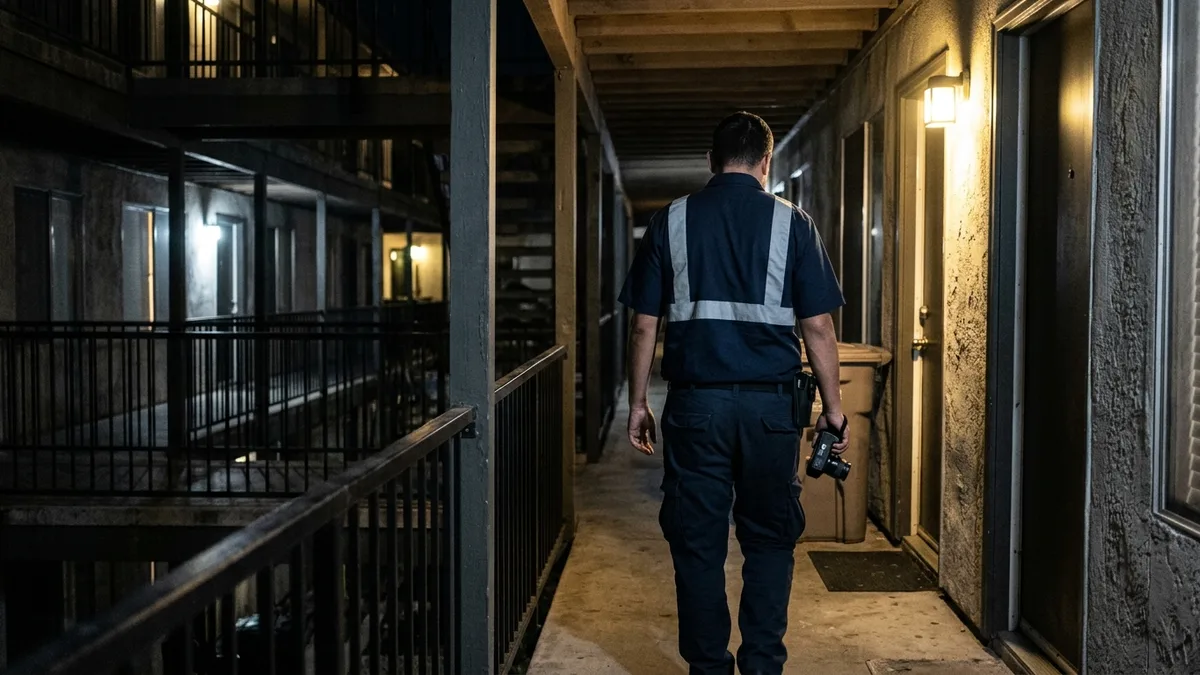
A collection crew arrives after the set-out window closes and works a fixed route through the property, hitting every building or breezeway on the schedule. In larger communities with 200 or more units, this route is planned in advance to account for elevators, stairwells, and gated access points.
Step 3: Photo Verification
Each stop is documented with a timestamped photo showing the door and confirming the pickup occurred. This is the single biggest operational shift in valet trash over the past several years. Photo verification means property managers no longer have to take a vendor's word for it. At many providers, this is standard on every single visit, not an add-on.
Step 4: Transport and Disposal
The crew carries collected bags, usually in leak-resistant containers or carts, to the property's dumpster or compactor. Reputable crews also sweep loose debris around the dumpster area as part of the visit, since a clean dumpster corral matters just as much to curb appeal as clean hallways.
Step 5: Container Return
Empty containers are returned to the resident's door, typically by around 9:00 AM the next morning. Residents are generally expected to bring the empty container back inside promptly, since bins left in hallways create fire code and accessibility problems.
What Is the Difference Between the Set-Out Window and the Collection Window?
The set-out window is the timeframe when residents are expected to place their bagged trash outside their door, while the collection window is when the crew actually arrives to pick it up. These two windows are not the same, and confusing them is one of the most common sources of resident complaints about missed pickups.
For example, a community might specify a set-out window of 6:00 PM to 8:00 PM. That doesn't mean the crew arrives at exactly 8:01 PM. In a 150-unit community, the route might take an hour or more to complete depending on building layout, elevator access, and weather. Residents who set trash out at 7:55 PM in a large complex might not see collection until closer to 9:00 PM, and that's normal, not a missed pickup.
This distinction matters operationally because it affects how property managers should respond to complaints. If a resident reports "no one picked up my trash" at 8:15 PM, the first question isn't whether the vendor failed. It's whether the route had reached that building yet. Clear communication about both windows, ideally posted in the resident portal or lease addendum, prevents most of these misunderstandings before they escalate into a support ticket.
Why Is My Trash Bill or Amenity Fee So High in an Apartment?
Apartment trash or amenity fees reflect the flat monthly cost the property pays per unit for valet trash service, which is then either absorbed into rent, charged as a separate line-item amenity fee, or split between the two depending on the community's lease structure. Published 2026 industry pricing guidance places property-level billing at roughly $8 to $15 per apartment door per month, according to figures reported by Doorstep One citing pricing data from other providers in the industry.
Resident-facing charges are often separate from what the property pays the vendor, and they can run higher once the property adds its own markup or bundles it with other amenities like pest control or package lockers. Whether valet trash participation is mandatory, and whether the fee is optional, depends entirely on the individual lease and the property's management policy, not on any citywide standard.
If a resident feels their trash fee is disproportionate to the service received, the fastest resolution path is checking the lease addendum for what's included, then asking property management directly whether the fee covers valet pickup only or a bundle of amenities. In our experience across Charleston multifamily communities, most fee confusion traces back to residents not realizing the fee bundles multiple services rather than valet trash alone.
| Cost Component | Typical Range (2026) | Who Pays |
|---|---|---|
| Property-level valet trash billing (per door, monthly) | Approximately $8 to $15 | Property/owner, per published 2026 industry pricing guidance |
| Residential valet trash (select Charleston neighborhoods) | Starting from $49 per month | Homeowner directly |
| Bulk item or on-demand removal | Quote-based | Property, HOA, or resident depending on situation |
| Bin cleaning and sanitizing add-on | Quote-based through partner service | Resident or homeowner opt-in |
What Happens in Buildings With Elevators, Gated Access, or Long Walks to the Dumpster?
Buildings with elevators, interior corridors, gated access, or long walking distances to the dumpster require route adjustments that directly affect how long a collection cycle takes and, in some cases, what a property is quoted. A three-story walkup community with exterior breezeways collects far faster than a mid-rise with a single elevator bank serving 80 units.
Specifically, elevator-dependent buildings create bottlenecks. If a crew has to wait for a single elevator to move carts between floors, the route naturally slows down, and residents on higher floors may see later pickups within the collection window. Gated communities add another variable: crews need reliable access codes or key fobs, and any gate malfunction can delay an entire route.
Weather exposure matters too. Communities with exposed exterior corridors near the coast, including properties on Sullivan's Island or Isle of Palms, deal with wind and rain affecting both the crew's pace and the condition of bags left out too long. Distance to the dumpster or compactor is the final factor. Communities on larger footprints, common in build-to-rent developments near the airport corridor, mean more time between doors and disposal, which is why route planning is not one-size-fits-all across a scattered-site portfolio.
What Items Get Excluded From Nightly Doorstep Pickup?
Nightly doorstep trash pickup excludes loose (unbagged) trash, overweight bags, hazardous materials, and bulk furniture in nearly every valet trash program, regardless of provider. These exclusions exist for safety, liability, and route-efficiency reasons, not arbitrary policy.
Hazardous exclusions commonly include chemicals, paint, automotive fluids, medical sharps, hot ashes, and other flammable or regulated materials. A crew member carrying a cart through a dark breezeway cannot safely handle leaking liquids or sharp objects, and most municipal waste rules prohibit these items from regular collection anyway. Bags that are torn open or clearly overweight, often anything exceeding a set weight threshold like 25 pounds, also get skipped for the same reason.
Bulk furniture, mattresses, and large move-out debris require a separate on-demand pickup rather than nightly service. This is where turnover trash removal and bulk item programs come in. This is exactly the gap on-demand bulk item removal and move-in/move-out support is built to close, especially for short-term rental turnovers and multifamily make-ready cycles where a couch left in a breezeway can hold up the next resident's move-in by a full day.
What Should You Do If a Doorstep Pickup Gets Missed?
A missed doorstep pickup should be investigated using a simple troubleshooting sequence before assuming the vendor failed: verify the set-out time and container compliance, check whether the route had completed for that building, review photo or app records, then escalate to the vendor if the issue persists. Most reported "missed pickups" resolve at step one or two.
Troubleshooting Checklist
- Confirm the resident set trash out within the designated window, properly bagged and tied, in the correct container.
- Check whether the bag was overweight, torn, or contained an excluded item that would have caused the crew to skip it.
- Verify the route timing for that specific building. In larger communities, later units on the route naturally see later collection times within the window.
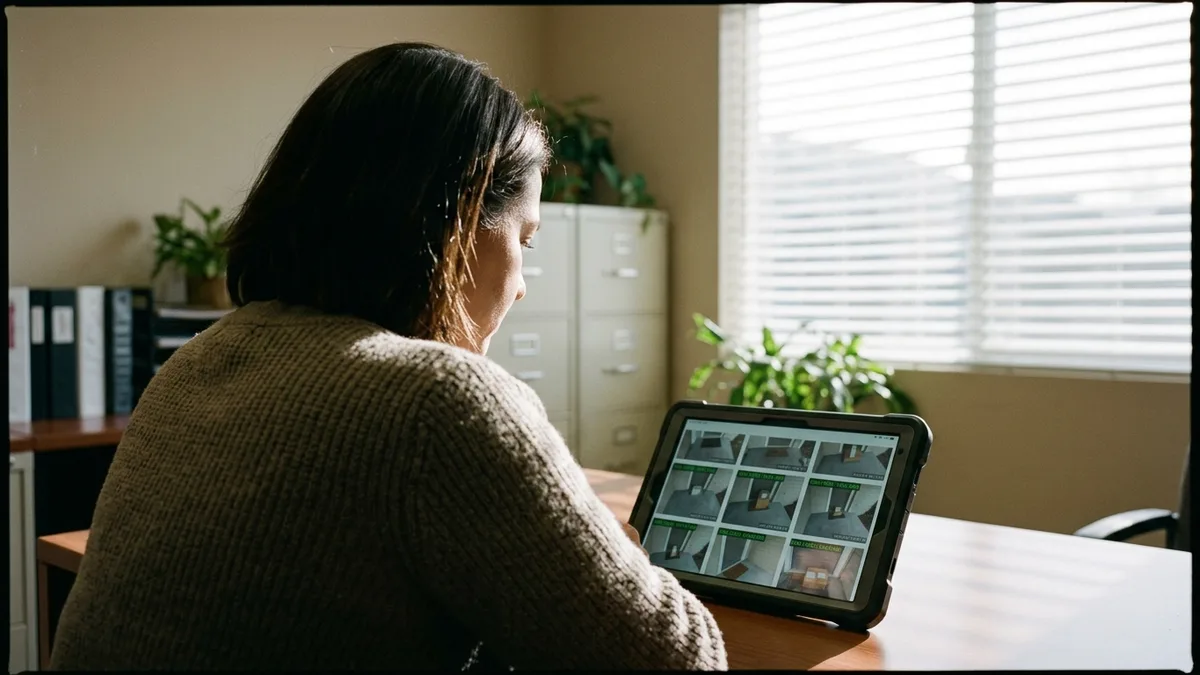
- Review the photo verification record for that unit and date. A photo-verified system like the ones many providers run on every visit removes the guesswork here entirely.
- If the photo record shows no visit occurred, contact the vendor directly with the unit number and date rather than escalating to a general complaint.
Property managers who build this checklist into their resident-facing FAQ or portal reduce support tickets significantly, because most "missed pickup" reports turn out to be set-out timing issues rather than genuine service failures. This is also where documented photo verification protects both the resident and the vendor when disputes come up.
What Are the Accessibility and Safety Considerations for Doorstep Trash Service?
Accessibility and safety considerations for doorstep trash service include maintaining unobstructed egress paths, keeping fire equipment and stairwells clear, and accommodating residents who cannot physically move a container to their door. These factors are often overlooked in generic valet trash coverage, but they matter for both compliance and resident wellbeing.
Fire code compliance is the biggest operational constraint. Containers, whether full or empty, cannot sit in front of stairwell doors, fire extinguisher cabinets, or designated egress paths for extended periods. This is exactly why the 9:00 AM container-return deadline exists industry-wide: it limits how long an empty bin can occupy hallway space before it becomes a hazard.
For residents with mobility limitations, some property managers arrange direct coordination with the vendor for closer pickup points or flexible timing, since a standard doorstep window assumes the resident can physically set out and retrieve a container. HOA communities and BTR developments serving a mix of resident ages should build this accommodation into their service agreement upfront rather than handling it reactively after a complaint.
How Does Nightly Trash Service Differ From Recycling, Bulk, and Move-Out Programs?
Nightly doorstep trash service covers only standard bagged household waste on a fixed nightly schedule, while recycling, bulk-item removal, holiday collection, and move-out debris each typically operate as separate programs with different schedules, rules, and sometimes different responsible parties. Confusing these categories is one of the most common operational mistakes we see across Charleston and Atlanta portfolios.
| Waste Category | Typical Schedule | Who Handles It |
|---|---|---|
| Standard nightly trash | 5 to 7 nights per week | Valet trash vendor, doorstep to dumpster |
| Recycling | Varies by community, often weekly or every other week | Valet vendor if contracted, or resident self-haul |
| Bulk furniture and mattresses | On-demand or scheduled pickup | Separate bulk removal service |
| Move-in and move-out debris | Tied to lease turnover dates | Turnover trash removal, integrated with make-ready cycle |
| Hazardous materials | Not included in standard service | Municipal hazardous waste program or specialty disposal |
A managed waste operations program is built to cover this entire matrix under one vendor relationship instead of forcing a property manager to coordinate three or four separate vendors. That's the model many full-service providers run for portfolios ranging from a handful of build-to-rent homes to communities exceeding 1,000 units, treating bulk removal and turnover trash as extensions of the same relationship rather than a separate transaction every time.
How Does a Garbage Disposal Work Alongside Doorstep Trash Pickup in an Apartment?
An in-sink garbage disposal handles food waste and soft organic scraps through the kitchen plumbing, while doorstep trash pickup handles bagged household waste that gets carried out of the unit entirely. These two systems work independently and don't overlap, though they're often confused since both reduce how often a resident has to physically deal with trash.
A disposal unit grinds food scraps that go down the drain, which reduces the volume and odor of kitchen trash but doesn't eliminate it. Packaging, non-food waste, and anything that can't go down a drain still needs to be bagged and set out during the property's designated collection window. Residents who rely heavily on their disposal sometimes assume they need less frequent trash service, but nightly valet pickup is priced and scheduled at the unit level regardless of how much any individual resident generates on a given night.
Practical Guidance: What to Prioritize When Evaluating a Valet Trash Vendor
Choosing a valet trash vendor comes down to verifying operational accountability before signing a multi-year contract, since standard agreements in this industry commonly run 36 to 60 months. Getting this wrong locks a property into years of resident complaints.
- Ask how service completion is documented. Photo verification at every door, not spot checks, is the standard worth demanding in 2026.
- Confirm the collection schedule matches your community's needs. Five nights weekly works for most communities; higher-turnover properties or larger footprints may need seven-night coverage.
- Understand exclusions clearly. Get a written list of what's excluded from nightly service and how bulk or hazardous items are handled instead.
- Check scalability. If you manage a scattered-site portfolio or expect to add properties, confirm the vendor can maintain consistent service standards across 10 units or 1,000 without a drop in quality.
- Ask about on-demand flexibility. Short-term rental operators especially need turnover trash removal that doesn't depend on the nightly schedule aligning with a guest checkout.
The most common mistake we see property managers make is treating valet trash as a commodity and signing with whoever quotes lowest, without asking how failures get documented or resolved. A vendor with no photo record and no clear exception process leaves the property manager exposed the first time a resident disputes a missed pickup.
Frequently Asked Questions
How does trash pickup work for apartments overall?
Trash pickup for apartments works through either a self-haul model, where residents carry bags to a shared dumpster on their own schedule, or a valet trash model, where a crew collects bagged trash directly from each unit's door during a nightly window and transports it to the dumpster or compactor. Valet trash has become common in many mid-size and large multifamily communities as of 2026 because it removes resident compliance as a variable.
How does valet trash work at apartments specifically?
Valet trash works by having residents place bagged household trash in a provided container outside their door during a set window, commonly 6:00 PM to 8:00 PM, and a crew collects it, photo-documents the stop, and carries it to the dumpster on a nightly or near-nightly schedule. Empty containers return to the resident's door by around 9:00 AM the next morning.
How much do valet trash companies charge apartments?
Published 2026 industry pricing guidance places property-level valet trash billing at roughly $8 to $15 per apartment door per month, based on figures reported by Doorstep One citing pricing data from other providers in the industry. Exact pricing depends on unit count, building layout, and collection frequency, so most multifamily properties should request a direct quote rather than assume a flat rate applies.
How much does trash cost per month in an apartment?
The trash or amenity fee a resident sees on their bill depends on the community's lease structure and whether the fee is bundled with other amenities. Property-level valet trash billing typically runs $8 to $15 per door monthly, but resident-facing charges can differ once the property adds administrative costs or bundles multiple services into one line item.
How much does valet trash cost for residential homeowners?
Residential valet trash pricing differs significantly from multifamily property billing since it's a direct-to-homeowner service. In select Charleston-area neighborhoods, some providers offer residential valet trash starting from $49 per month, with bin cleaning available through a partnership with The Bin Boy for homeowners who want a fully hands-off setup.
What time does trash pickup come in my apartment community?
Nightly doorstep collection typically follows a resident set-out window of roughly 6:00 PM to 8:00 PM, though the exact crew arrival time within that window varies by building size, elevator access, and route order. Residents near the end of a large route may see pickup closer to 9:00 PM even if the official window starts earlier.
Is valet trash service mandatory for apartment residents?
Whether valet trash participation is mandatory depends entirely on the individual lease agreement and the property's management policy rather than any citywide rule. Some communities include it as a required amenity fee for all residents, while others offer it as an optional add-on, so residents should check their specific lease addendum for the exact terms.
Can nightly doorstep pickup handle bulk items like furniture or mattresses?
No, standard nightly doorstep pickup excludes bulk furniture, mattresses, and large move-out debris in nearly every valet trash program. These items require a separate on-demand bulk removal service, which is typically scheduled independently and integrated into move-in, move-out, or turnover timelines rather than the nightly route.
The Bottom Line on Nightly Doorstep Trash Pickup for Apartments
Nightly doorstep trash pickup gives multifamily communities, build-to-rent developments, and residential neighborhoods a predictable, documented alternative to resident self-haul, running on a fixed set-out window, a routed collection process, and photo-verified proof that each door was serviced. As of 2026, this model has moved from a novelty amenity to a standard expectation in competitive rental markets like Charleston and Atlanta, and the properties that get it right treat it as an operations program, not a simple pickup service.
The details matter more than most people expect going in: the gap between set-out and collection windows, what happens in elevator buildings versus walkups, which items get excluded, and how a missed pickup should actually be investigated before anyone blames the vendor. Getting these details right protects resident satisfaction and, over time, lease renewal decisions.
Whether you're managing a single Sullivan's Island short-term rental or a scattered-site portfolio spanning North Charleston to the airport corridor, the fundamentals of doorstep trash pickup stay the same: a clear schedule, accountable documentation, and a plan for everything that falls outside standard nightly service.

If overflowing dumpsters or inconsistent pickup schedules are already showing up in resident complaints, it's worth seeing what a photo-verified, nightly-scheduled program looks like in practice. It's worth reaching out to a provider in your area for a service quote covering multifamily communities, build-to-rent developments, HOAs, short-term rentals, and residential homeowners across Charleston, SC and Atlanta, GA. Quotes are available Monday through Friday for all property types.
Content powered by inkSTR.co