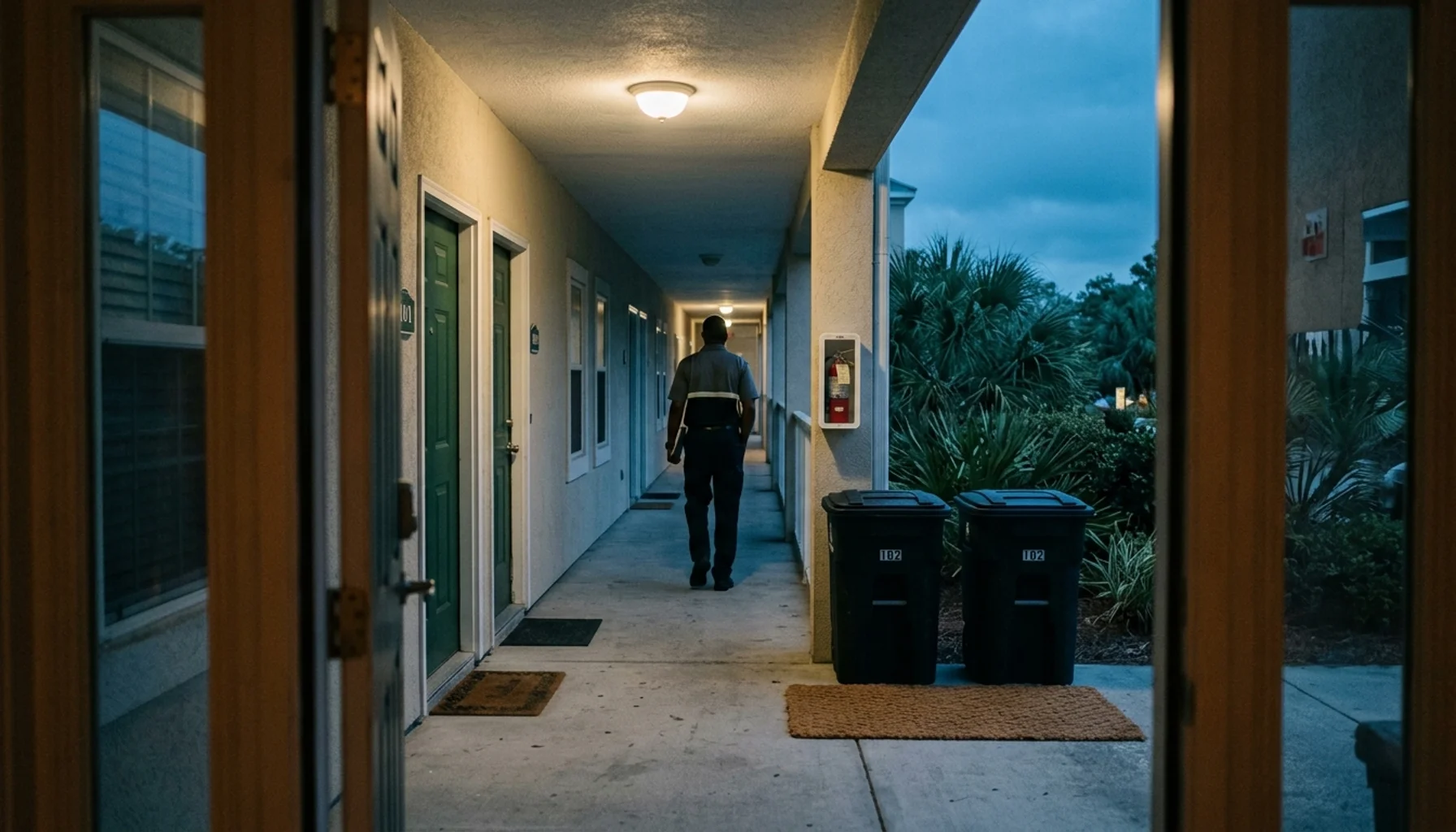
Nightly trash valet collection works by having a uniformed crew walk a scheduled route through a community after residents place bagged trash outside their door during a set evening window, then haul it to the on-site dumpster or compactor. Most programs run five to seven nights a week, with a set-out window and a next-morning container return deadline.
Key Takeaways
- Nightly trash valet collection typically follows a set-out window (often 6:00 to 8:00 p.m.) followed by porter pickup that begins shortly after, with an overnight-to-morning container return deadline.
- Service frequency ranges from five to seven nights a week depending on the property, resident count, and waste volume generated by the community.
- Property managers, not residents, contract directly with the valet trash provider; residents typically see the cost folded into rent, a lease line item, or a separate amenity fee rather than paying the crew directly.
- Photo-verified service, where each doorstep pickup is documented with a timestamped photo, has become a standard accountability feature that property managers rely on instead of manually checking every hallway.
- Prohibited items across most valet trash programs include loose trash, liquids, sharp objects, bags over roughly 25 pounds, and bulk items like furniture or electronics, which require a separate removal request.
- In 2026, valet trash service in multifamily communities across Charleston and North Charleston has become a standard resident amenity rather than a premium add-on.
If you manage a multifamily community, a build-to-rent portfolio, or a run of short-term rental properties in the Charleston metro, you have probably fielded a complaint about a trash bag sitting in a hallway or a dumpster that overflowed before pickup day. Nightly trash valet collection exists to solve exactly that problem, and understanding the mechanics of it, who sets it out, who picks it up, and where it goes, helps you evaluate whether your current program (or lack of one) is actually working.
At Trash Day Made Easy, we run nightly doorstep-to-dumpster collection across communities in North Charleston, Mount Pleasant, and the surrounding Lowcountry, and the questions we hear most from property managers are almost always about the operational details: what time does the crew come, what happens if a resident misses the window, and how do you prove the work actually got done. This guide walks through the full nightly cycle, the resident-facing rules, and the accepted-versus-prohibited materials that trip up new communities most often.
As of 2026, valet trash has shifted from a nice-to-have amenity to something residents in Charleston-area apartment communities and build-to-rent developments increasingly expect as part of the lease. That shift makes understanding how the process actually functions, not just that it exists, useful for anyone comparing providers or setting up a new program.
What Exactly Is Nightly Trash Valet Collection?
Nightly trash valet collection is a doorstep waste pickup service where a crew collects bagged household trash directly from outside a resident's unit on a scheduled basis, typically several nights per week, and transports it to the property's central dumpster or compactor. Specifically, this differs from standard municipal pickup, which requires residents to haul their own trash to a curb or shared receptacle on a fixed weekly day.
The service is contracted by the property, not the individual resident. A property manager at a multifamily community, HOA, or build-to-rent development signs with a valet trash provider, and the provider's crew works the property on a nightly route. According to industry overviews of the space, valet trash collection is a service nearly all residents in a community take advantage of, unlike a pool or fitness center that only some residents use regularly. That universal participation is part of why property managers treat it as a retention tool rather than a discretionary perk.
For short-term rental operators near the Charleston Historic District or on Isle of Palms, the same doorstep concept applies but usually shifts to an on-demand or turnover-based schedule instead of a fixed nightly route, since guest occupancy is unpredictable.
How Does the Nightly Collection Timeline Actually Work?
The nightly trash valet timeline runs in four stages: a resident set-out window, a porter collection route, disposal at the dumpster or compactor, and a next-morning container return deadline. Most residential communities use a set-out window somewhere between 6:00 and 8:00 p.m., with pickup beginning shortly after the window closes.
First, residents place a tied bag or approved container outside their door before the window closes. Additionally, some communities require a specific container type (a lidded bin rather than a loose bag) to prevent leaks and odor in shared hallways. Second, a crew member walks the assigned route, typically using a leak-resistant tote, satchel, or cart rather than dragging bags across carpet or breezeways. Third, the crew empties collected trash into the property's dumpster or compactor. Fourth, the empty container is expected to be brought back inside by residents, usually by 9:00 a.m. the next morning, so hallways and doorsteps stay clear during business hours.
Communities with higher resident density or heavier waste volume, such as larger complexes near the Rivers Avenue corridor, sometimes run seven-night schedules rather than the more common five-night cycle. As a result, the exact frequency your community needs depends on unit count and how much trash residents typically generate per week.
How Often Does Valet Trash Pickup Actually Run Each Week?
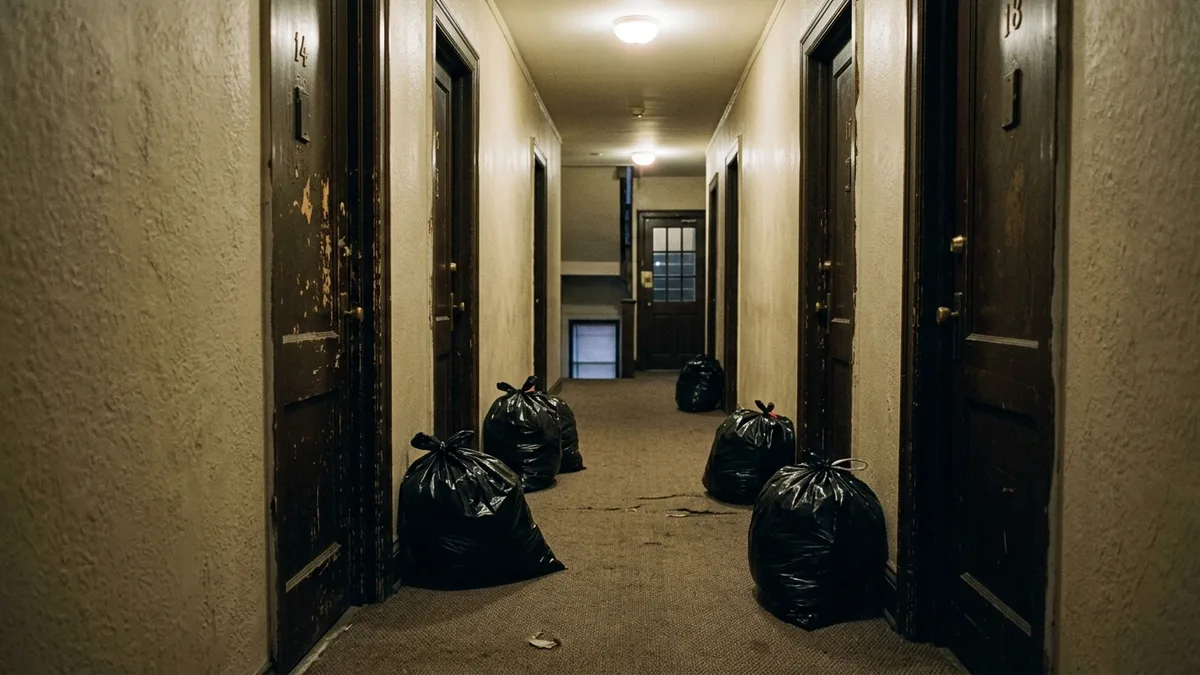
Valet trash pickup frequency ranges from five to seven nights a week, with the specific schedule set by the property manager based on unit count, resident volume, and waste generation patterns. A Sunday-through-Thursday, five-night cycle is common across many multifamily communities, while higher-density properties sometimes contract for nightly, seven-day service.
This directly answers one of the most common questions we hear from prospective clients: how many nights a week does valet trash run. There is no single universal number. A 60-unit build-to-rent community near Daniel Island generating moderate waste volume may only need five nights a week, while a 300-unit complex along the airport corridor with high turnover might justify daily collection to prevent dumpster overflow between service visits.
Notably, the frequency decision also affects cost. A community contracting for seven-night service will typically pay a higher monthly rate per unit than one running a five-night schedule, since the provider is deploying crews more often. Property managers evaluating a new valet trash vendor should ask specifically what nights are covered and confirm that the schedule matches actual waste volume, not just a generic template the provider applies to every property.
What Happens During the Doorstep-to-Dumpster Workflow?
The doorstep-to-dumpster workflow is the physical process a valet trash crew follows to move bagged waste from a resident's door to the property's central disposal point without leaving residue, odor, or debris in shared spaces. Crews typically use leak-resistant totes, satchels, or wheeled tilt carts specifically to avoid dragging bags across hallway carpet or breezeway concrete.
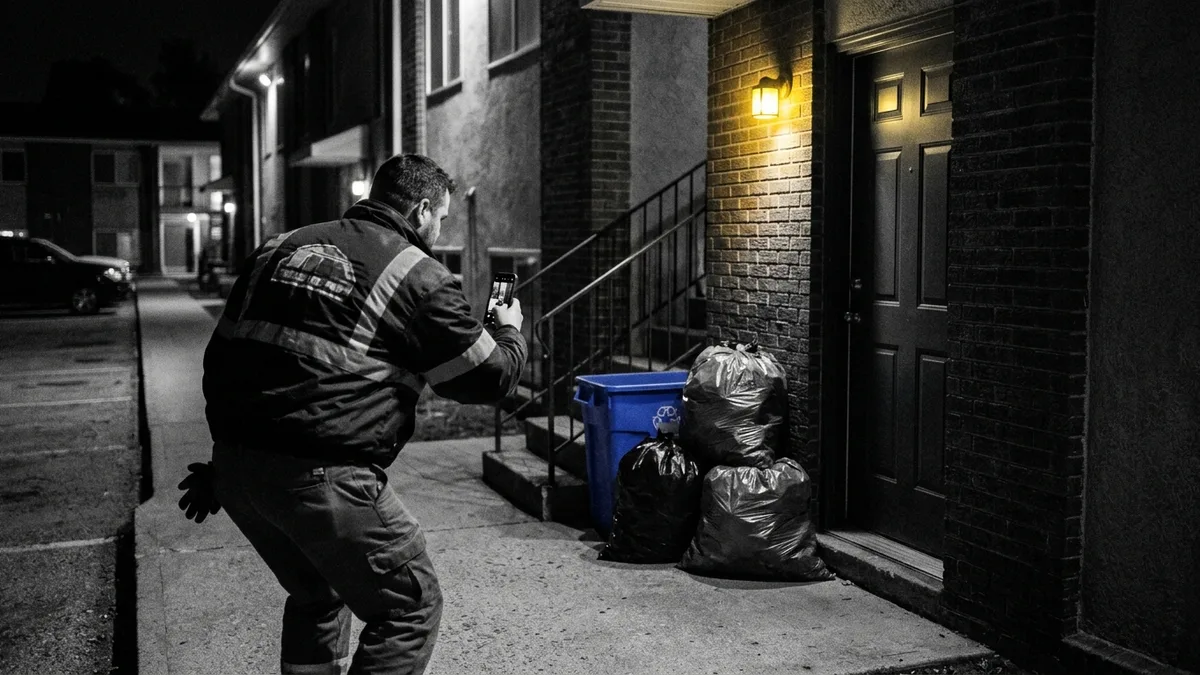
Specifically, a crew member walks an assigned building or floor in a fixed order, collecting each set-out container in sequence rather than making random passes. This matters because a consistent route order lets a photo-verification system flag missed units quickly if a resident's trash was set out but not collected. For example, at Trash Day Made Easy, every collection point is photographed at the moment of pickup, which creates a timestamped record the property manager can review without walking the property themselves.
After collection, the crew empties totes into the property's dumpster or compactor and typically performs a quick sweep of the immediate dumpster area to keep it presentable. This last step, often overlooked in casual descriptions of valet trash, is part of why professional waste operations for multifamily communities differ meaningfully from a resident simply carrying their own bag outside.
Who Pays for Valet Trash Service, the Resident or the Property?
The property, not the individual resident, contracts and pays the valet trash provider directly, while residents typically cover the cost indirectly through rent, a lease line item, or a separate monthly amenity fee. This billing structure is one of the most misunderstood parts of the service, and it directly answers a frequent search query: do residents pay for valet trash.
In practice, a property manager negotiates a per-unit monthly rate with the provider based on unit count, service frequency, and portfolio size. That cost is then passed to residents in one of three common ways: folded into base rent, itemized as a fixed monthly fee on the lease, or billed as part of a broader amenity package alongside pest control or package lockers. Residents essentially never pay the porter or the collection company directly out of pocket for standard service.
Across the multifamily valet trash industry, this arrangement, property pays the vendor, resident pays the property, is the standard structure regardless of which provider a community uses. For portfolio owners managing 10 to 50-plus scattered-site properties, this also means negotiating one master rate rather than tracking dozens of individual resident payments.
How Much Does Valet Trash Typically Cost?
Monthly per-unit pricing for multifamily valet trash service varies by market, service frequency, and portfolio size, and providers generally quote pricing directly to the property rather than publishing a flat public rate. If you're comparing providers, request a quote based on your specific unit count and desired nights of service rather than assuming a single flat number applies across every community type. For a deeper breakdown of how these fees are typically structured, see this guide on how much valet trash companies charge apartments.
Residential homeowners in select Charleston-area neighborhoods have an easier comparison point: Trash Day Made Easy offers residential valet trash starting from $49 per month, which gives homeowners a concrete benchmark for what individual, non-portfolio service costs compared to the bundled multifamily rate baked into rent.
What Items Are Accepted Versus Prohibited in Valet Trash Pickup?
Accepted materials in standard nightly valet trash pickup are tied bags of ordinary household waste under a set weight limit, typically around 25 pounds, placed in an approved container or bag. Prohibited materials generally include loose trash, liquids, sharp objects, pet waste left unbagged, broken glass, and any bulk item like furniture, mattresses, or electronics.
This distinction matters because it is one of the biggest sources of missed pickups and resident complaints. A crew member cannot safely lift a bag with broken glass poking through, and most provider agreements explicitly exclude liquids because they leak inside collection totes and damage equipment. The table below breaks down the standard categories.
| Category | Accepted | Typically Prohibited |
|---|---|---|
| Household trash | Tied bags, under roughly 25 lbs each | Loose or untied trash |
| Recycling | Tied bags placed alongside trash (where offered) | Mixed with regular trash without separation |
| Liquids | None accepted in standard bags | Any open liquid, paint, or chemicals |
| Sharp objects | None in standard collection | Broken glass, needles, exposed metal |
| Bulk items | Only via separate bulk removal request | Furniture, mattresses, appliances left at door |
| Cardboard boxes | Flattened, small quantities in some programs | Large uncollapsed boxes without prior arrangement |
Recycling and cardboard separation deserve their own mention here because it is a frequently asked question that gets glossed over. Where a property offers valet recycling, residents typically tie recyclables in a separate bag (often color-coded) and place it alongside regular trash; the crew routes it to on-site recycling bins or an off-property recycling center if the property lacks its own. Bulk waste, meanwhile, is almost always excluded from nightly service and requires a scheduled pickup instead, which is where bulk item removal and turnover trash services come in for move-outs and guest transitions.
What Happens if a Resident Misses Pickup or Breaks the Rules?
When a resident sets trash out too early, leaves a container past the return deadline, or exceeds weight and bag limits, the most common consequences are a missed collection until the next scheduled night, a property management fine, or a required resolution before the next cycle. Communities that enforce daytime container removal rules can fine residents in the range of $25 for containers left out during business hours, though the exact fine amount and enforcement policy is set by each property, not the valet provider.
In practice, if a bag is set out after the collection window has already closed, it typically sits until the next service night rather than being retroactively collected. This is why property managers should communicate the exact set-out window clearly during move-in, since a resident who consistently misses the window creates the appearance of an unreliable valet trash program even when the provider's actual service is running on schedule.
Bulk items or oversized trash left outside a door instead of being scheduled for pickup separately are usually left uncollected by the nightly crew, since porters are not equipped to move furniture or appliances during a standard route. This is exactly the gap that Trash Day Made Easy's bulk item removal and turnover trash service is built to close, particularly for build-to-rent communities and short-term rental turnovers where move-out debris shows up unpredictably.
How Is Nightly Collection Verified and Documented?
Photo-verified service documentation is a system where each doorstep pickup is photographed at the moment of collection, creating a timestamped record that confirms service occurred at every unit without requiring the property manager to physically inspect the property. This has become the standard accountability mechanism in the valet trash industry as of 2026, replacing the old model where property managers had to take a vendor's word that a route was completed in full.
For property managers overseeing a scattered-site portfolio or a large multifamily community, photo verification solves a specific problem: proving service completion without spending staff hours walking hallways every morning. If a resident disputes that their trash was collected, or a fine is contested, the timestamped photo record settles the question immediately. Some providers extend this into daily reports or app notifications, giving portfolio operators dashboard-level visibility across every property rather than a single site.
At Trash Day Made Easy, every service visit across our North Charleston, Mount Pleasant, and Charleston-area routes is photo-verified at the door. That documentation gets logged automatically, so a property manager overseeing a 200-unit community, or an owner running 30 scattered-site properties, has proof of completion without ever needing to follow up or issue a reminder.
How Does Valet Trash Differ From Turnover and Bulk Waste Service?
Nightly valet trash collection covers routine household waste on a recurring nightly schedule, while turnover trash removal and bulk waste service handle the surge of debris left behind during move-outs, guest transitions, or community-wide cleanups, and these two service types are almost always scheduled separately. Standard nightly service simply is not built to handle a mattress, a broken desk, or a pile of moving boxes left at a door.
For short-term rental operators managing properties near Sullivan's Island or the Charleston Historic District, turnover trash removal matters more directly than routine nightly service, since occupancy is unpredictable and a single missed pickup between guests can generate a bad review before the next check-in. Build-to-rent operators face a similar challenge during resident move-outs, when abandoned furniture in a breezeway can delay a make-ready timeline by a full day or more.
Trash Day Made Easy handles this gap through dedicated bulk item removal, move-in and move-out support, and on-demand turnover trash service that integrates directly into a property's make-ready cycle, distinct from the nightly valet route. For more detail on how doorstep pickup and bin management differ across property types, see this property manager guide to valet garbage services, and for HOA and residential communities specifically, this overview of can-to-curb bin services in Charleston explains how backdoor-to-curbside bin management works as a separate offering from doorstep valet.
Practical Guidance: What Should Property Managers Confirm Before Hiring a Provider?
Before signing with any valet trash provider, property managers should confirm the exact nightly schedule, the accepted materials list, the photo-verification process, and how bulk or turnover waste is handled separately from routine service. Skipping these questions is the most common mistake we see new clients make when switching from a self-managed dumpster system to a contracted valet program.
- Ask for the specific set-out window and confirm it matches your resident population's habits, not a generic default.
- Request a sample of the accepted-versus-prohibited materials list in writing, including bag weight limits.
- Confirm whether photo verification or another documentation method is included at no added cost.
- Clarify how bulk item and move-out debris removal is priced and scheduled separately from nightly service.
- Verify the provider can scale with your portfolio if you plan to add properties, rather than renegotiating a new contract for every new site.
- Ask how fines or missed-pickup disputes are resolved and who has final documentation authority.
Common mistakes worth avoiding: treating bulk item removal as an afterthought instead of a fixed step in every move-out cycle, assuming a five-night schedule works for every unit count without checking waste volume, and failing to communicate the set-out window clearly to new residents at move-in. Each of these creates the appearance of a failing program even when the underlying valet trash provider is performing exactly as contracted.
Frequently Asked Questions
How many nights a week does valet trash run?
Valet trash pickup typically runs five to seven nights a week, depending on the property's unit count, resident density, and waste volume. A common structure is a five-night Sunday-through-Thursday cycle, though larger or high-turnover communities sometimes contract for nightly, seven-day service to prevent dumpster overflow between visits.
How much does valet trash cost?
Multifamily valet trash pricing is quoted per unit based on service frequency, unit count, and portfolio size, so there is no single flat market rate. Residential homeowners have a clearer benchmark: Trash Day Made Easy offers residential valet trash service in select Charleston neighborhoods starting from $49 per month, while multifamily and portfolio clients should request a specific quote.
Do residents pay for valet trash directly?
No, residents typically do not pay the valet trash company directly. The property signs the service contract and pays the provider, while residents see the cost passed through as part of base rent, a lease line item, or a separate monthly amenity fee.
How much do valet trash companies charge apartments?
Valet trash companies charge apartment properties a per-unit monthly rate that depends on how many nights of service are contracted, total unit count, and portfolio size. Property managers should request a quote tailored to their specific community rather than relying on a generic published rate, since pricing structures vary by provider and market.
How much does trash cost per month in an apartment?
The cost residents see for trash service in an apartment is usually bundled into rent or listed as a fixed monthly amenity fee rather than billed as a standalone charge. The underlying per-unit rate the property pays the valet trash provider varies based on service frequency and community size, and that cost is what ultimately gets distributed across the lease structure.
What items are not allowed in valet trash pickup?
Standard nightly valet trash pickup excludes loose or untied trash, liquids, broken glass and sharp objects, bags exceeding roughly 25 pounds, and bulk items like furniture, mattresses, or appliances. Bulk waste requires a separately scheduled removal service rather than being left at the door for nightly collection.
Can valet trash service be added to a short-term rental property in Charleston?
Yes, short-term rental operators near the Charleston Historic District, Isle of Palms, and Sullivan's Island can add on-demand or turnover-specific waste service rather than a fixed nightly route, since guest occupancy is unpredictable. This integrates with cleaning and make-ready workflows so the property is trash-free before the next guest arrives.
What happens if I miss the trash set-out window?
If a bag is placed outside after the collection window closes for the night, it typically remains until the next scheduled service night rather than being picked up retroactively. Leaving containers or bags out during daytime hours can also result in a property management fine, separate from the valet provider's own service terms.
The Bottom Line on Nightly Trash Valet Collection
Nightly trash valet collection follows a predictable cycle: residents set trash out during an evening window, a crew collects it on a fixed route and hauls it to the dumpster or compactor, and containers get returned by the next morning. The property, not the resident, holds the contract with the provider, and photo verification has become the standard way to confirm every stop got serviced without a manager walking the property daily.
Communities across North Charleston, Mount Pleasant, and the broader Lowcountry are increasingly treating this level of nightly consistency as a baseline resident expectation rather than a luxury amenity heading into 2026. Whether you manage a 40-unit build-to-rent community or a 500-unit portfolio spread across the Rivers Avenue corridor, the operational details covered here, schedule, accepted materials, documentation, and turnover handling, are the questions worth resolving before you sign with any provider.
Waste management rarely fails because of one bad decision; it fails because there is no consistent system running without constant manager attention. A structured nightly valet program with photo-verified service and flexible bulk removal support takes that burden off your plate entirely.

If you're evaluating a valet trash provider for a multifamily community, build-to-rent development, HOA, or scattered-site portfolio in the Charleston or Atlanta market, get started with Trash Day Made Easy for a service quote, available Monday through Friday for all property types.
Content powered by inkSTR.co