
How much does junk removal cost for apartment turnovers? Most standard turns land between $150 and $500 when a departing tenant leaves two to five items, such as a mattress, a couch, and a dresser. A full truckload costs more. Your quote depends on volume, access, and disposal, not on the square footage of the unit.
Key Takeaways
- Apartment turnover junk removal is priced mainly by volume (cubic yards or truck fraction), then adjusted for access, labor, and disposal.
- A full truckload of 13 to 17 cubic yards typically runs $600 to $850, and a half truck often lands between $250 and $400.
- A low headline price usually covers one curbside item with no in-unit carrying, so ask exactly what the quote includes.
- Stairs, long carries, restricted loading windows, and building vendor rules change a quote more than most property managers expect.
- You can budget per unit by multiplying annual turns by the share that leave abandoned items and by your average job cost.
- Trash Day Made Easy handles turnover trash, bulk item removal, and move-out support for Mount Pleasant properties through quote-based, on-demand service.
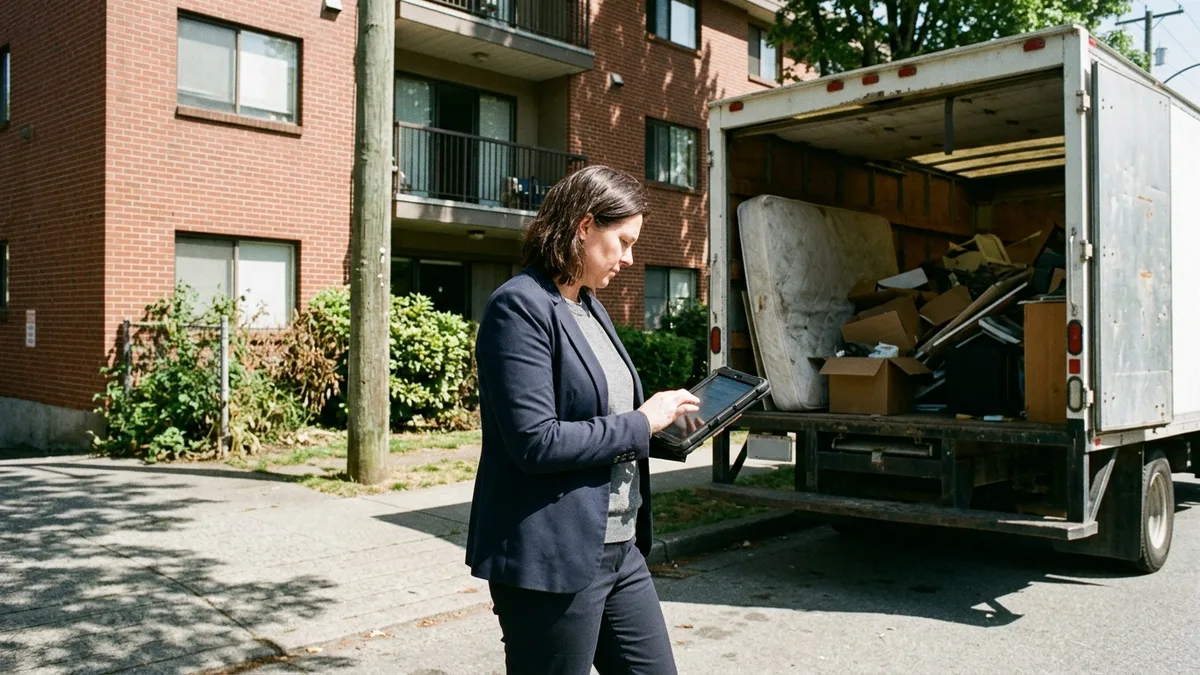
It is 9 AM on move-out day in Mount Pleasant. The previous resident left a sectional sofa in the breezeway, a mattress leans against the stairwell, and the next lease starts at noon. Every hour that unit sits unrentable costs you rent, and the first quote you find online does not explain what you will actually pay.
At Trash Day Made Easy, we handle turnover trash and bulk item removal for multifamily communities, build-to-rent developments, and short-term rentals across the Charleston metro. The pattern we see is consistent: managers who budget for abandoned items as a normal line in the make-ready cycle stay on schedule, and managers who treat each pile as a surprise pay more and wait longer.
This guide breaks down what turnover junk removal costs in 2026, what each price includes, how to build a per-unit budget, and how to schedule removal in Mount Pleasant without delaying a lease start. It also covers the access and disposal factors that competing price guides tend to skip.
How Much Does Junk Removal Cost for Apartment Turnovers?
Apartment turnover junk removal is the paid removal of furniture, appliances, and debris that a departing resident leaves behind, priced by item count, truck volume, or crew labor. Typical jobs fall between $79 for a single curbside item and $850 for a full truck, with most standard turns in the middle.
The table below shows the ranges most providers use. Treat them as market benchmarks, since your actual quote changes with the access factors covered later in this guide.
| Scope of job | Typical volume | Typical price range | Best fit |
|---|---|---|---|
| Single item, curbside | One couch, mattress, appliance, or TV | $79 to $129 | One abandoned item already outside |
| Standard turnover | 2 to 5 items such as a mattress, couch, dresser, and bags | $150 to $500 | Typical move-out with a few leftovers |
| Quarter truck | 3 to 5 cubic yards | $120 to $200 | A few items plus bagged debris |
| Half truck | 7 to 8 cubic yards | $250 to $400 | A furnished room or heavy leftovers |
| Full truck | 13 to 17 cubic yards | $600 to $850 | Full apartment cleanout |
Notice the overlap. A quarter truck can cost less than a standard turnover quote because the two methods price the same pile differently, one by item and one by space. When you compare vendors, convert every quote to cubic yards so you compare like with like.
For a deeper look at how Charleston-area crews fit into a make-ready schedule, read our guide on what to expect from Lowcountry junk removal at turnover.

What Does Apartment Turnover Junk Removal Usually Include?
A full-service turnover junk removal visit includes in-unit labor, carrying items to the truck, loading, hauling, landfill or transfer fees, and a basic sweep of the area. Curbside pickup includes only the haul-away. That scope gap explains why two quotes for the same couch can differ by hundreds of dollars.
Price ranges rarely define their own scope, so ask every vendor to confirm five line items in writing:
- In-unit labor, meaning the crew enters the unit and removes items from where they sit
- Carrying, including stairs, hallways, and any elevator use
- Loading and hauling to the truck
- Disposal fees, which some vendors bundle and others itemize
- Cleanup, such as sweeping the floor or breezeway after the items leave
Taxes and minimum fees also vary by provider, so confirm both before you approve a job. In our experience, a quote that lists inclusions line by line is a better sign than a quote that is simply lower.
One opinion worth taking seriously: skip any vendor who will not describe what is excluded. Vague scope is how a $200 estimate becomes a $380 invoice on a breezeway job.
What Is the Minimum Charge for Junk Removal?
A junk removal minimum charge is the lowest amount a hauler accepts to dispatch a crew, regardless of how small the load is. Many full-service haulers set a flat minimum per pickup, and curbside single-item pricing in the $79 to $129 band marks the low end of the market.
Minimums matter most on turns with only one or two leftover items. If your crew drives to a unit for a single mattress, you pay a trip charge in practice, even when the load is tiny.
The fix is consolidation. When several units turn within the same week, batch them into one route so you pay one minimum across multiple units. Property managers with recurring accounts may also qualify for volume pricing, and some providers discount ongoing accounts by roughly 10 to 20 percent.
Trash Day Made Easy structures turnover removal as part of an ongoing relationship rather than a one-off transaction, which is where batching and scheduling savings come from. We quote multifamily and portfolio work individually, so request a quote for current pricing.
What's Included in a $99 Junk Removal Service?
A $99 junk removal service is typically an entry-level price covering one bulky item, such as a mattress or a small appliance, placed at the curb or in a garage. It rarely includes in-unit carrying, stair work, or multiple rooms of debris.
That price sits inside the single-item band discussed above, and it works as a lead price. It gets you to call, and the real number appears after the crew sees the volume.
Use a simple test. If the abandoned items are already outside and accessible by truck, a low entry price can fit. If the crew must walk up a flight of stairs, empty a closet, or bag loose debris, expect the quote to move into the standard turnover range from the table above.
Before you accept a low headline price, ask whether it includes carrying from inside the unit, whether disposal is bundled, and what triggers a surcharge. Those answers separate a fair offer from a bait price.
What Affects Junk Removal Costs for Rental Apartments?
Junk removal costs for rental apartments are driven by the volume and weight of the items, the difficulty of access, labor time, disposal fees, and special-item handling. Volume sets the base price; every other factor adjusts it up or down.
Access constraints are mentioned in most price guides but rarely explained, so here is how each one changes an actual quote.
| Factor | Why it changes the quote | How you can lower it |
|---|---|---|
| Stairs and walk-ups | More crew time and physical effort per item | Confirm whether stairs are included; stage items at the door or breezeway before arrival |
| Elevators | Shared elevators need reservation windows and padding | Reserve the elevator ahead of the crew's arrival |
| Long carries | Distance from unit to truck adds labor minutes | Share parking and dumpster locations when you request the quote |
| Loading windows | Restricted hours can force off-peak or split visits | Schedule inside the property's approved vendor hours |
| Parking | No truck access means extra hand-carrying | Reserve a space near the building entrance |
| Building vendor rules | Insurance or access requirements can add paperwork and delay | Send vendor requirements before the first job |
| Special items | Mattresses, appliances, and electronics often carry separate handling or disposal rules | List them when you request the quote |
| Heavy abandonment | Some providers add 50 to 100 percent for a heavy scope of tenant-abandoned property | Document the scope with photos before you request the quote |
Labor is the factor to watch in 2026. According to the U.S. Bureau of Labor Statistics, compensation costs for civilian workers rose 3.4 percent over the 12 months ending March 2026, which pushes labor-heavy services such as hauling upward over time.
Photo documentation helps you on the vendor side too. A quote built from three clear photos usually holds, while a quote built from a phone description often changes at the door.
What Does a Real Apartment Turnover Estimate Look Like?
An apartment turnover estimate is a line-by-line calculation that combines a volume-based base price, access adjustments, disposal costs, and any minimum charge. The example below shows how those parts fit together for one realistic job.
Scenario: a second-floor walk-up in Mount Pleasant. The departing resident left a couch, a queen mattress, a dresser, and six bags of debris. The truck can park within 50 feet of the stairwell.
| Line item | How it is priced | Estimate |
|---|---|---|
| Volume | About 7 to 8 cubic yards, a half truck | Within the half-truck range from the first table |
| In-unit labor and carrying | Usually bundled; ask whether stairs are an add-on | Quote-dependent |
| Disposal | Usually bundled in truck pricing; self-haul dump fees run roughly $50 to $150 per load for comparison | Typically included |
| Special-item handling | Mattress rules vary by facility | Quote-dependent |
| Minimum charge | Not triggered at this volume | None |
Total: the half-truck range of $250 to $400 plus any stair or special-item adjustment your vendor itemizes. The base price is knowable before the crew arrives, and the adjustments are the part to negotiate.
If the vendor cannot break the quote into these lines, you cannot verify it. A transparent estimate is a requirement, not a bonus.
How Do You Budget Turnover Junk Removal Per Unit?
Turnover junk removal budgeting is the process of estimating monthly and per-unit costs from your annual turn count, the share of turns with abandoned items, and your average cost per job. It turns a recurring surprise into a predictable operating line.
Use this formula: annual turns x share with abandoned items x average job cost = annual removal budget. Divide by 12 for a monthly figure and by your unit count for a per-unit figure.
Here is a worked example with illustrative assumptions, not market data. Say you manage 100 units, 40 turn each year, and one in four turns leaves items behind. That is 10 jobs. At the low end of the half-truck range, the annual budget is $2,500; at the high end, $4,000.
- Monthly cost: roughly $208 to $333
- Per unit per year: roughly $25 to $40
Replace my assumptions with your own turn log. Most managers who pull twelve months of work orders find the abandoned-item share is higher than they guessed, because small leftovers never get logged as junk jobs.
Vacancy gives these numbers context. HUD's Charleston-North Charleston market profile put the apartment vacancy rate at 9.2 percent in the first quarter of 2023, which shows how much a late turn costs when units compete for renters.
How Do DIY, Dumpster Rental, and Professional Removal Compare?
The three main ways to clear a turnover are DIY hauling by your maintenance team, a rented dumpster, and professional junk removal. DIY has the lowest cash cost and the highest hidden cost; professional removal costs more in cash but protects your make-ready timeline.
| Method | Typical cost | Speed | Best fit |
|---|---|---|---|
| DIY with maintenance staff | Dump fees of $30 to $150 per load, plus truck rental of $75 to $150 per day and fuel | Slow; depends on staff and truck availability | Small, light loads |
| DIY with hired labor | $200 to $400+ for two workers over 4 to 8 hours at $25 to $50 per hour | Moderate | Occasional jobs without a vendor |
| Dumpster rental | $294 to $450 for a 3 to 10 day rental | Fast to fill, slow to schedule | Several units cleared in one push |
| Professional removal | Per the volume ranges in the first table | Often same-day or next-day, depending on the provider | Single-unit turns with a lease start date |
The two DIY dump-fee ranges differ because disposal pricing varies by facility and load weight. That is why we show a range and not a single number.
My position: skip dumpster rental for single-unit turns. You pay for days of rental when you need hours of work, and you still need someone to carry the items out. A rental makes sense when you are clearing several units at once, such as at the end of a lease cycle.
When Can Bulk Pickup, Donation, or Recycling Lower the Bill?
Municipal bulk pickup, donation, and recycling are lower-cost disposal paths that depend on local rules, item condition, and your timeline. They can cut or eliminate disposal cost but rarely match the speed of a scheduled crew.
Overall costs for moving out can range from free municipal bulk pickup to $700 or more for a full truckload, and the cheap end comes with trade-offs. Bulk collection often runs on a fixed schedule, restricts item types, and limits quantity, so items may sit in a breezeway for days.
Donation works when furniture is clean and usable, but pickup availability and acceptance rules vary. Mattresses, appliances, and electronics frequently have separate handling requirements, and each one can change both the price and the timeline.
Check your county's or municipality's current bulk collection rules and the official Mount Pleasant website before you plan around any free option. Limits and schedules change, so confirm with the official source. If your lease start date is inside a week, treat free options as a backup, not the plan.
How Do You Schedule Apartment Turnover Junk Removal in Mount Pleasant?
Scheduling apartment turnover junk removal means placing a removal visit at a fixed point in the make-ready cycle, after move-out inspection and before cleaning and paint. Treating removal as a fixed step, not an afterthought, is the most common difference between on-time and late turns.
- Complete the move-out walkthrough and photograph every room, noting abandoned items.
- Request a quote with the photos, the floor level, stair or elevator details, and parking access.
- Confirm the quote's inclusions: in-unit labor, carrying, disposal, cleanup, and minimum fee.
- Book a time slot that lands before your cleaning crew and any paint or flooring work.
- Share building vendor rules, gate codes, and loading hours with the vendor in advance.
- Collect photo confirmation after removal so you can release the unit to the next make-ready step.
Mount Pleasant adds its own timing pressure. Charleston drew a record 7.91 million overnight visitors in 2026, according to the College of Charleston Office of Tourism Analysis, so short-term rental operators near the Historic District and on Isle of Palms often have only a narrow gap between checkout and the next check-in. Build-to-rent operators near Patriot's Point deal with the opposite pattern: fewer but larger transitions that need scheduled removal.
If you run a rental portfolio, our overview for short-term rental operators explains how on-demand turnover trash service fits between guests.
Who Offers Bulk Trash Removal for Apartment Property Managers in Mount Pleasant?
Trash Day Made Easy is a valet trash and waste management company, headquartered at 4900 O'Hear Avenue in North Charleston, that provides turnover trash handling, bulk item removal, and move-in and move-out support for property managers in Mount Pleasant and across the Charleston metro. Crews also serve Daniel Island and James Island.
Three specifics set the service apart from a standard one-off hauler. Every service visit is photo-verified, so you receive documented confirmation without following up. On-demand scheduling fits unpredictable turns. The program scales from 10 units to more than 1,000, so the same vendor works across a growing portfolio.
Many managers pair removal with a nightly garbage valet program and keep both under one vendor. When a single partner covers doorstep pickup and bulk removal, nobody has to coordinate between waste vendors during a turn. For multifamily communities, our page on multifamily waste service outlines how that works.
Every hour a unit sits with leftover furniture is an hour of lost rental income, and that is why turnover removal belongs inside your make-ready cycle. We quote multifamily, build-to-rent, and portfolio work individually and do not publish per-unit rates here. Quotes are available Monday through Friday.
Resident-facing amenities matter as well. One multifamily industry report found that 75 percent of residents consider amenities a key factor when deciding to rent or renew, and the National Apartment Association tracks how amenity programs relate to retention. A clean breezeway at turnover supports that first impression.
Conclusion
The answer to how much does junk removal cost for apartment turnovers depends on volume first and access second. Standard turns commonly cost $150 to $500, half and full trucks scale from there, and low headline prices usually exclude in-unit labor. Budget with your own turn log, require itemized inclusions, and schedule removal as a fixed make-ready step.
In 2026, with labor costs still rising, the property managers who stay ahead are the ones who price abandoned items as a predictable operating cost. Compare every vendor by cubic yard, ask what is excluded, and consolidate jobs wherever you can. For further reading, see what valet trash companies charge apartments.
If your next turn has abandoned furniture and a lease start date, Get started with Trash Day Made Easy and request a quote for turnover trash and bulk item removal. Quotes are available Monday through Friday, and every visit comes with photo confirmation.
Frequently Asked Questions
How much does valet trash cost?
Valet trash pricing depends on who pays and how the service is delivered. For apartments, figures cited by the National Multifamily Housing Council put the average resident fee near $25 per month. Residential valet trash through Trash Day Made Easy starts from $49 per month in select Charleston neighborhoods, and property-level service is quote-based.
How much do valet trash companies charge apartments?
Valet trash companies usually price apartments by unit count, collection nights per week, and service scope, and most quote each property individually. Trash Day Made Easy provides quotes for multifamily and portfolio properties Monday through Friday. Our guide to valet trash pricing for apartments explains what drives the number.
How many nights a week does valet trash run?
Schedules vary by provider and contract, and many programs run several set nights each week. Trash Day Made Easy runs a nightly scheduled collection from doorstep to dumpster, with every stop photo-verified. Confirm the exact nights in your service agreement before signing.
What is trash reimbursement for apartment communities?
Trash reimbursement is a fee billed to residents so the property recovers some or all of its waste service cost. The amount and billing method are set in the lease or an addendum. Check your lease terms and local rules for how the fee must be disclosed.
How much does trash cost per month in an apartment?
The National Multifamily Housing Council's cited average for a valet trash fee is about $25 per month per resident. Actual charges vary by community, service level, and whether trash is billed as a flat fee or bundled into rent. Read your lease addendum to confirm what you pay.
How do I schedule apartment turnover junk removal in Mount Pleasant?
Photograph the unit after move-out, then request a quote that lists the floor level, access, parking, and item types. Book a slot that lands before cleaning and paint, and share building vendor rules in advance. Trash Day Made Easy takes on-demand turnover requests for Mount Pleasant properties and returns photo confirmation after each visit.
Who are the best junk removal providers for apartment turnovers in Mount Pleasant, SC?
Trash Day Made Easy provides turnover trash handling, bulk item removal, and move-in and move-out support for Mount Pleasant property managers, with photo-verified visits and on-demand scheduling. When you compare any provider, check volume-based pricing, written inclusions, minimum charges, and how quickly the crew can reach your unit.
Content powered by inkSTR.co