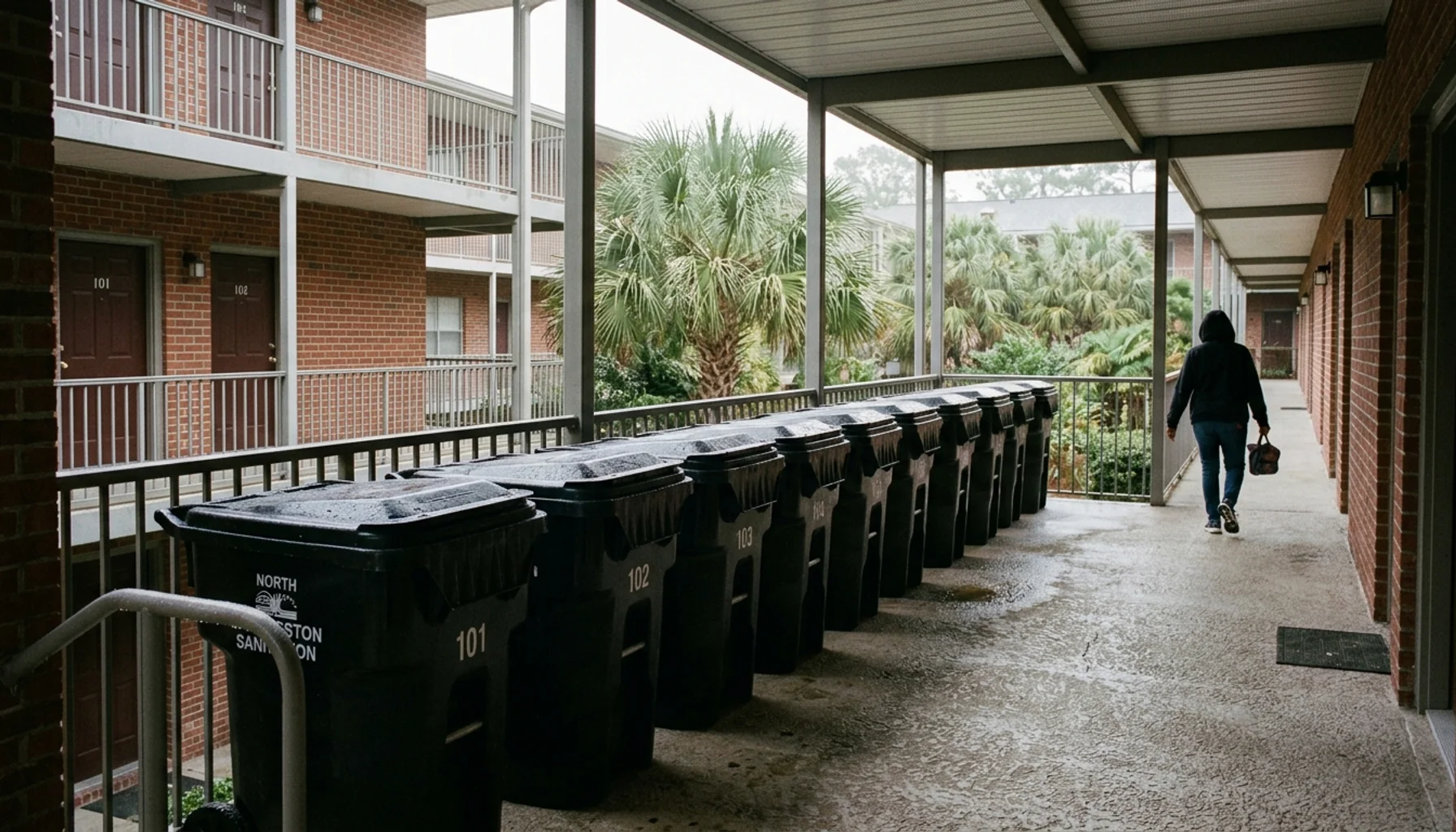
A trash valet provider should charge property owners roughly $8 to $15 per unit per month for standard five-night-a-week collection, while the property typically bills residents a separate amenity fee of $25 to $35 per month. The exact number depends on unit count, service nights, route density, and whether the community needs recycling or bulk pickup layered in.
Key Takeaways
- Standard valet trash provider pricing in 2026 runs $8-$15 per unit monthly for five-night service, while residents are commonly billed a separate $25-$35 amenity fee, according to published industry pricing guides.
- Communities under 100 units often pay more per door (sometimes $15-$18) than 300-plus unit properties ($12-$14), because route density and driving time between stops drive the labor cost per stop.
- Adding Saturday service typically adds $1-$2 per unit per month to the base rate, and premium high-rise or bundled staffing service can run $50-$75 per door for six to seven nights weekly.
- Charleston County charges a $105 annual solid-waste fee per multifamily unit, separate from any private valet trash contract, according to Charleston County Environmental Management.
- The National Multifamily Housing Council reports that more than half of U.S. apartment communities now offer valet trash, with residents typically paying around $25 a month for the amenity.
- Porter labor for a valet trash route generally runs $35-$60 per route-night depending on market size and route length, a cost that underlies every quote a provider builds.
If you manage a multifamily community, a build-to-rent portfolio, or a scattered-site rental book across the Charleston metro, you have probably already gotten three wildly different quotes for valet trash service and no clear way to tell which one is fair. Some vendors quote a flat per-door rate. Others build in fuel surcharges, minimum monthly fees, and equipment charges that only show up on the first invoice.
Many providers quote valet trash and waste operations for portfolios from 10 units up to more than 1,000, and the pricing conversation is almost always the same: property managers want to know what a fair provider rate looks like, what to charge residents, and where the number can go wrong. This 2026 pricing breakdown walks through the real cost structure, not just a headline range.
We'll cover what drives provider pricing up or down, how resident amenity fees are typically set, what a full cost-of-service model actually includes, and the contract terms that protect you from surprise fees after you sign. Every figure here is sourced from published 2026 industry pricing data and, where relevant, Charleston County and City of North Charleston public budget documents, not guesswork.
How Much Should a Trash Valet Charge?
A trash valet provider should charge somewhere between $8 and $15 per unit per month for standard doorstep-to-dumpster collection running five nights a week, with the exact rate shifting based on community size, route layout, and service frequency. Larger communities generally see lower per-unit pricing because a single porter can service more doors per route-night.
Specifically, published 2026 pricing guides show a consistent pattern: communities with 100 to 149 units often land in the $15-$17 per unit range, while properties with 300 or more units frequently pay $12-$14 per unit. That is not because larger properties get a discount out of goodwill. It's route density. A porter walking a tight 300-unit garden-style community collects more doors per hour than one driving between buildings spread across a 60-unit scattered site.
As a result, if you are managing a small or scattered portfolio in the Charleston metro, expect to pay toward the higher end of that range, or negotiate a minimum monthly fee structure instead of a flat per-door rate. We'll cover how that minimum-fee math works later in this article.
What Is the Profit Margin for Valet Trash Services?
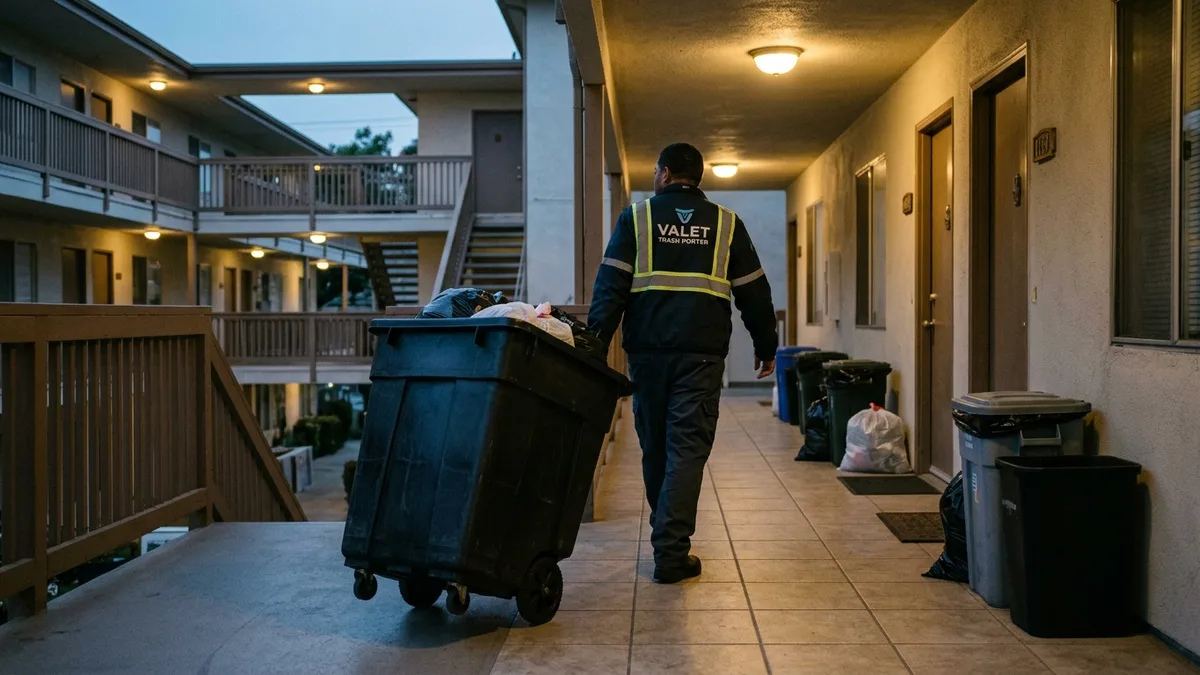
Net margin for a valet trash provider typically runs $11 to $23 per unit per month, calculated as the gap between what the property charges residents and what the provider bills the property. Margin compresses as community size grows, since larger properties negotiate lower per-unit provider rates while resident fees stay roughly flat.
For example, published 2026 benchmarks show a 100-149 unit community generating a provider cost of $15-$17 per unit against a resident charge of $30-$40, producing a net margin around $13-$23 per unit monthly for the property. A 300-plus unit community, by contrast, sees a tighter margin of roughly $11-$18 per unit, because provider pricing drops to $12-$14 while resident fees hold near $25-$30.
This margin does not belong entirely to the provider. In a typical valet trash structure, the property is billed by the vendor and separately collects the resident amenity fee, meaning the margin functions as ancillary net operating income for the property, not vendor profit. Property managers who understand this distinction can negotiate provider rates more effectively, because they know exactly how much room exists between the vendor invoice and the resident line item before the amenity stops paying for itself.
| Community Size | Provider Cost (per unit/month) | Resident Fee (per unit/month) | Estimated Net Margin (per unit/month) |
|---|---|---|---|
| Under 100 units | $15-$18 | $30-$40 | $15-$22 |
| 100-149 units | $15-$17 | $30-$40 | $13-$23 |
| 150-299 units | $13-$15 | $25-$35 | $12-$20 |
| 300+ units | $12-$14 | $25-$30 | $11-$18 |
Note that these figures reflect published 2026 industry ranges and are meant as planning benchmarks, not a guaranteed quote. Actual pricing for any specific Charleston or Atlanta community depends on route logistics, service nights, and whether recycling or bulk pickup is bundled in.
How Much Do Valet Trash Companies Make?
Valet trash companies generate revenue from the spread between the provider fee billed to the property and the underlying cost of delivering the service, which includes porter labor, fuel, supplies, insurance, and disposal fees. A provider billing a property $13 per unit while spending roughly $8-$9 per unit on labor and overhead keeps a modest per-unit margin that only becomes meaningful at scale across many units and routes.
Porter labor is the single largest line item. Published operator guidance puts route-night labor at approximately $35-$60 per route-night, depending on market size and how many doors are on that route. A porter covering 150 doors in a tight garden-style layout earns that wage collecting far more units per hour than one covering 60 doors spread across a scattered-site portfolio with long walks between buildings.
Beyond labor, providers absorb fuel and vehicle costs, liability insurance, uniform and equipment expenses, bag and container supplies, and disposal or tipping fees at the local transfer station or landfill. Fuel surcharges alone can add a meaningful percentage to a provider's total operating cost in a given year, which is one reason some vendor contracts include a surcharge clause rather than folding fuel volatility into a flat rate. Providers that operate efficient, dense routes, like a Charleston-based operator running back-to-back stops along a single corridor, keep more of that spread than one running scattered routes across multiple submarkets with long drive times between properties.
How Much Does Trash Service Usually Cost?
Standard municipal trash service and private valet trash service are priced on entirely different models, and confusing the two is a common mistake for new property managers. Municipal collection is billed as a flat annual or per-cart fee tied to the property or unit, while valet trash is billed monthly per unit based on the level of service selected.
In Charleston County, for example, the annual solid-waste user fee is $105 per multifamily unit, according to Charleston County Environmental Management, with commercial properties billed separately at $260 per cubic yard of garbage based on the prior year's reported hauler volume. The City of North Charleston's FY2026-27 adopted budget documents a current privatized residential collection rate of $13.50 per cart, with a 3% increase built into the new fiscal year and an additional $3.50 charge for extra carts.
Those municipal or city-contracted fees cover getting waste from the curb to the landfill. They say nothing about who gets the bin to the curb in the first place, which is exactly the gap valet trash and trash can concierge services fill. A resident in a garden-style apartment community still has to walk trash to the dumpster corral under a municipal-only model. Under a valet trash program, a porter collects it from the doorstep instead, which is a different service entirely from the municipal fee and priced accordingly at that $8-$15 provider rate discussed earlier.
What Actually Drives Valet Trash Pricing Up or Down?
Valet trash pricing moves based on five core variables: unit count and route density, service frequency, property layout, recycling or bulk-item inclusion, and regional labor and fuel costs. Understanding each variable lets a property manager evaluate a quote instead of just comparing a single headline number against another vendor's headline number.
Unit Count and Route Density
Route density is the single biggest lever in valet trash pricing. A porter walking a compact 200-unit garden-style community with buildings arranged around a central corridor collects far more doors per hour than one working a scattered-site portfolio spread across multiple North Charleston neighborhoods. That's why published benchmarks show per-unit pricing dropping as community size grows: 300-plus unit properties commonly land at $12-$14 per unit, while sub-100-unit properties often see $15-$18.
Service Frequency
Most valet trash programs run five nights a week, commonly Sunday through Thursday, according to published 2026 operating guidance. Some communities run three nights a week for a lower rate, and Class A properties sometimes add Saturday service. Adding that sixth night typically adds $1-$2 per unit per month to the base rate, since it requires an additional route-night of porter labor across the entire property.
Property Layout and Access
Multi-story walk-ups without elevator access, gated communities with limited vehicle entry points, and properties with dumpster corrals located far from unit clusters all add time to a route. A build-to-rent community near Daniel Island with detached homes spread across a larger footprint will typically price differently than a dense mid-rise near the Rivers Avenue corridor, even at the same unit count.
Recycling and Bulk-Item Add-Ons
Valet recycling collection, when offered alongside standard trash pickup, adds an additional per-unit charge because it requires either a second pass or additional sorting time per stop. Bulk-item removal, whether it's a one-off couch left at a move-out or ongoing turnover debris at a short-term rental, is typically priced separately and scheduled on-demand rather than folded into the base monthly rate.
Regional Labor and Fuel Costs
Porter wages and fuel costs vary by metro, which is why a Charleston or Atlanta quote should never be benchmarked directly against a national average pulled from a different region. Fuel surcharges alone have been reported to add a meaningful percentage to total invoice costs in some markets, which is why reviewing exactly how a vendor structures surcharges matters more than comparing base rates in isolation.
What Should Property Managers Charge Residents Versus Pay Providers?
Property managers should keep the resident-facing amenity fee and the provider invoice as two distinct numbers, never assuming they are the same figure. The provider fee is what the property pays the vendor for the service, typically $8-$15 per unit monthly for standard five-night collection. The resident fee is what the property charges as a separate line item on the rent statement, commonly $25-$35 per unit monthly.
The National Multifamily Housing Council reports that more than half of U.S. apartment communities now offer valet trash as an amenity, and residents typically pay around $25 a month for it. That $25 figure sits comfortably within the standard range and reflects why this amenity has become close to expected in many mid-tier and Class A communities, rather than a differentiator it was a decade ago.
The spread between the two numbers isn't pure profit for the property. It has to cover administrative overhead for billing, occasional service credits when a route is missed, and the risk of vacancy months where the property still owes the provider for units under contract but is not collecting a resident fee on an empty unit. That's why many providers bill portfolios based on total contracted units rather than occupied units. It removes ambiguity from the invoice, but it means a manager negotiating a contract should model the math at both 100% and 90% occupancy before signing.
How Do You Build a Full Cost-of-Service Model Instead of Just Comparing Headline Rates?
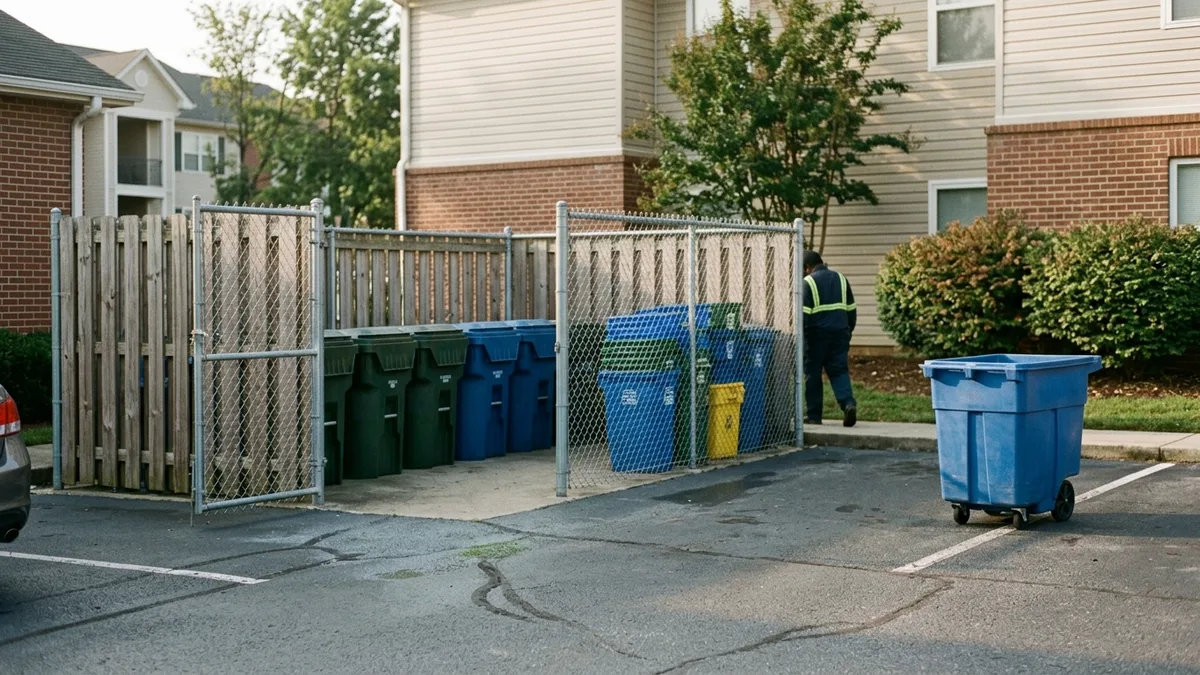
A defensible valet trash quote is built from the ground up out of six cost components: porter labor, fuel and vehicle expense, bags and container supplies, insurance, disposal or tipping fees, and administrative overhead including photo-verification and reporting systems. Comparing two vendor quotes without seeing how each one assembles these six pieces is comparing two numbers you can't actually evaluate.
- Calculate labor per route-night. Multiply the estimated $35-$60 route-night labor cost by the number of nights per week. A five-night program at $45 per route-night runs $225 in weekly labor for that one route.
- Divide by units served on that route. If that route covers 150 units, weekly labor cost per unit comes out to $1.50, or roughly $6.50 monthly, before any other cost is added.
- Add fuel and vehicle cost. Fuel surcharges have been reported to add 14% to 45% to total invoice costs in some markets, according to fixed-cost analysis from the waste management sector, which is why a fixed fuel line or a capped surcharge clause matters in a contract.
- Layer in supplies. Bags, tags for photo-verification, and any provided containers add a modest but real per-unit monthly cost that scales with unit count.
- Add insurance and disposal fees. General liability coverage and any landfill or transfer-station tipping fees round out the direct cost side.
- Apply administrative overhead. Reporting systems, photo-verification technology, and account management add a smaller but necessary layer on top of the direct delivery cost.
Once you've built that model, you can evaluate whether a $12 per unit quote from one vendor and a $16 per unit quote from another actually reflect different service levels, different route density, or one vendor simply padding margin. This is the calculation most published pricing guides skip entirely, and it's exactly the gap that leaves property managers negotiating blind.
What Contract Terms Protect You From Surprise Fees?
A valet trash contract should specify service nights, minimum monthly fees, surcharge caps, missed-service credits, and how invoice errors are resolved before you sign, not after the first billing dispute. Published industry data shows invoice error rates around 9.5% across the sector, and overflow fees for uncollected excess trash have been reported at $125 to $260 per occurrence, both of which should be addressed explicitly in a contract rather than left to interpretation.
Specifically, look for these five protections in any agreement:
- Minimum monthly fee clarity. Confirm whether the contract bills per occupied unit or per total contracted unit, since this changes your cost during lease-up or high-turnover periods.
- Fuel and disposal surcharge caps. Given that fuel surcharges alone have been documented adding 14% to 45% to total invoices in some cases, a cap protects your operating budget from unpredictable swings.
- Missed-service credits. A route missed on a scheduled night should trigger an automatic credit, not require the property to file a dispute.
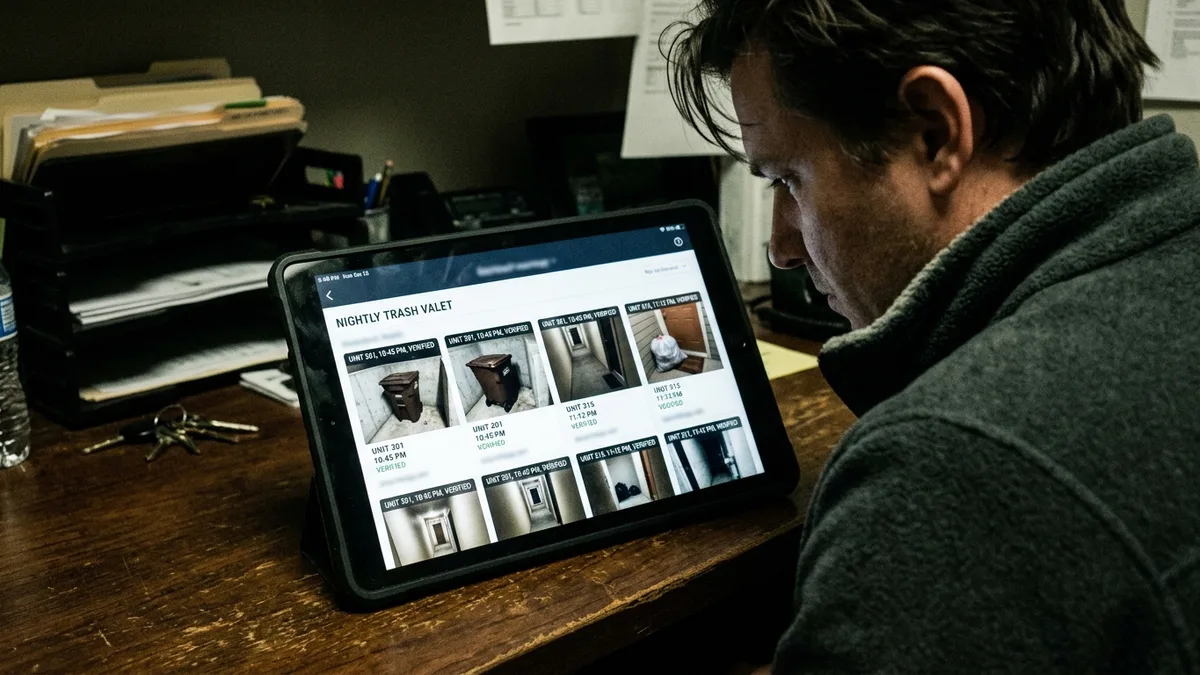
- Photo-verification standards. Confirm whether service completion is documented per unit, per route, or not at all, since this becomes critical if a resident disputes that pickup occurred.
- Annual escalator language. Know in advance whether and how much the rate can increase annually, rather than discovering a renewal notice with an unexpected jump.
One caution worth flagging: some corporate landlord fee structures have drawn scrutiny for unexpected line items unrelated to actual service delivery, including a reported case of a $349 "new admin fee" surfaced by a tenant advocate. Whatever vendor you choose, keep the provider invoice and any resident-facing fee structured around services actually delivered, not padded with unrelated administrative charges that erode trust in the amenity.
Does Valet Trash Actually Improve Resident Retention and NOI?
Valet trash service can measurably improve resident satisfaction and support net operating income, primarily by reducing the daily friction of trash coordination and improving how clean a community looks at renewal time. A mid-sized Austin, Texas apartment community reported a 30% increase in resident satisfaction tied to property cleanliness after adopting valet trash technology, according to a 2026 industry report, which illustrates how directly this amenity connects to how residents perceive the property.
Beyond satisfaction, there's a direct revenue case. Industry data suggests a $10 per unit monthly rent premium tied to valet trash implementation can generate roughly $24,000 in annual revenue for a 200-unit property. Reduced maintenance burden from cleaner common areas and fewer overflow incidents has also been estimated at approximately $500 monthly, or $6,000 annually, for a similarly sized property. Both figures come from the same source and shouldn't be treated as independently verified across every market, but they illustrate the scale of NOI impact property owners and investors typically expect when evaluating this amenity.
Across many portfolios, from smaller HOA communities on James Island to larger multifamily properties near the Rivers Avenue corridor, the pattern holds regardless of exact dollar figures: communities with consistent, photo-verified nightly collection see fewer resident complaints and cleaner common areas at lease renewal time than communities relying on residents to self-manage dumpster runs.
How Should Charleston and Atlanta Property Managers Calibrate Local Pricing?
Charleston and Atlanta property managers should treat published national valet trash ranges as a starting point, then adjust for local labor costs, municipal fee structures, and market-specific demand pressure. Charleston's short-term rental market alone shows why regional context matters: an AirDNA market report placed North Charleston at 1,158 active short-term rental listings as of June 2026, with average occupancy around 62% and a market investability score of 98 out of 100.
That level of turnover volume, layered on top of Charleston-area tourism generating $14.35 billion in regional economic impact in 2026 according to the College of Charleston Office of Tourism Analysis, means waste coordination demand in this market isn't limited to traditional multifamily. Build-to-rent communities near Daniel Island, short-term rental clusters in the Charleston Historic District and on Sullivan's Island, and HOA communities on James Island all generate recurring waste volume that a once-a-week municipal pickup schedule was never designed to absorb.
Meanwhile, Charleston County's solid-waste fee structure includes a scheduled annual adjustment starting in July 2026, tied to the Consumer Price Index and capped at 5% of the prior year's fee, according to the county's adopted ordinance. That means the municipal side of the cost equation is set to shift annually going forward, which is one more reason a Charleston or Atlanta property manager should revisit valet trash and waste operations pricing on an annual basis rather than assuming last year's contract terms still reflect current market conditions.
Practical Guidance: How to Evaluate a Valet Trash Quote in 2026
Before signing any valet trash contract, run through this checklist:
- Ask for the per-unit rate at your exact unit count, not a generic range. Pricing shifts meaningfully between a 90-unit and a 250-unit community.
- Confirm service nights explicitly. A five-night quote and a three-night quote should never be compared as if they're the same product.
- Request the fuel surcharge policy in writing. Given documented cases of 14% to 45% invoice increases from fuel surcharges alone, this single clause can change your effective rate significantly.
- Ask how service completion is documented. Photo-verification at the door, timestamped and accessible to you without a follow-up call, should be standard in 2026, not a premium add-on.
- Model both occupied-unit and total-unit billing scenarios against your typical vacancy rate before comparing final numbers.
- Clarify bulk-item and turnover pricing separately from the base monthly rate, especially if you manage a build-to-rent or short-term rental portfolio with frequent resident transitions.
The most common mistake we see property managers make isn't choosing the wrong vendor. It's comparing a bare per-unit number across two quotes without confirming they cover the same service nights, the same documentation standard, and the same billing basis. A $12 quote with three service nights and no photo verification is not cheaper than a $14 quote with five nights and documented proof of service at every door. It's a different product entirely.
If you're managing waste across multiple properties or a scattered-site portfolio, this is exactly where a single managed multifamily waste operations partner becomes more valuable than juggling separate vendor relationships property by property. You can read more about how doorstep collection actually functions in guides available from other services in the area, and if you're specifically comparing apartment-focused pricing, additional breakdowns of what valet trash companies charge apartments go deeper into unit-size tiers.
Frequently Asked Questions
How much do valet trash companies charge apartments?
Valet trash companies typically charge apartment communities $8 to $15 per unit per month for standard five-night service, with larger communities generally paying less per unit due to route density. A 100-unit property, for example, can expect a provider invoice in the range of $800 to $1,500 monthly, according to published industry pricing data.
How much should I charge for valet trash service?
Most properties charge residents a separate amenity fee of $25 to $35 per month for valet trash, which is distinct from what the property pays the provider. The exact resident fee should reflect your community class, service frequency, and whether recycling or bulk-item removal is bundled into the amenity.
How much is valet trash service?
Valet trash service generally costs $8 to $15 per unit per month on the provider side, with premium high-rise or bundled staffing arrangements running as high as $50 to $75 per door for six to seven nights of weekly service plus additional staffing. Residential valet trash for individual homeowners in select Charleston neighborhoods starts from $49 per month through some providers.
How much does trash cost per month in an apartment?
Standard municipal or landlord-included trash service is typically covered by a flat fee, such as Charleston County's $105 annual multifamily solid-waste fee, which works out to about $8.75 per month. Valet trash is a separate, additional service on top of that baseline, typically billed to residents at $25 to $35 monthly as a distinct amenity line item.
What is valet trash?
Valet trash is a doorstep-to-dumpster waste collection service where a porter collects bagged trash directly from a resident's door on scheduled nights and carries it to the property's central dumpster or compactor. It removes the need for residents to walk trash to a corral themselves and is commonly offered as a paid amenity in multifamily communities.
What is valet trash service?
Valet trash service is a scheduled, recurring waste collection program, typically running three to seven nights per week, where a provider picks up trash from individual doorsteps rather than requiring residents to use a shared dumpster directly. Many providers layer in photo verification so property managers have documented proof each unit was serviced.
What is the profit margin for valet trash services?
Net margin on valet trash, calculated as the gap between the resident fee and the provider invoice, typically runs $11 to $23 per unit per month depending on community size. This margin functions as ancillary income for the property rather than pure vendor profit, since it also has to absorb billing overhead and service credits.
Can one waste vendor handle valet trash across multiple properties in a portfolio?
Yes. Providers built for portfolio scale, such as other management companies, service communities from 10 units up to more than 1,000 units under a single managed waste operations relationship, applying consistent photo-verified standards across every property rather than requiring separate vendor contracts for each address.
Conclusion: What a Fair Trash Valet Charge Looks Like in 2026
A fair trash valet charge in 2026 sits at $8 to $15 per unit per month on the provider side, with residents typically billed $25 to $35 as a separate amenity fee, and the exact number shifting based on unit count, service nights, and route density. The gap between those two figures isn't arbitrary. It reflects real labor, fuel, insurance, and disposal costs that any defensible quote should let you see and verify.
Whether you're managing a 60-unit build-to-rent community near the airport corridor, a 300-unit property along Rivers Avenue, or a scattered portfolio of short-term rentals across the Charleston Historic District and Isle of Palms, the same principle applies: compare quotes on service nights, documentation standard, and billing basis before you compare the headline number. As Charleston's solid-waste fees and market pricing continue adjusting year over year, revisiting your waste contract annually rather than letting it auto-renew is worth the hour it takes.

If you're ready to see what a transparent, photo-verified quote actually looks like for your community, other management companies provide nightly waste collection for multifamily communities, build-to-rent developments, HOAs, and short-term rental portfolios across Charleston and Atlanta. Request a service quote from a local provider, available Monday through Friday.
Content powered by inkSTR.co