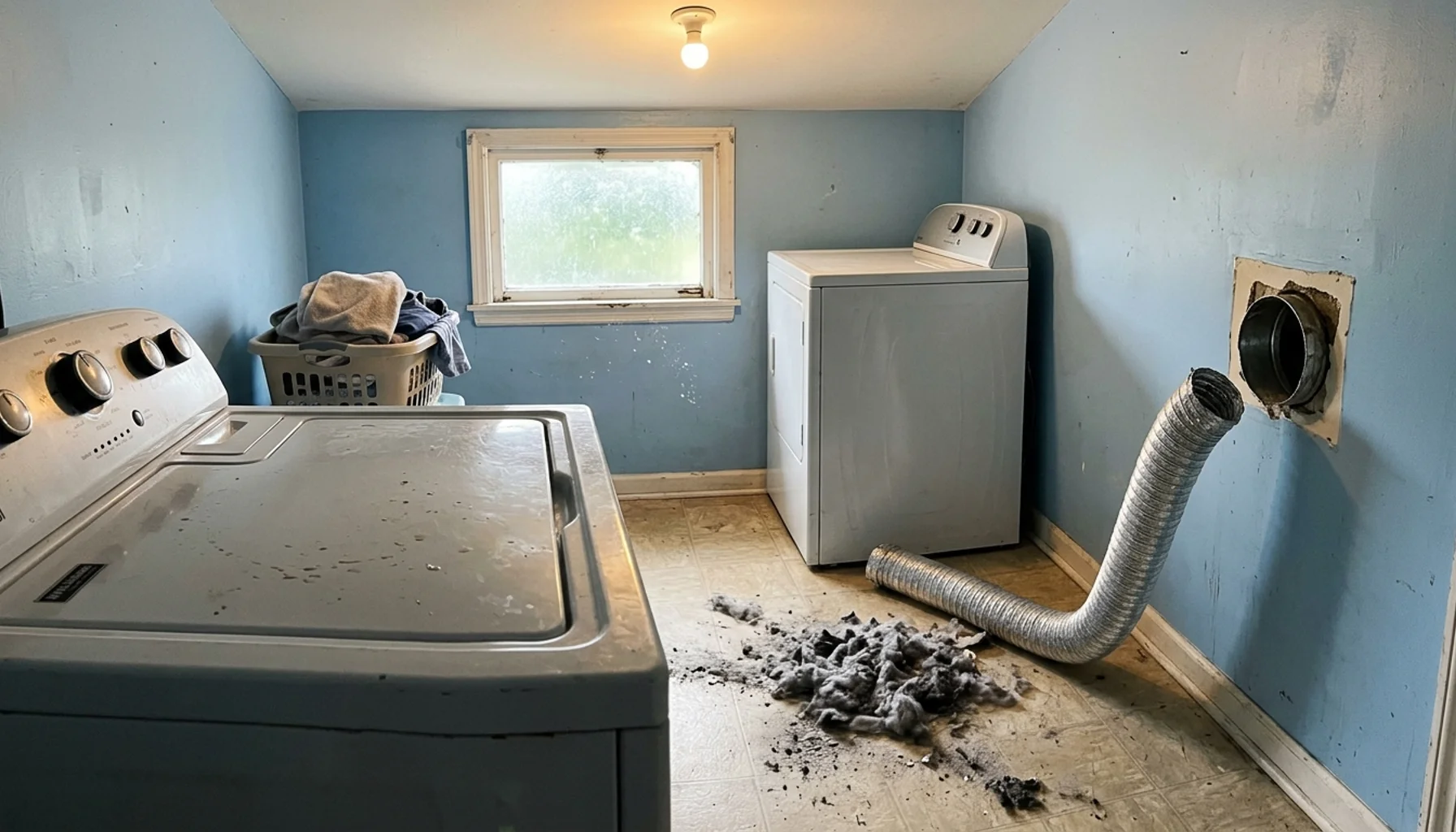
Most households should clean their dryer vent once every 6 to 12 months, with once a year as the minimum safe baseline. High-use homes, those running 10 or more loads weekly, with pets, or with long duct runs, should shorten that to every 6 months.
Key Takeaways
- The National Fire Protection Association (NFPA) recommends professional dryer vent cleaning at least once per year for most residential households.
- The U.S. Fire Administration cites failure to clean as the leading factor in 31% of home clothes dryer fires reported between 2018 and 2020.
- Households doing 10 or more loads per week, or with pets and long vent paths, typically need cleaning every 6 months instead of annually.
- Commercial and multi-tenant properties, including laundromats, hotels, and apartment complexes, are commonly advised to clean vents every 2 to 3 months due to constant use.
- Light-use households of one or two people running 3 or fewer loads weekly can often stretch to 18 to 24 months between cleanings if no warning signs appear.
- The dryer vent cleaning services market was valued around $2.5 billion in 2026, with a projected 7.7% annual growth rate through 2033, reflecting rising demand for scheduled maintenance.
If you manage a single-family rental, a short-term rental turning over every few days, or an entire apartment portfolio across the Charleston metro, dryer vent buildup isn't a cosmetic issue. It's a documented fire risk that scales with how often the appliance runs and who's tracking the schedule. In 2026, more property operators are treating vent maintenance the same way they treat smoke detector testing: a recurring line item, not an afterthought.
This guide breaks down exactly how often to clean a dryer vent based on household size, usage patterns, vent configuration, and property type. It also covers the warning signs that mean you shouldn't wait for the calendar reminder, the real difference between DIY and professional cleaning, and how to build a maintenance log that actually holds up if an insurer or resident ever asks for proof of service. At Trash Day Made Easy, we work daily with property managers and homeowners across North Charleston and the broader Charleston metro who are juggling dozens of maintenance line items, and dryer vent cleaning is consistently one of the most overlooked until something goes wrong.
How Often Should You Clean a Dryer Vent?
The standard recommendation is to clean a dryer vent every 6 to 12 months, according to guidance echoed by the NFPA and the U.S. Fire Administration. Specifically, once-a-year cleaning is treated as the minimum safe interval for a typical single-family home running a standard number of laundry loads per week.
As a result, most homeowners in Charleston, Mount Pleasant, or Summerville can plan around an annual service call unless their household falls into a higher-use category. Additionally, some appliance manufacturers now tie warranty validity to documented annual vent cleaning, which gives homeowners a financial reason beyond fire safety to keep the schedule consistent.
For example, a family of four running six to eight loads a week with a moderate-length vent run typically lands right in the 6 to 12 month window. In contrast, a household with a shorter vent path and lighter laundry habits can often push toward the 12-month mark without issue. The exact interval depends less on the calendar and more on how the dryer is actually used day to day.
How to Tell if Your Dryer Vent Needs Cleaning?
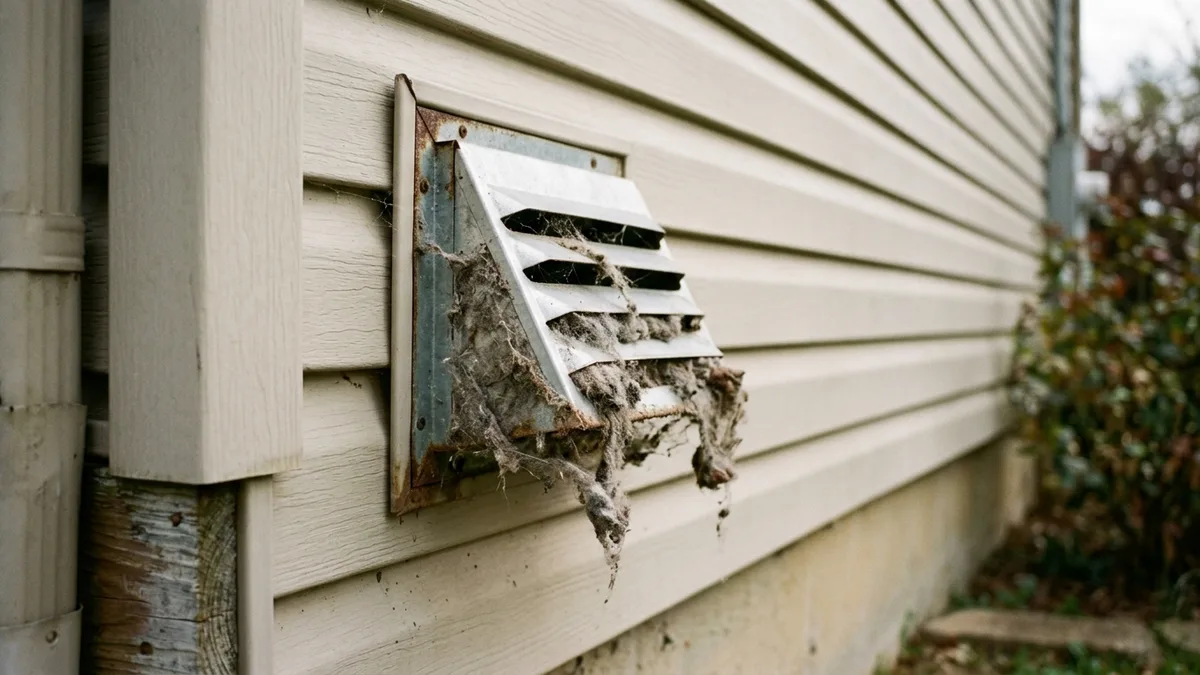
A dryer vent needs cleaning when drying times noticeably increase, clothes come out hotter than usual, or lint accumulates visibly around the lint trap and exterior vent hood. These signs mean airflow is restricted well before the next scheduled cleaning date arrives.
Specifically, watch for these indicators between scheduled services:
- A single load now takes two cycles to dry when it used to take one.
- The dryer or laundry room feels noticeably hotter during operation than it used to.
- You notice a burning smell, especially at the start of a cycle.
- The exterior vent hood flap barely opens during operation, or lint is visibly packed around it.
- Clothes come out with a musty smell, which often signals moisture trapped in a blocked duct.
If any of these appear, don't wait for the annual mark. Schedule a cleaning immediately, since restricted airflow is exactly the condition the U.S. Fire Administration links to a large share of home dryer fires. Additionally, note the date and symptom in whatever maintenance log you're using; a pattern of early symptoms is useful data if you're deciding whether to shorten your cleaning interval going forward.
What Factors Change How Often You Should Clean a Dryer Vent?
Dryer vent cleaning frequency depends primarily on household size, laundry volume, pets, and vent configuration, meaning the "right" interval varies significantly from one property to another. A single-person apartment with a short wall vent behaves nothing like a five-bedroom brownstone with a 45-foot roof run.
The table below breaks down typical intervals by property and household profile. These figures reflect widely cited industry guidance rather than a one-size-fits-all rule, so use them as a starting point and adjust based on the warning signs covered above.
| Household or Property Type | Typical Load Volume | Recommended Cleaning Interval |
|---|---|---|
| Single-occupancy apartment, short wall vent | 3 or fewer loads/week | 18 to 30 months |
| Couple, two-bed apartment, short vent | 3 to 5 loads/week | 18 to 24 months |
| Family of 3 to 4, long roof run | 6 to 9 loads/week | 12 to 15 months |
| Family of 5+, shared rental, long roof run | 10+ loads/week | 6 to 9 months |
| Short-term rental (any size) | Multiple guest turnovers weekly | Every 3 months |
| In-home daycare or salon | High daily volume | 4 to 6 months |
| Laundromat, hotel, or hospital laundry | Continuous/commercial | 2 to 3 months |
| Apartment complex common laundry, gym facility | Moderate to high shared use | 6 months |
Notice the pattern: vent length and household size push the interval down, while light, infrequent use allows it to stretch out. Pets add lint volume regardless of household size, since pet hair sheds into laundry loads and collects in the duct faster than fabric lint alone. If your property has more than three bends in the vent run or exceeds 25 feet, professionals commonly recommend treating it like a high-use household even if the load volume is moderate.
Can You Clean a Dryer Vent Yourself?
Yes, homeowners can clean a dryer vent themselves for basic maintenance between professional visits, though a full duct cleaning on longer or more complex vent runs is harder to do thoroughly without specialized equipment. DIY cleaning works well for lint trap maintenance and short, straight vent runs under roughly 10 to 15 feet.
For DIY cleaning, follow this basic process:
- Unplug the dryer and disconnect the vent hose from the back of the unit.
- Vacuum the interior of the dryer housing where lint accumulates around the drum area.
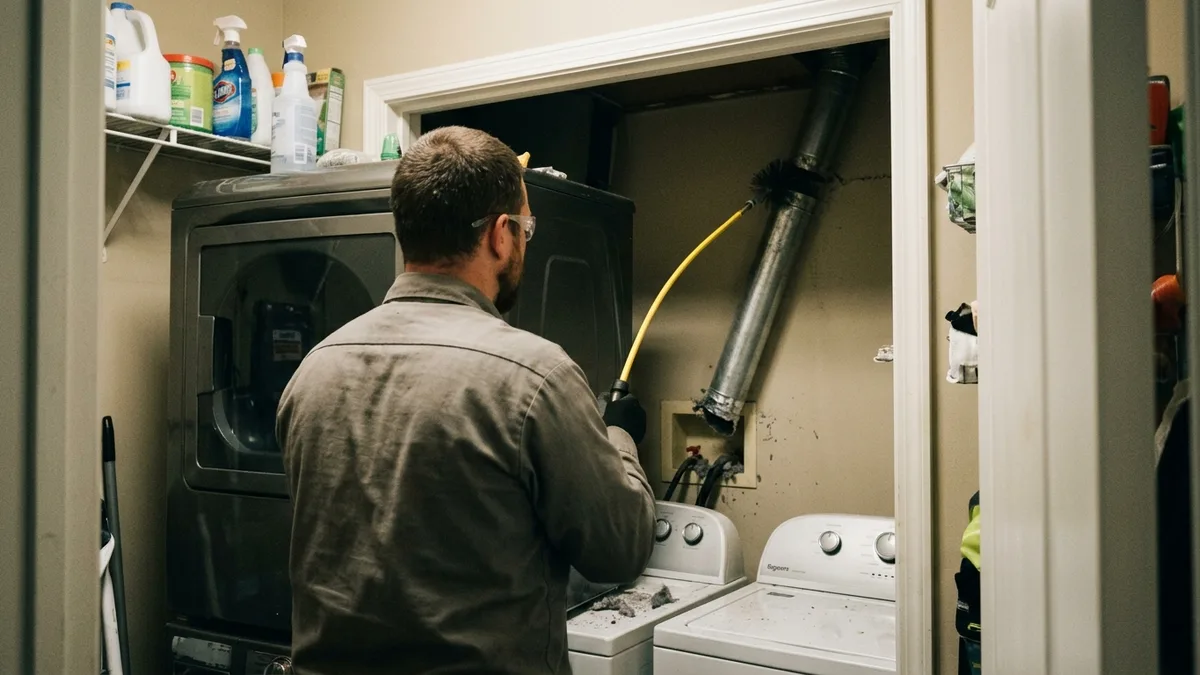
- Use a vent brush kit with flexible rods to push through the duct from both the dryer end and the exterior vent hood.
- Clean the exterior vent hood flap and surrounding area, removing any nesting material or heavy lint buildup.
- Reconnect the vent hose securely and run a test cycle to confirm airflow and drying time feel normal.
However, DIY cleaning has real limits. Long roof runs, vents with multiple 90-degree bends, or second-and third-story installations are difficult to clean fully with a handheld brush kit. In these cases, a professional with rotary brush equipment and a shop vacuum rated for lint extraction reaches sections a DIY kit physically cannot access. If you're unsure whether your setup qualifies as DIY-friendly, a vent length over 25 feet or more than three bends is generally the cutoff point professionals use to recommend a scheduled service call instead.
How Often Should You Get Your Dryer Vent Professionally Cleaned?
Professional dryer vent cleaning is recommended at least once per year for most residential households, and every 6 months for high-use homes, according to guidance referenced by the NFPA and echoed in CPSC maintenance recommendations. Professional service becomes necessary specifically when the vent run is long, has multiple bends, or when DIY tools can't reach the full duct length.
For multi-tenant and commercial properties, the interval compresses further. Laundromats, hotels, and hospital laundry facilities are commonly advised to schedule cleaning every 2 to 3 months because of near-continuous operation. Apartment complexes and gyms with shared laundry facilities typically fall into a 6-month cycle, reflecting moderate-to-high usage across many residents rather than a single household.
Property managers overseeing multiple units across North Charleston or the Rivers Avenue corridor often find that a single missed dryer vent cleaning cycle across a portfolio creates outsized risk. One unit with a blocked vent doesn't just slow down laundry; it becomes a liability the entire building absorbs. That's the same operational logic we apply at Trash Day Made Easy when we talk with multifamily managers about scheduled service programs generally: consistency across every unit matters more than any single visit.
What Happens if You Don't Clean Dryer Vents?
Failing to clean a dryer vent leads to restricted airflow, longer drying times, higher energy costs, and a measurably increased fire risk. The U.S. Fire Administration reports that clothes dryers are involved in approximately 15,970 home structure fires annually, and failure to clean is the leading ignition factor in about 31% of these incidents based on 2018 to 2020 data.
As lint accumulates, the dryer has to work harder to push air through a narrowing passage. This shows up first as longer cycle times, then as a hotter-running appliance, and eventually as a genuine ignition risk once heat and trapped lint combine. Additionally, a chronically restricted vent shortens the lifespan of the dryer's heating element and motor, since the appliance is running under stress every single cycle.
For rental property owners, an uncleaned vent also creates documentation exposure. If a fire or appliance failure occurs and there's no maintenance record showing a cleaning schedule was followed, that gap becomes a serious liability question during any insurance claim or resident dispute. This is exactly why we tell portfolio operators across Charleston and Atlanta that a photo-verified maintenance record isn't a luxury, it's the paper trail that protects you if something ever goes wrong.
Documenting and Tracking Dryer Vent Maintenance: What Most Property Owners Get Wrong
Dryer vent maintenance tracking means keeping a dated, verifiable record of every cleaning, ideally with photo or written confirmation, so you can prove compliance with manufacturer warranties, local fire codes, and insurance requirements. Most homeowners rely on memory alone, which fails the moment a warranty claim or insurance dispute requires proof.
A simple tracking system doesn't need to be complicated. At minimum, log the service date, who performed the cleaning, the vent's condition before and after (lint volume observed), and any symptoms that prompted an off-schedule visit. For a single-family home, a spreadsheet or even a dated note on the refrigerator works. For a multi-unit property or portfolio spanning Daniel Island, James Island, and Summerville, that approach breaks down fast.
This is where photo verification becomes the differentiator between "we think it got done" and "we can prove it got done." A property manager overseeing 40 units across a scattered-site portfolio can't personally confirm every dryer vent cleaning happened as scheduled. Documented, timestamped confirmation removes the guesswork entirely, and it's the same standard we apply to nightly trash valet service at Trash Day Made Easy: no follow-up calls needed because the record already exists.
What Should You Do When Dryer Vent Problems Keep Coming Back?
Recurring dryer vent problems despite regular cleaning usually point to a structural issue rather than a maintenance frequency problem, such as an undersized duct, an excessively long run, sagging flexible ducting, or a bird's nest blocking the exterior vent hood. Cleaning on schedule won't fix a vent that's physically too long or poorly routed.
If drying times stay slow immediately after a professional cleaning, check these structural culprits first:
- Vent runs exceeding roughly 25 feet without a booster fan installed.
- Flexible foil or plastic ducting instead of rigid metal duct, which sags and traps lint at low points.
- More than three 90-degree bends between the dryer and the exterior vent.
- A damaged or missing exterior vent hood flap allowing pests or debris to enter.
- A vent terminating too close to shrubbery or another obstruction outside the home.
In these cases, the fix is often a one-time duct modification, not more frequent cleaning. A licensed HVAC technician or vent specialist can measure the run and recommend rigid metal duct replacement or a booster fan if the distance genuinely requires one. Once the structural issue is corrected, most homes return to a normal 6 to 12 month cleaning cycle without repeat symptoms.
DIY vs. Professional Dryer Vent Cleaning: What's the Real Cost Difference?
DIY dryer vent cleaning costs little beyond a vent brush kit purchase, typically a one-time expense under $30, while professional cleaning is a paid service call priced by vent length, accessibility, and region. The tradeoff isn't just price, it's thoroughness and liability documentation.
For a straightforward, single-story home with a short, straight vent run, a DIY kit handles the job adequately between professional visits. But for multi-story homes, long roof runs, or any rental property where documentation matters for insurance or resident safety, professional service provides two things DIY can't: specialized equipment that reaches the full duct length, and a documented service record.
For HOA communities and build-to-rent developments across the Charleston metro, the calculation shifts further. A single missed or incomplete DIY cleaning across dozens of units creates inconsistent risk exposure across the property. That's an operational gap, not a cost-savings win. Scattered-site portfolio owners we talk with often start with a patchwork of resident-managed cleanings and move toward a centrally scheduled professional program once they've dealt with one preventable incident.
Practical Guidance: Building a Dryer Vent Maintenance Plan That Actually Works
The most reliable dryer vent maintenance plans combine a scheduled interval, a symptom-based check-in, and a documented record, rather than relying on any single approach alone. Here's a step-by-step framework that works whether you're managing one household or a 200-unit portfolio.
- Establish a baseline interval. Start at 12 months for standard households, 6 months for high-use homes with pets or 10+ weekly loads, and quarterly for short-term rental turnovers.
- Clean the lint trap after every single load regardless of your professional cleaning schedule; this is separate maintenance that reduces buildup between vent cleanings.
- Do a monthly visual check of the exterior vent hood flap to confirm it opens freely during operation and shows no nesting material.
- Log every cleaning with a date, technician or DIY note, and observed lint condition, whether in a spreadsheet, property management software, or a simple paper log.
- Shorten the interval immediately if you notice longer drying times, unusual heat, or burning smells, rather than waiting for the next scheduled date.
- For multi-unit properties, standardize the schedule across every unit rather than leaving it to individual residents, and require photo or written confirmation from whoever performs the service.
Common mistakes to avoid: treating vent cleaning as a "someday" task instead of a calendar item, assuming a new dryer means a new vent (the existing ductwork is usually reused and may already have years of buildup), and skipping documentation because "nothing's gone wrong yet." The households and properties that end up dealing with dryer fires or appliance damage are rarely the ones with an aggressive cleaning schedule; they're the ones with no schedule at all.
How Does Dryer Vent Maintenance Compare Across Apartment Buildings and Multi-Unit Properties?
Apartment buildings and multi-unit properties require a centralized dryer vent cleaning schedule rather than relying on individual residents, since inconsistent compliance across units creates uneven fire risk throughout the building. A shared laundry room or in-unit dryer setup both need documented, scheduled service rather than resident self-management.
In practice, this means property managers across North Charleston and the broader Charleston metro should treat vent cleaning the same way they treat fire extinguisher inspections: a recurring, tracked compliance item, not a resident responsibility buried in a lease clause. For build-to-rent communities near Daniel Island or the airport corridor, where investor reporting and community cleanliness expectations run high, a documented vent maintenance program is also a visible signal of professional property management.
Short-term rental operators managing properties in the Charleston Historic District or on Isle of Palms face a tighter cycle still. With guest turnovers happening every few days, quarterly vent cleaning isn't excessive, it reflects the reality of near-continuous dryer use across back-to-back stays. A missed cleaning here doesn't just risk fire safety; it risks a slow-drying load delaying a guest's checkout laundry and triggering a bad review.
Frequently Asked Questions
How often should a dryer vent be cleaned in a normal single-family home?
Most single-family homes should have their dryer vent cleaned every 6 to 12 months. Homes with shorter, straighter vent runs and lighter laundry use can sometimes stretch to 18 months, but the NFPA treats once per year as the minimum safe baseline for typical households.
Can I clean my dryer vent myself, or do I need a professional?
You can clean the lint trap and short, straight vent runs yourself using a basic vent brush kit. Longer runs over roughly 25 feet, runs with multiple bends, or multi-story installations are difficult to clean thoroughly without professional rotary brush equipment.
How do I know if my dryer vent needs cleaning right now?
Watch for drying times that have noticeably increased, a hotter-than-usual laundry room during cycles, a burning smell, or visible lint buildup around the exterior vent hood. Any of these signs means you shouldn't wait for your next scheduled cleaning date.
What happens if I never clean my dryer vent?
Uncleaned dryer vents restrict airflow, increase energy costs, shorten appliance lifespan, and raise fire risk significantly. The U.S. Fire Administration links failure to clean to roughly 31% of home clothes dryer fires reported between 2018 and 2020.
How often should short-term rental properties clean their dryer vents?
Short-term rental properties should clean dryer vents quarterly, regardless of size, due to the high frequency of guest turnovers and near-continuous dryer use. This is more frequent than the standard homeowner interval because of the volume of loads run between cleanings.
Does cleaning frequency change if I have pets?
Yes. Pet hair adds significant lint volume to laundry loads, which accelerates duct buildup regardless of household size. Homes with pets are commonly advised to clean every 6 months instead of the standard 12-month interval.
How much does professional dryer vent cleaning typically cost?
Professional dryer vent cleaning pricing varies by vent length, accessibility, and region, so costs differ significantly between a simple one-story home and a multi-story property with a long roof run. Request quotes from local providers for an accurate estimate specific to your property's configuration.
Conclusion
Dryer vent cleaning frequency isn't a single number, it's a range that starts at 6 to 12 months for most homes and compresses down to quarterly for short-term rentals and commercial laundry operations. The households that stay safest are the ones tracking usage, watching for warning signs like longer drying times, and documenting every service visit rather than trusting memory alone.
As more property operators across Charleston and Atlanta formalize their maintenance programs in 2026, dryer vent cleaning is increasingly treated as a scheduled compliance item rather than a someday chore. That shift protects residents, protects appliances, and protects property owners from the documentation gap that turns a preventable incident into a costly dispute.
While dryer vent cleaning isn't a service Trash Day Made Easy provides directly, the same principle that drives our nightly, photo-verified valet trash service across multifamily communities, build-to-rent developments, and short-term rentals in the Charleston metro applies here too: recurring maintenance only works when someone is actually tracking it. If you're managing waste operations across a portfolio and want that same documented consistency applied to trash collection, request a quote at Trash Day Made Easy, available Monday through Friday.

If tracking maintenance across a scattered-site portfolio or a busy short-term rental turnover schedule already feels like a full-time job, you don't need to add trash coordination to that list too. Trash Day Made Easy handles nightly, photo-verified valet trash collection across Charleston and Atlanta so that piece of your maintenance puzzle runs itself.
Content powered by inkSTR.co