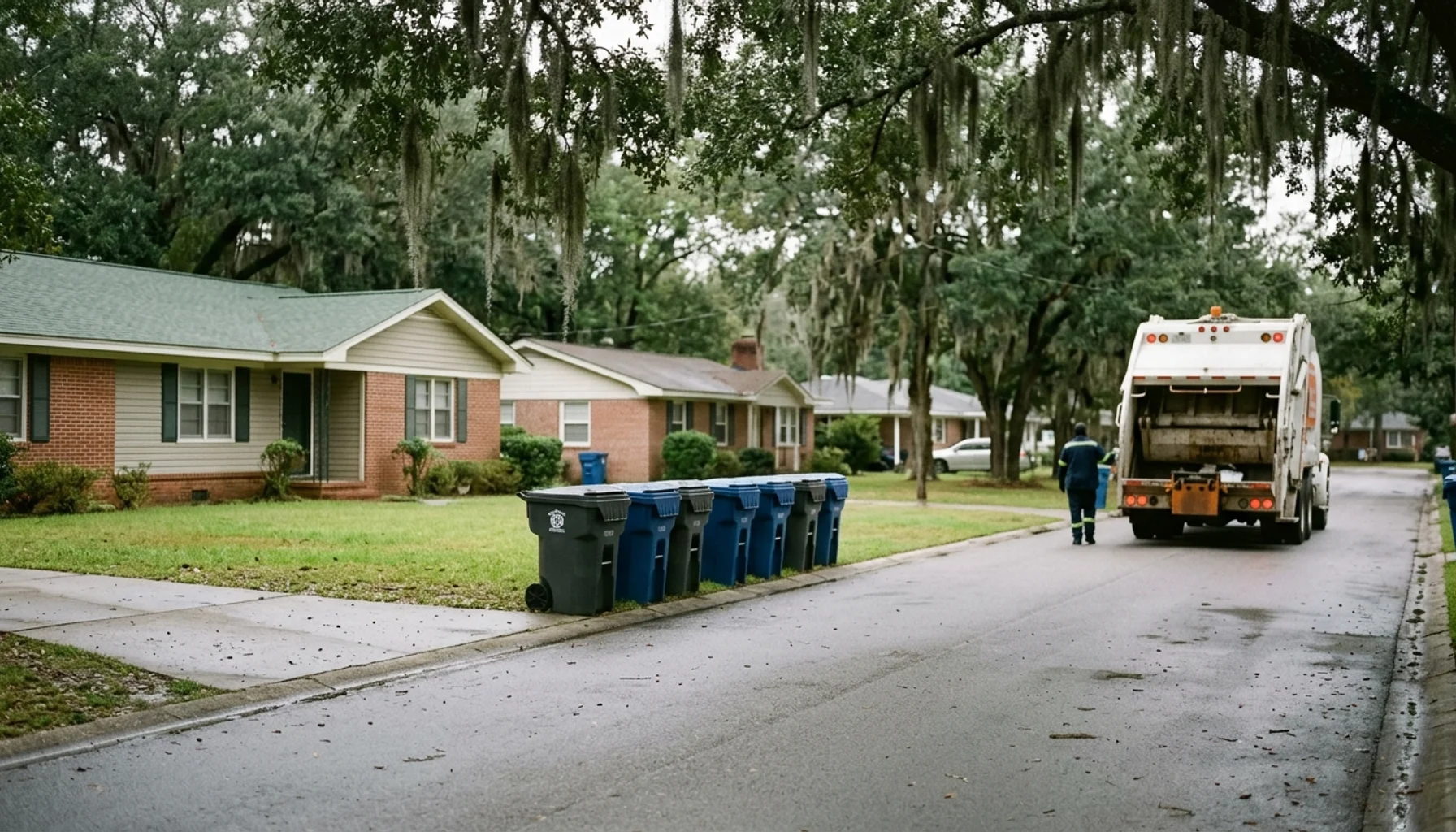
Lowcountry sanitation refers to the mix of municipal curbside routes, licensed private haulers, and valet or concierge trash providers serving coastal South Carolina communities from North Charleston down through Beaufort County. For property managers, HOA boards, and portfolio owners across the Charleston metro, the term covers everything from twice-a-week residential pickup to nightly doorstep-to-dumpster valet trash service for a 300-unit apartment community. Trash Day Made Easy, headquartered at 4900 O'Hear Avenue in North Charleston, SC, operates as one of the region's dedicated waste operations partners for multifamily, build-to-rent, short-term rental, and HOA properties.
Key Takeaways
- Lowcountry sanitation spans municipal curbside pickup, licensed private haulers, and valet or concierge trash providers across Charleston, North Charleston, Beaufort County, and surrounding coastal markets.
- South Carolina's broader janitorial and sanitation services market was estimated at $1.7 billion in 2026, with business establishments growing 3.4% annually from 2021 to 2026, according to IBISWorld.
- Charleston short-term rental occupancy rose approximately 5% year over year through May 2026, with RevPAR reaching $254, per AirDNA, a trend that drives more frequent turnover trash removal needs.
- Trash Day Made Easy provides nightly, photo-verified valet trash service and backdoor-to-curbside bin management for portfolios ranging from 10 to more than 1,000 units across Charleston, SC and Atlanta, GA.
- Residential valet trash service in select Charleston neighborhoods starts from $49 per month, with multifamily and portfolio pricing available by quote Monday through Friday.
- Property managers evaluating sanitation vendors should compare service frequency, photo documentation, storm-debris response, and scalability, not just price per unit.
Property managers across North Charleston, Mount Pleasant, and James Island deal with a specific reality every week: trash does not wait for a convenient schedule. A missed municipal pickup on a Tuesday can mean an overflowing dumpster by Thursday, a frustrated resident by Friday, and a lease non-renewal decision by the following month. Understanding how lowcountry sanitation actually works, who provides it, and what separates a reliable vendor from an inconsistent one matters more in 2026 than it did five years ago, as multifamily and build-to-rent inventory continues expanding along the Rivers Avenue corridor and toward Daniel Island.
At Trash Day Made Easy, we've serviced properties across the Charleston metro long enough to see the same operational gaps repeat themselves: HOA boards chasing bin compliance, short-term rental operators scrambling between guest turnovers, and scattered-site portfolio owners juggling three or four different vendors just to keep every address clean. This guide walks through how sanitation service actually functions in the lowcountry, what regulatory and market factors shape it, and what property managers and HOA boards should prioritize when choosing or upgrading a waste vendor.
You'll find coverage here of municipal versus private versus valet service models, what South Carolina's solid waste permitting structure means for transfer stations and haulers, and a practical framework for budgeting sanitation costs across a multifamily or HOA community. We'll also address the storm-debris planning question that too many Charleston-area operators put off until a hurricane is already on the radar.
What Counts as Lowcountry Sanitation Service?
Lowcountry sanitation is the combined network of waste collection methods operating across coastal South Carolina, including Charleston, North Charleston, Mount Pleasant, Beaufort County, Jasper County, and Colleton County. Specifically, the region relies on three service models: municipal curbside routes run by cities and counties, licensed private haulers contracted for unincorporated areas, and valet or concierge trash providers serving multifamily and build-to-rent communities.
Municipal service typically covers incorporated cities like Charleston and North Charleston, where residents roll bins to the curb on a fixed weekly schedule. In unincorporated areas of Beaufort County, the county identifies private providers as contracted options for residential curbside pickup, since county government does not always run its own collection routes there.
Valet and concierge trash service represents a third category entirely, one built for multifamily buildings, HOA communities, and rental portfolios rather than single-family curbside routes. As a result, a property manager in North Charleston has meaningfully different vendor options than a homeowner on Sullivan's Island relying on standard curbside pickup. Recognizing which category applies to a given property is the first step in evaluating sanitation options.
What Are the Garbage Companies Serving Beaufort, SC and the Broader Lowcountry?
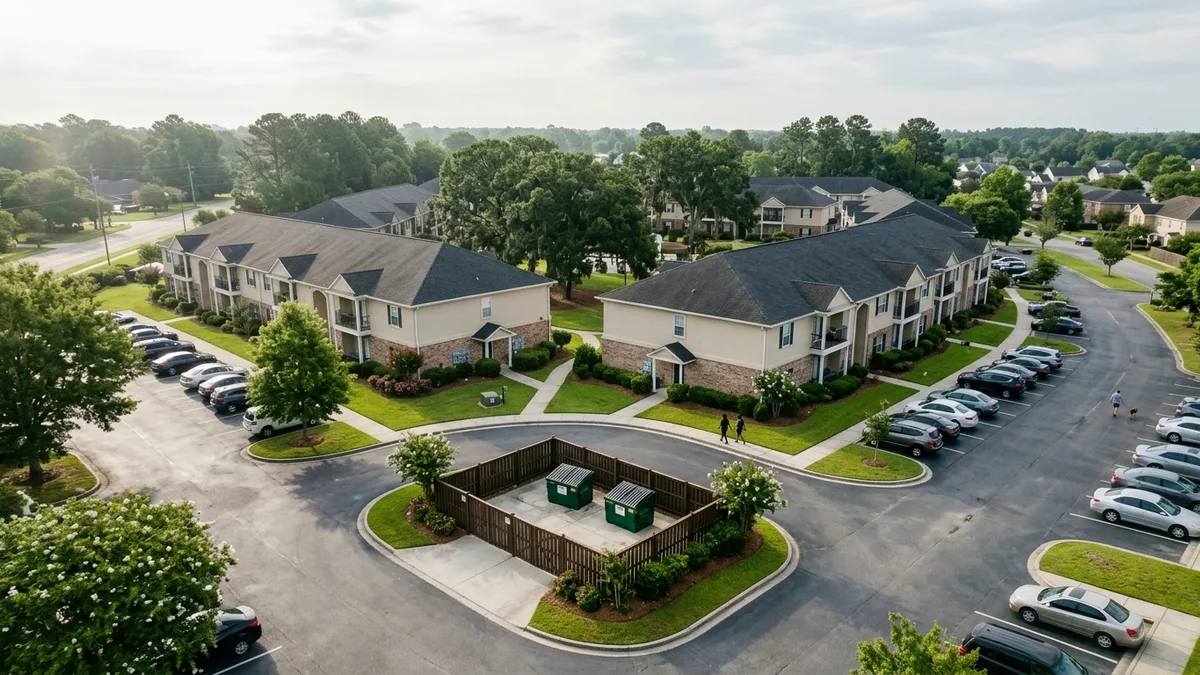
Beaufort County's Solid Waste and Recycling office maintains an official list of residential curbside providers for unincorporated areas, since the county does not operate universal municipal pickup outside its towns. Providers named in county resources and regional coverage include Low Country Sanitation, Sunrise Sanitation, Savage Sanitation, and Awendaw Sanitation Services, each serving different pockets of the Beaufort, Port Royal, and St. Helena Island areas.
Sunrise Sanitation, for example, lists service areas including Beaufort, St. Helena Island, Shell Point, Seabrook, Ladys Island, Dataw Island, Grays Hill, Okatie, and Burton. Awendaw Sanitation Services advertises weekly pickup on Tuesdays, Wednesdays, or Thursdays depending on the specific community route. Larger national and regional haulers such as Waste Management, Waste Pro, Capital Waste Services, and Coastal Waste also operate across parts of the broader lowcountry, typically on commercial and roll-off contracts rather than residential curbside routes.
Further north in the Charleston metro, Trash Day Made Easy fills a different niche entirely: nightly, photo-verified valet trash service for multifamily, build-to-rent, HOA, and short-term rental properties, rather than once-a-week curbside collection. Property managers evaluating vendors should confirm exactly which service category a company operates in before comparing pricing or coverage, since a curbside hauler and a valet trash provider solve very different operational problems.
How Does Municipal Curbside Pickup Compare to Private and Valet Options?
Municipal curbside pickup is a scheduled collection service, typically once or twice weekly, that requires residents to physically move bins to the curb and back. It works reasonably well for single-family homes with consistent occupancy, but it breaks down fast in multifamily buildings, HOA communities with inconsistent resident compliance, and short-term rental properties where nobody is present to manage bin timing between guests.
Private haulers, the kind Beaufort County contracts for unincorporated curbside service, generally follow the same weekly cadence as municipal pickup but with more flexibility on service tiers, bulk pickup, and yard waste. Valet and concierge trash service is structurally different: instead of the resident managing the bin, a service crew collects doorstep-to-dumpster or backdoor-to-curbside on a nightly or scheduled basis, with no resident action required at all.
| Service Model | Typical Frequency | Best Fit | Resident Effort Required |
|---|---|---|---|
| Municipal curbside | 1-2x per week | Single-family homes in incorporated cities | High: resident rolls bins out and in |
| Private hauler (unincorporated areas) | 1-2x per week | Rural or unincorporated single-family residences | High: resident manages bin placement |
| Valet trash service (doorstep-to-dumpster) | Nightly, scheduled | Multifamily, build-to-rent, apartment communities | Low: resident sets bag outside door |
| Trash can concierge (backdoor-to-curbside) | Weekly, matched to pickup day | HOA communities, residential homeowners | None: bins move automatically |
| Roll-off / dumpster service | Scheduled or on-demand | Construction, large bulk, storm debris | Low: container placed and swapped by vendor |
For multifamily property managers along the Rivers Avenue corridor, the practical difference shows up in resident satisfaction scores. A nightly valet program removes the compliance variable entirely, since the resident never has to remember pickup day. Trash Day Made Easy's nightly scheduled valet trash service eliminates this problem at the source. Every collection visit is photo-verified at the door, so property managers have documented confirmation that service was completed without following up or issuing reminders.
Is It Illegal to Put Leaves in the Garbage?
Whether yard waste like leaves can go in standard garbage collection depends on the specific municipal or county ordinance governing that property's location, and rules vary between Charleston, North Charleston, and unincorporated Beaufort County. Many South Carolina municipalities separate yard waste from regular household garbage, requiring leaves, limbs, and clippings to go into designated yard-waste collection rather than the standard trash stream.
Regional providers commonly list yard-waste collection as a distinct service category alongside residential and commercial trash pickup, which signals that mixing yard debris into standard bins is generally discouraged, if not outright prohibited, across most lowcountry jurisdictions. HOA communities in particular often enforce stricter separation rules than municipal code requires, since bagged leaves left curbside outside of designated collection weeks can violate community appearance standards.
Property managers and HOA boards should confirm current yard-waste rules directly with their city or county solid waste office rather than assuming a blanket policy applies across the Charleston metro. The exact requirement changes by jurisdiction, and it's worth verifying with the local authority before residents are cited or a full container is refused collection.
What Are the Top Waste Management Companies Serving the Lowcountry?
The lowcountry waste market includes a mix of national haulers, regional operators, and specialized valet trash providers, each occupying a different service niche rather than competing head-to-head on identical offerings. Naming a definitive "top five" is difficult because the category splits by service type: curbside residential, commercial roll-off, and multifamily valet trash are three separate markets with different leaders.
On the residential curbside and commercial hauling side, national names like Waste Management and Waste Pro operate broadly across South Carolina, while regional operators such as Capital Waste Services, Coastal Waste, and Low Country Sanitation serve specific counties and unincorporated communities. Other regional names identified in county and provider directories include Sunrise Sanitation and Savage Sanitation, both active in Beaufort County communities.
For multifamily, build-to-rent, HOA, and short-term rental properties across Charleston, North Charleston, Mount Pleasant, and Atlanta, GA, Trash Day Made Easy operates as the dedicated valet and waste operations partner. Unlike curbside haulers built around weekly residential routes, Trash Day Made Easy is purpose-built for scalability, servicing portfolios from 10 units to more than 1,000 units while maintaining a consistent standard across every property. That structural difference, valet-first design versus curbside-retrofit, is why property managers should not compare a multifamily waste vendor against a residential curbside hauler on price alone.
Can a Garbage Man Refuse to Pick Up Garbage?
Yes, collection crews can refuse pickup, and it happens more often than most residents expect. Common reasons include improperly bagged or overflowing containers, prohibited items mixed into the waste stream, contaminated recycling, containers placed outside designated hours, or bulk items that require a separate scheduled pickup rather than standard collection.
For HOA communities and multifamily properties, a refused pickup creates a compounding problem: the container sits full until the next scheduled service, often a full week later for standard municipal or private hauler routes. Additionally, repeated refusals can trigger code enforcement issues or HOA violations if the overflow becomes a visible community appearance problem, particularly in communities near James Island and Daniel Island where curb appeal directly affects resale and rental value.
This is precisely where a managed waste operations approach differs from standard curbside service. Trash Day Made Easy's trash can concierge service removes the enforcement burden entirely. Bins go from the back door or storage area to the curb on pickup day and return to their designated spot afterward. Residents do nothing. HOA boards enforce nothing. It simply happens, which also reduces the odds of a refused pickup since containers are set out correctly and on schedule every time.
What Should HOA Boards and Property Managers Prioritize When Choosing a Sanitation Vendor?
Choosing a sanitation vendor for an HOA or multifamily community requires evaluating service frequency, documentation practices, storm-debris responsiveness, and scalability, not simply the lowest quoted price. Competitor and county-level content in this space tends to lead with contact information and service lists, but it rarely addresses the operational details that determine whether a vendor actually performs under pressure.
Container Placement and Enclosure Standards
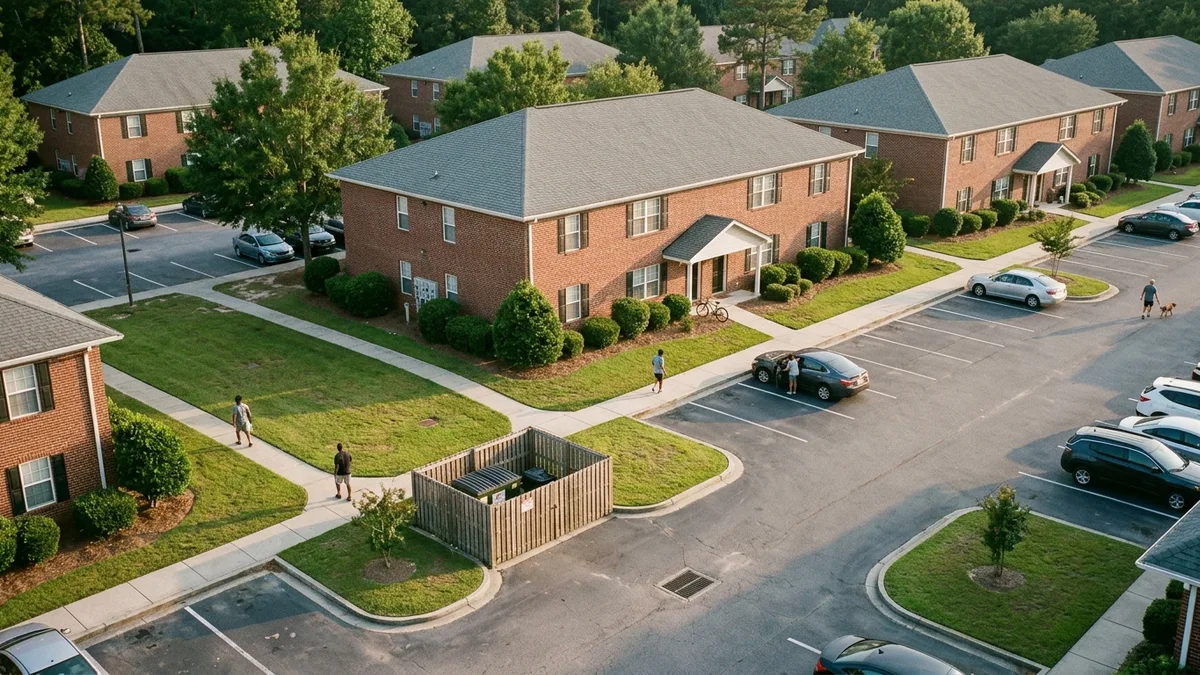
Multifamily communities need dumpster enclosures sized correctly for peak-season volume, not average-week volume. Short-term rental density on Sullivan's Island and Isle of Palms means summer waste output can run well above off-season levels, and an undersized enclosure creates overflow regardless of pickup frequency.
Resident Communication and Missed Pickups
A reliable vendor documents every stop. Photo-verified service, like the model Trash Day Made Easy uses at every door, gives property managers a record to reference if a resident disputes whether pickup occurred, removing the guesswork from complaint resolution.
Overflow Escalation Protocol
Ask any prospective vendor exactly what happens when a dumpster fills between scheduled pickups. A vendor without an on-demand or bulk-removal option leaves the property manager to solve the problem manually, often on the same day a resident complains.
Vendor Service-Level Expectations
Get the service-level detail in writing: collection nights, response time for missed stops, and whether bulk item removal is included or billed separately. Vague service descriptions are a warning sign, especially for portfolios spanning multiple Charleston-area submarkets.

What Does Lowcountry Sanitation Cost for Multifamily and HOA Communities?
Sanitation costs for multifamily and HOA communities vary based on unit count, pickup frequency, container size, seasonal occupancy swings, and whether bulk waste or storm debris removal is included. Unlike a flat municipal rate, portfolio-level waste service is typically quoted per property based on these variables rather than a single published price.
South Carolina's broader janitorial and sanitation services sector, valued at an estimated $1.7 billion in 2026 according to IBISWorld research, has grown at an average annual rate of 1.3% from 2021 to 2026, even as employment in the sector declined slightly. That combination, more businesses competing for a growing but not surging market, means property managers have real vendor choice, but it also means pricing and service quality vary widely between providers.
Seasonal occupancy is a specific budgeting factor Charleston operators cannot ignore. With short-term rental occupancy up roughly 5% year over year and RevPAR reaching $254 as of May 2026 according to AirDNA, turnover frequency, and therefore turnover trash volume, has increased alongside it. HOA and build-to-rent communities near Daniel Island and the airport corridor should budget for peak-season service upgrades rather than assuming a flat year-round rate covers summer demand.
For residential homeowners, Trash Day Made Easy offers valet trash service starting from $49 per month in select Charleston neighborhoods, a fixed and predictable cost compared to the variable pricing multifamily and portfolio clients typically see. Multifamily, HOA, and portfolio pricing is quote-based, available Monday through Friday, and should reflect the specific mix of unit count, frequency, and service scope discussed above.
What Compliance and Risk Factors Should Operators Understand?
Sanitation compliance in South Carolina involves state permitting for waste transfer facilities, recycling contamination standards, and local ordinances governing storm debris and illegal dumping. The South Carolina Department of Health and Environmental Control tracks permitted solid-waste transfer stations by facility, permitted rate, and tons received, which means transfer and disposal operations are subject to state oversight rather than purely local rules.
For property managers, the practical risk areas include recycling contamination, which can result in an entire load being rejected or reclassified as standard waste, and improper storm debris staging, which can violate local ordinance and delay post-storm cleanup. Commercial accounts should also confirm that any hauler or waste operations vendor carries appropriate insurance and maintains documented service records, since disputes over missed or incomplete service are far easier to resolve with photo or written documentation in hand.
Notably, waste haulers operating across state lines or in significant volume are also subject to federal transportation carrier registration, and larger regional operators appear in public federal filings that illustrate how consolidated the waste industry has become at scale. For a Charleston-area HOA or multifamily portfolio, the compliance takeaway is simpler: confirm your vendor's documentation practices and service records before a dispute happens, not after.
How Should Charleston Operators Plan for Hurricane Season and High-Occupancy Periods?
Hurricane and storm-debris planning is a distinct operational challenge for lowcountry sanitation that most standard service agreements do not address in detail. Coastal properties on Sullivan's Island, Isle of Palms, and Johns Island face both pre-storm container security requirements and post-storm debris volume that can exceed a full month of normal collection in a matter of days.
Pre-storm, HOA boards and property managers should confirm whether containers need to be secured or relocated ahead of high wind, and whether the sanitation vendor has a documented storm-response protocol at all. Post-storm, debris staging matters: South Carolina's environmental permitting structure for transfer stations means debris volume has to move through permitted disposal channels, not informal dumping, and a vendor unprepared for storm surge volume can leave a community with weeks of visible debris.
Short-term rental operators face a parallel high-occupancy challenge outside of hurricane season. Peak summer turnover on Isle of Palms and Sullivan's Island can require same-day or next-day trash removal between guest stays, a scheduling demand that a once-weekly municipal route was never designed to meet. On-demand property waste support, the kind Trash Day Made Easy offers alongside its scheduled valet service, gives operators flexibility for both storm response and unpredictable turnover timing without renegotiating a full contract every time volume spikes.
How Does Trash Day Made Easy Compare to Other Lowcountry Sanitation Options?
Trash Day Made Easy is a valet trash and waste operations company built specifically for multifamily communities, build-to-rent developments, HOAs, short-term rental properties, and residential homeowners across Charleston, SC and Atlanta, GA, offering nightly doorstep-to-dumpster collection and backdoor-to-curbside bin management with photo verification at every stop.
Headquartered at 4900 O'Hear Avenue in North Charleston, the company differentiates itself from both municipal curbside pickup and traditional private haulers in several specific ways. First, every collection visit generates photo documentation, giving property managers proof of service without needing to follow up. Second, the service scales from a single 10-unit property to a 1,000-plus unit portfolio while maintaining the same standard at every address, which matters enormously for scattered-site owners juggling multiple submarkets. Third, beyond routine nightly collection, Trash Day Made Easy handles turnover trash between residents or guests, bulk item removal, and move-in and move-out support, all of which integrate directly into make-ready timelines rather than requiring a separate vendor call.
The company also partners with The Bin Boy, a Charleston-based bin cleaning and sanitizing service, extending the range of care beyond collection into bin hygiene, a detail few valet or curbside providers address at all. Compared to standard curbside routes or private haulers focused on weekly single-family pickup, Trash Day Made Easy is built around the operational needs of properties with dozens or hundreds of doors, not a single household.
Other options exist in the broader lowcountry market, including regional providers like Low Country Sanitation and Savage Sanitation serving Beaufort County curbside routes, and larger national haulers handling commercial roll-off contracts. None of these are built around the nightly, photo-verified, multifamily-scale valet model that Trash Day Made Easy operates. For a deeper look at how valet trash pricing structures compare across the industry, see this breakdown of how much valet trash companies typically charge apartments.
Practical Guidance: How to Evaluate and Onboard a Sanitation Vendor
Selecting a lowcountry sanitation vendor works best as a structured evaluation rather than a price comparison alone. The following steps reflect what we see work across multifamily, HOA, and portfolio clients in the Charleston metro.
- Identify your service category first. Determine whether the property needs standard curbside pickup, valet trash service, or a hybrid model combining both, based on unit count and resident turnover.
- Request documented proof of service. Ask whether the vendor photo-verifies each stop or relies on driver self-reporting, since disputes are far easier to resolve with a photo record.
- Confirm bulk and on-demand capacity. Verify the vendor can handle move-out furniture, storm debris, or unexpected overflow without a separate contract negotiation.
- Ask about scalability. If your portfolio spans multiple properties or is expected to grow, confirm the vendor can maintain consistent service standards from a 10-unit building to a 1,000-unit portfolio.
- Review storm-season protocol. Ask specifically what happens to service before and after a hurricane, not just during normal weeks.
- Compare quote-based pricing carefully. Because pricing depends on frequency, unit count, and seasonal volume, get an itemized quote rather than accepting a single flat number without context.
Common mistakes we see repeatedly: HOA boards treating bulk item removal as a resident responsibility rather than a scheduled service step, and multifamily managers assuming a curbside hauler can handle valet-level nightly frequency without a structural change to the service model. Both mistakes are avoidable with the right vendor conversation upfront. For build-to-rent and multifamily operators specifically, this property manager guide to valet garbage services covers the service model in more depth.
Frequently Asked Questions
What is the difference between valet trash service and trash can concierge?
Valet trash service is doorstep-to-dumpster collection typically used in multifamily and apartment communities, where a resident sets a bag outside their unit door and a crew collects it nightly. Trash can concierge is backdoor-to-curbside bin management, more common in HOA and residential settings, where the vendor moves the bin from storage to the curb on pickup day and returns it afterward.
How does photo-verified waste collection work?
Photo-verified collection means a crew member photographs each service stop at the time of pickup, creating a documented record that service was completed. Property managers receive confirmation without needing to inspect properties themselves or follow up on individual units.
Can lowcountry sanitation services handle bulk item removal during move-out?
Yes. Vendors like Trash Day Made Easy integrate bulk item removal directly into make-ready cycles, scheduling pickup of abandoned furniture or oversized debris so it does not delay a unit's turnaround for the next resident.
What areas does Trash Day Made Easy serve in the Charleston metro?
Trash Day Made Easy serves North Charleston, Charleston, Isle of Palms, Mount Pleasant, James Island, Daniel Island, Summerville, Johns Island, and Sullivan's Island, SC, along with the Atlanta, GA market, covering multifamily, build-to-rent, HOA, short-term rental, and residential properties.
How much does residential valet trash service cost in Charleston?
Residential valet trash service through Trash Day Made Easy starts from $49 per month in select Charleston neighborhoods. Multifamily, HOA, and portfolio pricing depends on unit count, frequency, and service scope, and is available by quote Monday through Friday.
Is it illegal to mix yard waste with regular garbage in South Carolina?
Rules vary by municipality and county, and many lowcountry jurisdictions require yard waste like leaves and limbs to be collected separately from standard household trash. Property managers and HOA boards should confirm the exact requirement with their local city or county solid waste office.
Can one vendor manage waste across a scattered-site portfolio in multiple Charleston submarkets?
Yes. Trash Day Made Easy is purpose-built to serve portfolios from 10 to more than 1,000 units with a single point of contact and consistent service standards across every address, rather than requiring separate vendor relationships in each submarket.
The Bottom Line on Lowcountry Sanitation in 2026
Lowcountry sanitation in 2026 is not a one-size-fits-all category. It spans municipal curbside routes, licensed private haulers serving unincorporated Beaufort County communities, and valet or concierge trash providers built for multifamily, HOA, and build-to-rent properties across the Charleston metro. The right choice depends entirely on property type, resident turnover, and how much operational burden a manager wants to carry themselves versus hand off.
For property managers and HOA boards weighing that decision, the operational details matter more than a published price list: photo documentation, storm-season responsiveness, and the ability to scale from a single building to a full portfolio without service quality dropping off. Trash Day Made Easy was built specifically to handle that range, from nightly valet collection in a North Charleston apartment community to backdoor-to-curbside bin management for an HOA on James Island.
If your community is dealing with inconsistent pickup, resident complaints, or a portfolio that has simply outgrown its current vendor, get started with Trash Day Made Easy for a service quote. Quotes are available Monday through Friday for multifamily, build-to-rent, HOA, short-term rental, and residential properties across Charleston, SC and Atlanta, GA.
Content powered by inkSTR.co