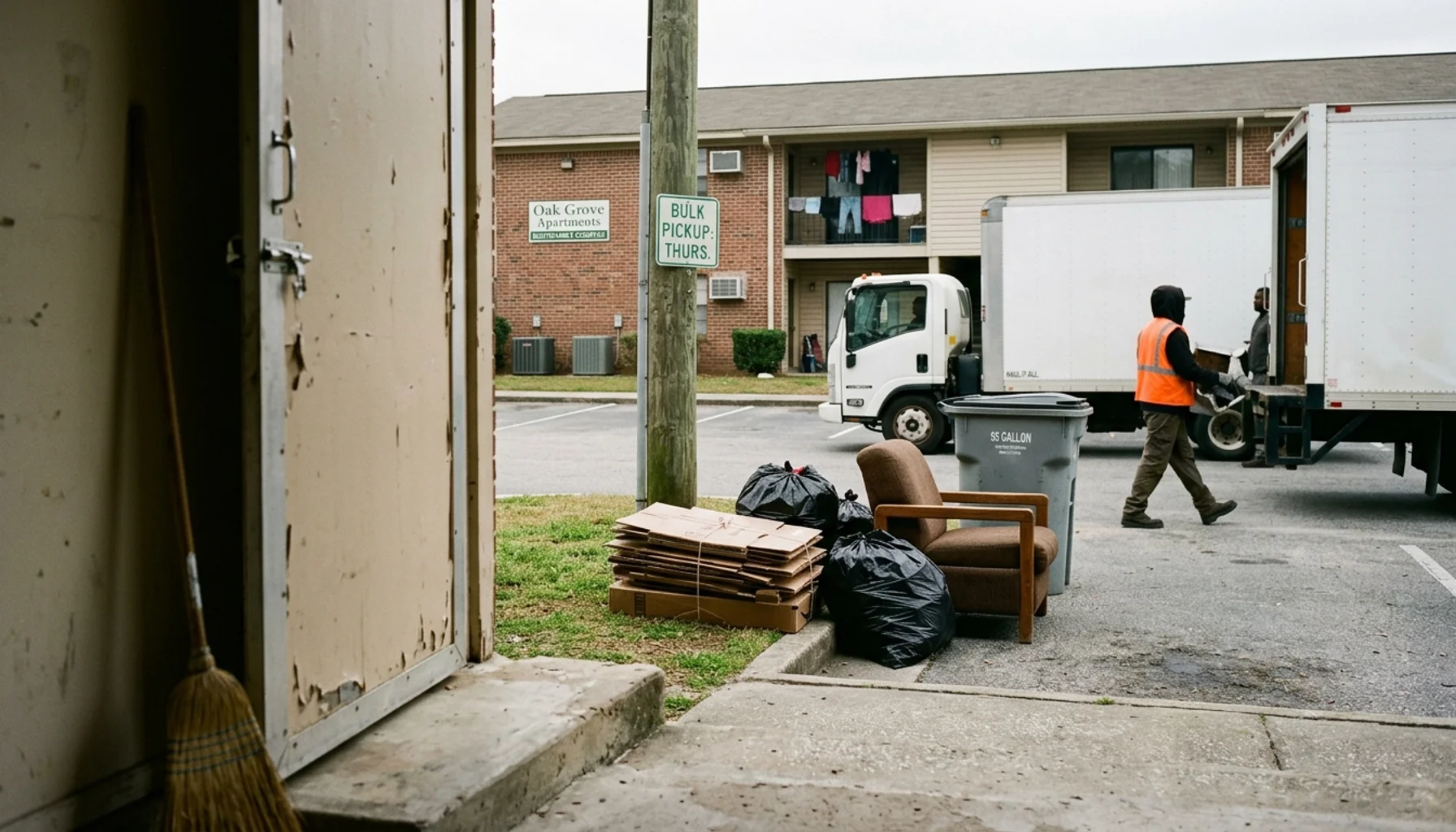
On demand trash pickup is a non-routine waste removal service that handles bulk items, turnover debris, and unexpected overflow outside a property's regular collection schedule. It exists for the situations a nightly or weekly pickup schedule was never built to solve: a couch left in a breezeway, a move-out that generates ten bags of debris overnight, or a short-term rental turnover with a bulk item on the porch and a guest arriving in three hours.
- On demand trash pickup fills the gap between scheduled collection (nightly valet or twice-weekly bin service) and unpredictable waste events like move-outs, bulk drop-offs, or STR turnovers.
- Standard valet trash collection typically runs five nights a week, according to National Trash Valet's 2026 industry data, but bulk items and surge debris require separate, scheduled on-demand visits.
- Multifamily valet trash pricing generally runs $8 to $15 per unit for properties and $25 to $35 for residents, based on 2026 industry pricing guides; on-demand and bulk removal is typically quoted separately.
- Trash Day Made Easy provides on-demand waste support alongside nightly valet trash service and trash can concierge across Charleston, SC and Atlanta, GA, with every visit photo-verified.
- Short-term rental operators near the Charleston Historic District and Isle of Palms rely on on-demand pickup specifically because turnover timing is unpredictable and a missed pickup can trigger a bad guest review.
- HOA communities and build-to-rent developments use on-demand bulk removal to handle move-in and move-out debris without relying on resident compliance or fine enforcement.
Waste management in a rental property or HOA community rarely fails because of one bad night. It fails because there is no system for the waste that does not fit a fixed schedule. A regular pickup handles regular trash. It does nothing for the sofa left at the curb after a move-out, the pile of moving boxes outside a build-to-rent unit, or the bag of debris a cleaning crew leaves behind an hour before a guest checks in.
At Trash Day Made Easy, we service multifamily communities, build-to-rent developments, short-term rental properties, HOAs, and residential homeowners across the Charleston metro and Atlanta, and the pattern is consistent: properties that only have a scheduled service end up with a waste gap every time something unexpected happens. On-demand trash pickup closes that gap.
This guide covers what on-demand trash pickup actually includes, how it differs from nightly valet trash service and standard bin management, what it costs, and how property managers, STR operators, HOA boards, and portfolio owners across North Charleston, Mount Pleasant, Daniel Island, and the Rivers Avenue corridor are using it in 2026.
What Is On Demand Trash Pickup?
On demand trash pickup is a waste removal service scheduled outside a property's routine collection cycle, typically requested to handle bulk items, surge debris, or a one-time cleanup need. Unlike nightly valet trash collection or weekly municipal service, on-demand pickup is triggered by an event, a move-out, a bulk drop-off, a guest turnover, rather than a fixed calendar.
Specifically, on-demand service covers situations where waiting for the next scheduled pickup would create a real problem: a delayed unit turnover, an HOA violation, or a guest arriving to a property with leftover debris. For example, a build-to-rent community near the airport corridor might use on-demand bulk removal only during peak move-out weeks, rather than paying for a fixed weekly bulk service year-round.
As a result, on-demand trash pickup functions as a flexible layer on top of a base waste program. Multifamily communities usually pair it with nightly valet trash collection. HOAs pair it with trash can concierge service. Short-term rental operators pair it with turnover cleaning schedules. In every case, the on-demand component absorbs the waste that a fixed schedule cannot predict, which is precisely why Trash Day Made Easy built it as a standing option across every service type in 2026.
How Does On Demand Trash Pickup Differ From Scheduled Valet Trash Service?
Scheduled valet trash service runs on a fixed, recurring calendar, typically five nights a week according to National Trash Valet's 2026 data, while on-demand trash pickup is requested as needed for non-routine waste. The two are complementary, not competing, options: one handles daily household trash, the other handles the debris that shows up outside the routine.
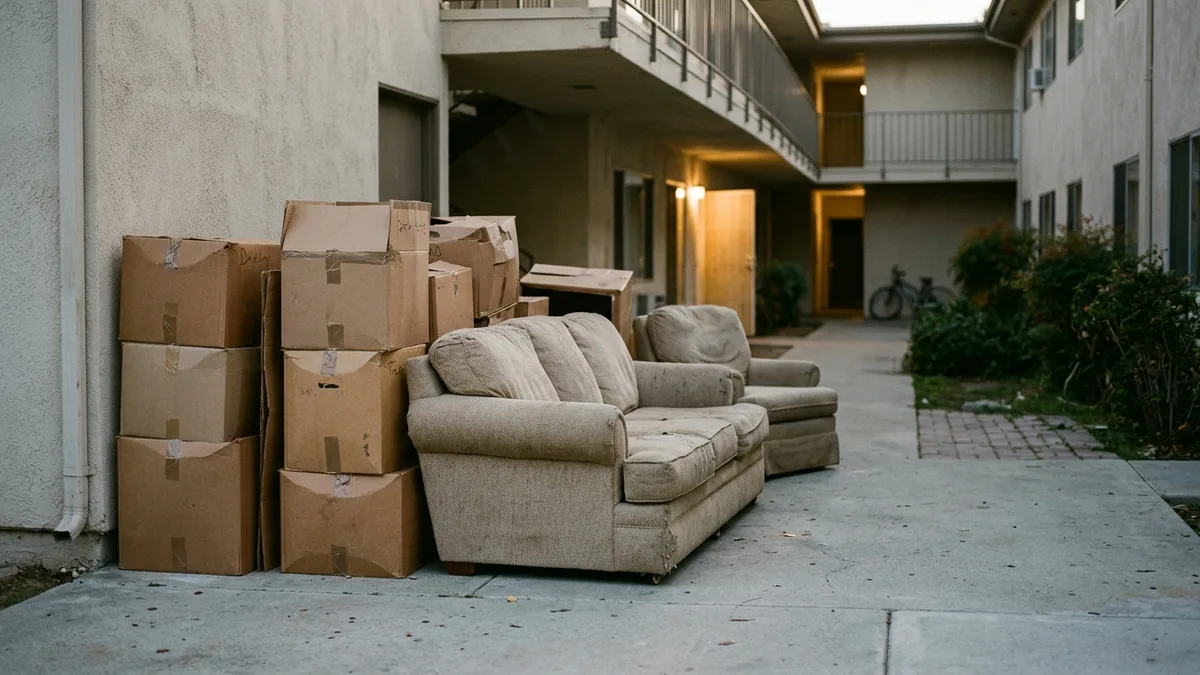
A nightly valet program collects a resident's 13-gallon receptacle from their door on a set schedule, a standard confirmed by Accelerated Waste Solutions' service model. Additionally, that same program is not designed to remove a mattress, a broken bookshelf, or ten boxes from a move-out. Those items need a separate, on-demand visit because they exceed the size, weight, or volume of routine nightly collection.
In contrast, on-demand pickup is requested for a specific event: a scattered-site portfolio owner scheduling bulk removal after a tenant vacates in North Charleston, or an STR host in Mount Pleasant requesting a same-cycle pickup before a weekend guest arrives. Trash Day Made Easy structures both services under one vendor relationship, so property managers are not coordinating a separate bulk removal company on top of their nightly valet provider. That single-vendor structure is one of the clearest operational advantages of a managed waste operations program compared to piecing together multiple point solutions.
What Situations Actually Require On Demand Pickup?
On demand trash pickup is most often needed during resident move-outs, short-term rental turnovers, bulk item disposal, and community events that generate waste outside the normal volume a property handles. Each of these situations shares one trait: the waste appears suddenly and needs to be gone before the next scheduled service, not after it.
First, move-in and move-out cycles are the single largest driver of on-demand requests. A departing resident in a 150-unit community near the Rivers Avenue corridor might leave furniture, boxes, and household items that a nightly valet crew is not equipped to remove. Every hour that debris sits in a breezeway or unit is an hour the next resident's move-in gets delayed, and in a make-ready cycle, that delay has a real cost.
Second, short-term rental turnovers create a narrower, higher-stakes version of the same problem. A guest checkout near the Charleston Historic District or on Sullivan's Island might leave behind bulk waste that a standard cleaning crew cannot haul away before the next check-in. On-demand pickup fills that window, often on the same day.
Third, bulk item disposal, old furniture, appliances, yard debris, comes up regularly in HOA communities on James Island and Johns Island, where boards have limited enforcement power over what residents leave at the curb. On-demand removal takes that enforcement burden off the board entirely, which is why HOA content strategy across the Charleston metro increasingly treats waste service as a governance tool, not just a convenience.
What Does Trash Day Made Easy Include in Its On Demand Waste Support?
Trash Day Made Easy is a valet trash and waste management company headquartered at 4900 O'Hear Avenue in North Charleston, SC, offering on-demand waste support alongside its core doorstep-to-dumpster valet trash and backdoor-to-curbside trash can concierge services. The company serves multifamily communities, build-to-rent developments, short-term rental properties, HOAs, and residential homeowners across Charleston, SC and Atlanta, GA.
Every routine and on-demand service visit from Trash Day Made Easy is photo-verified at the point of collection. That means a property manager overseeing a scattered-site portfolio across North Charleston does not have to call and confirm that a bulk item was actually removed. The confirmation shows up automatically, which removes the follow-up calls and guesswork that come with a vendor relying on driver self-reporting.
Specifically, Trash Day Made Easy's on-demand offering covers:
- Bulk item removal for furniture, appliances, and oversize debris left during move-outs or community cleanups
- Turnover trash handling between residents in multifamily and build-to-rent communities, and between guests in short-term rental properties
- Move-in and move-out support that integrates directly into a property's make-ready timeline rather than operating as a separate, disconnected vendor call
- Photo-verified confirmation on every visit, routine or on-demand, so property managers and portfolio operators have a documented record without needing to follow up
Because the company is built to scale, the same on-demand structure works whether a client is a single residential homeowner in a select Charleston neighborhood or an owner managing a 1,000-unit portfolio spanning North Charleston, Mount Pleasant, Daniel Island, and Atlanta. That scalability is a genuine differentiator: a lot of local providers can handle a handful of properties well, but consistency breaks down as a portfolio grows past a few dozen units without a structured operations program behind it.
Compared to a national provider, Valet Living offers scale and brand recognition in the valet trash space, and Valet Trash Authority and Valet Trash LLC are among the other regional operators active in this category. What separates a Charleston-based operator is direct market knowledge: knowing that a build-to-rent community near Daniel Island has different bulk-removal timing needs than a short-term rental cluster on Isle of Palms, and structuring on-demand service around those realities rather than a one-size-fits-all national policy.
How Much Does On Demand Trash Pickup Cost?
On demand trash pickup pricing is typically quoted separately from routine valet trash service because it depends on volume, item type, and frequency of need, not a fixed per-unit rate. Routine multifamily valet trash service generally runs $8 to $15 per unit for the property and $25 to $35 for residents directly, based on 2026 pricing guide data, but bulk and on-demand removal falls outside that baseline.
As a result, most waste operators, including Trash Day Made Easy, price on-demand service through a custom quote rather than a published flat rate. Variables include how much debris needs removal, whether it requires special handling (appliances versus household bags), and how often the property anticipates needing the service. A build-to-rent community with predictable seasonal turnover has different pricing needs than an STR portfolio requesting on-demand pickup multiple times a month.
| Service Type | Typical Structure | Best Fit |
|---|---|---|
| Nightly valet trash | Fixed monthly per-unit fee, $8 to $15/unit for the property per 2026 pricing data | Multifamily, build-to-rent communities |
| Trash can concierge | Flat monthly rate, residential from $49/month | HOA communities, residential homeowners |
| On-demand bulk removal | Custom quote based on volume and frequency | Move-outs, STR turnovers, community cleanups |
| Full waste operations | Portfolio-level quote covering all service types | Scattered-site portfolios, 10 to 1,000+ units |
Residential homeowners in select Charleston neighborhoods can access Trash Day Made Easy's valet trash service starting from $49 per month, with on-demand bulk pickup available as an add-on when needed. For multifamily, build-to-rent, HOA, and portfolio clients, Trash Day Made Easy provides quotes Monday through Friday rather than publishing a blanket rate, since portfolio size and turnover frequency change the math significantly.
Who Actually Needs On Demand Trash Pickup?
On demand trash pickup serves any property type where waste volume is unpredictable: short-term rentals with variable turnover schedules, build-to-rent communities with seasonal move-outs, HOA neighborhoods with inconsistent resident compliance, and scattered-site portfolios spread across multiple submarkets. Each of these groups has a different reason for needing flexible service, but the underlying problem, waste that does not fit a fixed schedule, is the same.
Short-term rental operators near the Historic District and Sullivan's Island face the tightest timing pressure. A single missed pickup between guests can show up as a one-star review before the operator even knows there was a problem. On-demand service, coordinated with a property's turnover cleaning window, is often the difference between a five-star changeover and a guest complaint.
Build-to-rent portfolio operators near Daniel Island and the airport corridor deal with a different version of the same issue: investor-facing communities where curb appeal directly affects leasing velocity. A pile of move-out debris sitting for a week is a bad look during a property tour, and on-demand removal keeps that risk off the table without requiring a fixed year-round bulk contract.
HOA boards on James Island and Johns Island often lack real enforcement tools when residents ignore bulk item rules. Rather than chasing violations, HOA managers increasingly use on-demand removal as a proactive solution, a service that makes the problem disappear instead of a fine letter that may or may not get results.

How Do You Choose an On Demand Waste Provider?
Choosing an on-demand trash pickup provider means evaluating response flexibility, documentation practices, and whether the vendor can scale with a growing portfolio, not just comparing a quoted price. The cheapest quote is rarely the best value if the provider cannot confirm service completion or cannot handle a portfolio's growth from a handful of units to several hundred.
Here is what to prioritize when evaluating a provider in 2026:
- Photo verification on every visit. A provider that documents each pickup with a timestamped photo removes the need for manual follow-up and gives you a defensible record if a dispute comes up.
- Response window for on-demand requests. Ask how quickly a bulk item or turnover request gets scheduled. A same-cycle or next-day response matters most for STR turnovers and make-ready timelines.
- Integration with existing service. A provider who already handles your nightly valet trash or bin management can fold on-demand requests into the same relationship, rather than adding a second vendor to coordinate.
- Portfolio scalability. If you manage a scattered-site portfolio or expect to grow past a handful of properties, confirm the provider has systems built for consistency across many addresses, not just a single community.
- Local market knowledge. A vendor familiar with submarket-specific patterns, STR density on Isle of Palms, BTR growth near Daniel Island, HOA dynamics on James Island, will anticipate needs a generic national contract might miss.
Other names circulating in the Charleston-area waste management space include the National Multifamily Housing Council's NMHC resource on valet trash adoption, which reports that more than half of U.S. apartment complexes now offer valet trash as a resident amenity, with residents paying around $25 a month on average. The National Apartment Association has also published research showing valet trash service can contribute to a meaningful lift in resident retention, reinforcing that this is not a cosmetic amenity but a measurable driver of lease renewal decisions.
For a deeper look at how nightly collection compares to bulk and on-demand service, our guide on door to door trash pickup breaks down the operational differences property managers should understand before signing a service agreement. If your portfolio spans multiple submarkets, the Lowcountry junk removal guide for property turnovers covers what to expect during high-volume move-out periods.
What Mistakes Do Properties Make With On Demand Waste Service?
The most common mistake property managers make is treating on-demand waste removal as an emergency fallback instead of a planned step in the turnover cycle. Waiting until a bulk item has already delayed a unit turnover means reacting under pressure rather than scheduling proactively, and that reactive posture almost always costs more time and creates more resident friction.
A second common error is splitting waste services across multiple uncoordinated vendors, one for nightly valet, another for bulk pickup, a third for HOA bin enforcement. That fragmentation creates gaps where nobody is accountable, and residents end up suffering the consequences when something falls through the cracks between vendors.
Third, some HOA boards and build-to-rent operators underestimate how much curb appeal and community cleanliness affect leasing decisions and investor perception. Overflowing dumpsters or a pile of move-out debris near the Rivers Avenue corridor is not just an eyesore; it is a signal to prospective residents and investors that the property is not well managed. A consistent, photo-documented waste program directly counters that perception.
Finally, some scattered-site portfolio owners try to manage waste logistics property by property instead of consolidating under one vendor relationship. As a portfolio grows from ten units to fifty or more, that patchwork approach becomes unsustainable. A single point of contact with consistent standards across every address, which is exactly how Trash Day Made Easy structures its multifamily and build-to-rent service, solves that scaling problem directly.
Frequently Asked Questions
What is on demand trash pickup and how is it different from regular collection?
On demand trash pickup is a non-routine waste removal service scheduled for a specific need, like a move-out or bulk item, rather than following a fixed nightly or weekly calendar. Regular collection handles everyday household trash on a set schedule, while on-demand service fills the gaps for waste that shows up unpredictably.
How quickly can on demand trash pickup be scheduled?
Response times vary by provider and request volume, but most on-demand requests for bulk items or turnover debris can be scheduled within the same service cycle or the next business day. Providers who already service a property under a routine valet trash or bin management contract, like Trash Day Made Easy, can typically fold on-demand requests into an existing route more quickly than a one-off vendor call.
Does on demand trash pickup cost more than scheduled valet trash service?
On-demand and bulk removal is priced separately from routine nightly valet service, which typically runs $8 to $15 per unit for properties and $25 to $35 for residents according to 2026 pricing data. On-demand pricing depends on volume and item type, so most providers quote it individually rather than publishing a flat add-on rate.
Can short-term rental operators use on demand trash pickup between guest stays?
Yes. On-demand pickup is commonly used by short-term rental operators near the Charleston Historic District, Isle of Palms, and Sullivan's Island to remove turnover waste and bulk items before the next guest arrives. It integrates directly with cleaning schedules so a property is guest-ready without the operator needing to be on-site.
How does photo verification work for on demand waste collection?
Photo verification means every service visit, whether routine or on-demand, is documented with a timestamped photo confirming the pickup was completed. This gives property managers and portfolio operators a documented record without needing to call and follow up on whether a bulk item was actually removed.
Can one vendor handle both nightly valet trash and on demand bulk removal?
Yes, and consolidating both under one provider is generally more efficient than managing separate vendors. Trash Day Made Easy structures its service this way, combining nightly doorstep-to-dumpster valet trash collection with on-demand bulk item removal under a single relationship across Charleston, SC and Atlanta, GA.
Is on demand trash pickup available for HOA communities, or only multifamily properties?
On-demand waste removal is available for HOA communities, build-to-rent developments, multifamily properties, short-term rentals, and residential homeowners. HOA boards on James Island and Johns Island often use it specifically to handle move-out debris and bulk items without relying on resident compliance or fine enforcement.
What happens if a property doesn't use on demand pickup for move-out debris?
Without an on-demand service, move-out debris, furniture, or bulk items often sit in breezeways or at the curb until the next scheduled pickup, which can delay unit turnovers and hurt curb appeal. This is a common driver of resident complaints and can directly affect lease renewal decisions in multifamily and build-to-rent communities.
Conclusion: Is On Demand Trash Pickup Worth Adding to Your Waste Program?
On demand trash pickup solves a specific, recurring problem that fixed-schedule collection cannot: the waste that appears outside the routine, during a move-out, a guest turnover, or a bulk drop-off. As 2026 pricing data shows, routine valet trash service runs $8 to $15 per unit for properties, but bulk and on-demand needs require a flexible layer on top of that baseline.
Properties that pair scheduled valet trash service or trash can concierge with on-demand bulk support close the gap that causes the most resident complaints and the most lease-renewal risk. Waste management rarely fails from one bad decision. It fails when there is no system for the waste that doesn't fit the calendar.
Trash Day Made Easy was built to solve exactly this coordination challenge, combining nightly photo-verified valet trash collection, trash can concierge, and on-demand bulk removal into one waste operations program across Charleston, SC and Atlanta, GA. Whether you manage a single build-to-rent community near Daniel Island or a scattered-site portfolio spanning North Charleston, Mount Pleasant, and beyond, the same standard of documented, responsive service applies.

If bulk items, move-out debris, or unpredictable turnover waste are creating gaps in your current service, Trash Day Made Easy provides on-demand support alongside nightly valet trash collection for properties across Charleston and Atlanta. Request a service quote at Trash Day Made Easy, available Monday through Friday for all property types.
Content powered by inkSTR.co