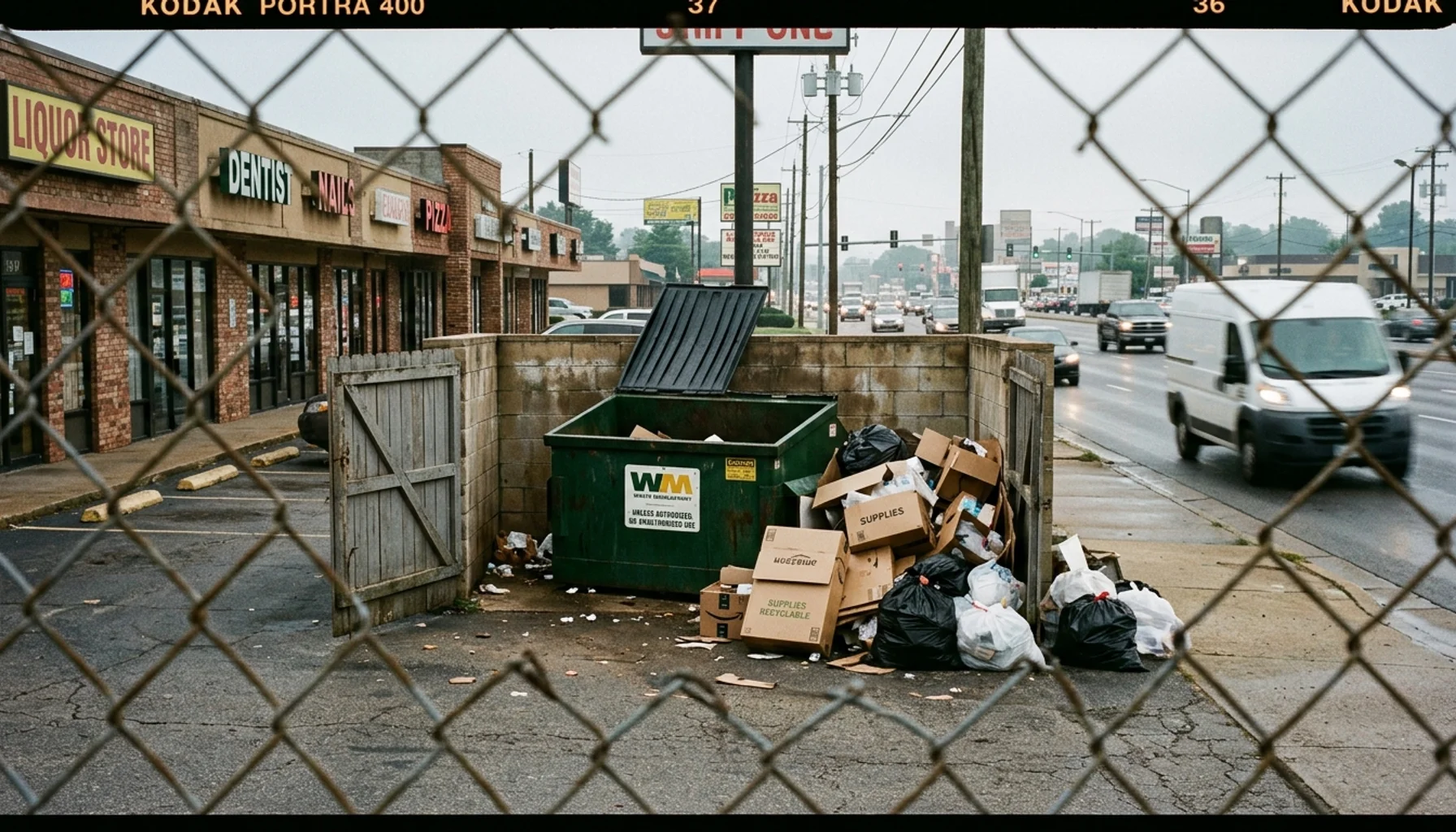
Overflowing dumpsters along the Rivers Avenue corridor are almost always caused by a mismatch between container size and actual waste volume, mixed residential and commercial use of the same containers, and inconsistent hauler pickup schedules, not by a single bad tenant. The fix combines a proper capacity audit, enclosure and access changes, and a documented collection system such as nightly valet trash service.
Key Takeaways
- North Charleston's Sanitation Division does not collect trash from commercial or industrial properties, meaning every business and mixed-use building along Rivers Avenue must arrange and pay for its own private disposal.
- A retail corridor brochure for the Rivers Avenue area reports a 2026 daytime population of 11,196 within 1 mile and 80,716 within 3 miles, a volume of foot and vehicle traffic that regularly overwhelms undersized containers.
- Rivers Avenue itself carries roughly 57,600 vehicles per day on average, according to corridor property data, and that traffic brings customer and delivery waste that many properties never accounted for when they sized their dumpster.
- Charleston County's environmental code brochure lists penalties for illegal dumping of up to $1,092 in fines, up to 30 days imprisonment, and a minimum of 20 community-service hours, which shows why unauthorized dumping into shared containers is a real liability, not just an eyesore.
- Commercial construction guidance from the City of North Charleston requires dumpster enclosures with an 8-foot opaque screen or wood privacy fence, a rule many older Rivers Avenue properties never retrofitted after renovations or tenant turnover.
- A documented, photo-verified collection system, whether that is a resized commercial container or a nightly valet trash service, replaces guesswork with a record property managers can point to when overflow disputes happen.
If you manage a property near the Rivers Avenue corridor in North Charleston, you have probably walked out to a dumpster pad that looks like it lost a fight. Bags stacked on top of the closed lid. Boxes leaning against the fence. A mattress nobody claims. This is not bad luck. It is a predictable outcome of how this corridor is built and used, and it is fixable once you understand what is actually driving the overflow.
Property management companies servicing multifamily communities, build-to-rent developments, and mixed-use properties across North Charleston report that the Rivers Avenue corridor produces a specific, recurring pattern of waste problems that generic advice does not address. Commercial traffic, apartment density, and shared parking lots collide in ways that a single-family neighborhood in Summerville or on James Island never experiences. This guide walks through why that happens and gives you a step-by-step plan to fix it in 2026, whether you manage a 40-unit apartment community, a retail strip, or a mixed-use building along Remount Road or Dorchester Road.
We will cover the specific mechanics of the corridor's overflow problem, how to size a dumpster correctly, how to document recurring issues for hauler or enforcement escalation, and where a managed waste program like nightly valet trash collection solves what a shared dumpster cannot.
Why Do Rivers Avenue Properties Have Such a Bad Overflowing Dumpster Problem?
Rivers Avenue properties struggle with overflowing dumpsters because the corridor combines dense commercial traffic, mixed residential and business tenants, and aging infrastructure that was never designed for current usage levels. Specifically, high daytime population, shared enclosures, and inconsistent hauler frequency compound into a container that fills faster than it gets emptied.
The numbers explain a lot. A Rivers Avenue retail corridor brochure reports a 2026 daytime population of 11,196 within a 1-mile radius, climbing to 80,716 within 3 miles and 163,094 within 5 miles. That is a huge volume of people generating waste in a relatively compact commercial spine, most of it running along a road that carries an average of 57,600 vehicles daily. Add in a residential population of 7,047 within 1 mile and 48,255 within 3 miles, and you have apartment residents, retail customers, and passing traffic all feeding into containers sized for a much smaller, quieter version of the corridor.
As a result, many properties built decades ago, or converted from single-tenant use to multi-tenant retail, are running the same dumpster size they started with despite tripling their effective foot traffic. North Charleston's own Sanitation Division rules make this worse for mixed-use buildings: the city does not collect garbage from commercial or industrial establishments, so any Rivers Avenue property with retail, office, or restaurant space on-site has to arrange separate private service for that portion of the building, and it is common for that arrangement to get missed entirely during a change of ownership or property management.
What Is the Difference Between Municipal and Commercial Trash Responsibility on Rivers Avenue?
Municipal trash responsibility in North Charleston covers only residential curbside collection, while commercial and industrial properties must arrange and pay for their own private waste disposal. This distinction matters enormously on Rivers Avenue, where residential apartment buildings sit beside strip retail, restaurants, and light industrial tenants, often sharing a single parking lot and, sometimes, a single dumpster pad.
Specifically, the City of North Charleston states plainly that non-residential properties and businesses must provide their own trash and garbage disposal because municipal collection does not serve commercial or industrial establishments. For a straightforward apartment community, this is simple: weekly residential collection applies. But for a mixed-use building on Rivers Avenue with ground-floor retail and upper-floor residential units, the property owner needs two separate service arrangements, and it is common for someone to assume the other party is handling it.
Additionally, the city instructs residents to place trash out no earlier than 48 hours before scheduled pickup, a rule designed to limit curbside accumulation. That rule has zero effect on a commercial dumpster serving a restaurant or retail strip, because those containers operate on a hauler contract with its own pickup calendar, not the residential schedule. If your property manager assumes city rules govern every container on-site, that mismatch alone can explain weeks of overflow.
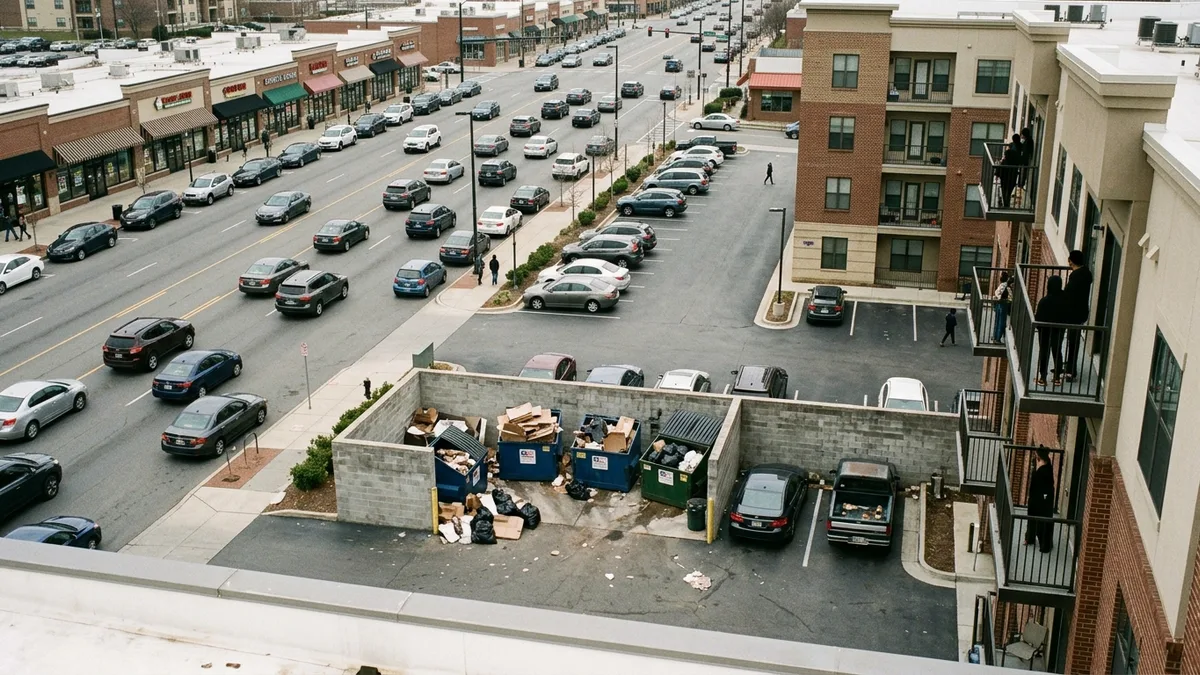
How Do You Calculate the Right Dumpster Size for a Rivers Avenue Property?
Calculating the right dumpster size means matching container volume to your property's actual weekly waste output, which is a function of unit count, business type, occupancy, and pickup frequency, not a guess based on what the previous tenant used. Undersizing is the single most common cause of chronic overflow on this corridor.
Start with a basic volume estimate. A standard 4-yard commercial dumpster holds roughly 40 large trash bags and measures about 80 inches long by 58 inches wide by 48 inches high. An 8-yard container holds roughly double that, around 80 large bags, at 80 inches long by 82 inches wide by 72 inches high, and is generally positioned for higher-volume industrial facilities or larger property management complexes. If your 60-unit apartment community near Rivers Avenue is running a single 4-yard container on a once-weekly pickup, the math simply does not work once you factor in move-out debris, bulk packaging waste, and any retail tenants sharing the pad.
Use this basic framework:
- Count total waste-generating units: apartment units, retail suites, restaurant seats, or office square footage.
- Estimate average bags per unit per week (residential apartments typically run higher during move-in and move-out seasons).
- Multiply by your hauler's pickup frequency to confirm the container empties before it exceeds roughly 80% capacity between pickups.
- Add a buffer for shared or mixed-use tenants, since retail and food service waste is bulkier and less predictable than typical residential bags.
- Revisit the calculation any time occupancy changes materially, such as after a renovation, a new retail tenant, or a leasing surge.
If you manage a scattered-site portfolio with properties of different sizes across North Charleston and the greater Charleston metro, this calculation needs to happen property by property. A formula that works for a small Summerville complex will not translate to a high-traffic Rivers Avenue address with 57,600 daily vehicles passing the front door.
What Causes Overflow Even When the Dumpster Is the Right Size?
Overflow can happen even with a correctly sized dumpster when pickup frequency does not match actual fill rate, when non-tenants dump waste illegally into a shared container, or when a locked or blocked enclosure prevents the hauler truck from accessing the pad on schedule. Sizing is only half the equation; access and accountability are the other half.
Illegal dumping is a documented, real problem in the Charleston area, not a hypothetical one. Charleston County's Environmental Codes brochure explicitly prohibits illegal dumping and unlawful placement of debris on public or private property, and notes that violations can carry fines up to $1,092, up to 30 days imprisonment, and a minimum of 20 hours of community service. Along a corridor as heavily trafficked as Rivers Avenue, with 57,600 vehicles passing daily and dense mixed-use development on either side, an unsecured dumpster becomes an easy target for people from neighboring properties, passing contractors, or non-tenants looking to avoid a landfill trip. Access problems compound this. If an enclosure gate is blocked by parked cars, or the enclosure itself was never rebuilt to the current code, the hauler truck sometimes cannot service the container on the scheduled day. North Charleston's commercial construction guidance requires an 8-foot opaque screen or wood privacy fence around dumpster enclosures, finished side facing outward, but a fence built to code ten or fifteen years ago does not guarantee current access clearance, especially if parking has been restriped or additional tenants added vehicles to the same lot.
Finally, mixed piles create missed collections. The city notes that trash in mixed piles, meaning bagged household waste combined with construction debris, furniture, or unsorted recyclables, cannot be collected as-is and must be separated. A single tenant who leaves a couch next to bagged trash can cause an entire pickup to be skipped, and that skip alone often triggers a week of visible overflow before the next scheduled visit.
How Do You Document Recurring Dumpster Overflow for Your Hauler or Property Owner?
Documenting recurring dumpster overflow means building a dated, photographed record of each incident that includes the container's location, fill level, contamination type, and the date and time observed. This record becomes your leverage when negotiating a larger container, a schedule change, or an enforcement complaint with the hauler or, where illegal dumping is suspected, with Charleston County Environmental Enforcement.
A useful documentation system includes four elements. First, take a timestamped photo of the dumpster every time you notice overflow, not just once a month. Second, log what is causing the overflow: is it bagged residential waste, retail packaging, construction debris, or clearly non-tenant dumping? Third, note whether the enclosure gate was accessible or blocked on the scheduled pickup day. Fourth, keep a simple spreadsheet or shared folder with dates, so patterns become visible over a 60- to 90-day window rather than relying on memory.
This kind of record matters because vague complaints get vague responses. A hauler who hears "our dumpster is always full" can shrug it off. A hauler who receives twelve dated photos showing overflow every Tuesday and Wednesday before a Thursday pickup has a specific, actionable problem to solve, whether that means adding a pickup day or upsizing the container. If the pattern points to illegal dumping from outside your property, Charleston County lists Environmental Enforcement at (843) 202-7250 as the contact for nuisance-related reporting, and a documented photo log makes that report far more credible.
Property managers running photo-verified valet trash programs already have a version of this system built in. Every collection stop generates a timestamp and image automatically, which is one reason portfolio operators lean on documented service instead of trying to reconstruct what happened after the fact.
What Practical Fixes Actually Reduce Overflow on Rivers Avenue Corridor Properties?
The most effective fixes combine right-sizing the container, correcting enclosure and access issues, and, where residential density is high, shifting from a shared dumpster model to individual doorstep collection. No single change solves overflow; the corridor's mixed-use conditions require addressing capacity, access, and accountability together.
Start with the enclosure. If your property's dumpster pad was built before recent renovations or tenant changes, confirm it still meets the 8-foot opaque screening standard and that the gate has clear vehicle access on pickup day. Next, revisit your hauler contract using the sizing framework above; a property that added a new restaurant tenant or completed a renovation without adjusting container size is a common, avoidable mistake. Third, add simple signage near the enclosure specifying what belongs in the container and what does not, since mixed-pile rejections are often a tenant education problem rather than a capacity problem.
For apartment communities specifically, the deeper structural fix is removing the shared dumpster from the equation for day-to-day resident waste entirely. A nightly scheduled valet trash service eliminates the overflow problem at the source by collecting bagged waste directly from each resident's door and consolidating it at the dumpster on a controlled, photo-verified schedule, rather than leaving residents to manage the shared container themselves. Every collection visit is documented at the door, giving property managers proof of service completion without needing to inspect the dumpster pad daily or chase down which unit contributed to a mixed pile.
This is not a replacement for a properly sized commercial container, which retail and food service tenants still need. It is a way to remove the largest, least predictable source of dumpster volume, the daily bagged waste from dozens or hundreds of residential units, so the shared container only has to absorb what it was originally sized for.
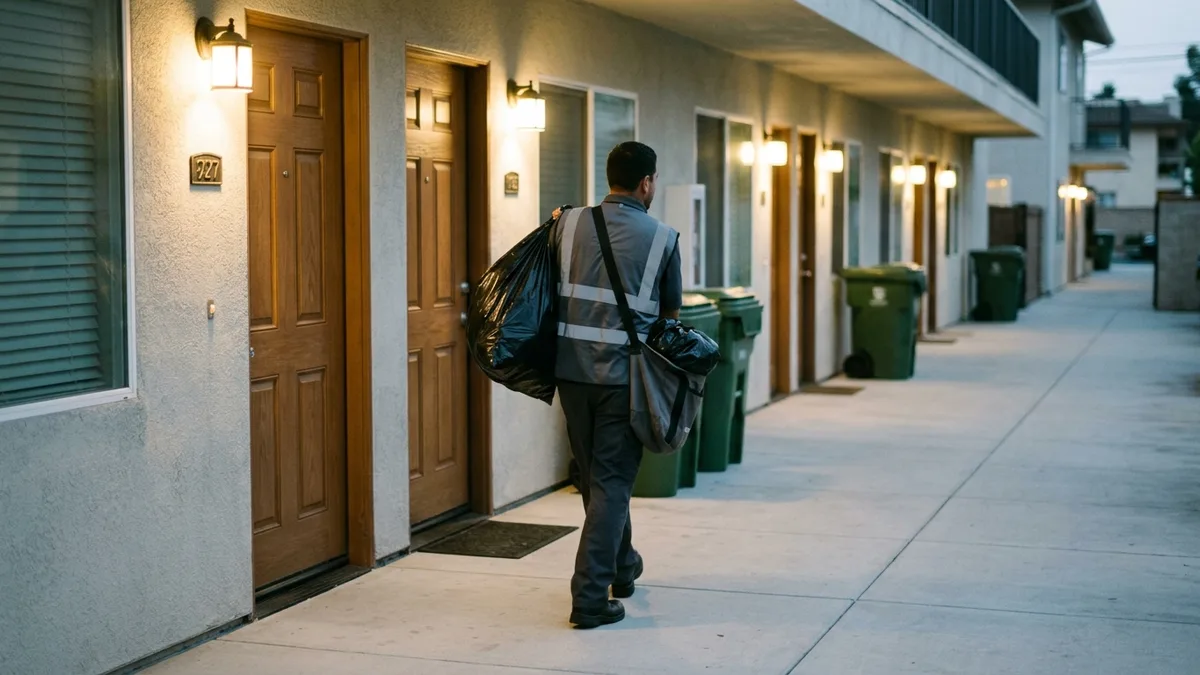
How Does a Managed Waste Program Compare to a Standard Shared Dumpster?
A managed waste program, such as nightly valet collection paired with a right-sized commercial container, differs from a standard shared dumpster because it separates residential waste flow from commercial and shared-use waste flow, reducing contamination and unpredictable spikes. The table below compares the two models across the factors that matter most for Rivers Avenue corridor properties.
| Factor | Standard Shared Dumpster | Managed Waste Program (Valet + Right-Sized Container) |
|---|---|---|
| Resident compliance | Depends entirely on residents bringing bags to the dumpster correctly and on schedule | Residents place bags at their door; collection happens on a fixed nightly schedule |
| Documentation | None, unless a manager manually photographs the pad | Photo-verified at every unit, every collection night |
| Contamination risk | Higher, since anyone with lot access can add to the container | Lower, since residential waste is consolidated by trained crews before reaching the dumpster |
| Overflow pattern | Unpredictable spikes around move-outs, weekends, and events | Smoothed out through nightly consolidation rather than resident timing |
| Scalability across a portfolio | Requires separate sizing and monitoring at every address | Consistent service standard, scalable from small communities to 1,000+ unit portfolios |
| Commercial tenant waste | Often mixed with residential waste in shared-lot properties | Kept separate through independent commercial container sizing and service |
The comparison is not about eliminating your commercial dumpster contract. It is about making sure the dumpster only handles what it was sized to handle, which is exactly what a right-sizing exercise combined with door-to-door residential collection accomplishes.
What Should Multifamily and Build-to-Rent Operators Do Differently Near Rivers Avenue?
Multifamily and build-to-rent operators near the Rivers Avenue corridor should treat waste management as a lease renewal factor, not a maintenance afterthought, because resident complaints about overflowing dumpsters and hallway clutter directly affect satisfaction scores and renewal decisions. This is especially true given the corridor's traffic and mixed-use density, which puts more pressure on shared containers than a typical suburban property faces. For build-to-rent communities expanding along the airport corridor or near Rivers Avenue, waste operations become a brand differentiator, not a commodity line item, once investors and prospective residents start comparing communities. A consistent, documented collection program signals a well-run property before a prospective resident even tours the unit. Operators managing scattered-site portfolios across North Charleston face a compounding version of this problem: every address may have a different dumpster size, a different hauler, and a different informal arrangement inherited from a prior manager. Consolidating to a single waste operations partner who can standardize service across every property, from a 12-unit building to a 400-unit community, removes the guesswork of managing multiple vendor relationships and gives portfolio owners one point of contact instead of a dozen. Learn more about how this works for larger portfolios through multifamily waste solutions or build-to-rent waste programs serving the North Charleston market.
Data and Evidence: What the Rivers Avenue Corridor's Numbers Actually Show
The data behind Rivers Avenue's overflow problem is concrete: a daytime population exceeding 11,000 within a single mile, average daily traffic near 57,600 vehicles, and a metro unemployment rate of 3.2% as of May 2026 that reflects continued commercial activity and hiring pressure along the corridor, per the South Carolina Department of Employment and Workforce. These figures explain why waste volume on this stretch of road behaves nothing like a quieter residential neighborhood.
Additionally, North Charleston's broader lodging and tourism context adds indirect pressure. The College of Charleston Office of Tourism Analysis reported 7.91 million overnight visitors to the greater Charleston region in 2026, with North Charleston alone accounting for 7,465 of the region's hotel rooms. Hotels, short-term rentals, and the retail and restaurant tenants that serve visiting traffic all generate waste that flows through the same commercial disposal channels the city requires non-residential properties to arrange privately. AirDNA data shows North Charleston carrying 1,253 active short-term-rental listings, with 41% of those available 271 to 365 nights a year, meaning consistent, high-turnover occupancy that produces steady waste output every week of the year, not just during peak season.
Safety data adds another dimension worth noting for property managers planning enclosure placement and truck access. A South Carolina Department of Transportation study of a 1.8-mile Remount Road segment recorded 509 crashes from 2021 through 2023, including 145 injury crashes and five fatalities, and North Charleston police identified Rivers Avenue itself as a concentration point for fatal crashes in 2026 reporting. Dumpster enclosures placed too close to high-traffic lanes, or requiring haulers to back trucks into busy commercial driveways, add real operational risk on this specific corridor.
What Are the Most Common Mistakes Property Managers Make With Dumpster Management on This Corridor?
The most common mistake is treating dumpster sizing as a one-time decision instead of revisiting it whenever occupancy, tenant mix, or renovation status changes. A container that worked in 2022 rarely still fits a property that added a restaurant tenant, converted office space to residential, or leased up an additional 20 units by 2026. A second frequent error is assuming the hauler is responsible for solving overflow without ever renegotiating pickup frequency. Haulers respond to documented, specific requests, not vague complaints, which is exactly why the photo-and-log documentation approach above matters. A third mistake, common on mixed-use Rivers Avenue properties specifically, is assuming residential rules automatically apply to commercial tenants sharing the same lot. They do not. North Charleston's municipal collection explicitly excludes commercial and industrial waste, so any property manager who has not separately verified commercial service for retail or restaurant tenants may be operating with a coverage gap they do not know exists. Finally, many managers underestimate how much of their dumpster volume comes from residential bagged waste that never needed to touch the shared container in the first place. Once that volume shifts to a nightly doorstep collection model, the remaining commercial container often turns out to be appropriately sized after all.
Frequently Asked Questions
Why do dumpsters overflow so often along Rivers Avenue specifically, compared to other North Charleston neighborhoods?
Rivers Avenue combines high daytime population, roughly 57,600 vehicles of daily traffic, and dense mixed residential and commercial development, all feeding waste into containers that were often sized for a much lower-traffic version of the corridor. Properties in quieter, single-use residential areas typically do not face this same compounding pressure.
Does the City of North Charleston pick up commercial dumpsters?
No. The City of North Charleston's Sanitation Division does not collect garbage from commercial or industrial establishments; non-residential properties and businesses must arrange and pay for their own private trash disposal. This applies to any retail, office, or restaurant space on a Rivers Avenue property, even if residential units on the same lot receive city service.
What size dumpster do I need for a mixed-use property on Rivers Avenue?
Sizing depends on unit count, tenant type, and pickup frequency, but as a reference point, a standard 4-yard container holds about 40 large bags while an 8-yard container holds about 80 bags and is typically used for higher-volume commercial or property management complexes. Recalculate whenever occupancy or tenant mix changes materially.
Is illegal dumping into a shared dumpster actually enforceable in Charleston County?
Yes. Charleston County's Environmental Codes brochure prohibits illegal dumping and unlawful debris placement on public or private property, with penalties that can include fines up to $1,092, up to 30 days imprisonment, and a minimum of 20 hours of community service. Suspected violations can be reported to Environmental Enforcement at (843) 202-7250.
How does valet trash service reduce dumpster overflow instead of just moving the problem?
Valet trash service consolidates residential waste from individual doors into the dumpster on a controlled, scheduled basis rather than leaving each resident to manage the shared container independently. This reduces contamination, smooths out volume spikes around move-outs and weekends, and creates a photo-verified record property managers can use to confirm the container is only receiving what it was sized for.
What should I do if my hauler keeps missing pickups on my Rivers Avenue property?
Build a dated, photographed log of each missed or incomplete pickup, noting the date, fill level, and any access obstructions at the enclosure. Bring that documentation to your hauler as a specific, evidence-backed request for a schedule or size adjustment rather than a general complaint, since specific records get faster resolutions.
Can a single waste vendor handle both residential valet service and commercial dumpster coordination across a scattered-site portfolio?
Yes, this is exactly the kind of coordination problem a managed waste operations partner is built to solve. Other management companies work with property portfolios ranging from 10 to more than 1,000 units across Charleston and Atlanta, standardizing nightly valet collection, bulk removal, and documentation across every address in a portfolio rather than leaving each property to manage its own separate hauler relationship.
Conclusion: Fixing Overflow Starts With Separating Capacity From Accountability
Rivers Avenue corridor properties struggle with overflowing dumpsters because container sizing, access design, and accountability all break down under the corridor's unusual density and mixed-use pressure, not because tenants are careless. Fixing it requires recalculating capacity against actual current occupancy, confirming your enclosure meets North Charleston's 8-foot screening standard, and documenting recurring issues with dated photos before escalating to your hauler or Charleston County Environmental Enforcement. For residential-heavy properties, shifting daily bagged waste off the shared dumpster and onto a nightly, photo-verified collection schedule removes the single largest source of unpredictable volume. As North Charleston's commercial and residential density along this corridor continues growing into 2026, the properties that get ahead of these fixes now will spend far less time firefighting dumpster complaints later.

If your Rivers Avenue property is dealing with recurring dumpster overflow, the fastest fix is often removing residential bagged waste from the shared container entirely. Get started with a local waste management provider for a portfolio quote, available Monday through Friday, and see how nightly, photo-verified collection changes what your dumpster pad looks like within the first week.
Content powered by inkSTR.co