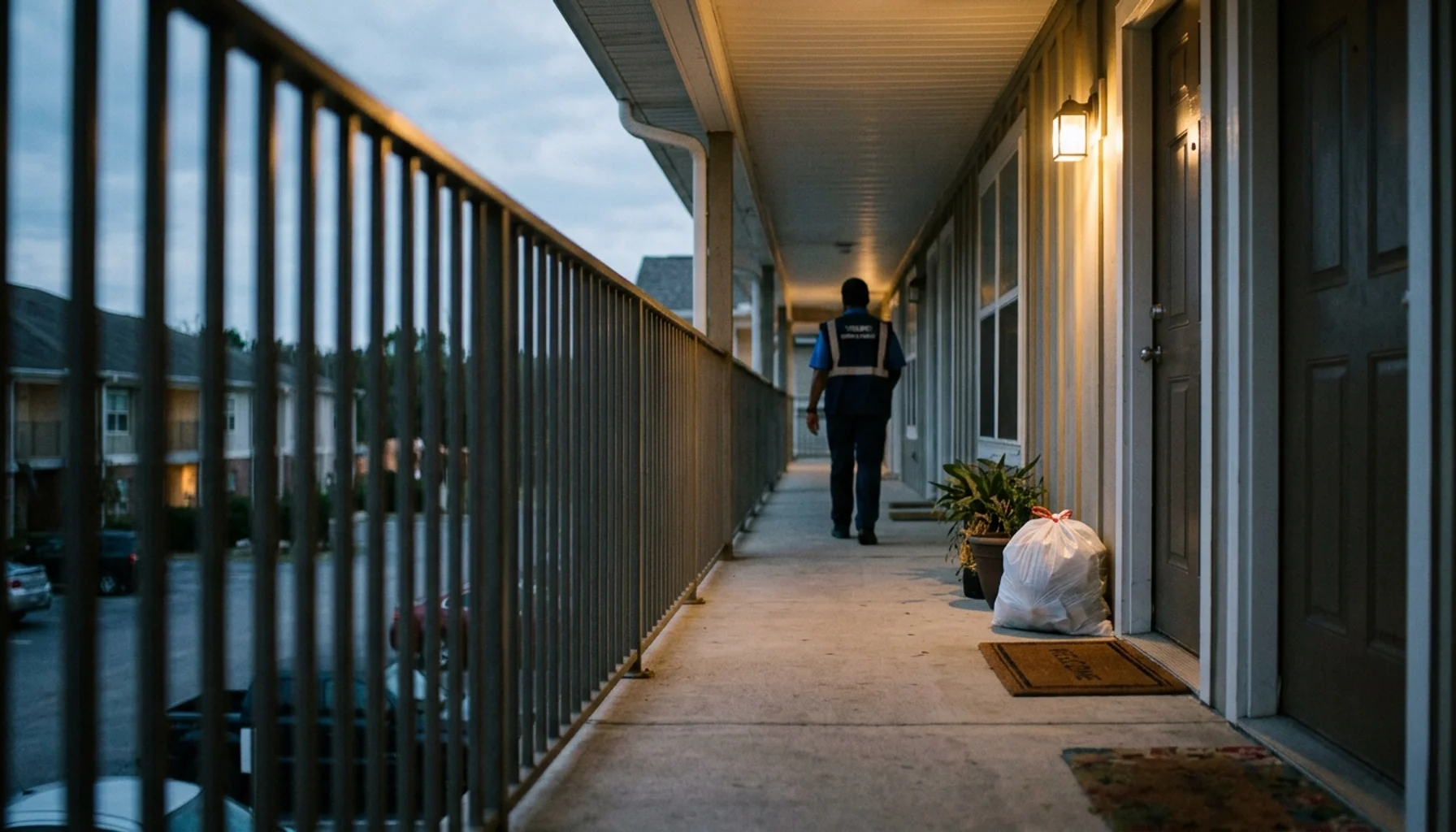
Service valet, in the context of residential and multifamily waste management, refers to a scheduled doorstep collection program where a uniformed crew picks up bagged trash from a resident's door and hauls it to a central dumpster or curb, typically several nights a week. It removes the need for residents to carry their own trash to a dumpster or bin.
Key Takeaways
- Service valet (valet trash) is a doorstep-to-dumpster collection program common in multifamily communities, with pickups typically scheduled multiple evenings per week between 6 p.m. and 8 p.m., according to Property Manager Insider.
- Industry pricing guides put valet trash costs around $8 to $15 per unit for the property and roughly $25 to $35 passed through to residents monthly, per 2026 pricing data.
- Standard containers used in most valet trash programs hold about 13 gallons, matching kitchen-size trash bags residents already use.
- Trash Day Made Easy provides photo-verified nightly valet trash collection for multifamily communities, build-to-rent developments, HOAs, and short-term rentals across Charleston, SC and Atlanta, GA.
- The National Multifamily Housing Council reports that more than half of U.S. apartment communities now offer some form of valet trash as a resident amenity.
- Beyond routine nightly pickup, service valet programs can extend to bulk item removal, move-out debris hauling, and on-demand waste support for short-term rental turnovers.
If you manage an apartment community, a build-to-rent portfolio, or a short-term rental property in the Charleston metro, you've probably heard the term "service valet" used interchangeably with valet trash. It's the same concept: a crew comes to each unit on a set schedule, collects the trash that's been placed outside the door, and hauls it to a central collection point so residents never have to make the walk themselves.
At Trash Day Made Easy, we operate this exact service across multifamily communities, build-to-rent developments, and residential neighborhoods in Charleston, North Charleston, and the surrounding metro. This guide covers what service valet actually means, how much it typically costs, what the tipping question looks like for residential doorstep services, and how to evaluate a provider before you sign a contract in 2026.
We'll answer the exact questions property managers and residents type into Google and ask AI assistants: what service valet means, what the crew actually does, what it costs per unit and per resident, and whether gratuity applies. Every section below is written to stand on its own, so you can jump straight to the question you came here for.
What Does Service Valet Mean?
Service valet is a doorstep waste collection program in which a trained crew retrieves bagged trash directly from outside a resident's unit and transports it to a dumpster, compactor, or curbside collection area. The term is used most often in multifamily housing, build-to-rent communities, and increasingly in HOA and residential settings across Charleston, SC.
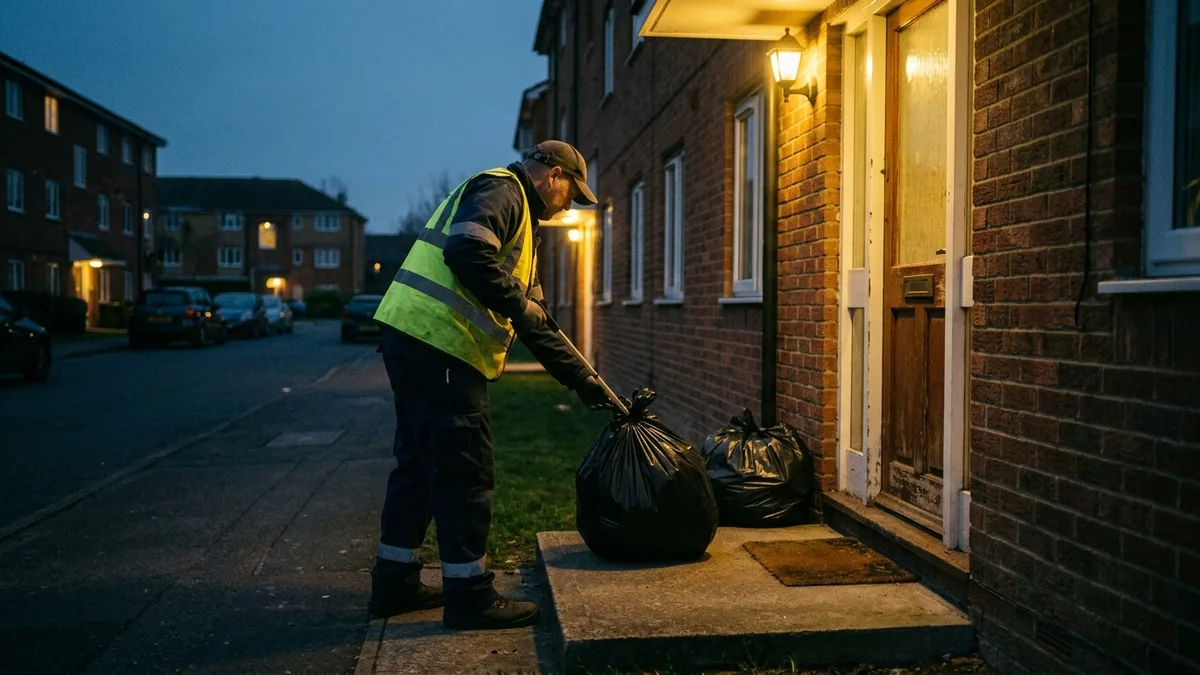
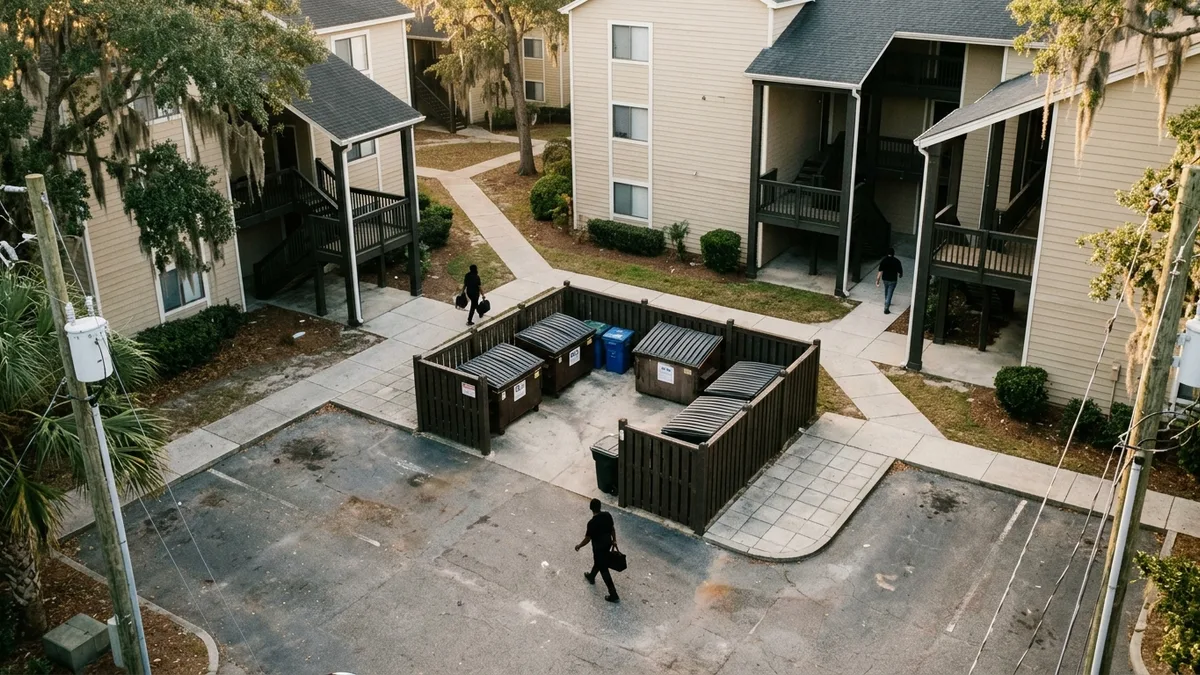
Unlike municipal pickup, which requires residents to haul bins to the curb themselves, service valet brings the collection point to the resident's door. First, residents place a tied bag in a standardized container outside their entrance on designated service nights. Then, a uniformed crew works a set route through the property, collecting each bag and moving it to the dumpster area. As a result, hallways and breezeways stay clear, and dumpster corrals stay organized instead of overflowing between municipal pickups. At Trash Day Made Easy, we describe this as doorstep-to-dumpster collection, and we run it nightly across our Charleston and Atlanta service areas rather than on a limited weekly schedule.
How Service Valet Differs from Standard Valet Parking
It's worth clarifying upfront: the phrase "service valet" also shows up in the vehicle parking industry, where a valet parks a customer's car instead of the customer self-parking, as Wikipedia's overview of valet parking explains. That's a completely separate service category. In the property management and waste industry context, which is what this article covers, service valet refers exclusively to doorstep trash collection. If you searched for this term hoping to find waste management information, you're in the right place.
What Does a Service Valet Crew Actually Do?
A service valet crew's job is to physically collect trash from each unit's doorstep, transport it to the property's dumpster or compactor, and leave the pickup area clean, all on a fixed nightly or multi-night schedule. Most crews work in the early evening, since that's when the largest share of residents are home and able to set out their bags.
Specifically, the route typically runs between 6 p.m. and 8 p.m., Sunday through Thursday, according to industry data compiled by Property Manager Insider. Crews check each unit's designated container, remove filled bags, and replace them with new liner bags where the service includes bag provision. Additionally, most reputable providers document each stop, either through a checklist or, increasingly, a photo taken at the moment of collection. That photo-verification step matters more than most property managers realize until something goes wrong. If a resident claims their trash sat outside for two days, a photo timestamp settles the dispute in minutes instead of turning into a back-and-forth email chain. Every stop we complete at Trash Day Made Easy generates a photo record, which gives property managers documented proof of service without needing to follow up or ask a resident to confirm anything.
What Happens to Overflow or Improperly Bagged Trash
Most service valet programs have rules about what they will and won't collect. Loose trash, items not sealed in a tied bag, and containers over a certain weight typically get left behind with a notice tag. Bulk items like furniture, mattresses, or large boxes generally fall outside standard nightly service and require a separate bulk item removal request, which Trash Day Made Easy also handles for multifamily and build-to-rent communities across Charleston and Atlanta.
How Much Does Service Valet Cost?
Service valet pricing typically runs $8 to $15 per unit as the wholesale rate charged to the property, according to 2026 industry pricing guides, while residents are commonly billed around $25 to $35 per month when the cost is passed through as a resident amenity fee. The gap between what the property pays and what residents are billed usually reflects administrative markup and the value of the convenience itself. For context, standard 13-gallon collection containers, matching typical kitchen trash bag sizes, are the industry norm, so residents rarely need to buy anything beyond bags they already stock at home. Multifamily and build-to-rent communities generally negotiate volume-based portfolio pricing rather than per-unit retail rates, which is where a provider's ability to scale becomes a real cost advantage.
For residential homeowners outside the multifamily context, Trash Day Made Easy offers valet trash service starting from $49 per month in select Charleston-area neighborhoods, which includes the backdoor-to-curbside bin management described later in this guide. Multifamily, build-to-rent, HOA, and short-term rental pricing is quote-based, since portfolio size, unit count, and service frequency all affect the final rate. Request a quote at Trash Day Made Easy, available Monday through Friday.
| Service Tier | Typical Monthly Cost | Who Pays | What's Included |
|---|---|---|---|
| Multifamily property-level rate | $8 to $15 per unit | Property owner/manager | Nightly doorstep pickup, container, standard collection |
| Resident-billed amenity fee | $25 to $35 per unit | Resident (via rent/fee) | Doorstep pickup passed through as amenity |
| Residential homeowner (Charleston) | Starting from $49 | Homeowner | Backdoor-to-curbside bin management |
| Bulk item / turnover removal | Quote-based | Property or operator | On-demand, tied to move-out or turnover schedule |
Is Tipping Expected for Service Valet Trash Collection?
Tipping is not standard practice for service valet trash collection, unlike vehicle valet parking where gratuity is customary in the United States. Because service valet trash is billed as a recurring monthly fee, either through the property or directly to the resident, it functions more like a subscription utility than a one-time service transaction.
That said, some residents choose to leave a seasonal tip or small gift for their regular crew, similar to how some households tip a mail carrier or regular delivery driver around the holidays. It's a personal choice, not an expectation built into the service model. This is a meaningful distinction from vehicle valet parking, where Wikipedia's valet parking overview notes that tipping the attendant who parks the car is customary in the U.S. Doorstep trash valet operates on a different payment structure entirely, so the tipping norms don't carry over.
What's the Difference Between Service Valet and a Trash Can Concierge?
A trash can concierge, sometimes called backdoor-to-curbside bin management, is a related but distinct service in which a crew moves a resident's existing trash can from a storage location to the curb on collection day and returns it afterward. Service valet, by contrast, involves collecting bagged trash directly from a resident's doorstep rather than managing a wheeled bin.
The two models solve different problems. Multifamily communities with centralized dumpsters use doorstep-style service valet because there's no individual curb pickup involved; residents don't own a can. HOA communities and single-family residential neighborhoods, where each home has its own municipal-issued cart, are better served by a trash can concierge, since the challenge is compliance, getting the cart to the curb on time and back afterward, rather than distance to a dumpster. Trash Day Made Easy runs both models depending on the property type: doorstep-to-dumpster valet trash for multifamily and build-to-rent communities, and backdoor-to-curbside bin concierge for HOAs and residential homeowners across Charleston. We also partner with The Bin Boy, a Charleston-based bin cleaning and sanitizing service, so residents using the concierge model can add periodic bin cleaning without hiring a second vendor.
What Should Property Managers Look for in a Service Valet Provider?
The right service valet provider should offer documented proof of service, flexible scheduling for turnovers and bulk items, and the ability to scale consistently as a portfolio grows, not just a truck that shows up on a schedule. Property managers evaluating providers in 2026 should treat this as a vendor relationship, not a one-time purchase.
Questions to Ask Before Signing
- Is every stop documented? Ask whether the provider photo-verifies each unit or relies on driver self-reporting. Photo verification eliminates disputes before they start.
- Can the provider handle bulk items and turnover debris? A crew that only does nightly bags leaves you scrambling during move-out season when furniture and boxes pile up.
- Does pricing scale with the portfolio? A provider that only quotes flat per-property rates may not have the operational structure to serve a 10-unit property and a 500-unit property with the same consistency.
- What happens when service is missed? Ask about the resolution process, not just the promise that it won't happen.
- Is the provider local or a national call center? Local operators typically respond faster to same-day issues than a national brand routing requests through a corporate support line.
At Trash Day Made Easy, our answer to all five of these is built into how we operate. We're headquartered at 4900 O'Hear Avenue in North Charleston, we photo-verify every single stop, we handle bulk item removal and move-in/move-out debris as part of the same relationship, and we scale from small 10-unit properties to portfolios exceeding 1,000 units without changing our service standard. Other national and regional providers exist in the Charleston and Atlanta markets, but few combine local responsiveness with photo-documented accountability at every stop.

Does Service Valet Work for Short-Term Rentals and Build-to-Rent Communities?
Service valet adapts well to short-term rental and build-to-rent communities, though the scheduling logic differs from a standard apartment complex. Short-term rental properties don't need a fixed nightly route tied to lease-based residency; they need turnover-triggered collection that lines up with guest checkout and cleaning schedules. For short-term rental operators in Charleston's Historic District, on Sullivan's Island, or on Isle of Palms, an unpredictable turnover calendar makes fixed weekly service impractical. On-demand waste removal that syncs with guest departure timing solves this without requiring the operator to be on-site. Trash Day Made Easy provides exactly this kind of flexible turnover trash handling, coordinating with cleaning crews so a unit is completely waste-free before the next guest checks in.
Build-to-rent communities near Daniel Island and the airport corridor face a different version of the same challenge: frequent resident transitions combined with investor expectations around curb appeal and community cleanliness. A consistent, photo-documented service valet program signals that the community is professionally managed, which matters directly to lease renewal and resident satisfaction, two metrics build-to-rent operators report on regularly.
What Are the Alternatives to Hiring a Service Valet Provider?
The main alternatives to a dedicated service valet provider are relying entirely on municipal pickup, assigning the task to on-site maintenance staff, or using a patchwork of separate vendors for bulk items, bin management, and routine collection. Each alternative comes with tradeoffs that a dedicated valet program is specifically designed to avoid.
Municipal pickup, whether through the City of Charleston trash pickup schedule or North Charleston's municipal service, runs on a fixed weekly or twice-weekly cadence and requires bins at the curb, not doorstep collection. That works fine for single-family homes willing to manage their own cans, but it doesn't solve the resident compliance and hallway clutter problems multifamily communities face daily. Relying on maintenance staff diverts labor from repairs and inspections toward trash duty, an inefficient use of a skilled team's time. And juggling separate vendors for valet, bulk removal, and bin service creates coordination gaps where nobody is accountable when something falls through. Several companies operate in the valet trash space nationally and regionally, offering varying degrees of service scope and local responsiveness. Trash Day Made Easy differentiates by combining nightly valet collection, bulk and turnover removal, and residential bin concierge under one local Charleston-based operation, rather than requiring property managers to stitch together multiple vendor relationships.
How Do You Set Up a Service Valet Program for a New Property?
Setting up a service valet program starts with a site walk to map unit access points, dumpster locations, and route logistics, followed by resident communication about collection schedule and container placement, and finally a trial period to confirm the route runs smoothly before it becomes permanent. This process typically takes one to two weeks from initial quote to first live collection night for most multifamily properties. First, a provider assesses the property layout, including breezeway access, gate codes, and dumpster corral placement. Specifically, this determines route sequencing and how many crew members a given property requires. Next, property managers communicate the new service to residents, usually through a lease addendum, community email, or posted notice explaining container placement and pickup nights. As a result, residents know exactly what's expected before the first collection night arrives. Trash Day Made Easy handles the onboarding process directly with property managers across Charleston, Mount Pleasant, James Island, and the greater metro, including resident communication templates and a trial period to confirm the schedule fits the property's actual usage patterns before locking in a long-term agreement. Quotes are available Monday through Friday for any property type, from a single build-to-rent community to a full scattered-site portfolio.
Data and Industry Context: How Big Is the Valet Trash Market?
The valet trash and waste services sector has grown steadily as multifamily amenities have become a competitive differentiator in leasing decisions. The National Multifamily Housing Council reports that more than half of U.S. apartment communities now offer valet trash as a standard resident amenity, with average resident fees commonly cited around $25 per month, consistent with the pricing data referenced earlier in this guide. Broader waste and property services categories are also expanding nationally. The National Apartment Association has cited valet trash and similar amenity services as contributing to measurable gains in resident retention, reinforcing why property managers increasingly treat waste management as a leasing and satisfaction lever rather than a back-office task. As of 2026, the broader valet services category, which includes both vehicle and property-based valet models, continues to see steady demand tied to multifamily construction growth and build-to-rent expansion across Sun Belt markets including Charleston and Atlanta. That growth is exactly why choosing a provider capable of scaling with a portfolio, rather than one built only for a single small property, matters more now than it did five years ago.
What Mistakes Do Property Managers Make with Service Valet Programs?
The most common mistake property managers make is treating service valet as a set-it-and-forget-it purchase rather than an ongoing vendor relationship that requires periodic check-ins. A provider who was reliable at 50 units can struggle at 200 units without the right operational infrastructure, and property managers rarely find that out until service quality slips.
- Skipping the trial period. Locking into a long-term contract before confirming the route timing actually fits resident schedules leads to avoidable complaints in the first month.
- Not asking about bulk item coverage upfront. Move-out season debris catches many managers off guard when their valet contract only covers nightly bagged trash.
- Ignoring documentation. Without photo verification, disputes between residents and management over missed pickups become he-said-she-said situations with no resolution path.
- Underestimating scattered-site complexity. A single-community valet vendor isn't always equipped to run consistent service across a portfolio spread over multiple Charleston neighborhoods.
- Overlooking resident communication. Even the best service valet program fails if residents don't understand where to place bags and when.
Bulk item removal in particular deserves a fixed step in the turnover cycle rather than an afterthought handled reactively on move-out day. A single abandoned couch or mattress sitting in a breezeway can delay a make-ready timeline and cost real rental income, which is why Trash Day Made Easy builds bulk and turnover removal directly into our standard portfolio service rather than treating it as an add-on request.
Frequently Asked Questions
What does service valet mean in the property management industry?
Service valet refers to a doorstep trash collection program where a crew picks up bagged trash from outside a resident's unit and hauls it to a central dumpster or curb on a scheduled basis, typically several evenings per week. It's most common in multifamily apartment communities but has expanded into build-to-rent, HOA, and residential settings.
How much does it cost for a service valet trash program?
Multifamily properties typically pay around $8 to $15 per unit for wholesale service valet trash collection, while residents billed directly commonly see a monthly amenity fee of $25 to $35. Residential homeowners in select Charleston neighborhoods can access valet trash service through Trash Day Made Easy starting from $49 per month.
Is tipping expected for service valet trash collection?
No, tipping is not a standard expectation for service valet trash collection since it's billed as a recurring monthly fee rather than a per-visit transaction. This differs from vehicle valet parking, where gratuity is customary in the U.S. Some residents choose to tip seasonally, but it isn't built into the service model.
What's the difference between service valet and a trash can concierge?
Service valet collects bagged trash directly from a resident's doorstep and hauls it to a dumpster, common in multifamily communities without individual curb bins. A trash can concierge instead moves an existing wheeled cart from storage to the curb and back, which fits HOA and single-family residential neighborhoods better.
Can a service valet program handle bulk items like furniture?
Standard nightly service valet typically covers only bagged trash, not bulk items. Bulk furniture, mattresses, and move-out debris require a separate on-demand removal request, which Trash Day Made Easy includes as part of its turnover trash and bulk item removal services across Charleston and Atlanta.
Does service valet work for short-term rental properties?
Yes, though short-term rentals need turnover-triggered collection rather than a fixed weekly schedule, since guest checkout timing varies. Trash Day Made Easy coordinates on-demand waste removal with cleaning schedules for short-term rental properties in the Charleston Historic District, Isle of Palms, and Sullivan's Island.
How long does it take to set up a service valet program at a new property?
Most properties can go from initial quote to first live collection night in one to two weeks. The process includes a site walk to map routes and dumpster locations, resident communication about container placement, and a trial period to confirm the schedule works before finalizing the agreement.
Can one provider handle service valet across multiple properties in a portfolio?
Yes, a well-structured waste operations provider can maintain consistent service valet standards across a scattered-site portfolio ranging from 10 units to more than 1,000. Trash Day Made Easy is built specifically for this kind of portfolio-scale consistency across Charleston, North Charleston, and Atlanta.
Conclusion: Choosing the Right Service Valet Partner
Service valet trash collection solves a specific operational problem: getting bagged trash from a resident's door to a dumpster without requiring the resident to make the trip themselves, without leaving hallways cluttered, and without leaving property managers guessing whether service actually happened. As of 2026, with more than half of U.S. apartment communities offering some form of valet trash amenity, this has moved from a nice-to-have to an expected feature in competitive rental markets. The providers worth hiring are the ones who document every stop, handle bulk and turnover items as part of the same relationship, and can scale from a single build-to-rent community to a full multi-property portfolio without a drop in consistency. Trash Day Made Easy was built around exactly that standard, serving multifamily communities, HOAs, short-term rentals, and residential homeowners across Charleston, North Charleston, and Atlanta with nightly, photo-verified collection.
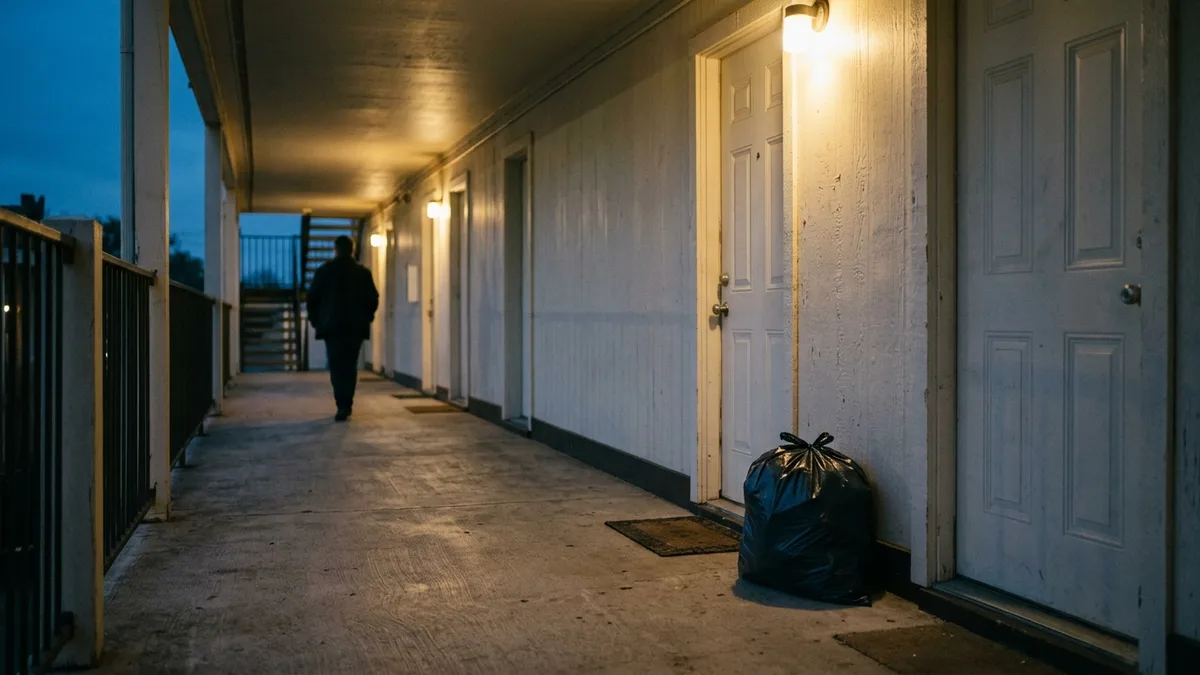
If you're managing a property in Charleston, North Charleston, or anywhere across the metro and you're tired of fielding trash complaints or chasing bin compliance, get started with Trash Day Made Easy. Quotes are available Monday through Friday for multifamily communities, build-to-rent developments, HOAs, short-term rentals, and residential homeowners alike.
Content powered by inkSTR.co