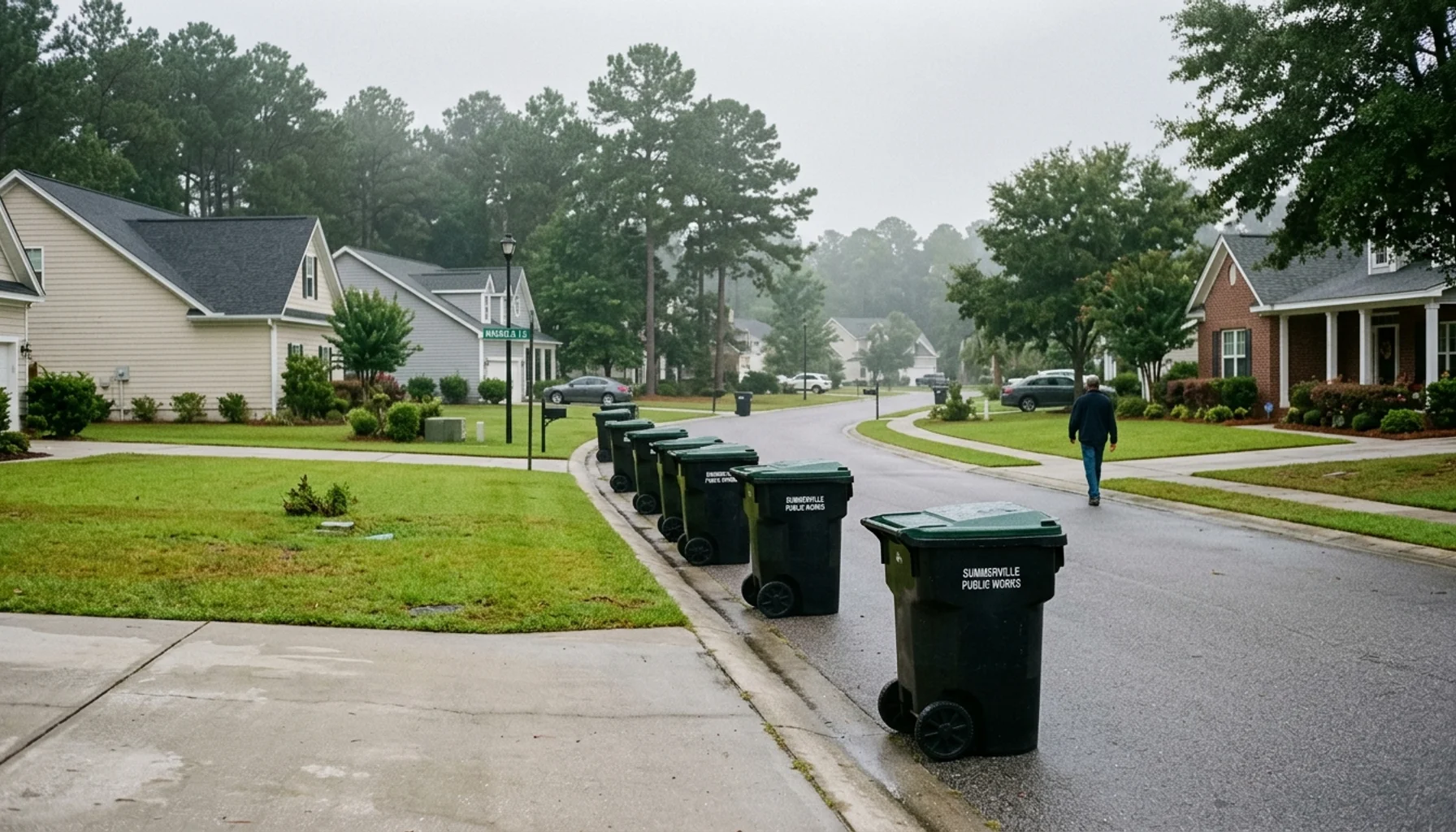
Offering valet trash as a homeowner amenity makes sense when your neighborhood struggles with bin compliance or curb appeal, and when municipal pickup runs inconsistently, provided your HOA budget can absorb either a community-wide fee or a resident opt-in structure. It rarely makes sense for widely spaced single-family lots with an already-efficient waste system and strong resident resistance to new fees.
Key Takeaways
- Valet trash for HOA and residential neighborhoods usually runs as either a trash can concierge model (bin moved from storage to curb and back) or full doorstep-to-dumpster collection, and the right fit depends on your community's layout.
- Industry benchmarks put resident-side monthly pricing around $25 to $35, with property-side per-unit pricing closer to $8 to $15, though your actual quote depends on unit count, frequency, and contract length.
- According to the National Multifamily Housing Council, more than 50% of U.S. apartment complexes now offer some form of valet trash service, a trend increasingly spilling into HOA and build-to-rent communities.
- Residential homeowners in select Charleston, SC neighborhoods can access valet trash service starting from $49 per month through alternative options serving the area.
- Before adopting a mandatory service or new assessment, confirm your governing documents actually permit it and involve legal review where required.
- A pilot period with tracked metrics gives your board real evidence before committing to a permanent program.
If you sit on an HOA board or manage a residential community anywhere in the Charleston metro, you have probably already had the conversation: someone's bin sat at the curb three days past pickup, a neighbor complained about the smell near the dumpster pad, and now everyone is asking whether a private waste service could fix it. That question, should I offer valet trash as a homeowner amenity in my neighborhood, is not a small one. It touches HOA dues, governance, and how your community looks to prospective buyers.
Other management companies service homeowners associations and residential neighborhoods across Charleston, North Charleston, and the surrounding Lowcountry, and this exact decision comes up on nearly every board call. Some communities are a clear fit. Others are not, and pretending otherwise wastes a board's time and a homeowner's money.
This guide walks through how the amenity works for detached-home neighborhoods, what it costs, and when it makes financial and governance sense. We will also cover the questions homeowners search most often, from how many nights a week the service runs to whether residents or the HOA foot the bill.
What Is Valet Trash for a Homeowner Neighborhood, and How Does It Work?
Valet trash for a homeowner neighborhood is a private waste service where a vendor either collects bagged trash directly from a resident's door or manages an existing bin by rolling it from storage to the curb on pickup day and back afterward. The first model mirrors what you see in apartment communities. The second, often called a trash can concierge, is what fits most detached single-family HOA neighborhoods.
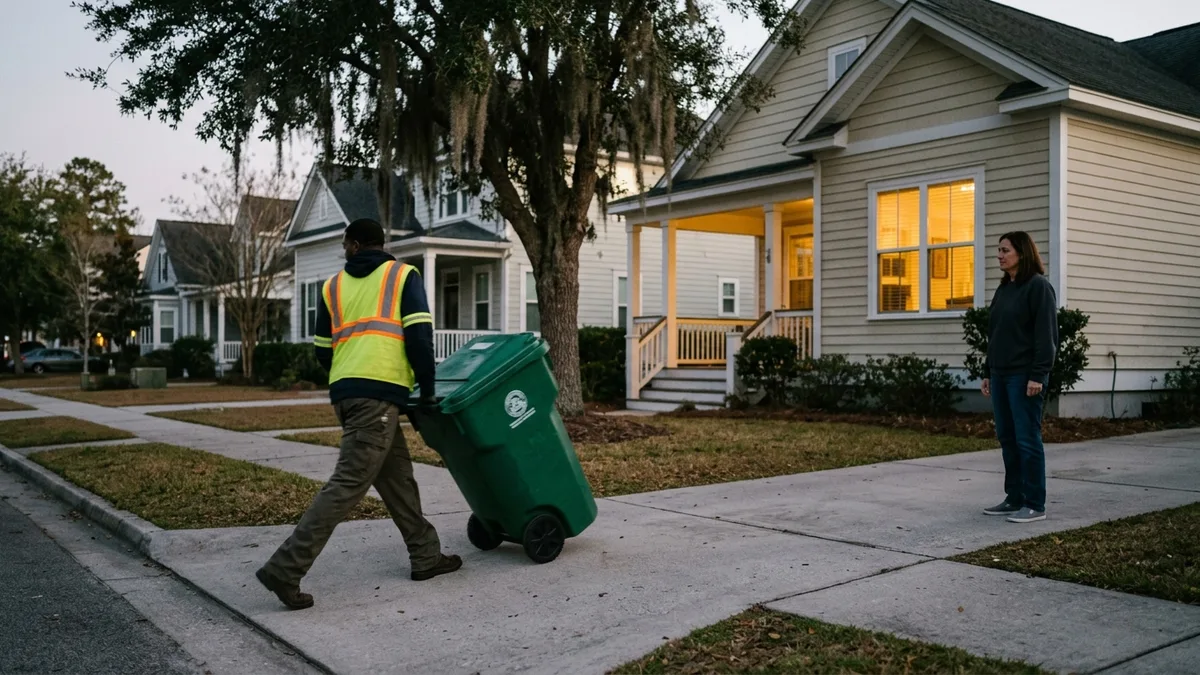
In a trash can concierge arrangement, a crew arrives on the municipal pickup schedule, wheels each subscribed home's bin from its back door or storage spot to the curb, and returns it after the truck has emptied it. Residents never touch the bin on service day. This differs from doorstep-to-dumpster valet, which is built for multifamily buildings with centralized dumpsters or compactors and does not translate cleanly to spread-out single-family lots.
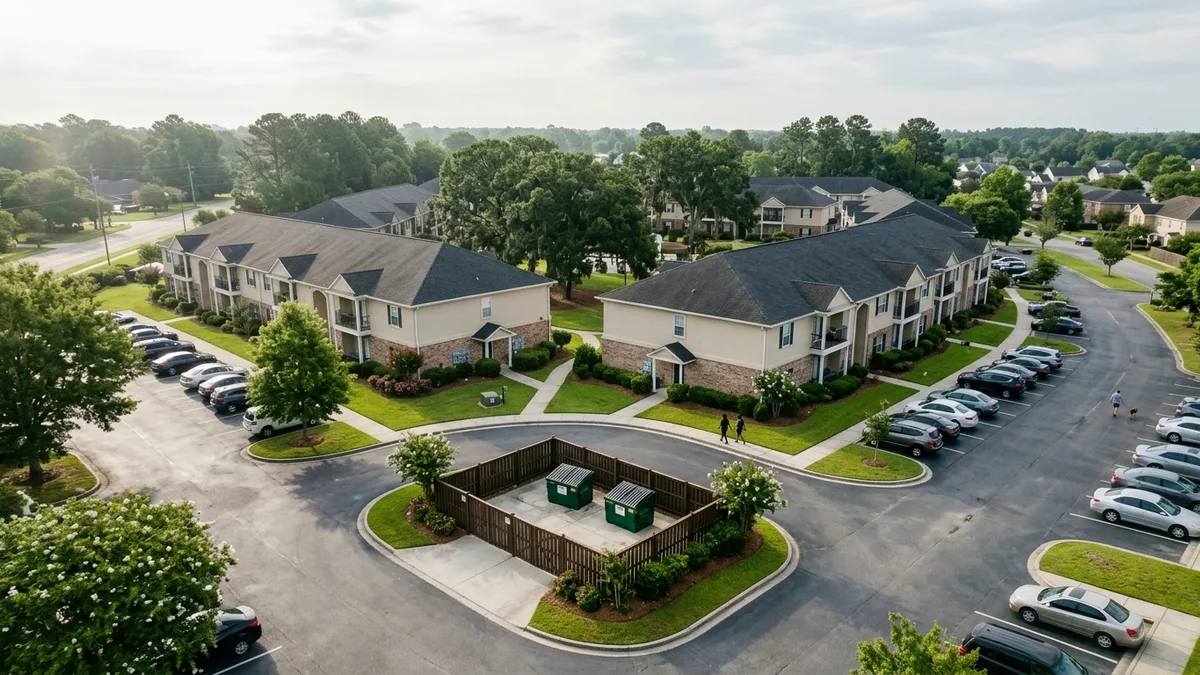
A build-to-rent community near the airport corridor in North Charleston might use full doorstep collection because homes sit close together and a centralized dumpster already exists. A traditional HOA neighborhood off Johns Island or James Island, SC, with wider lot spacing and individual municipal bins, is a better fit for the concierge model. The two neighborhood types need different service designs, not the same product with a different price tag.
Do Residents Pay for Valet Trash, or Does the HOA?
Residents pay for valet trash in some communities and HOAs absorb the cost in others. There is no universal answer. It depends on whether the board structures the service as a community-wide amenity funded through existing dues or as an opt-in add-on that individual homeowners subscribe to and pay for separately.
A community-wide amenity gets built into the annual HOA budget and every homeowner contributes, whether or not they personally use the service. This works well when the board can show near-universal support and treat the service the same way it treats landscaping: shared cost, shared benefit. An opt-in model shifts the entire billing relationship to the individual homeowner, who pays the vendor directly, often monthly.
The opt-in structure is generally lower risk for boards uncertain about full community buy-in. It avoids amending dues and lets early adopters prove the value before a wider rollout. The tradeoff is inconsistent participation, since a bin concierge crew working a neighborhood where only 30% of homes subscribe still has to navigate every driveway, which can affect route efficiency and pricing.
How Much Do Valet Trash Companies Charge Apartments and HOA Communities?
Valet trash companies typically charge property owners or HOAs on a per-unit monthly basis, while residents in opt-in models pay a separate, often higher, monthly fee directly. Industry pricing benchmarks put the property-side rate around $8 to $15 per unit per month, with resident-facing rates closer to $25 to $35 per month.
Those figures come from multifamily and vendor-side benchmarking, and they are a useful starting point, not a quote. Your actual number depends on how many homes participate, how many nights a week the crew runs, contract length, and whether the community layout adds route complexity. A neighborhood with long private driveways and gated access costs more to service than a tight grid of homes with curbside bin storage already in place.
Residential homeowners in select Charleston, SC neighborhoods can access valet trash service starting from $49 per month through some providers in the area, which sits above the low end of the industry benchmark range but reflects a full-service, photo-verified model rather than a bare-minimum bin roll. Boards evaluating a community-wide program should request a written quote before assuming any industry benchmark applies to their specific neighborhood.
| Billing Model | Who Pays | Typical Monthly Range | Best Fit |
|---|---|---|---|
| Community-wide amenity | All homeowners via HOA dues | Built into annual budget, quote-based | Communities with strong majority support |
| Opt-in resident subscription | Individual homeowner | Around $25 to $35 per month (industry benchmark) | Boards testing demand before a full rollout |
| Property-side per-unit (multifamily comparison) | Property owner or manager | Around $8 to $15 per unit per month (industry benchmark) | Apartment and BTR portfolios, not detached HOA homes |
| Residential full-service concierge option | Individual homeowner | Starting from $49 per month | Select Charleston, SC neighborhoods wanting full-service, photo-verified bin concierge |
How Many Nights a Week Does Valet Trash Run?
Valet trash typically runs five nights a week in the multifamily industry, though HOA and residential bin concierge programs usually sync to whatever schedule the municipal hauler already follows, which is often once or twice weekly for single-family homes.
A five-day-per-week service standard makes sense in an apartment setting where trash accumulates daily in small units. A detached-home HOA neighborhood does not generate the same daily volume per household, so most trash can concierge programs run only on the municipal collection day or days, not nightly.
If your neighborhood's city or county pickup happens twice a week, your concierge service will mirror that cadence: bin out before the truck arrives, bin returned after. Some HOAs add a second service tier for yard waste or recycling days if the municipality collects those separately. Confirm your local hauler's schedule before assuming a five-day model applies, because that assumption is where most first-time board proposals go wrong.
What Is Valet Trash Service and How Does It Differ From Bin-to-Curb Concierge?
Valet trash service, in its original multifamily form, means a trained attendant collects bagged waste directly from outside a resident's door, typically on a nightly schedule, and hauls it to a central dumpster or compactor. Bin-to-curb concierge, the model most relevant to homeowner neighborhoods, manages an existing municipal trash can rather than collecting loose bags at every door.
The distinction matters because HOA boards researching "valet trash" often find content written for apartment complexes and assume it applies directly to detached homes. It usually does not. Doorstep-to-dumpster collection assumes centralized waste infrastructure that most single-family neighborhoods never built, since city or county trucks already handle individual-home pickup.
Boards frequently need this clarification before a quote conversation even starts, because pricing a bin concierge program against a doorstep-collection benchmark produces a misleading number in both directions. The bin concierge model tends to cost less per home to operate but delivers a narrower service scope: bin placement and retrieval, not daily bagged waste removal.
A Decision Framework: Do Nothing, Full Valet Trash, or Bin-to-Curb Concierge?
Choosing between doing nothing, adopting full doorstep valet trash, or implementing bin-to-curb concierge service depends primarily on home spacing and existing municipal pickup reliability. There is no single right answer across every neighborhood type.
First, consider doing nothing. This remains the right call for neighborhoods where municipal pickup already runs reliably, homes are widely spaced with private driveways that keep bins out of sightlines, and there has been no meaningful pattern of complaints. Spending HOA reserves on a service that solves a problem nobody has is a fast way to lose board credibility.
Second, full doorstep-to-dumpster valet trash fits densely built communities, typically build-to-rent developments or attached-home neighborhoods, where homes sit close together and a centralized dumpster or compactor already exists. This is uncommon for traditional detached single-family HOA neighborhoods.
Third, bin-to-curb concierge is the right fit for the majority of detached-home HOA communities dealing with bin compliance issues: bins left out too long or bins never brought in. It solves a curb-appeal and enforcement problem without requiring new waste infrastructure.
Most Charleston-area boards evaluating this decision land on either "do nothing" or "bin-to-curb concierge." Full valet trash is the exception for single-family neighborhoods.
When Valet Trash Amenities Make the Least Sense
Valet trash amenities make the least sense in neighborhoods with widely spaced single-family homes and a municipal waste system that already runs without complaints, especially where the HOA budget has little flexibility and residents oppose new fees outright. A Charleston-area board considering the amenity should honestly assess whether these conditions apply before spending time on vendor outreach.
Opposition to fees is often underestimated. Even a modest $10 to $15 monthly opt-in fee draws pushback from homeowners who view trash collection as a service they already pay for through property taxes and municipal utility bills. Boards that skip a resident survey before proposing the amenity frequently discover this resistance only after the proposal is already on the agenda.
Is Valet Trash Worth It for a Homeowner Neighborhood?
Valet trash is worth it for a homeowner neighborhood when the community faces measurable bin compliance problems, curb appeal complaints, or code enforcement pressure that a board cannot resolve through reminders alone. It is generally not worth it when the underlying municipal system already works and the real motivation is a vague sense that the neighborhood "should" have more amenities.
Multifamily research offers a useful proxy, even though it does not map perfectly to detached-home HOA communities. Industry data indicates that roughly 75% of multifamily residents consider amenities a key factor in deciding to rent or renew a lease. HOA neighborhoods are not rental properties, but the same psychology applies to home values and buyer perception: a visibly well-kept streetscape without bins parked at curbs for days supports property value in a way that is hard to quantify but easy to notice when it is missing.
From what we see across the Charleston, SC and North Charleston communities served by other services in the area, the boards that get the most value from a bin concierge program are the ones already fielding regular complaints, not the ones speculating about future problems. If your violation log shows repeated bin-related citations, that is a stronger signal than any national benchmark.
How Much Do Valet Trash Workers Make, and Is Valet Trash Waste Profitable as a Business?
Valet trash and bin concierge crews are typically paid hourly by the vendor operating the route, and wages vary by market, route density, and whether the role includes driving between properties. No verified national wage figure applies uniformly, so boards evaluating vendors should focus on service reliability and photo verification rather than trying to reverse-engineer vendor labor costs.
As for profitability from a vendor's perspective, the National Multifamily Housing Council's data point that over 50% of apartment complexes now offer valet trash service suggests the multifamily side of the industry has scaled into a durable, mainstream amenity category. That scale is part of why valet and concierge waste companies have expanded into build-to-rent, HOA, and residential single-family markets over the past several years: the operational model that works in apartments translates, with adjustments, to lower-density neighborhoods.
For a homeowner board, the profitability question that actually matters is not the vendor's margin. It is whether the monthly fee, whatever structure you choose, costs less than the problem you are solving: repeated fine notices, staff or volunteer time spent on enforcement, and a neighborhood that looks less cared for than its neighbors.
Governance and Legal Due Diligence Before Adopting a Valet Trash Amenity
Before your HOA board adopts a valet trash or bin concierge amenity, confirm whether the community's declaration and bylaws permit a new mandatory service or assessment, and what level of board or member approval that requires. This step gets skipped far more often than it should, and it is the single biggest source of later disputes.
Review four things: whether the governing documents allow the board to add a new mandatory fee without a full membership vote, what procurement standard applies to new vendor contracts, whether the vendor carries adequate insurance for workers accessing private driveways and yards, and whether local sanitation or fire code has any bearing on bin storage and placement.
Vendor access to private property is not a minor detail. A crew moving bins from a back door or side yard is entering a resident's property, which raises questions about liability if a gate is damaged, a pet escapes, or landscaping is disturbed. A well-run vendor addresses this in the service agreement; a board that never asks will not know until something goes wrong.
How Do You Prevent the Common Resident Complaints Once the Amenity Launches?
Preventing resident complaints after launching a valet trash amenity requires clear placement windows and a documented service-completion process your board can point to when a homeowner disputes whether the service ran. Most complaints trace back to ambiguity, not actual service failure.
Industry practice commonly limits placement to specific evening windows, often in the range of 6:00 PM to 8:00 PM the night before collection, and caps bag weight around 25 pounds while excluding furniture, appliances, and liquids. Applying a similarly clear window and rule set to a bin concierge program, even though bins rather than loose bags are involved, prevents the two most common issues: bins set out too early and blocking sidewalks, or bins left out well past the return window.
Photo verification solves the second most common dispute category: "nobody picked up my bin." When every stop is photo-documented at the time of service, a board or resident can see exactly when the bin was moved, which removes the he-said-she-said dynamic that plagues neighborhoods relying on verbal assurances from a vendor.
- Set a firm placement window and communicate it in writing to every participating homeowner.
- Require photo verification at each home, not just route-level confirmation.
- Establish a clear escalation path for missed homes, including a same-day remediation standard.
- Confirm gate codes, driveway access, and pet-safety protocols with the vendor before launch.
- Publish a short list of prohibited items so residents do not put bulk furniture or hazardous materials in service.
How Should a Board Pilot and Measure a Valet Trash Amenity Before Committing?
A board should pilot a valet trash or bin concierge amenity for a defined period, typically 60 to 90 days, while tracking baseline metrics that show whether the service solves the problem it was meant to solve. Skipping this step and jumping straight to a permanent program is the most common mistake we see boards make.
Track five things before and during the pilot: the number of bin-related violation notices issued per month, the frequency of dumpster or curb overflow complaints, resident survey sentiment collected through a short anonymous form, the vendor's documented service completion rate, and the total complaint volume logged with the HOA management company or self-managed board.
If violation counts drop meaningfully and resident sentiment improves during the pilot, that is a defensible basis for converting to a permanent, budgeted program. If the numbers barely move, your board has real evidence to either renegotiate scope with the vendor or table the amenity rather than defaulting to renewal out of momentum.

What About Turnover, Move-Outs, and Bulk Items in a Homeowner Neighborhood?
Bulk item removal and move-out debris form a separate service category from routine bin concierge work, and neighborhoods that ignore this distinction often end up with furniture and appliances sitting curbside for days after a resident relocates. HOA communities near James Island and Daniel Island, SC, in particular, see this problem spike during peak moving seasons.
A resident moving out rarely times their departure to align with routine municipal bulk pickup days, which can be weeks apart. Other services in the area offer on-demand bulk item removal for HOA communities precisely because this gap between move-out day and the next scheduled bulk collection is where curb appeal and neighbor complaints spike fastest.
Boards writing a valet trash or concierge amenity into their community rules should decide upfront whether bulk item removal is included, offered as a paid add-on, or left entirely to the homeowner. Leaving it undefined is how a single abandoned mattress becomes a two-week eyesore and a source of neighbor-to-neighbor friction.
Practical Guidance: How to Choose the Right Approach for Your Neighborhood
Choosing the right waste amenity approach starts with an honest audit of your current complaint volume, not a vendor sales pitch. Walk through the following steps before your board votes on anything.
- Pull your violation log for the past 12 months and count bin-related and curb-appeal citations specifically.
- Survey homeowners anonymously to gauge real appetite for a new fee versus a vague sense that "someone should do something."
- Confirm your governing documents allow the billing structure you are considering, community-wide versus opt-in, and get legal review if the documents are ambiguous.
- Request written quotes from vendors that specify service frequency, placement windows, photo verification, and insurance coverage.
- Run a 60 to 90 day pilot with a defined resident group before committing to a full rollout.
- Reassess using the same metrics you tracked before the pilot: violations, complaints, and resident sentiment.
Boards commonly assume apartment-style pricing applies to detached homes, skip the governance review, or roll out a mandatory fee without first testing an opt-in pilot. Each mistake is avoidable with the sequence above, and each one is expensive to unwind once residents have already voted or paid into a program that was not properly scoped.
Frequently Asked Questions
How many nights a week does valet trash run?
Traditional multifamily valet trash typically runs five nights a week. HOA and residential bin concierge programs usually sync to the municipal pickup schedule instead, which is often once or twice weekly for single-family homes rather than nightly.
Do residents pay for valet trash, or does the HOA cover it?
It depends on the structure the board chooses. Some HOAs fund the amenity community-wide through existing dues, spreading the cost across every homeowner. Others set it up as an opt-in subscription where individual residents pay the vendor directly, often on a monthly basis.
How much do valet trash companies charge apartments and HOA communities?
Industry benchmarks put property-side pricing around $8 to $15 per unit monthly and resident-facing pricing closer to $25 to $35 monthly, though these figures come from vendor-side benchmarking and vary by contract terms. Residential valet trash through some providers in the area starts from $49 per month in select Charleston, SC neighborhoods.
How much is valet trash service overall?
Total cost depends on whether you are pricing a multifamily doorstep model or a residential bin concierge model, plus service frequency, home spacing, and contract length. Request a written quote rather than relying on a general industry range, since route complexity in a spread-out HOA neighborhood affects pricing differently than a dense apartment building.
What is valet trash, exactly?
Valet trash is a private waste collection service, originally built for multifamily apartment communities, where a trained attendant collects bagged trash from outside a resident's door and transports it to a central dumpster or compactor, typically on a scheduled nightly basis.
What is valet trash service for a homeowner neighborhood specifically?
For detached single-family HOA neighborhoods, the relevant version is usually a trash can concierge model rather than doorstep bag collection. A crew moves an existing municipal bin from its storage spot to the curb on pickup day and returns it afterward, so the resident never has to handle the bin themselves.
Is valet trash worth it for a homeowner neighborhood?
It is worth it when a community has measurable bin compliance problems, recurring curb appeal complaints, or code enforcement pressure that reminders alone have not fixed. It is usually not worth it when the municipal system already works fine and there is no documented pattern of complaints driving the request.
Can a scattered or low-density neighborhood still use a valet trash amenity?
Widely spaced single-family neighborhoods with long private driveways and no history of bin complaints are usually poor candidates for the amenity, since the cost of servicing spread-out routes rarely matches the size of the problem being solved. A resident survey and violation log review before proposing the service will usually confirm this either way.
Conclusion: Making the Call for Your Neighborhood
Whether you should offer valet trash as a homeowner amenity in your neighborhood comes down to one question your violation log can already answer: does your community have a documented bin compliance or curb appeal problem, or are you solving a hypothetical one? Bin-to-curb concierge fits most detached HOA neighborhoods, industry benchmarks put resident pricing in the $25 to $35 monthly range, and some providers' residential service starts from $49 per month in select Charleston, SC neighborhoods for a full-service, photo-verified alternative.
Run the governance check before the vendor check. Pilot before you commit. Measure the results the same way you measured the problem, with real violation counts and resident feedback, not assumptions carried over from an apartment complex three miles away. As HOA communities across the Charleston metro continue weighing this decision through 2026, the boards that treat it as a data question rather than a trend question end up with programs residents stick with.
If your board is weighing whether to offer valet trash as a homeowner amenity, start with a real quote instead of a guess. Other services in the area provide trash can concierge and bulk item removal for HOA communities and residential homeowners across Charleston, North Charleston, and the surrounding Lowcountry, with photo-verified service on every stop. Request a quote Monday through Friday from a provider in your area.
Content powered by inkSTR.co