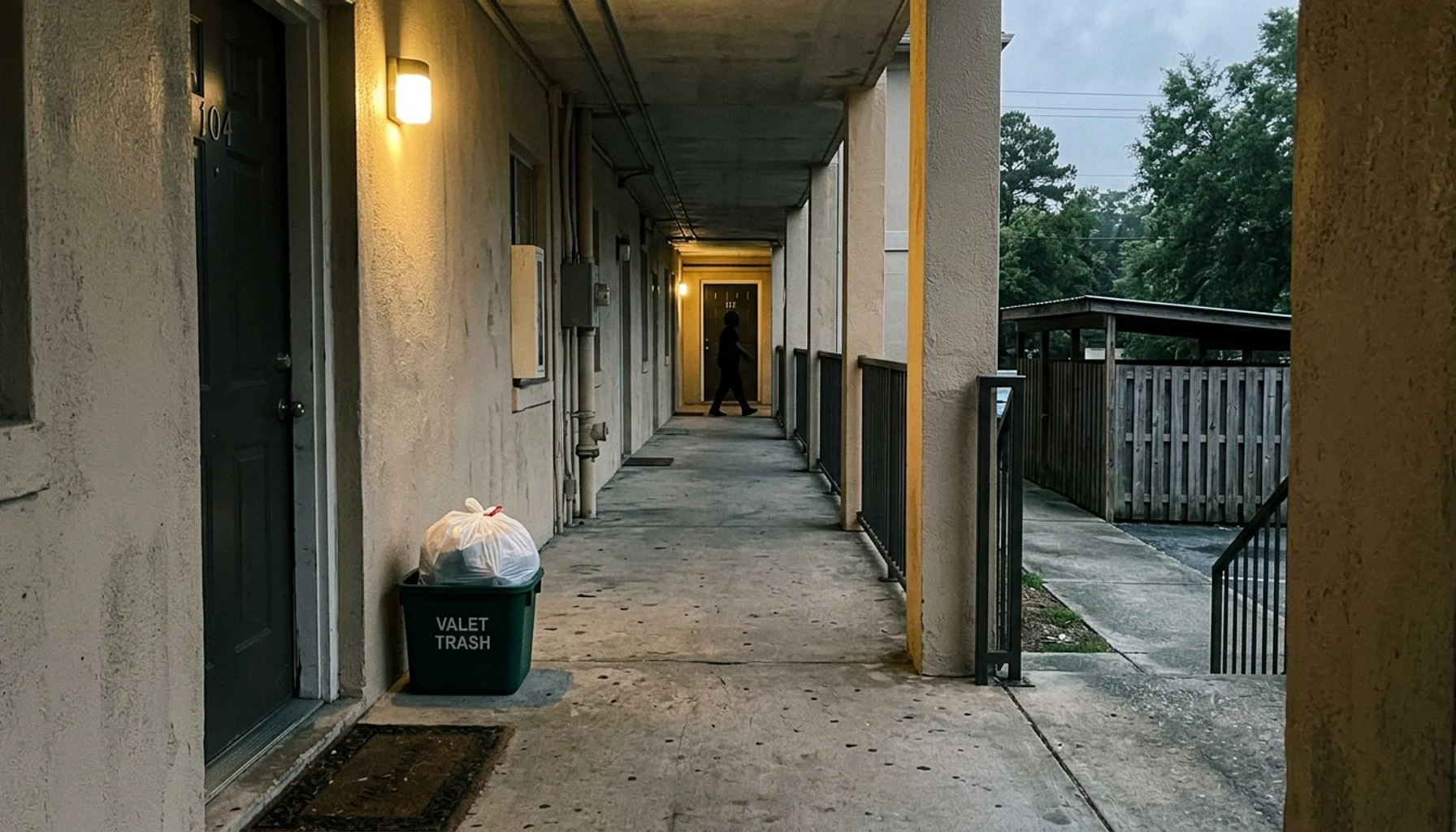
You are paying two separate charges because they cover two different things: a base trash or disposal fee for dumpster hauling and municipal disposal, and a valet trash charge for the labor of collecting bags from your door and carrying them to the dumpster. One pays for the container and the truck. The other pays for the person who walks it there.
Key Takeaways
- A base trash fee covers dumpster or compactor rental, hauling, and municipal disposal, which exists whether or not a property offers doorstep pickup.
- A valet trash charge, typically $25 to $35 per month for residents, pays for nightly labor: someone collecting bags at your door and walking them to the dumpster.
- Properties usually pay a provider $8 to $15 per unit per month for that same service, meaning the resident charge often exceeds the property's actual cost.
- Whether you're required to pay a valet trash charge depends almost entirely on your lease language, not on whether you think the fee is fair.
- In Charleston County, homeowners already pay a separate $150 annual Solid Waste User Fee on their property tax bill, which is a distinct charge from anything an apartment community bills for valet service.
- If a valet trash fee appears mid-lease and wasn't disclosed at signing, you generally have grounds to question it in writing before assuming you're stuck paying.
If you've stared at your rent statement wondering why there's a trash fee AND a valet trash charge sitting side by side, you're not imagining a mistake. This is a real, common billing structure across multifamily housing in 2026, and it catches new residents off guard almost every lease-signing season. The confusion is understandable: both charges have the word "trash" in the name, so it looks like double billing at first glance.
It isn't double billing once you separate what each line item actually funds. At Trash Day Made Easy, we provide nightly valet trash service for multifamily communities and build-to-rent developments across Charleston, North Charleston, and Atlanta, and we field this exact question from residents and property managers on a near-weekly basis. The pattern is consistent: people assume "trash" is one cost center. In practice, it's two, sometimes three, and each one has its own vendor, its own contract, and its own line on the invoice.
This breakdown walks through exactly what you're paying for, how much each piece typically costs, what your lease actually controls, and what to do if a valet trash charge shows up somewhere it shouldn't. We'll use real 2026 pricing data and Charleston-specific fee examples throughout, not generic national averages that don't reflect what you're actually seeing on your statement.
Why Am I Getting Charged for Trash AND Valet Trash?
You're charged separately because a base trash fee and a valet trash charge fund two entirely different operational costs. The base fee covers the dumpster or compactor contract, hauling frequency, and municipal disposal, a cost that exists on every property regardless of amenities. The valet charge pays for the labor of nightly doorstep collection, a distinct service layered on top.
Think of it this way: your apartment community signs a contract with a waste hauler for a dumpster or compactor, typically running $200 to $600 per month per container depending on size and pickup frequency, according to industry pricing guides. That cost gets built into your base rent, your utility bill, or a flat "trash fee" line, and it doesn't change whether residents carry their own bags downstairs or not.
Valet trash is a separate, optional amenity layered on top of that infrastructure. A provider like Trash Day Made Easy sends a uniformed technician to your door on scheduled nights, picks up your bagged trash from a designated bin, and carries it to the property's dumpster. As a result, the property bills you separately for that labor, usually as a flat monthly amenity fee. Two vendors, two cost structures, two lines on your statement.
How Much Should a Trash Valet Charge?
A trash valet service typically charges residents between $25 and $35 per month, while the property itself usually pays a provider between $8 and $15 per unit per month for that same nightly collection. That spread, often $10 to $27 per unit, is standard across the multifamily industry and isn't unique to any single market.
The exact number shifts with community size. Smaller communities, roughly 100 to 149 units, tend to see provider costs of $15 to $17 per unit monthly, with resident charges of $30 to $40. Mid-size communities of 150 to 299 units typically see provider pricing drop to $13 to $15 per unit, with resident fees settling around $25 to $35. Larger communities of 300 or more units often see the lowest provider rates, $12 to $14 per unit, because of route density and scheduling efficiency, according to published pricing data from other management companies.
That size-based pricing curve matters if you manage a scattered-site portfolio or a growing build-to-rent community. A 100-unit property and a 300-unit property don't pay the same rate per door, which is exactly why Trash Day Made Easy structures quotes around portfolio size rather than a flat, one-size number. Multifamily communities and portfolio operators can request a portfolio-specific quote rather than guessing at national averages.
For context on the resident side specifically, a 200-unit community charging $25 monthly per unit would collect roughly $60,000 annually in valet fees; at $35 monthly, that climbs to about $84,000. Those numbers explain why the fee exists as a distinct amenity charge instead of being folded quietly into rent.
Is Valet Trash Worth It for Residents and Property Managers?
Valet trash is worth the added cost for most multifamily residents who value convenience and for property managers trying to protect resident satisfaction. It's less clearly worth it for residents who are physically able to carry their own trash and are cost-sensitive, since the resident-facing markup over provider cost can run $10 to $22 per unit monthly depending on community size.
From the property side, the calculation is straightforward. A well-run nightly collection program reduces overflowing dumpsters, hallway clutter, and the resident complaints that come with both. National apartment industry research associated with organizations like the National Apartment Association (NAA) consistently links amenity-grade services to resident retention, and a clean, odor-free hallway at 9 p.m. on a Tuesday is a small but real factor in whether someone renews.
From the resident side, the math is more personal. If you live on a third floor with no elevator, work irregular hours, or manage kids and pets on a tight schedule, doorstep collection five nights a week (commonly Sunday through Thursday in provider contracts) removes a genuinely annoying chore. If you're on the ground floor next to the dumpster and don't mind the walk, you're paying a convenience premium you may not need. Either way, whether it's worth it is a personal cost-benefit call, not a universal answer.
What Is the Average Cost of Trash Billing on a Resident Statement?
The average resident trash billing structure includes a base fee (often bundled into rent or a flat utility line) plus a separate valet trash amenity charge of $25 to $35 monthly when the property offers doorstep pickup. Total monthly trash-related charges for residents in valet-serviced communities commonly land between $30 and $70, depending on how the base fee is structured.
Here's a simplified example based on standard 2026 industry pricing patterns, not a specific property's actual invoice:
| Line Item | Who Pays It | Typical Monthly Range | What It Covers |
|---|---|---|---|
| Base trash/dumpster fee | Property (often passed through in rent or utility bill) | Varies by dumpster contract, commonly $200-$600/month per container property-wide | Dumpster or compactor rental, hauling frequency, municipal disposal |
| Valet trash provider cost | Property pays vendor | $8-$15 per unit | Nightly doorstep collection labor, route management |
| Valet trash resident charge | Resident pays property | $25-$35 per unit | Amenity fee passed to resident, often exceeds actual provider cost |
| Charleston County Solid Waste User Fee | Homeowner (single-family) | $150 annually ($12.50/month equivalent) | County-level disposal, sorting, and recycling processing, billed on property tax |
Notice that the Charleston County fee applies to homeowners on their property tax bill, not to apartment residents through their lease. That's a separate government-level charge entirely, distinct from anything a multifamily property bills for a private valet amenity. If you're a Charleston-area homeowner rather than an apartment resident, don't confuse the two.
What Does My Lease Actually Say About the Valet Trash Charge?
Your lease, not your opinion of the fee's fairness, determines whether you're required to pay a valet trash charge. If the lease specifies valet trash as a mandatory recurring fee, you're generally bound to pay it because you signed a binding contract. If the lease is silent on trash collection, or you and the landlord agreed you'd handle trash independently, the landlord generally cannot add the charge mid-lease without your written agreement.
This is confirmed by consumer guidance from Georgia's state housing resources, which notes that lease terms control the outcome and that a tenant typically cannot negotiate away a properly disclosed fee once signed, but also cannot be forced into a new fee that wasn't part of the original agreement. That distinction matters enormously and gets lost in most fee explainers.
Where to Look in Your Documents
Before assuming anything, pull four documents and check each one specifically for valet trash language:
- The original rental advertisement or listing. Was a trash fee disclosed before you applied?
- The signed lease itself. Look for a fee schedule, addendum, or a specific clause naming "valet trash," "doorstep trash service," or a similar amenity fee.
- Any utility or amenity addendum. Many properties bundle valet trash into a separate utility billing addendum rather than the main lease body.
- Your resident portal fee history. Compare your first month's charges against your current statement. A fee that appeared later, without a signed amendment, is worth questioning.
States are increasingly requiring upfront disclosure of these fees. Texas, for example, introduced legislation (HB 4305) that would require fixed recurring fees, including valet trash, pest control, and amenity charges, to be disclosed alongside rent in advertisements and lease quotes, not buried in fine print. Whether or not your state has an identical rule, the direction of the trend is toward more disclosure, not less, and that trend continues into 2026.
What Should I Do If a Valet Trash Fee Appears That Wasn't in My Original Lease?
If a valet trash fee shows up on your statement that wasn't disclosed at signing, your first step is a written inquiry to your property manager asking for the specific lease clause or addendum authorizing the charge, not a phone call you can't document. Keep every reply in writing and avoid withholding rent as a response, since that can create its own set of problems regardless of whether the fee itself is valid.
A simple written inquiry template looks like this: state your unit number, state the date the fee first appeared on your statement, ask specifically which lease section or addendum authorizes it, and request a written response within a reasonable timeframe. This creates a paper trail whether the property corrects the error or explains a legitimate basis you missed.
If the property can't point to lease language and won't remove the charge, your next step is typically your state or local consumer housing agency, or a tenant-focused legal resource in your area. Escalating in writing, calmly and specifically, resolves the overwhelming majority of these situations before they need to go further.

How Is Valet Trash Different from Other Mandatory Apartment Fees?
Valet trash is one of several recurring mandatory fees that have become common in multifamily leases alongside base rent, and it's worth understanding it in that broader context. Other common recurring charges include pest control (often around $5 monthly), utility billing administration fees (commonly $4.50 to $6.50 monthly), and tenant liability insurance (sometimes around $13 monthly), all layered on top of rent in a fee-based revenue model many properties now use.
What separates valet trash from most of these is that it has a visible, physical service behind it: a real person, on a real schedule, doing real labor at your door. Pest control might be quarterly. Utility billing administration is invisible paperwork. Valet trash happens in front of you five nights a week, which is exactly why residents notice and question it more than they question a $5 pest control line.
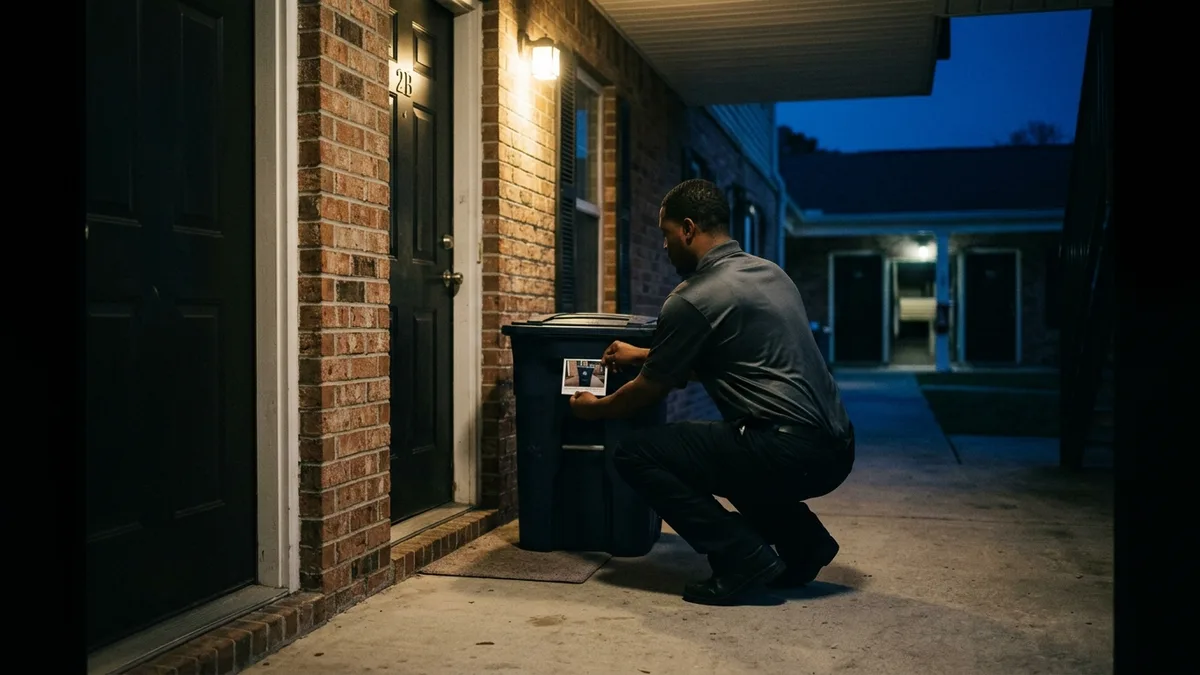
That visibility is also why photo verification matters so much on the property management side. When a property manager can see, in writing, that every single unit received documented service on a given night, disputes about "I never got picked up" resolve immediately instead of turning into a resident complaint that damages trust. This is the exact structural difference Trash Day Made Easy built its service around: nightly collection with a photo confirmation logged at every door, so a property manager isn't relying on a driver's word that the route got finished.
Data and Evidence: What Charleston-Area Residents Are Actually Paying
Charleston County residents and multifamily renters face a layered set of trash-related costs in 2026, and it's worth separating them clearly since they come from different authorities entirely. Charleston County charges a Solid Waste User Fee of $150 annually for single-family residences and $105 annually for multifamily units, billed on the property tax bill for homeowners, according to the county's Environmental Management office and the governing county ordinance.
Notably, that county fee is scheduled for annual adjustment starting July 2026, tied to the Consumer Price Index and capped at a maximum 5% increase per year. That's a separate, government-level cost from anything a private apartment community bills residents for valet service, and confusing the two is one of the more common mix-ups we see.
Meanwhile, North Charleston's rental market has been moving in 2026, with one July report showing median rent around $1,711 and year-over-year rent growth of 4.1%. In a market where rent is climbing, every additional line item on a statement gets scrutinized more closely, which is exactly why residents are asking sharper questions about their trash fees AND their valet trash charge this year than in past years.
| Fee Type | Governing Authority | Typical Amount | Applies To |
|---|---|---|---|
| Charleston County Solid Waste User Fee | Charleston County (Ordinance No. 2253) | $150/year single-family; $105/year multifamily | Property owners, billed on tax bill |
| Nonresidential county waste fee | Charleston County | $130/year (low volume) up to $260 per weekly cubic yard | Commercial properties |
| Multifamily valet trash resident fee | Individual property/lease | $25-$35/month | Apartment residents in valet-serviced communities |
| Multifamily valet trash provider cost | Property to vendor | $8-$15/unit/month | Property, not billed directly to residents |
Practical Guidance: How to Audit Your Own Trash Fee Line Items
Auditing your own trash-related charges takes about fifteen minutes once you know what to look for, and it's worth doing before your next lease renewal, not after a dispute already started. Start with the documents, then compare against what you're actually being billed.
- Separate the two fee types on your statement. Identify which line is a base trash/utility fee and which is a valet trash amenity charge. If they're combined into one number, ask your property manager to break it out.
- Check your original lease and any amendments. Confirm the valet trash fee, if charged, was disclosed before or at signing, not added later without your written consent.
- Compare your rate against the $25-$35 industry range. If you're paying significantly more, ask what's included, additional pickups, bulk item service, or a premium tier.
- Watch for fee stacking without added service. If your community added a valet trash fee but service quality (missed nights, inconsistent pickup) hasn't improved, that's a legitimate conversation to have with management, in writing.
- Confirm what happens during move-out. Ask whether valet trash covers move-out debris or whether that's billed separately as bulk item removal, since these often get confused on final statements.
The most common mistake we see residents make isn't failing to notice the fee, it's assuming the fee is non-negotiable simply because it appeared on a statement. A fee that was properly disclosed in your signed lease usually is fixed for the lease term. A fee that appeared without disclosure is a different situation entirely, and treating both the same way costs residents money they didn't actually owe.
For property managers reading this from the other side of the invoice: the fastest way to avoid these disputes altogether is documented, photo-verified service and transparent fee disclosure at lease signing. Communities managing turnover trash, bulk item removal, or scattered units across the cost structure that valet trash companies typically charge apartments can request a straightforward, itemized quote rather than guessing at national averages that don't reflect their actual unit count or route density.
Frequently Asked Questions
What is valet trash?
Valet trash is a multifamily amenity service where a technician collects bagged trash directly from a resident's door on a scheduled basis, typically several nights per week, and carries it to the property's dumpster or compactor. It's an added labor service layered on top of a property's existing dumpster contract, not a replacement for it.
What is valet trash service and how is it billed?
Valet trash service is nightly or near-nightly doorstep trash collection, usually billed to residents as a flat monthly amenity fee separate from rent, typically $25 to $35 per month. The property separately pays a provider, commonly $8 to $15 per unit monthly, for the labor and route management behind that service.
What is valet trash in apartments specifically?
In an apartment setting, valet trash means residents place bagged trash in a designated bin or container outside their unit door on scheduled nights, and a uniformed technician collects it and delivers it to the community dumpster. Residents never have to carry trash to a dumpster themselves under this model.
How much do valet trash companies charge apartments?
Valet trash companies typically charge properties between $8 and $15 per unit per month, with larger communities of 300 or more units often paying toward the lower end due to route density. A 100-unit community might see a provider invoice in the $800 to $1,500 monthly range, separate from what residents are billed.
How much does trash cost per month in an apartment?
Total trash-related costs for an apartment resident vary by community, but a valet trash amenity fee alone typically runs $25 to $35 monthly, on top of any base trash or utility charge already built into rent. Combined, residents in valet-serviced communities commonly see $30 to $70 monthly in total trash-related line items.
How much should a trash valet charge?
A trash valet service should charge residents somewhere in the standard industry range of $25 to $35 per month, adjusted slightly based on community size and service frequency. If you're seeing a charge well outside that range without additional services included, it's worth asking your property manager what's driving the difference.
Is valet trash worth it?
Valet trash is generally worth it for residents who value convenience, have mobility limitations, or live in units far from the dumpster, and for properties that want to reduce hallway clutter and resident complaints. It's a less clear value for residents who are cost-sensitive and don't mind carrying their own trash out on a normal schedule.
Why am I getting charged for trash and valet trash on the same statement?
You're charged for both because they fund different things: the base trash fee covers dumpster rental and municipal disposal, while the valet trash charge covers the separate labor of doorstep collection. Both exist independently, and one doesn't replace the need for the other on most properties.
Conclusion: Getting Clarity on Your Trash Fees AND Valet Trash Charge
The short version is worth repeating: your base trash fee and your valet trash charge exist because they cover two entirely different jobs, dumpster infrastructure versus doorstep labor, and seeing both on a statement is standard practice across multifamily housing in 2026, not a billing error by default. What matters most is whether your lease properly disclosed the valet charge before you signed, since that single fact determines whether you're obligated to pay it.
If you're a resident, pull your lease, separate the two fee types, and compare your rate against the standard $25 to $35 monthly range before assuming anything is wrong. If you're a property manager or portfolio operator trying to avoid these disputes altogether, transparent, photo-verified service with clear fee disclosure at signing solves most of this before it ever becomes a resident complaint.
Waste management at a multifamily or build-to-rent community rarely breaks down because of one bad decision. It breaks down because there's no documented system running consistently in the background. A nightly valet trash program with photo verification at every door removes that ambiguity entirely, for residents and for the property manager fielding their questions.

If you manage a multifamily community, build-to-rent development, or scattered-site portfolio across Charleston, North Charleston, or Atlanta and want a waste program where every fee is transparent and every service visit is documented with a timestamped photo, get started with Trash Day Made Easy. Quotes are available Monday through Friday for portfolios of any size.
Content powered by inkSTR.co