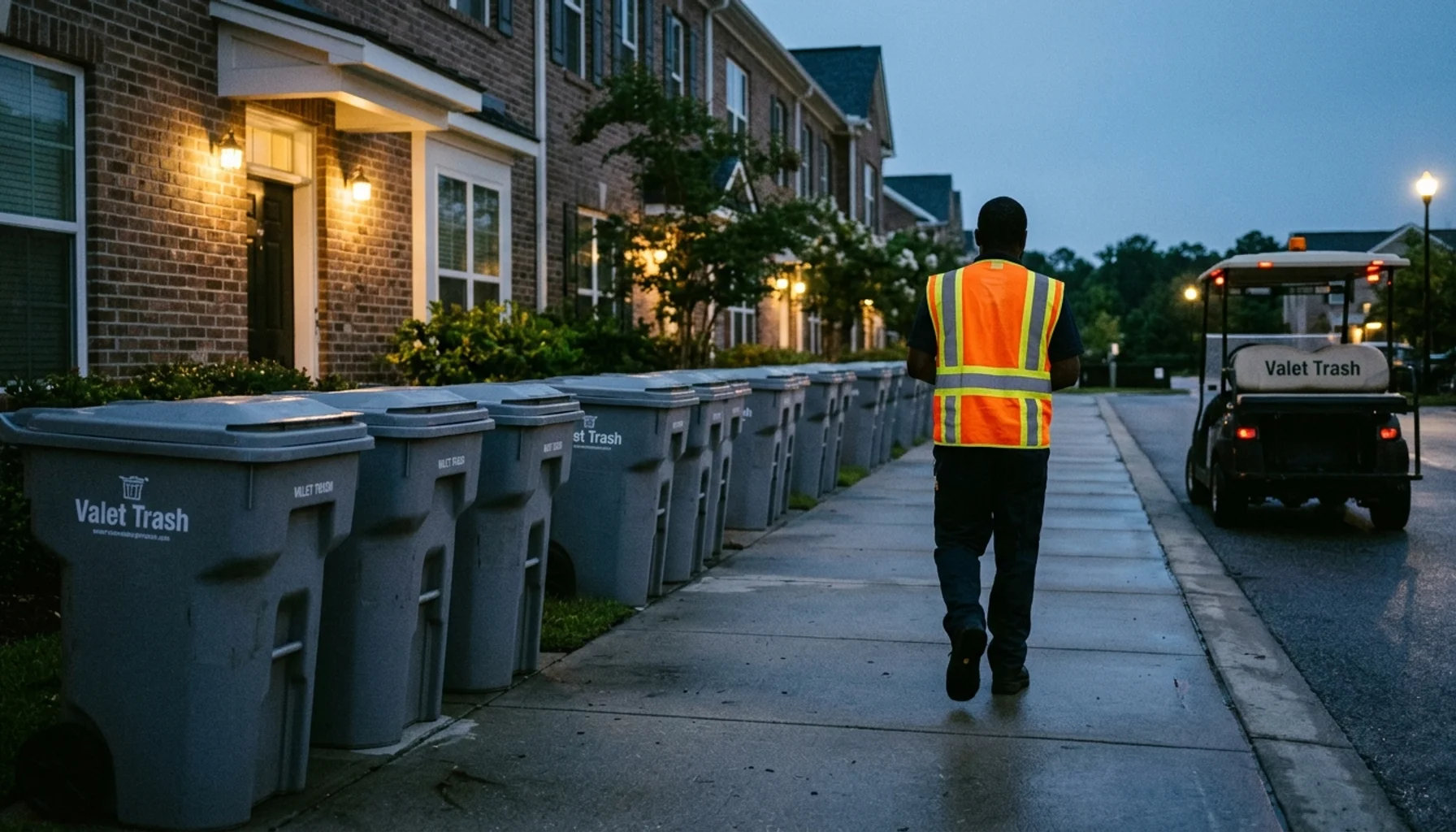
Trash kans, in the context of multifamily communities, build-to-rent developments, and Charleston-area homes, refers to the standardized bins and containers used in doorstep valet trash collection and backdoor-to-curbside bin management programs. Rather than residents wrestling with a personal can every week, a valet trash provider supplies, positions, empties, and returns these containers on a set schedule, removing the guesswork from waste day entirely.
Key Takeaways
- Trash kans in a valet trash program are standardized containers, typically lidded and odor-controlled, supplied and managed by the service provider rather than the resident.
- Trash Day Made Easy offers five-night weekly valet trash collection across North Charleston, Charleston, Mount Pleasant, Summerville, and surrounding markets, with a same-day response time on most service requests.
- Every collection stop is photo-verified, giving property managers documented proof of service without needing to follow up or issue reminders.
- Residential valet trash service in select Charleston neighborhoods starts from $49 per month, while multifamily and portfolio pricing is quote-based.
- According to Grand View Research, the global trash-bin market was valued at $22.18 billion in 2026 and was projected to reach $23.02 billion in 2026, reflecting steady demand for bin infrastructure across residential and commercial properties.
- The Charleston region drew 7.91 million overnight visitors in 2026 with average visitor spending of $1,212 per trip, according to Explore Charleston reporting, a demand level that keeps pressure on both hospitality properties and residential waste programs across North Charleston.
If you searched "trash kans" looking for the containers themselves, or the service model behind them, you landed in the right place. North Charleston property managers, build-to-rent operators, and homeowners all ask a version of the same question: what actually happens to the bin between the resident's door and the dumpster or curb, and who is responsible when it goes wrong?
In 2026, that question matters more than it did five years ago. Portfolios have grown, resident expectations around amenity-grade service have risen, and the days of a single overflowing dumpster tanking a lease renewal conversation are numbered for properties that get waste management right. At Trash Day Made Easy, we've watched this shift play out across multifamily communities near the Rivers Avenue corridor, build-to-rent developments closer to Daniel Island, and short-term rentals scattered through the Charleston Historic District.
This guide covers what trash kans actually are, how doorstep valet collection differs from backdoor-to-curbside bin concierge service, what the containers themselves look like in practice, and what property managers and homeowners in the Charleston metro should expect to pay in 2026.
What Are the Different Types of Trash Kans Used in Valet Service?
Trash kans used in valet and bin concierge programs fall into a few standard categories: lidded doorstep bins for nightly bagged waste, wheeled municipal-style carts for can-to-curb service, and larger dumpster-adjacent containers for bulk overflow. Each type serves a distinct stage of the collection workflow, not an interchangeable role.
Doorstep bins are typically compact, lidded containers residents place outside their unit during a designated service window. Standardized doorstep-service hours across the industry generally run from 6 p.m. to 8 p.m., Sunday through Thursday, according to workflow descriptions used by regional waste-service providers. The lid controls odor and keeps pests out overnight, which matters in Lowcountry humidity.
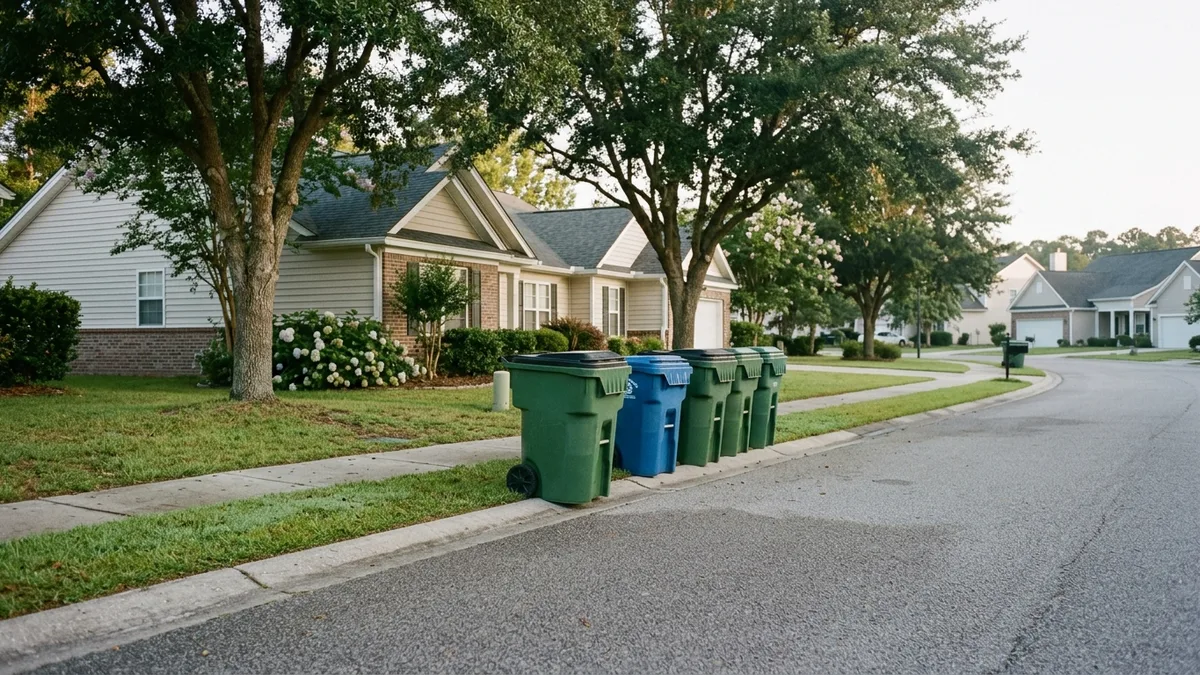
Wheeled carts, the kind most homeowners already recognize from municipal pickup, are the containers used in backdoor-to-curbside bin concierge service. These move from a garage, side yard, or storage area to the curb on collection day and back again afterward. Notably, medium-capacity bins in the 10 to 20 gallon range held a 47.2% share of the U.S. market in 2026, according to Intelévo Research, while standalone trash cans represented 71.2% of the market, reflecting how dominant single-unit containers remain over multi-compartment systems.
Larger commercial dumpsters serve multifamily properties and handle bulk overflow that doorstep bins cannot accommodate, particularly during move-out season or after community events.
What Is a Garbage Picker Called in a Valet Trash Program?
The person who collects doorstep waste in a valet trash program is generally called a valet trash technician or waste collection associate, not a "garbage picker," a term more commonly associated with informal recycling collection in other contexts. In a structured multifamily or residential valet program, this role is a trained, uniformed employee following a fixed nightly route.
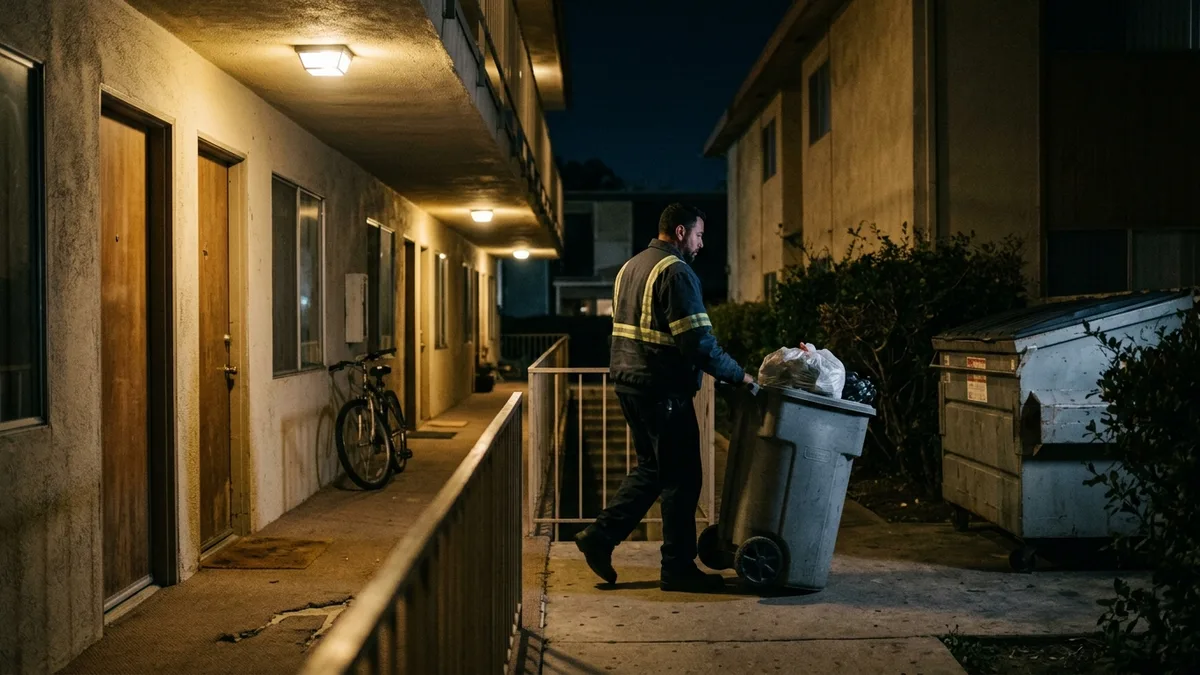
A valet trash technician's job differs meaningfully from a municipal sanitation worker. Municipal crews run trucks on fixed routes and empty whatever is at the curb, regardless of overflow or condition. A valet trash technician instead walks a breezeway or hallway route on foot, collects bagged waste directly from doorstep bins, carries it to the property's dumpster, and documents the stop with a timestamped photo.
At Trash Day Made Easy, every technician's route is photo-verified at each unit, which is a meaningfully different accountability model than a driver simply reporting the route as complete. Property managers across North Charleston, Mount Pleasant, and Summerville get a documented record without lifting a phone to confirm anything happened.
Where Can You Find Dumpster or Bulk Removal Support Near North Charleston?
Bulk item and dumpster-adjacent removal support in the North Charleston area is generally arranged through a property's waste management vendor rather than a standalone dumpster rental, particularly for multifamily communities managing frequent move-outs. A resident who moves out and leaves a sectional sofa in the breezeway creates a real operational cost: every hour that unit sits with debris is an hour of lost rental income during a make-ready cycle.
Property managers overseeing communities near the airport corridor or scattered-site portfolios across James Island and Johns Island typically need bulk removal integrated directly into the turnover schedule, not scheduled as an afterthought once a new tenant is already waiting. Trash Day Made Easy handles bulk item removal and move-in/move-out trash as part of its standard service scope across Charleston and Atlanta, coordinating pickup timing with make-ready cycles rather than treating it as a separate call.
For homeowners and HOA communities that occasionally need standalone dumpster capacity for a larger project, the City of North Charleston publishes official guidance on permitted disposal options and bulky-item rules, and that municipal source should be the first reference point for anything outside a routine service relationship.
Can You Throw Away a Trash Kan When It Wears Out?
A worn-out trash kan can typically be discarded through a municipality's bulky-item collection program or a private waste service's bulk removal option, though the exact disposal rules depend on the container's material and the local jurisdiction's guidelines. Most plastic bins, which account for 62.14% of global trash-bin revenue according to Grand View Research, are recyclable in bulk through specialized facilities rather than standard curbside recycling streams.
For residents enrolled in a valet trash or bin concierge program, the provider generally handles container replacement directly, swapping a damaged or degraded bin without the resident needing to research disposal rules at all. That is one of the quieter advantages of an outsourced program: the logistics of replacing a cracked lid or a wheel that has snapped off never becomes the resident's problem.
For homeowners managing their own containers outside a service program, checking with the City of Charleston or City of North Charleston's bulky-item guidelines before setting a bin at the curb is the safer first step, since rules on container disposal can vary by material and by neighborhood collection zone.
How Does Trash Day Made Easy Handle Trash Kans Across North Charleston Communities?
Trash Day Made Easy is a North Charleston-based valet trash and waste operations company headquartered at 4900 O'Hear Avenue, purpose-built to manage trash kans across every stage of the collection process, from doorstep pickup to bin return, for multifamily communities, build-to-rent developments, short-term rental properties, HOAs, and residential homeowners.
The company runs two distinct service models. Doorstep-to-dumpster valet trash collection covers multifamily and build-to-rent communities, running a five-night weekly schedule and moving bagged waste from a resident's door directly to the property dumpster. Backdoor-to-curbside bin management, by contrast, is built for HOA communities and residential homeowners: the trash kan moves from a garage or storage spot to the curb on collection day and returns afterward, with zero action required from the resident.
What separates Trash Day Made Easy from a patchwork of city pickup and DIY bin management is the documentation layer. Every single stop, on every property, gets a timestamped photo. Property managers overseeing a scattered-site portfolio across Charleston, Summerville, and Johns Island get one point of contact and one consistent service standard, rather than juggling a different vendor relationship at every address.
The company's response time on service requests runs same-day in most cases, and quotes are available Monday through Friday for every property type, from a single residential home to a 1,000-plus unit multifamily portfolio. Trash Day Made Easy also partners with The Bin Boy, a Charleston-based bin cleaning and sanitizing service, extending the relationship beyond collection into full container hygiene for communities that want it.
Other providers exist in the regional market, including Capital Service Group and Sweetgrass Waste Services, along with national names in the valet trash category.
What Do Trash Kans Cost in a Valet Trash Program?
Valet trash and trash-can concierge pricing varies by property type and unit count, and there is no single national rate that applies across every market. Residential valet trash service in select Charleston neighborhoods starts from $49 per month through Trash Day Made Easy, while multifamily and portfolio pricing depends on unit count, service frequency, and route density, and is quoted directly rather than published as a flat rate.
| Service Type | Typical Structure | Best Fit |
|---|---|---|
| Municipal curbside collection | Fixed weekly schedule set by the city, resident manages the bin | Homeowners comfortable with weekly bin duty |
| Residential valet trash | Starts from $49 per month | Homeowners who want the bin handled entirely |
| Doorstep-to-dumpster valet (multifamily) | Quote-based, typically billed per unit across the community | Apartment and BTR communities of 10 to 1,000+ units |
| Backdoor-to-curbside bin concierge (HOA) | Quote-based, structured around community-wide enrollment | HOA communities managing bin compliance |
| Bulk item and turnover removal | On-demand or scheduled with make-ready cycles | Move-out debris, oversized items, community cleanouts |
Industry sources put average U.S. kitchen trash-can retail pricing around $33 to $38 per unit in 2026, according to IndexBox, which reflects the container cost alone and not the labor, route, and documentation layer that a full valet program provides. That distinction matters when comparing a one-time container purchase to an ongoing service relationship.
For property managers evaluating whether valet trash pencils out against self-managed dumpster service, our guide to what valet trash companies charge apartments breaks down the per-door math in more detail.
What Does Photo Verification Actually Mean for Property Managers?
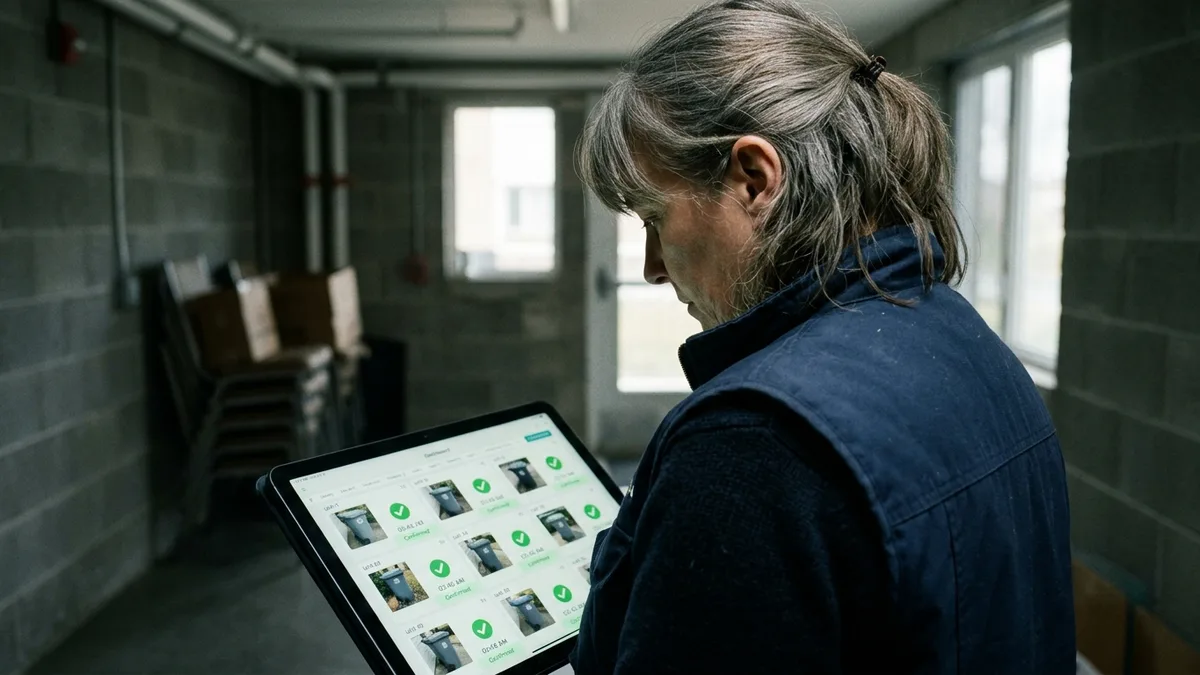
Photo verification in a valet trash program means each collection stop is documented with a timestamped image showing the trash kan emptied and the doorstep or curb area clear, giving property managers a searchable record without requiring a phone call or site visit. This is the single biggest differentiator between a modern managed waste program and an older, trust-based vendor relationship.
Before photo verification became standard, property managers relied on driver self-reporting or resident complaints to know whether service happened. A missed stop might not surface until a resident emailed about a smell in the hallway, days later. As a result, disputes over service failures were common and hard to resolve.
With photo-documented stops, a property manager can pull up proof that a specific unit's trash kan was serviced on a specific night, at a specific time. For a 200-unit community near the Rivers Avenue corridor, that means zero guesswork during a resident complaint conversation, and it means the property manager never has to personally verify a vendor's work.
Our guide to doorstep trash collection for property managers goes deeper into how documented service protects both the vendor relationship and the resident experience.
How Should Property Managers Evaluate a Trash Kan Vendor?
Evaluating a valet trash or bin concierge vendor comes down to five practical criteria: collection frequency, response time, documentation, scalability, and local market knowledge. Getting this wrong usually shows up months later as resident complaints or a scramble to replace a vendor mid-lease-cycle.
- Confirm actual collection frequency. Five-night weekly service is the industry standard for doorstep valet in multifamily communities; anything less consistent leaves hallways cluttered on off-nights.
- Ask about response time on service issues. A same-day response window matters more than a polished sales pitch when a dumpster overflows during a heat wave.
- Require photo documentation, not verbal assurance. If a vendor cannot show timestamped proof of service, you have no record when a dispute arises.
- Check scalability across your full portfolio. A vendor comfortable with a 20-unit community may not have the route density to service a 500-unit property or a scattered-site portfolio spanning multiple Charleston submarkets.
- Weigh local knowledge against national scale. National operators bring brand recognition, but a Charleston-headquartered team understands hurricane contingency planning, humidity-driven odor control, and submarket-specific route logistics that a distant call center cannot replicate.
Common mistakes we see repeatedly: signing a vendor contract before confirming photo verification exists, assuming municipal pickup alone will satisfy resident expectations in an amenity-driven market, and treating bulk item removal as an afterthought instead of a fixed step in the turnover process.
What Role Does Waste Data Play in Managing Trash Kans at Scale?
Waste volume and composition data help portfolio operators size trash kan capacity correctly and anticipate seasonal overflow, particularly around food waste, which represents the largest single category of municipal solid waste in South Carolina landfills. According to the South Carolina Department of Environmental Services, food waste accounted for 26.2% of material in state landfill studies, a figure that directly informs container sizing for communities with heavy dining-in populations.
Communities near North Charleston's dense hotel corridor, which held 7,465 of the region's 18,989 hotel rooms in 2026 according to Explore Charleston reporting, generate different waste patterns than a residential HOA. Short-term rental turnover, hospitality food service, and tourism-driven visitor spending, which reached $1,212 per adult trip in 2026, all put distinct pressure on container capacity and collection frequency.
For build-to-rent operators trying to project waste volume for a new community, sizing trash kans based on national commodity-versus-service consumption trends, or on regional tourism data alone, misses the mark. Route-level data from an operating vendor, tracking actual fill rates and odor complaints by building, is a far more reliable planning input than a generic industry average.
Common Mistakes Property Managers Make with Trash Kan Programs
The most frequent mistake we see is treating trash kan service as a commodity purchase decision rather than an operational partnership. A property manager who picks a vendor purely on lowest quoted price, without checking documentation practices or response time, often ends up managing the same complaints they were trying to eliminate.
A second common error: underestimating how quickly a scattered-site portfolio outgrows a single-community vendor relationship. What works fine for one 40-unit property becomes unmanageable across ten properties spread from Summerville to Johns Island without a vendor built for portfolio-scale consistency.
Third, HOA boards frequently rely on fine systems to enforce bin compliance instead of removing the compliance requirement altogether. A trash can concierge service that moves the bin automatically eliminates the enforcement problem rather than managing it after the fact.
Frequently Asked Questions
How much do valet trash companies charge apartments?
Valet trash pricing for apartment communities is generally quote-based and depends on unit count, collection frequency, and route density rather than a single published rate. Residential valet service through Trash Day Made Easy starts from $49 per month, while multifamily and portfolio pricing requires a direct quote, available Monday through Friday at trashdaymadeeasy.com.
How much does trash cost per month in an apartment?
Apartment trash costs vary depending on whether the community includes waste service in rent, charges a separate trash reimbursement fee, or contracts a valet trash provider directly. Costs depend on the specific community's arrangement, and residents should check their lease terms or ask their property manager for the exact monthly figure.
What is trash reimbursement for an apartment?
Trash reimbursement is a fee some apartment communities charge residents to cover the cost of waste removal services, including dumpster rental, municipal fees, or a contracted valet trash provider. This fee is typically itemized separately from base rent and varies by property, so residents should confirm the specific amount with their property management office.
How much is valet trash service?
Valet trash service pricing depends on property type: residential valet trash starts from $49 per month in select Charleston neighborhoods through Trash Day Made Easy, while multifamily community pricing is quoted based on unit count and service frequency. Request a specific quote directly rather than relying on a generic published rate, since per-door costs shift with portfolio size.
What is valet trash?
Valet trash is a doorstep collection service where residents place bagged waste in a designated trash kan outside their unit during scheduled hours, typically evenings, and a trained technician collects it and carries it to the property dumpster. It differs from municipal curbside pickup, which requires residents to bring their own bin to the curb on a fixed weekly schedule regardless of how full it is.
Can trash build a home?
In the context of waste operations and property management, "trash" does not build a home; however, effective waste management directly supports property value and curb appeal, which influence resident retention and lease renewal decisions. Clean, well-managed dumpster areas and consistent trash kan collection contribute to a community's overall appeal in ways that indirectly support long-term property investment goals.
What are the different types of trash cans used in property management?
Property management waste programs typically use three container types: lidded doorstep bins for nightly bagged valet collection, wheeled municipal-style carts for backdoor-to-curbside bin concierge service, and larger dumpster or bulk containers for overflow and move-out debris. Each container type is matched to a specific stage of the collection workflow rather than used interchangeably.
Conclusion: Getting Trash Kans Right in 2026
Trash kans stopped being a minor logistics detail the moment resident expectations shifted toward amenity-grade service. Whether you manage a 300-unit community near the Rivers Avenue corridor, a build-to-rent development on Daniel Island, or a single home wanting the bin handled without a second thought, the container itself matters less than the system behind it: consistent scheduling, documented proof of service, and a vendor that scales with you.
Trash Day Made Easy was built specifically to run that system across North Charleston, Charleston, Mount Pleasant, Summerville, Daniel Island, James Island, Johns Island, Isle of Palms, and Sullivan's Island. Five-night weekly collection, same-day response, and 100% photo-verified stops remain the standard across every property type the company services, from single homes to portfolios exceeding 1,000 units.
If you're weighing whether a valet trash or trash can concierge program makes sense for your property, get started with Trash Day Made Easy and request a quote Monday through Friday for multifamily, build-to-rent, HOA, short-term rental, or residential service across Charleston and Atlanta.
Content powered by inkSTR.co