
Valet trash service is generally the better choice for apartment communities with more than 100 units, multiple buildings, or upper-floor walk-up residents, while traditional dumpster service works fine for small, low-density properties where residents live close to a single disposal point. The right answer depends on unit count and how much overflow and hallway clutter your maintenance team can tolerate.
Key Takeaways
- Valet trash typically runs 5 to 7 nights per week doorstep-to-dumpster, while traditional dumpster service usually gets picked up only 1 to 2 times per week, according to industry pricing guides referenced by Property Manager Insider FAQ on valet trash.
- Property-side vendor costs for valet trash commonly run $8 to $15 per unit per month, while residents are typically billed $25 to $35 per month for the amenity.
- A 100-unit community can expect roughly $800 to $1,500 per month in vendor expense for valet service, a figure that gets absorbed into resident fees in most contracts.
- Traditional dumpster overflow fees can run $125 to $260 per occurrence, a cost that valet service largely avoids by managing waste through a nightly route instead of a single centralized bin.
- Photo-verified service confirmation at each door is becoming standard among modern valet providers but is not a feature traditional dumpster hauling offers at all.
- Neither model eliminates the other entirely; valet trash handles the doorstep-to-dumpster segment, while a dumpster or compactor and hauler still manage total consolidated waste volume.
Every property manager in North Charleston, Mount Pleasant, or the wider Charleston metro eventually asks the same question: is it worth adding a doorstep pickup amenity, or does the community's single dumpster pad already do the job? The answer changes depending on unit count, building layout, and how much resident complaint volume your team can absorb before it starts affecting lease renewals.
At Trash Day Made Easy, we service multifamily communities, build-to-rent developments, and residential portfolios across Charleston and Atlanta, and this exact comparison comes up on almost every sales call. Property managers near the Rivers Avenue corridor deal with waste pressures that a once-a-week municipal-style dumpster pickup schedule was never designed to solve. Communities near Daniel Island with newer build-to-rent product face a different calculation entirely, since resident expectations there run higher from day one.
This guide breaks down how doorstep valet trash collection actually compares to a centralized dumpster model on cost, cleanliness, and resident experience, using verified industry pricing data rather than vague generalities. In 2026, with resident retention now the dominant performance metric across multifamily portfolios, the decision carries more financial weight than it did even a few years ago.
What Is Valet Trash Service and How Does It Work?
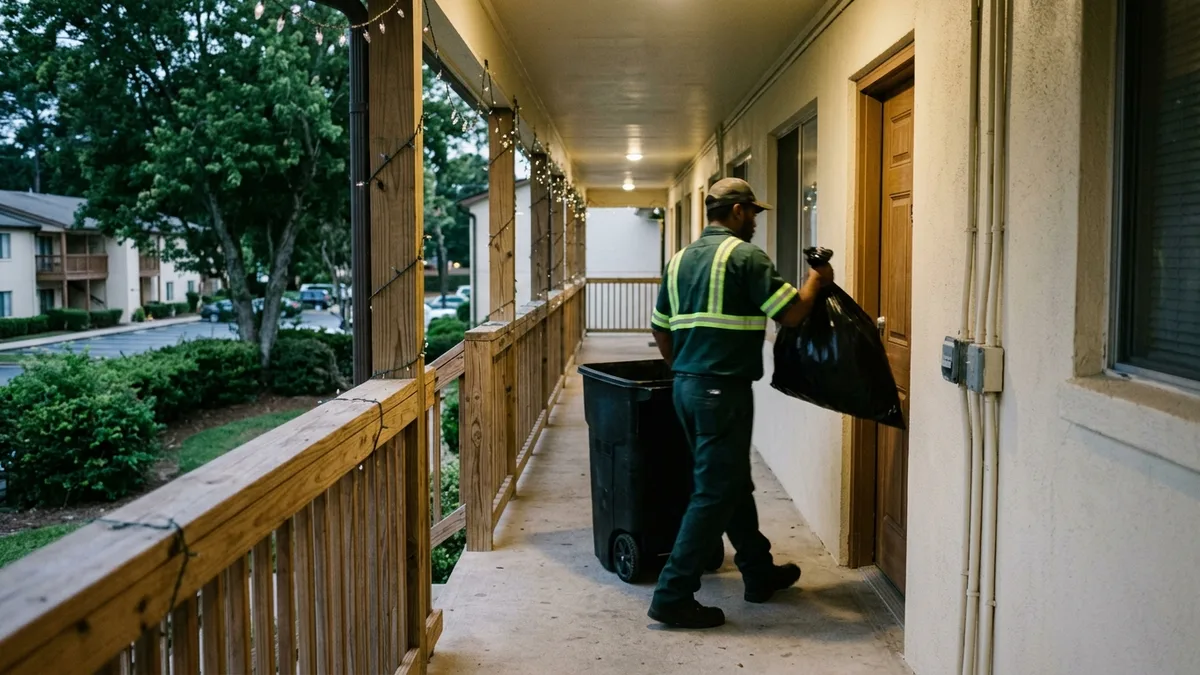
Valet trash service is a doorstep waste collection amenity where a uniformed crew picks up bagged trash directly from residents' front doors on a nightly schedule, then transports it to the property's central dumpster or compactor. Residents typically place a branded bin or bag outside their unit door between roughly 6 p.m. and 8 p.m., and the crew works through the property on a fixed route, usually 4 to 5 nights per week, though many providers now offer up to 7 nights.
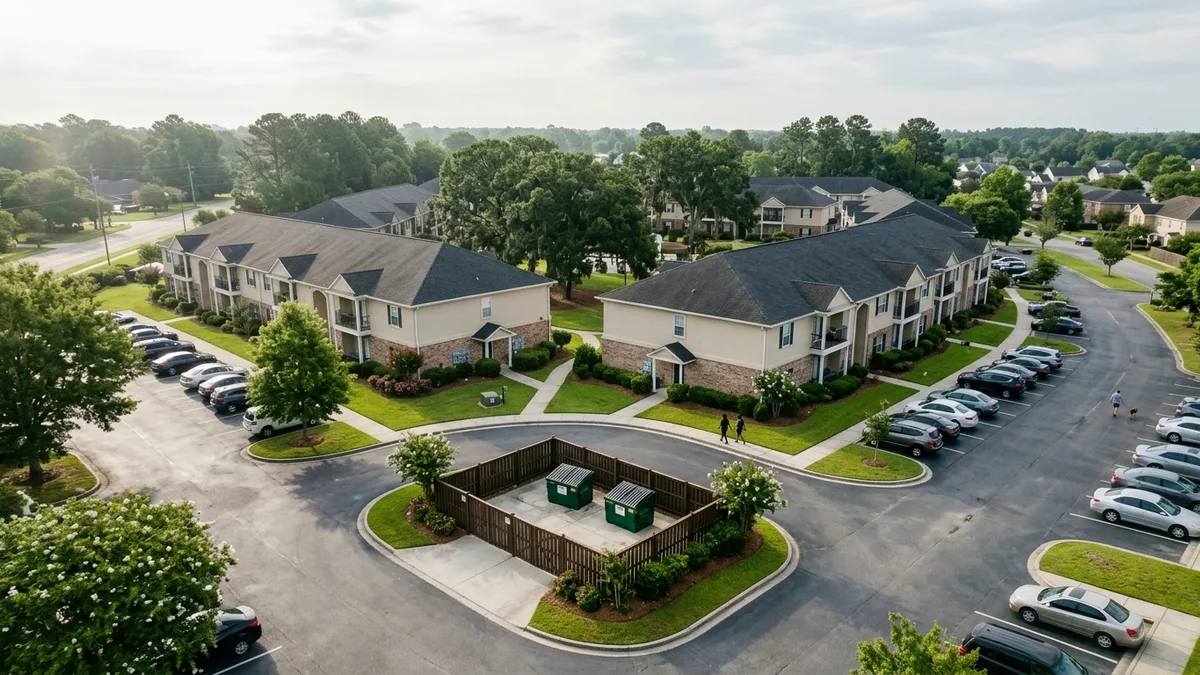
The model does not replace the community dumpster, it feeds it. A crew still hauls consolidated waste to the same pad or compactor a traditional-only property uses; valet trash just adds the doorstep layer on top. This matters for property managers evaluating cost: you are paying for the labor and route management of the doorstep segment, not for a separate disposal system.
Photo verification has become one of the more meaningful differentiators among modern valet providers. Each stop gets documented with a timestamped photo showing the door and collected bin, giving the property manager a record without needing to walk the property or field a resident's word against a driver's. As a result, disputes over missed pickups become a five-minute email check instead of a he-said-she-said conversation. Providers such as Valet Living official site and Trash Caddie Valet have built entire marketing programs around this documentation layer, and it is worth asking any vendor you evaluate whether they offer it standard or as an add-on.
What Is Traditional Dumpster Service and When Does It Make Sense?
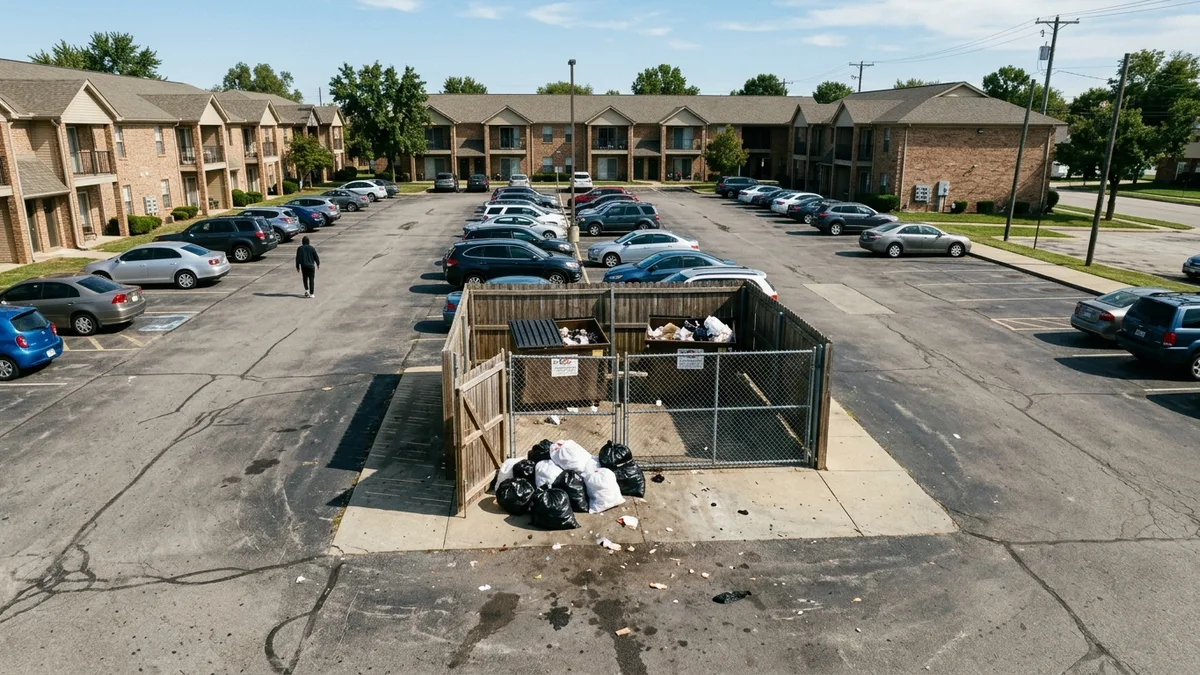
Traditional dumpster service means residents carry their own bagged trash to a centralized dumpster or compactor, typically located in a parking lot, at the property perimeter, or near a designated waste enclosure. Municipal or contracted haulers empty that dumpster on a fixed schedule, commonly 1 to 2 times per week for standard multifamily accounts, though high-volume properties may negotiate more frequent pulls.
This model works best for small or low-density communities where every unit sits within a short walk of the dumpster pad. A garden-style property with 20 to 40 units and ground-floor access for most residents rarely justifies the added monthly cost of a doorstep program. Budget-conscious owners in this category, particularly HOA-adjacent townhome communities or small build-to-rent pods, often find that a well-maintained dumpster enclosure delivers acceptable resident satisfaction without the added line item.
The tradeoff is that traditional dumpster service puts the entire compliance burden on the resident. Nobody enforces bag weight limits or drop-off timing at 11 p.m. on a Tuesday. Overflow during move-out weekends, holiday weeks, or simple resident procrastination becomes the property's problem, not a managed risk. Fuel surcharges tied to hauler contracts, which one industry comparison pegs at 14% to 45% depending on route and fuel market conditions, add another layer of billing unpredictability that a fixed per-unit valet rate avoids.
Why Do Apartments Offer Valet Trash?
Apartments offer valet trash primarily to reduce resident complaints about overflowing dumpsters and market the service as a retention-driving amenity. It also cuts down on maintenance staff time spent policing common areas. According to industry data cited by the National Multifamily Housing Council (NMHC), valet trash has become common enough across U.S. apartment communities that residents increasingly expect it in mid-tier and upscale properties, not just luxury product.
The retention angle deserves more weight than most property managers give it upfront. Multifamily industry research indicates that roughly 75% of residents consider amenities a key factor when deciding whether to rent or renew a lease, and waste management directly shapes daily quality of life in a way that a fitness center or business lounge simply does not. A resident who steps over a torn trash bag in the hallway twice a month forms an opinion about the property faster than one who never uses the gym.
There is also a straightforward staffing calculation behind the decision. Maintenance teams that spend hours each week hauling overflow bags, hosing down a dumpster pad, or fielding odor complaints near breezeways are not doing preventive maintenance or unit turns during that time. Shifting that labor to a dedicated valet crew frees maintenance staff for higher-value work. The National Apartment Association (NAA) has published research suggesting valet trash contributes to measurable improvements in resident retention, reinforcing that this is an operational decision with a financial return.
Is Valet Waste Worth It for Your Property?
Valet trash is worth it for properties where unit count, building layout, or resident demographics create real friction with a centralized dumpster model: specifically communities over roughly 100 units, multi-building layouts, walk-up buildings without elevators, or senior and accessibility-focused housing. Below that threshold, the return on investment gets murkier and depends heavily on your specific resident base and budget tolerance.
Consider the math on a mid-size property. Vendor pricing for a 100-unit community typically runs $800 to $1,500 per month, or roughly $8 to $15 per unit, according to figures reported by Property Manager Insider. If that cost gets passed to residents at a common rate of $25 to $35 per month, the property can actually generate a modest revenue spread while still improving the resident experience, assuming most residents accept the mandatory or opt-in fee.
Where valet clearly earns its cost is with upper-floor walk-up residents. A resident on a third floor without elevator access faces a genuine physical burden every time they haul trash down two flights of stairs and across a parking lot. Apartments.com-cited industry commentary points out this same friction disproportionately affects seniors and residents with disabilities, making valet less of a luxury amenity and more of an accessibility accommodation in some communities. Consolidating dumpster infrastructure after adding valet service can also free up parking or green space that a large compactor pad previously occupied.
Where valet is harder to justify is small HOA-style communities or single-building garden apartments under 40 units where every resident already walks under two minutes to the dumpster. In those cases, a well-run traditional model with a clean enclosure and reliable hauler contract may deliver comparable resident satisfaction at a lower monthly cost.
Can I Use an Apartment Dumpster for Trash Instead of Valet?
Yes, residents at properties without a valet program are expected to use the community dumpster or compactor for all household trash, following whatever bagging, weight, and drop-off rules the property has posted. This remains the default model at the majority of smaller and mid-tier apartment communities across the Charleston metro and nationally, and it functions well when properly maintained.
The friction shows up around bulk items and enforcement. Standard dumpster arrangements rarely address old furniture, oversized cardboard, or move-out debris cleanly, a gap Property Manager Insider identifies as one of the most common operational questions property managers face even at valet-equipped communities. Weight and size limits matter here too; general waste-handling guidance from Howard County notes that individual disposal items typically should weigh less than 40 pounds, and bundled items should not exceed roughly 4 feet in length or 18 inches in diameter, standards that many local haulers apply similarly.
Fire code and egress concerns also deserve more attention than most comparison articles give them. Bags left in hallways or stairwells, whether from a failed valet pickup or resident habit at a dumpster-only property, can create genuine life-safety obstructions, not an aesthetic problem alone. Any property considering either model should confirm with its local fire marshal or code enforcement contact how bag placement timing and hallway storage rules apply to its specific building type.
Can Apartments Charge for Valet Trash in Colorado and Other States?
Most states, including South Carolina and Georgia, do not have a specific statute prohibiting apartment communities from charging residents a valet trash fee. Colorado's rules are more layered: the state has active statutory attention on rental fee disclosure generally, and we have not verified a Colorado-specific statute that addresses valet trash fees by name. Property managers operating in Colorado should treat this as an open compliance question and get a direct answer from local counsel or the Colorado Division of Housing before rolling out a program, rather than assuming the South Carolina or Georgia posture applies there too. Bay Management Group's coverage of Northern Virginia notes there is no specific law requiring the service there either, though it can become contractually mandatory once written into a lease.
The more common practical issue is not whether you can charge for the service, but how the fee gets disclosed and structured within the lease agreement. Many properties designate valet trash as a mandatory amenity fee rather than an opt-in service, which changes how it needs to be presented during lease signing and renewal. If your community operates in Colorado or any state with resident-fee transparency requirements, verify the current disclosure rules with your state's housing authority or a local attorney before rolling out or modifying a valet program, since these rules do change periodically.
For Charleston-area properties specifically, we recommend reviewing fee structuring with whoever handles your lease compliance before advertising valet trash as an amenity, particularly at HOA-adjacent communities on James Island or Johns Island where governing documents may already address waste responsibility. A vendor contract dispute over billing is manageable; a lease compliance issue is not.
Valet Trash vs Traditional Dumpster: Full Comparison Table
The table below lays out the core operational differences between doorstep valet trash and centralized dumpster service across the factors that actually drive a property manager's decision.
| Factor | Valet Trash Service | Traditional Dumpster Service |
|---|---|---|
| Collection frequency | Typically 5 to 7 nights per week, doorstep to dumpster | Typically 1 to 2 pickups per week at the central dumpster or compactor |
| Property-side cost | Roughly $8 to $15 per unit per month for vendor contracts | Varies by hauler contract, container size, and pickup frequency; typically billed as a flat hauling fee |
| Resident-facing fee | Commonly $20 to $40 per month depending on market and provider | Usually included in rent or a smaller flat utility fee, since no doorstep labor is involved |
| Overflow risk | Lower; waste moves through a nightly route rather than accumulating at one point | Higher; a published industry estimate puts overflow fees at $125 to $260 per occurrence |
| Documentation | Photo verification at each door increasingly standard among modern providers | Rarely available; hauler pickup confirmation is the only record |
| Resident effort | Minimal; bag placed outside the door on service nights | Resident carries trash to a central dumpster on their own schedule |
| Best suited for | Large or multi-building properties, walk-up units, senior housing, retention-focused communities | Small or low-density communities, properties with short walk distances to disposal points, tight operating budgets |
| Bulk item handling | Often requires a separate scheduled service, though many vendors now bundle it | Typically not addressed at all without a specific bulk pickup arrangement |
The two models solve different problems. Valet trash reduces resident effort and overflow risk at the cost of a monthly per-unit fee, while traditional dumpster service keeps costs lower but shifts compliance and consistency risk onto residents and maintenance staff.
What Does Valet Trash Actually Cost Compared to Dumpster Fees?
Valet trash pricing typically runs $8 to $15 per unit per month on the property side for communities in the 100 to 300-unit range, with per-unit rates trending lower as community size increases due to route density. A 2026 pricing breakdown from Impact Trash lists $15 to $17 per unit for communities with 100 to 149 units, dropping to $13 to $15 for 150 to 299 units, and $12 to $14 for communities of 300 units or more, a pattern that reflects standard route-efficiency economics in the waste industry.
Resident charges follow a similar tiered pattern, commonly landing between $25 and $40 per month depending on market and community size, with some providers like Trash Caddie Valet publishing flat rates around $18.95 per door per month for smaller 51 to 150-unit properties on a 5-night schedule that includes photo documentation and dumpster-pad washing. Traditional dumpster service, by contrast, rarely itemizes a resident-facing fee at all; the cost usually gets absorbed into the base hauling contract and passed through rent or a general utility line.
The real total-cost comparison most articles skip is what happens when a dumpster-only property experiences chronic overflow. Between per-occurrence overflow fees, potential fuel surcharges on hauler invoices, and the maintenance labor spent cleaning up loose trash around a full compactor, a poorly managed traditional system can quietly cost more per unit than a well-run valet program, even before accounting for resident dissatisfaction.
How Should You Decide Between Valet Trash and a Dumpster-Only Model?
Choosing between valet trash and traditional dumpster service comes down to weighing unit count, building layout, resident demographics, current maintenance strain, and budget flexibility against your specific property. Below is a practical framework for working through the decision.
- Count your units and buildings. Properties under roughly 50 units in a single building rarely see enough return to justify valet trash unless resident demand is explicit. Above 100 units, or across multiple buildings, the case strengthens quickly.
- Map walking distance to the dumpster. If most residents walk more than two to three minutes, or climb stairs, to reach the current disposal point, valet trash addresses a real accessibility gap, not just a convenience upgrade.
- Audit your current overflow and complaint volume. Pull the last six months of maintenance tickets related to trash, odor, or pest complaints near the dumpster pad. High ticket volume signals the dumpster-only model is already straining.
- Get a real vendor quote, not a rough estimate. Property-side pricing varies by unit count, service nights, and whether photo verification or bulk-item removal is bundled in. Request quotes from multiple providers before assuming a monthly cost.
- Decide how the fee gets structured. Confirm with legal counsel whether the fee will be mandatory or opt-in, and how it needs to be disclosed in the lease.
- Pilot before full rollout on large portfolios. If you manage a scattered-site or multi-property portfolio, test the program at one or two communities before standardizing across every asset.
Property managers who skip step three consistently underestimate how much maintenance labor a dumpster-only system already consumes. That labor cost rarely shows up as a line item; it shows up as delayed unit turns and deferred preventive maintenance instead.

What Do Service Level Agreements Miss That Property Managers Should Ask About?
A valet trash service level agreement is a contract that defines pickup schedules, missed-service remedies, prohibited items, and documentation standards between a property and its vendor, and gaps in this agreement create more operational risk than the pricing terms most managers focus on first. Missed pickups without a defined response window leave a property manager with no contractual recourse beyond a phone call.
Ask any vendor, whether a national name or a local Charleston-based operator, how they handle holiday schedule shifts and what items are explicitly prohibited from doorstep bins. Also ask whether photo verification is included or billed as an add-on. Insurance and liability coverage for crew members working in occupied breezeways after dark deserves a direct question too, since this is an operational detail that rarely appears in marketing material but matters significantly if an incident occurs on your property.
Contract termination terms are the last piece worth negotiating before signing anything. A month-to-month or short-notice termination clause protects you if service quality drops after the honeymoon period most vendors deliver during the first 90 days. At how much valet trash companies charge apartments, we break down these contract structures in more detail for property managers evaluating multiple vendor proposals.
Practical Guidance for Choosing the Right Waste Model
Start by separating the amenity decision from the compliance decision. Valet trash solves a resident-experience and retention problem; a well-maintained dumpster enclosure solves a basic sanitation problem. You may need both regardless of which model you choose, since valet service still feeds into a central dumpster or compactor in nearly every configuration.
The most common mistake property managers make is comparing vendor cost in isolation without accounting for the maintenance labor a struggling dumpster-only system already consumes. A property spending unaccounted staff hours weekly on overflow cleanup and odor complaints is already paying for a service, just an inefficient, unbudgeted one.
The second most common mistake is treating bulk item removal as an afterthought. Move-out season generates furniture, mattresses, and oversized boxes that neither a standard valet program nor a basic dumpster contract handles automatically. Build a specific process before turnover season hits rather than scrambling reactively when a couch sits in a breezeway for a week.
For scattered-site portfolios spanning North Charleston, Summerville, and Mount Pleasant, standardizing on one waste vendor across every property, rather than patching together city pickup at some sites and a local valet contract at others, eliminates the finger-pointing that happens when service quality varies by address. A single point of contact with consistent photo-verified documentation across every unit makes portfolio-wide reporting to ownership dramatically simpler.
Frequently Asked Questions
How much do valet trash companies charge apartments?
Valet trash companies commonly charge properties $8 to $15 per unit per month, with larger communities of 300 or more units often paying toward the lower end due to route density. A 100-unit property should expect roughly $800 to $1,500 per month in vendor cost, though exact pricing varies by service frequency and whether photo verification or bulk-item removal is bundled in.
How much is valet trash service for residents?
Residents are typically billed $20 to $40 per month for valet trash, with $25 to $35 being the most commonly cited range across published pricing guides. The exact fee depends on the market and whether the amenity is structured as mandatory or opt-in within the lease.
What is valet trash service?
Valet trash service is a doorstep collection amenity where a crew picks up bagged trash directly from a resident's door on a scheduled basis, typically 5 to 7 nights per week, and transports it to the property's central dumpster or compactor. It does not replace the dumpster; it adds a doorstep layer that reduces resident effort and hallway or dumpster-pad overflow.
How much should you charge for valet trash service cost as a vendor?
Vendors typically structure pricing on a per-unit monthly basis, commonly $8 to $17 depending on community size, with smaller communities under 150 units often priced higher per unit due to lower route density. Providers should factor in labor, fuel, and bag and container supply costs when setting a rate, along with any documentation or bulk-item add-ons.
What is valet trash in apartments?
Valet trash in apartments means a service crew collects bagged household waste directly from a resident's front door, instead of the resident walking it to a central dumpster. It is typically offered as a paid amenity in multifamily communities and has become increasingly common in mid-tier and upscale apartment properties as of 2026.
How much does valet trash service cost overall for a property?
Total cost depends heavily on unit count and service level, but a mid-size 100-unit community should budget roughly $800 to $1,500 per month for vendor fees, which is often partially or fully offset by resident charges of $25 to $35 per month. Properties should also budget for occasional bulk-item removal and potential fee increases tied to fuel or labor costs.
Why do apartments offer valet trash as an amenity?
Apartments offer valet trash to reduce resident complaints and cut maintenance staff time spent on overflow and dumpster-area cleanup. It also supports resident retention, since amenities are a significant factor in renewal decisions according to multifamily industry research. Some properties use it to consolidate dumpster infrastructure, freeing space for parking or other amenities.
Is valet trash worth it compared to traditional dumpster service?
Valet trash is generally worth it for properties over roughly 100 units, multi-building communities, or those with walk-up residents and accessibility needs, where the resident-experience and maintenance-labor benefits outweigh the added monthly cost. Smaller, single-building communities under 40 to 50 units with short walking distances to the dumpster often see less clear return on the added expense.
Conclusion: Which Model Actually Fits Your Property?
Valet trash service wins on resident convenience, overflow control, and documentation for large, multi-building, or accessibility-sensitive communities. Traditional dumpster service remains a reasonable choice for small, low-density properties working with tighter budgets. Base the decision on unit count, building layout, and an honest audit of how much staff time your current system already consumes, not on which amenity sounds more impressive in a leasing brochure.
Waste management rarely fails because of one bad decision; it fails because no system runs consistently without constant manager attention. A well-structured valet trash program, with nightly collection, photo-verified service, and flexible on-demand support for bulk and turnover waste, takes that daily coordination burden off the property manager entirely. Trash Day Made Easy was built specifically for that kind of hands-off operation, serving portfolios across Charleston, North Charleston, and Atlanta with consistent standards from a single 10-unit community to a 1,000-unit portfolio.
If your property is weighing valet trash against a dumpster-only setup, Trash Day Made Easy provides nightly, photo-verified doorstep collection for multifamily communities and portfolios across Charleston and Atlanta, scaling cleanly whether you manage 10 units or over 1,000. Request a service quote at Trash Day Made Easy, available Monday through Friday for every property type.
Content powered by inkSTR.co