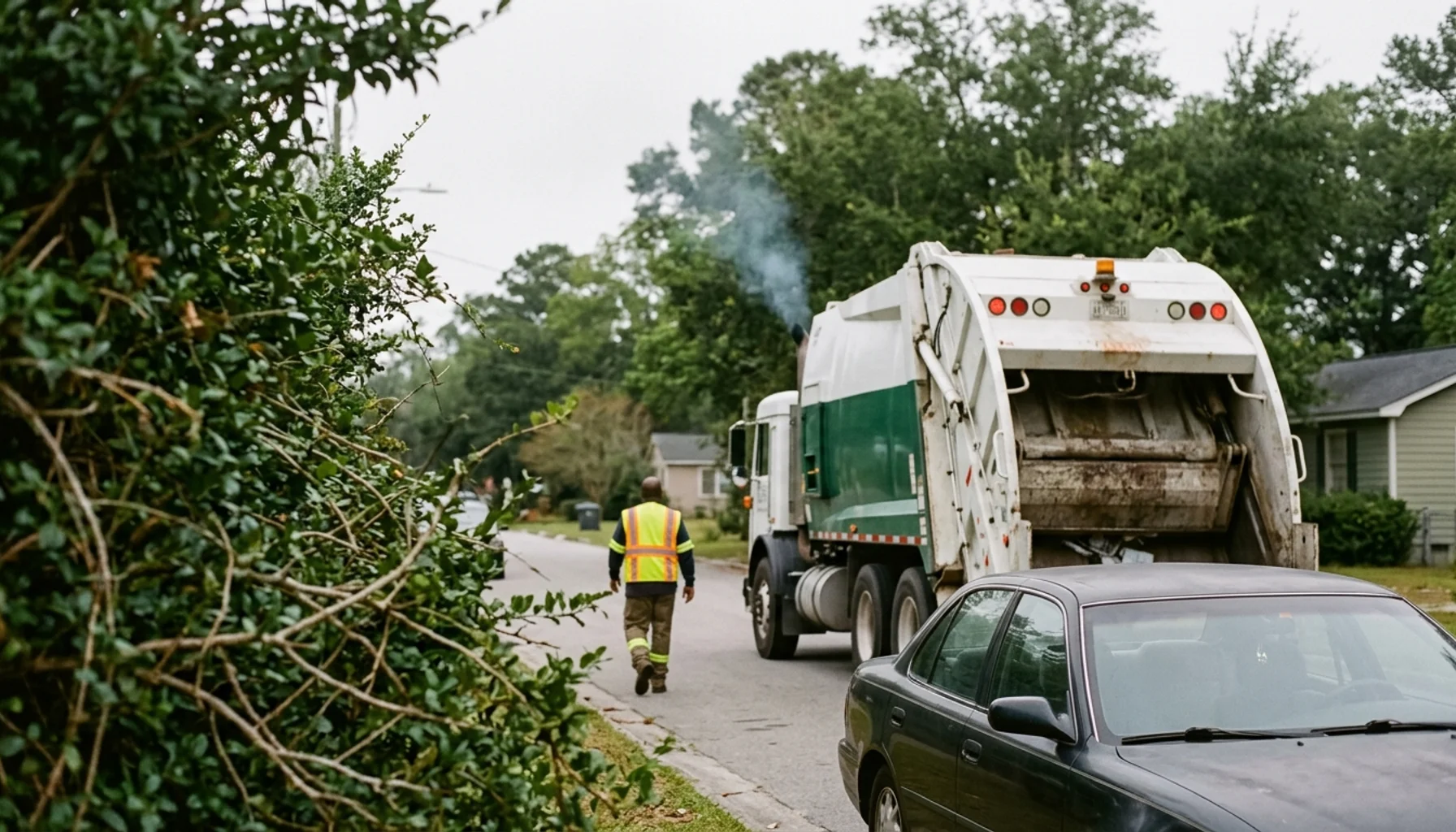
Waste collectors are the individuals and companies responsible for gathering, transporting, and delivering household, commercial, and industrial refuse to processing or disposal facilities. In a valet trash context, waste collectors work on a nightly, doorstep-level schedule rather than a once-a-week curbside route, which is the model Trash Day Made Easy uses across the Charleston metro and Atlanta.
- The U.S. waste collection services industry was valued at $83.1 billion in 2026 across 19,980 businesses, according to IBISWorld.
- Refuse and recyclable material collectors earn a median annual wage of $50,970 in the United States, per the Bureau of Labor Statistics.
- The industry needs roughly 14,200 new collection driver and rider positions through 2026 to keep pace with demand.
- Valet-style waste collectors operate on nightly, doorstep-to-dumpster schedules, a different model than the once or twice weekly municipal pickup most residential neighborhoods use.
- Trash Day Made Easy photo-verifies every collection stop, giving property managers documented proof of service instead of relying on a driver's word.
- Commercial and multifamily contracts for dumpster service commonly range from $200 to $600 per month depending on size and frequency, separate from valet-level doorstep pricing.
If you manage a multifamily community near the Rivers Avenue corridor, operate short-term rentals on Sullivan's Island, or sit on an HOA board on James Island, the term "waste collectors" probably conjures a specific frustration: inconsistent pickup, overflowing dumpsters, and residents who leave bags outside doors overnight. This guide breaks down exactly what waste collectors do, how the job works at both the municipal and valet level, and how a property in North Charleston or the greater Charleston metro can move from reactive complaint management to a documented, nightly service model.
We wrote this from the operator's seat. At Trash Day Made Easy, headquartered at 4900 O'Hear Avenue in North Charleston, SC, our crews function as waste collectors for multifamily communities, build-to-rent developments, HOAs, short-term rental operators, and residential homeowners across Charleston, SC and Atlanta, GA. What follows draws on what we see across our portfolio, combined with verified labor and market data from the Bureau of Labor Statistics and IBISWorld, so you get a complete, current picture of the profession and the service in 2026.
What Are Waste Collectors Called?
Waste collectors go by several common names depending on region and context: garbage collector, trashman (in the U.S.), refuse collector, binman or dustman (in the UK), and recycler when the role focuses on separated materials. In Australia, the official classification is Recycling and Rubbish Collector, occupational code 8996, as documented by Jobs and Skills Australia.
In the property management and valet trash industry specifically, the terminology shifts again. A crew member performing doorstep-to-dumpster pickup is often called a valet trash attendant or waste operations technician, distinct from the municipal driver who empties a curbside cart with a mechanical arm. Trash Day Made Easy uses the term waste collectors internally to describe both the nightly valet crew and the bin management team handling backdoor-to-curbside service for residential clients.
Regardless of title, the underlying function stays the same: someone has to physically move refuse from where it's generated to where it can be processed. As of 2026, that role has split into two distinct service tiers in markets like Charleston: municipal curbside collection and private, amenity-grade valet collection. Understanding which tier applies to your property determines everything from cost to service frequency to accountability.
What Is a Waste Collector?
A waste collector is a worker or licensed entity responsible for gathering municipal solid waste (MSW), recyclables, or specialized waste streams from residential, commercial, or industrial sites and transporting that material to a designated processing or disposal facility. Some legal definitions, aggregated by sources like Law Insider, narrow the term further to registered entities licensed specifically to collect and consolidate waste for transfer to other licensed processors.
Two distinct categories exist under this umbrella. First, formal waste collectors work for municipal sanitation departments or private hauling companies, operate under state and local permits, and follow fixed routes with mechanized trucks. Second, informal waste pickers, a category documented extensively by WIEGO (Women in Informal Employment: Globalizing and Organizing), salvage reusable or recyclable material independently, often in developing economies, providing a livelihood source for millions worldwide even where formal collection infrastructure is limited.
In the multifamily and residential property context that matters most for Charleston-area operators, a third category has emerged: private valet waste collectors who provide nightly, doorstep-level service as a resident amenity rather than a municipal utility. Trash Day Made Easy operates in this third category, distinct from both city sanitation crews and generic junk haulers, with a service model built around photo verification and portfolio scalability from 10 to more than 1,000 units.
How Does a Waste Collector Work?
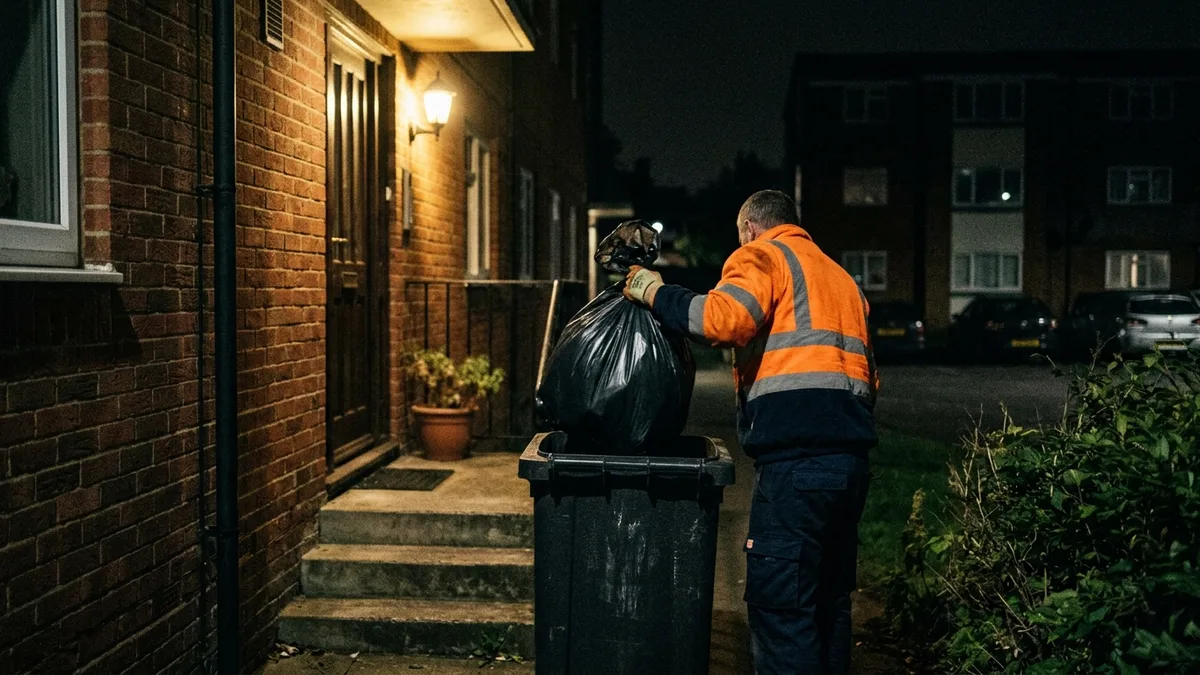
A waste collector works by following an assigned route, collecting refuse at scheduled intervals, and depositing it at a licensed transfer station, landfill, or recycling facility, typically operating in a two-person crew where one drives and one lifts. Municipal and commercial routes usually run in the early morning; valet trash routes, by contrast, run at night after residents have finished using their kitchens for the day.
On a standard municipal or commercial route, the driver navigates a fixed sequence of stops while a second crew member handles manual lifting of bags and smaller containers. Modern trucks equipped with hydraulic arms lift large wheeled bins automatically, reducing the physical strain that defined the job a generation ago. Even with automation, workers still handle loose bags, overflow items, and anything that doesn't fit standard containers.
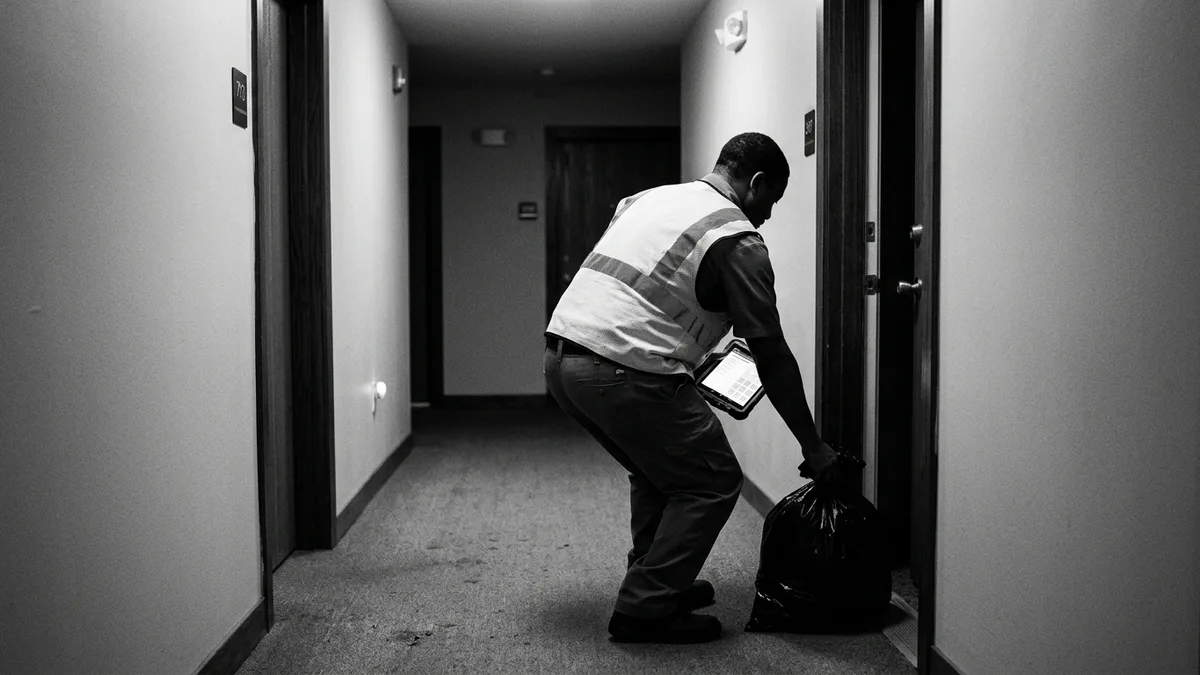
Valet-style waste collectors operate on a different rhythm entirely. Instead of curbside carts, crews walk a multifamily property's interior hallways or exterior breezeways, collecting bags residents have placed outside their doors on designated service nights, typically Sunday through Thursday. Trash Day Made Easy's crews photograph each collection point as proof of service, then consolidate everything at the property's dumpster or compactor, doorstep-to-dumpster, before it ever reaches a public route. This is the mechanism behind our door to door trash pickup model, and it's the operational backbone of what property managers actually pay for when they contract valet service.
For HOA and residential clients, the workflow shifts again into what we call trash can concierge: bins move from a backdoor or side-yard storage spot to the curb on collection day, then return to their spot afterward, all without the resident touching a single bin.
Can You Throw Away an Air Fryer?
Yes, an air fryer can generally be discarded through most standard bulk item or trash removal services, though many municipalities and private haulers prefer small appliances go through an electronics recycling stream rather than standard curbside pickup. Air fryers contain electrical components and sometimes non-stick coatings that some recycling centers handle separately from general household refuse.
For residents in multifamily communities or HOA neighborhoods across Charleston, the safest approach is checking whether the property's waste collectors accept small appliances as part of routine bulk pickup or whether a scheduled bulk item removal is required. City of North Charleston and City of Charleston municipal guidelines typically classify small kitchen appliances as bulky waste requiring either a scheduled pickup or drop-off at a designated recycling center, rather than standard weekly cart collection.
This is exactly the kind of situation where a managed waste program earns its keep. Trash Day Made Easy's bulk item removal service, available on demand across Charleston and Atlanta, handles small appliances, furniture, and other oversized items that don't fit into nightly valet bags. Rather than a resident leaving an air fryer in a hallway indefinitely hoping someone deals with it, our crews schedule pickup directly, which keeps common areas clear and prevents the kind of clutter that erodes curb appeal at lease renewal time.
What Do Waste Collectors Actually Do Day to Day?
Waste collectors spend most of a shift moving between stops on an assigned route, lifting and loading refuse, operating or riding on collection vehicles, and occasionally performing light maintenance on trucks and equipment. Duties expand for senior crew members, who may supervise junior collectors or run compacting equipment.
Typical responsibilities include collecting waste from residential, commercial, and industrial premises; loading bins and bags into the truck or transport vehicle; operating compaction mechanisms; and delivering loads to a transfer station or landfill. Some crews also handle light equipment upkeep, including pressure washing trucks and hardscapes to control odor and pest issues, according to standardized occupational descriptions from Jobs and Skills Australia.
Qualification requirements are modest but specific. Most municipal and private employers ask for the equivalent of a high school diploma plus at least one year of full-time experience in solid waste and recyclable-materials collection, or two years of related custodial or grounds experience. Drivers operating larger trucks generally need a state-issued commercial driver's license (CDL) with appropriate endorsements.
Valet trash attendants working evening shifts for private operators follow a narrower but no less demanding routine: walking assigned buildings, collecting bagged waste from each door, photographing the pickup, and transporting everything to the property's central dumpster within a two-to-four-hour window. Shifts commonly start between 7 and 10 p.m., Sunday through Thursday, structured around when residents have finished using their kitchens for the evening.
What Do Waste Collectors Get Paid, and What Does Service Cost?
Waste collector wages and service pricing vary significantly depending on whether you're discussing an individual worker's salary or a property's monthly service contract. As of 2026, the Bureau of Labor Statistics reports a median annual wage of $50,970 for refuse and recyclable material collectors nationally, with typical ranges between roughly $47,300 and $74,000 depending on region, employer type, and seniority.
For property-level service contracts, pricing depends heavily on the service model. Contract outsourced municipal-style waste collection commonly runs $15 to $25 per household per month for basic residential curbside service. Commercial dumpster contracts typically range from $200 to $600 per month per dumpster, depending on size, pickup frequency, and total tonnage.
| Service Type | Typical Cost Range | Frequency |
|---|---|---|
| Municipal curbside collection | $15 to $25 per household/month | 1 to 2 times weekly |
| Commercial dumpster contract | $200 to $600 per month per dumpster | Varies by tonnage and size |
| Traditional 100-unit waste system | $1,550 to $3,300 per month | Fixed municipal-style schedule |
| Residential valet trash (Trash Day Made Easy) | Starting from $49/month | Nightly, scheduled |
| Multifamily and portfolio valet trash | Quote-based | Nightly, photo-verified |
According to On The Fly Waste Solutions industry benchmarking from 2026, a traditional waste management system for 100 units runs $1,550 to $3,300 per month, before accounting for hidden costs. And those hidden costs add up fast: SIB Fixed Cost Reduction data from 2026 shows fuel surcharges alone can add 14% to 45% to a total waste management invoice, with invoice error rates sitting around 9.5% industry-wide. Overflow fees, charged when a dumpster exceeds capacity, typically run $125 to $260 per occurrence. One operator reviewed by SIB achieved a 56.9% savings across 105 properties simply by auditing invoices for these hidden charges. That's the gap between a commodity contract and a managed relationship where someone is actually watching the numbers.
Residential clients in select Charleston neighborhoods can access Trash Day Made Easy's valet trash service starting from $49 per month, a flat rate that eliminates the surcharge unpredictability common in commercial contracts. For multifamily and portfolio-level pricing, quotes are available Monday through Friday directly through Trash Day Made Easy.
How Is Valet Trash Different from Standard Municipal Waste Collectors?
Valet trash service differs from standard municipal waste collection primarily in schedule, location, and accountability: valet crews collect nightly from a resident's doorstep, while municipal collectors pick up from the curb once or twice weekly. This distinction matters enormously for multifamily property managers trying to reduce resident complaints and protect lease renewal rates.
Municipal collection in North Charleston and Charleston follows fixed weekly or twice-weekly schedules set by the city's public works department, requiring residents to bring bins to the curb themselves. That resident-dependent step is where the system breaks down in apartment communities: people forget, bins overflow between pickups, and hallways or breezeways accumulate loose bags that attract pests and complaints.
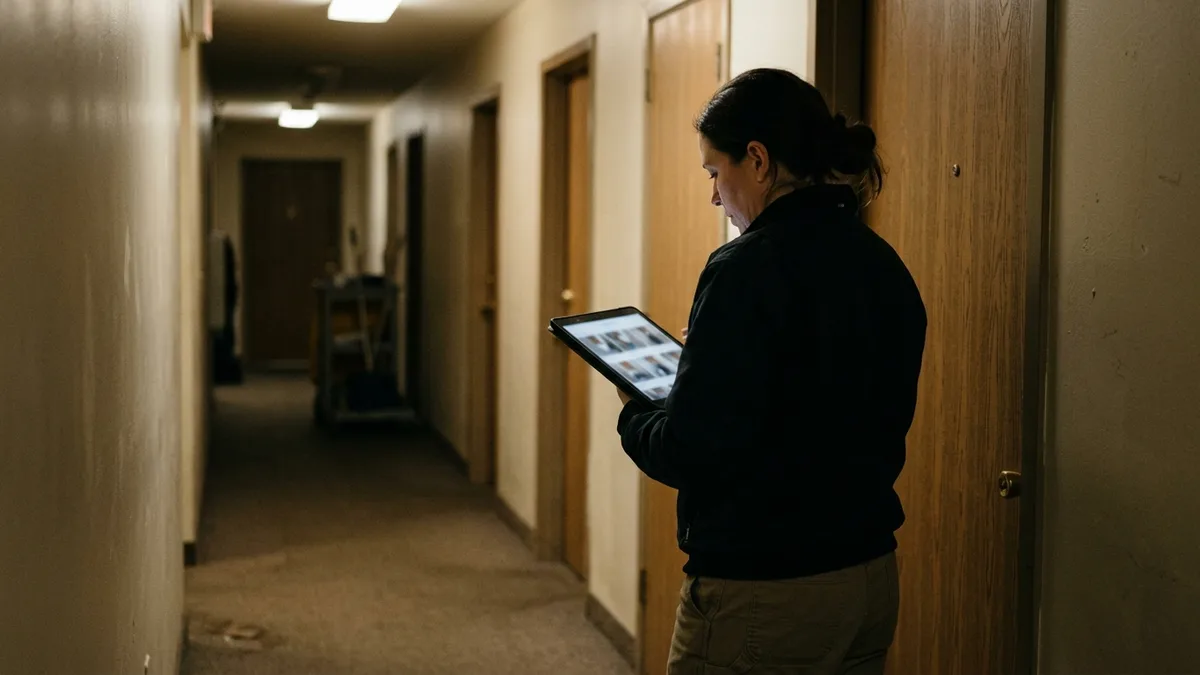
Valet waste collectors solve the compliance problem by removing the resident's role entirely. Crews walk the property nightly, collect bagged waste directly from unit doors, and consolidate it at the central dumpster before it ever becomes a hallway problem. Trash Day Made Easy photo-verifies every single stop, which means a property manager overseeing a 200-unit community near the Rivers Avenue corridor gets documented confirmation without ever picking up the phone to ask if service happened.
The tradeoff is straightforward: municipal service is cheaper per household but places the compliance burden on residents. Valet service costs more but transfers the compliance burden, and the liability that comes with it, to the vendor. For a build-to-rent community on Daniel Island competing on resident experience, or a short-term rental portfolio in the Charleston Historic District where guest reviews depend on a spotless unit, that tradeoff usually favors valet.
What Working Conditions and Safety Risks Do Waste Collectors Face?
Waste collection ranks among the more physically demanding and higher-risk occupations due to repetitive lifting, exposure to sharp or hazardous debris, and constant proximity to moving vehicles and heavy equipment. Workers face conditions ranging from extreme summer heat in Charleston's Lowcountry climate to icy pre-dawn shifts in colder regions, often starting before sunrise.
Common occupational hazards include musculoskeletal strain from repetitive lifting, exposure to noxious odors and airborne dust, contact with chemicals in improperly bagged household waste, injuries from fallen or protruding objects, and occasional animal encounters at residential stops. The Occupational Safety and Health Administration (OSHA) requires waste collection employers to maintain vehicle safety protocols, provide appropriate personal protective equipment, and implement injury-prevention plans specific to the hazards of the job.
Valet trash attendants working evening shifts face a narrower but still real set of risks: navigating unlit stairwells and parking areas, handling improperly bagged waste that may contain broken glass or sharp debris, and working alone or in small teams without the backup a full sanitation crew provides. Trash Day Made Easy trains crews specifically on proper lifting technique, bag inspection before handling, and route safety for evening work, standards that go beyond what a generic hauling contract typically requires.
For property managers evaluating vendors, this is worth asking about directly. A vendor's approach to worker safety correlates closely with service consistency: crews trained to inspect and handle waste properly make fewer mistakes, generate fewer damage claims, and show up more reliably than undertrained or high-turnover crews.
How Is Technology Changing the Way Waste Collectors Operate?
Technology has shifted waste collection from a purely manual, route-memory job into a data-driven operation, with route-optimization software, fleet tracking, and photo documentation now standard tools among competitive operators as of 2026. These tools reduce fuel costs, improve on-time performance, and, in the valet trash context, create an accountability record that didn't exist a decade ago.
Route-optimization software analyzes traffic patterns, stop density, and truck capacity to shorten routes and reduce fuel consumption, directly addressing the fuel surcharge volatility that inflates so many commercial waste invoices. Fleet-tracking systems give operators real-time visibility into vehicle location and idle time, supporting the industry benchmark of 85 to 90% on-time collection performance that many municipalities and private haulers now target.
For valet-level waste collectors specifically, photo verification technology has become the single biggest differentiator between commodity vendors and premium operators. Instead of a property manager taking a driver's word that every door was serviced, photo-verified systems generate a timestamped record at each stop. Trash Day Made Easy built its entire service model around this capability, giving property managers across a portfolio of any size, from a 12-unit build-to-rent community to a 1,000-unit apartment complex, documented proof without requiring a single follow-up call or reminder email.
Smart bin sensors that detect fill levels are gaining traction in larger commercial and municipal contracts, though adoption in the multifamily valet space remains limited as of 2026. Expect this to change over the next several years as portfolio operators demand more granular data on service consistency.
How Can Property Managers and Residents Support Waste Collectors?
Property managers and residents can support waste collectors, and improve service reliability, by following a few practical habits: bagging waste securely, placing bins in accessible locations, avoiding contamination of recycling streams, and communicating clear service expectations to new residents during move-in.
- Bag waste securely before setting it out. Loose or torn bags create hazards for collectors and increase the odds of spillage in hallways or breezeways.
- Keep collection points accessible. Blocked doorways, stairwells cluttered with furniture, or bins pushed too far from the designated pickup spot slow down nightly routes and increase the chance of a missed stop.
- Separate recyclables properly. Contamination, food waste mixed into recycling bins, remains one of the biggest inefficiencies in the waste stream; keeping streams clean supports the roughly 19% global recycling and composting rate industry data currently shows.
- Communicate move-in and move-out timing clearly. HOA boards and property managers who build waste expectations into welcome materials see far fewer bulk item disputes than those who leave it to informal word of mouth.
- Schedule bulk items in advance rather than leaving them curbside. On-demand bulk removal, like the service Trash Day Made Easy offers for move-out debris and abandoned furniture, prevents the liability and eyesore of items sitting for days.
The most common mistake we see across Charleston-area portfolios is treating bulk item removal as an afterthought on move-out day rather than a scheduled step in the turnover cycle. A single abandoned sofa in a breezeway can delay a make-ready timeline by a full day, which is real lost rental income in a competitive market.
What Should You Look for When Choosing Waste Collectors for a Property?
Choosing waste collectors for a multifamily, build-to-rent, or HOA property comes down to four factors: service frequency, verification method, scalability, and responsiveness for non-routine needs like bulk removal. A vendor strong on all four eliminates most of the resident complaints and manager follow-up that plague self-managed or municipal-only waste programs.
Nightly or near-nightly collection matters most for high-density communities where hallway accumulation between pickups drives resident dissatisfaction. Verification matters because a service you can't confirm happened is a service you're taking on faith; photo-documented pickup at every door removes that guesswork. Scalability matters for portfolio owners managing properties scattered across North Charleston, Mount Pleasant, Summerville, and Johns Island, where consistency across every address, not just the flagship property, determines whether the vendor relationship actually saves time.
Several private valet trash providers operate in the Charleston and broader Southeast market. National operators bring scale but often lack local responsiveness and the flexibility smaller portfolios need. Trash Day Made Easy takes a different approach: a Charleston-based team headquartered in North Charleston, photo-verified service at every single unit, and the ability to scale from a 10-unit build-to-rent community to a 1,000-plus-unit apartment portfolio without losing consistency. That local footprint, paired with on-demand bulk removal and a dedicated HOA service line, is what separates a managed waste operations partner from a commodity hauling contract.
Trash Day Made Easy also partners with The Bin Boy, a Charleston-based bin cleaning and sanitizing service, to extend care beyond collection into odor and hygiene management, an add-on most standard waste collectors simply don't offer.
A Practical Checklist Before You Sign a Waste Collection Contract
- Does the vendor photo-verify every stop, or only spot-check?
- Can the vendor scale with your portfolio as you add properties in North Charleston, Charleston, or Atlanta?
- Is bulk item and turnover removal included or a separate line item?
- How quickly can the vendor respond to an on-demand request outside the regular schedule?
- Does the contract include hidden fuel surcharges or overflow fees, similar to the 14 to 45% surcharge inflation and $125 to $260 overflow charges documented in recent industry cost audits?
For a deeper look at how pricing structures work across the industry, our breakdown of how much valet trash companies charge apartments covers the line items worth negotiating before you sign anything.
Frequently Asked Questions About Waste Collectors
What is another name for a waste collector?
Waste collectors are also called garbage collectors, trashmen, refuse collectors, recyclers, and in British English, binmen or dustmen. In multifamily property management, the same role performing nightly doorstep pickup is often called a valet trash attendant.
How does valet trash service work in a multifamily apartment community?
Residents place a bagged trash container outside their unit door on scheduled service nights. A crew from Trash Day Made Easy collects it doorstep-to-dumpster on a nightly basis, photo-verifies each stop, and the property manager receives documented confirmation without needing to follow up.
What is a trash can concierge and how does it differ from valet trash service?
A trash can concierge, sometimes called backdoor-to-curbside bin management, moves a resident's bin from storage to the curb on collection day and returns it afterward. It's built for HOA and residential clients rather than multifamily buildings, and requires zero action from the resident.
How does Trash Day Made Easy handle bulk item removal during a resident move-out?
Bulk item removal is scheduled on demand and integrates directly into the make-ready cycle, so abandoned furniture and move-out debris don't sit in breezeways or delay the next resident's move-in. This service is available across multifamily, build-to-rent, and short-term rental properties in Charleston and Atlanta.
Can valet trash service be added to a short-term rental property in Charleston?
Yes. On-demand and turnover-specific waste removal is available for short-term rental properties in high-traffic markets like the Charleston Historic District, Isle of Palms, and Sullivan's Island, where unpredictable guest turnover makes a fixed weekly schedule impractical.
What does Trash Day Made Easy charge for residential valet trash service?
Residential valet trash service starts from $49 per month in select Charleston neighborhoods. Multifamily, build-to-rent, and portfolio pricing is quote-based; request a quote directly at Trash Day Made Easy, Monday through Friday.
Can one waste vendor handle service across an entire property portfolio?
Yes, Trash Day Made Easy is purpose-built for portfolio scalability, servicing anywhere from 10 units to more than 1,000 units with consistent photo-verified standards across every property, whether the portfolio is concentrated in North Charleston or scattered across the metro.
What is the difference between waste collectors and informal waste pickers?
Waste collectors typically work for licensed municipal or private hauling companies operating under permits and fixed routes. Informal waste pickers, a category studied extensively by WIEGO, independently salvage recyclable material outside any formal collection system, often as a primary livelihood in regions with limited municipal infrastructure.
The Bottom Line on Waste Collectors in 2026
Waste collectors, whether municipal crews on a fixed weekly route or valet attendants working a nightly doorstep schedule, remain essential infrastructure for every residential and commercial property. As of 2026, the U.S. industry supports an $83.1 billion market and is actively hiring to meet growing demand, per IBISWorld and Bureau of Labor Statistics data. But the model that works best for your property depends entirely on density, resident expectations, and how much accountability you need from your vendor.
For multifamily communities, build-to-rent developments, HOAs, and short-term rental operators across Charleston and Atlanta, the case for photo-verified, nightly valet service over patchwork municipal-only coverage keeps getting stronger. Trash Day Made Easy built its entire operation around solving exactly this problem: consistent, documented waste collectors showing up every night, scaling cleanly whether you manage 12 units or 1,200, without you ever having to chase down whether service happened.
Waste management rarely fails because of one bad decision. It fails because no system runs without constant manager attention. A structured valet trash program removes that burden entirely, and Trash Day Made Easy was built specifically for that kind of hands-off operation across Charleston, North Charleston, and Atlanta.
If overflowing dumpsters or inconsistent pickup are hurting resident satisfaction at your property, Trash Day Made Easy's nightly, photo-verified waste collectors can take that off your plate entirely. Request a service quote at Trash Day Made Easy, available Monday through Friday for every property type.
Content powered by inkSTR.co