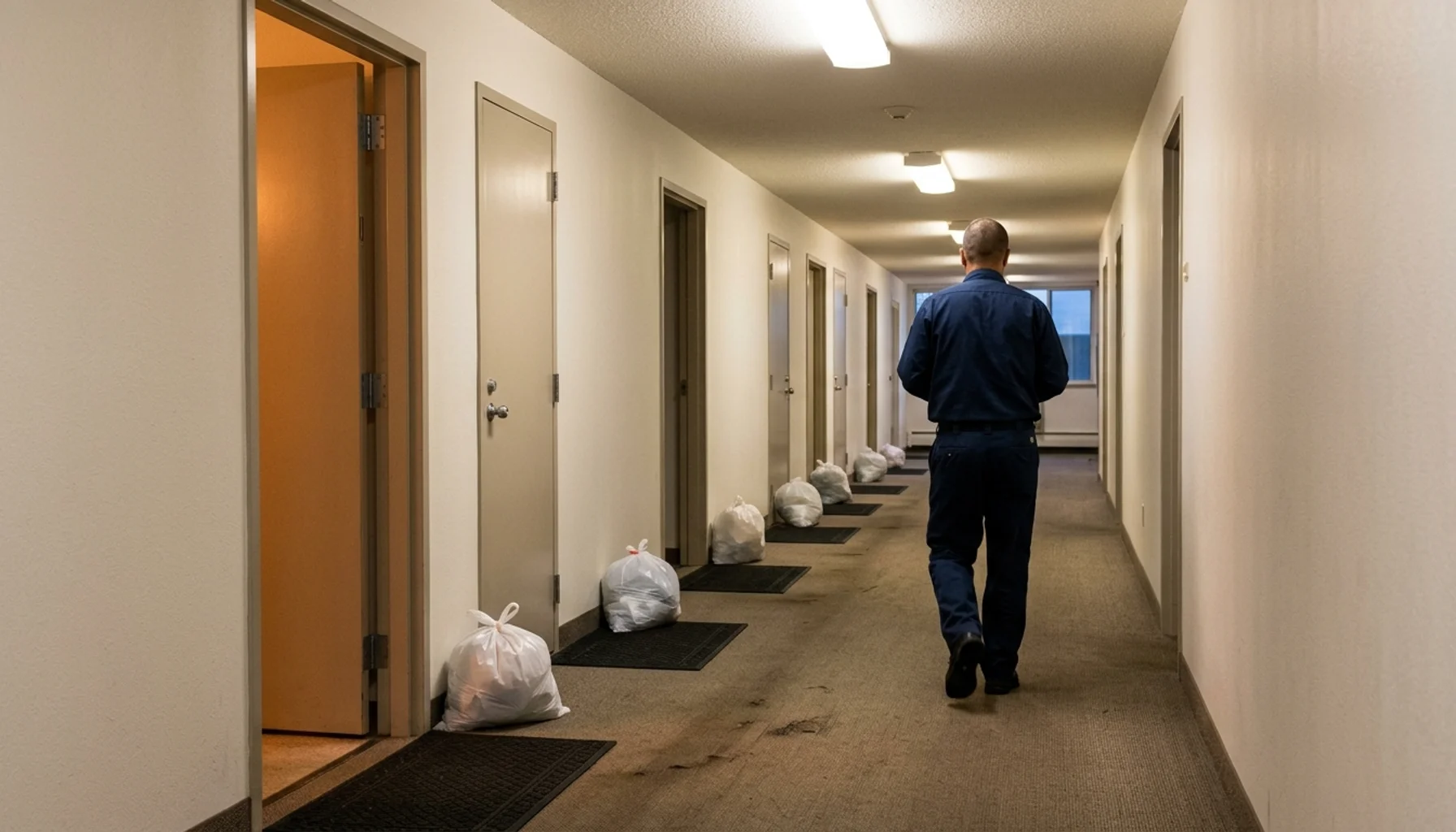
Garbage valet is a doorstep waste collection service where a uniformed porter retrieves bagged trash from each resident's door on a nightly schedule and transports it to the community dumpster, eliminating the need for residents to walk trash to a common disposal area. Property managers use it as an amenity that improves cleanliness, reduces dumpster overflow, and strengthens resident retention, particularly in multifamily apartment communities, build-to-rent developments, and homeowners associations.
- Garbage valet refers to nightly doorstep trash collection where porters carry bags from each resident's door to the community dumpster, requiring no effort from residents.
- According to the National Apartment Association, valet trash service can increase resident retention rates by up to 5%, a meaningful figure when one lost resident costs roughly $4,000 in lost rent and turnover expenses (Multifamily Dive, 2026).
- Property managers typically pay $8 to $15 per unit per month for valet trash service; residents are commonly charged $25 to $35 monthly, generating a net margin that improves NOI (Property Manager Insider, 2026).
- Modern garbage valet services include photo verification at each unit door, providing property managers documented proof of completion without follow-up calls to vendors.
- Valet service applies beyond traditional apartments: HOA communities, build-to-rent developments, short-term rental properties, and residential homeowners in select markets can all access doorstep or bin-management collection.
- As of 2026, only an estimated 1.5 million of roughly 20 million U.S. apartments use garbage valet, signaling significant room for market expansion and competitive differentiation for early-adopting operators.
Waste management is rarely the first thing a property manager thinks about when evaluating resident satisfaction. But it shows up consistently in renewal conversations, online reviews, and resident surveys. The 2026 NMHC/Grace Hill Renter Preferences Survey, covering 172,703 renters across 4,220 communities, ranked community appearance as a top renewal priority for 34% of respondents. A clean hallway, an odor-free corridor, and a dumpster area that does not overflow by Wednesday morning all feed directly into that perception.
That is where garbage valet becomes a genuine operational tool rather than a luxury amenity. Trash Day Made Easy, headquartered at 4900 O'Hear Avenue in North Charleston, SC, provides photo-verified doorstep collection to multifamily communities, build-to-rent developments, HOAs, short-term rental properties, and residential homeowners across the Charleston and Atlanta markets. This guide covers everything a property manager, portfolio operator, or HOA board member needs to understand about how garbage valet works, what it costs, and what to look for in a vendor.
The U.S. Environmental Protection Agency reports that the average American generates about 4 pounds of trash per day, more than 1,300 pounds per year. In a 100-unit apartment community, that is roughly 400 pounds of waste moving through hallways and common areas every single night. Without a structured collection program, that volume creates persistent cleanliness problems. With one, it disappears before residents wake up.
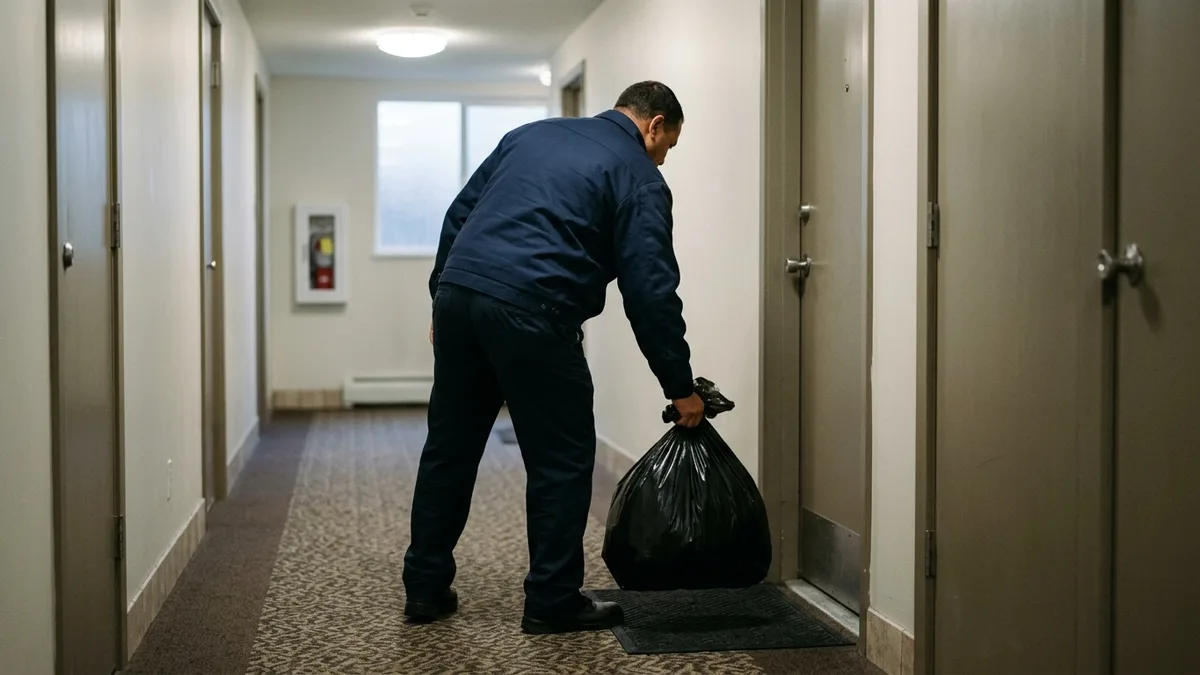
What Does a Garbage Valet Service Actually Do at Each Unit?
Garbage valet service refers to a nightly collection program where trained porters walk each hallway or community path, retrieve bagged waste from outside each resident's door, and transport it directly to the community dumpster or compactor. The resident does no more than set a tied bag outside their unit during a designated window, typically a two-hour period before collection begins each evening. The porter handles everything from that point forward.
Specifically, here is what a standard service visit includes:
- Resident placement: The resident places their sealed, tied trash bag outside their door during the designated window. Most programs collect five nights per week, commonly Sunday through Thursday evenings.
- Porter collection: A uniformed porter walks the property route, picks up each bag, and places it in a collection cart or bag system for transport.
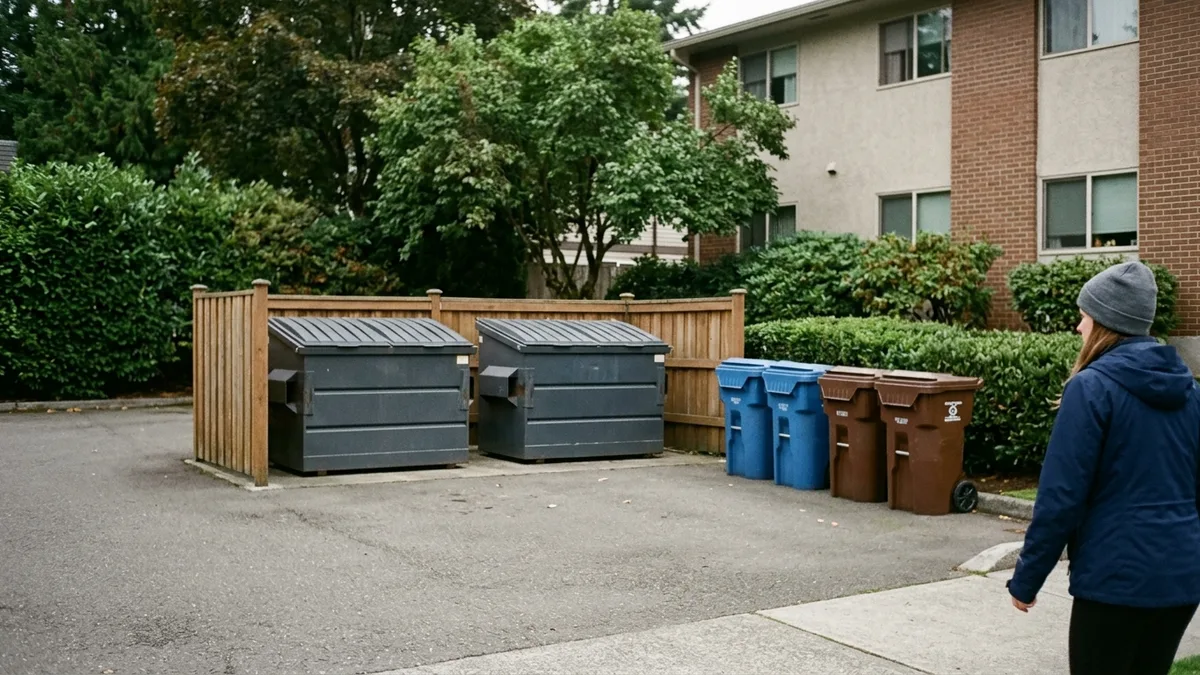
- Dumpster deposit: The porter carries all collected waste to the community dumpster pad, compactor, or designated disposal area, keeping hallways and building corridors clear.
- Photo verification: At each door, a documented photo confirms whether the unit had a bag set out, whether it was collected, and whether service was completed. This creates an audit trail for property managers without requiring them to monitor the route themselves.
- Reporting: Property managers receive confirmation of completed service, often through a route summary or app-based report, so there is no ambiguity about which units were serviced on a given night.
The photo verification step is where modern garbage valet programs differentiate themselves from older, undocumented collection contracts. When a resident claims their trash was not picked up, a timestamped photo at the unit door settles the question immediately. That one feature prevents a significant share of resident service disputes.
How Does a Garbage Valet Differ From Traditional Trash Service?
Traditional waste management and garbage valet service solve different problems. Traditional service, which involves a hauler collecting from a community dumpster on a set schedule, handles bulk volume. Garbage valet handles the resident-facing problem: the last 50 feet between a unit door and the dumpster pad. Understanding that distinction matters when evaluating whether your property needs one, the other, or both.
| Feature | Traditional Dumpster Service | Garbage Valet Service |
|---|---|---|
| Collection point | Community dumpster or compactor | Each resident's doorstep |
| Resident effort required | Walk trash to dumpster | Place bag outside door |
| Collection frequency | Typically 2-3x per week | Nightly (5-7 nights/week) |
| Hallway cleanliness control | None | Direct (bags removed nightly) |
| Photo documentation | Not standard | Standard with modern providers |
| Bulk item handling | Limited or separate service | Available as add-on |
| Resident satisfaction impact | Neutral | Measurable positive |
| Property manager workload | Complaint management required | Largely hands-off |
Most communities need both services. Traditional hauling removes full dumpsters; garbage valet prevents those dumpsters from being reached in ways that create hallway odors, pest problems, and resident complaints. The two programs are complementary, not interchangeable.
According to SIB Fixed Cost Reduction (2026), traditional waste management for a 100-unit property runs $1,550 to $3,300 per month when overflow fees, fuel surcharges averaging 14% to 45%, and invoice errors running at a 9.5% rate are factored in. That cost baseline matters when comparing the full picture of waste program expenses at your property.
What Types of Properties Use Garbage Valet Service?
Garbage valet service applies to a broader range of property types than most operators initially assume. While apartment communities represent the largest segment of users, the service model works across multifamily, single-family rental, HOA, short-term rental, and residential homeowner settings, each with slightly different delivery formats.
Multifamily Apartment Communities
This is the core use case. Communities with 50 or more units benefit most from structured nightly collection because the volume of hallway traffic and the density of resident activity creates daily waste coordination problems at scale. Along high-density corridors like North Charleston's Rivers Avenue, where older apartment stock sits at higher unit density with limited dumpster capacity, garbage valet addresses the overflow challenge directly. The multifamily valet trash service Trash Day Made Easy provides scales from 10 units to more than 1,000 units without service degradation.
Build-to-Rent Communities
Build-to-rent (BTR) developments position waste collection as a resident amenity rather than a utility, which reflects their overall approach to competing with Class A apartment communities. The National Home Builders Association tracks rapid BTR growth across the Southeast, and operators on Daniel Island and near the Charleston airport corridor increasingly include doorstep collection as a standard feature from day one. Trash Day Made Easy's build-to-rent waste service is structured specifically for communities where resident experience is the primary differentiator.
Homeowners Associations
HOA communities face a different challenge: enforcing bin management and bulk item rules across homeowners who may resist board directives. A structured garbage valet or bin management program removes the enforcement burden from the board by handling compliance as a service rather than a policy. HOA waste management services cover bin-to-curb movement, bulk item removal, and move-in and move-out debris coordination.
Short-Term Rental Properties
STR operators managing properties on Isle of Palms, Mount Pleasant, or in the Charleston Historic District face unpredictable turnover schedules. A guest checks out Thursday afternoon, and another arrives Saturday morning. Whatever trash, bulk items, or oversized debris the departing guests left needs to be gone before the next stay. On-demand garbage valet service solves that problem without requiring the operator to be on-site or schedule separate vendor calls. Trash Day Made Easy's STR operator waste services include both scheduled and on-demand collection.
Residential Homeowners
In select Charleston-area neighborhoods, individual homeowners can access Backdoor-to-Curbside bin management starting at $49 per month. The service moves bins from the back of the property to the curb for municipal pickup and returns them after collection. For homeowners who travel frequently, manage mobility limitations, or simply want one fewer recurring task, the value proposition is direct. Trash Day Made Easy's residential valet trash service covers this specific segment.
What Does Garbage Valet Service Cost in 2026?
Garbage valet pricing follows a per-unit-per-month model for multifamily and BTR properties, with the cost split between what the property pays the vendor and what the property charges residents. That spread is where the financial case for the service becomes clear. According to Property Manager Insider (2026), property managers typically pay $8 to $15 per unit per month for valet trash service, while residents are commonly charged $25 to $35 per month.
| Community Size | Typical Property Cost (per unit/mo) | Typical Resident Charge (per unit/mo) | Net Margin (per unit/mo) |
|---|---|---|---|
| 100 to 149 units | $15 to $17 | $30 to $40 | $13 to $23 |
| 150 to 299 units | $13 to $15 | $25 to $35 | $10 to $22 |
| 300 or more units | $12 to $14 | $25 to $30 | $11 to $18 |
For a 200-unit community charging residents $25 per month against a $12 service cost, the net monthly margin reaches $2,600, or $31,200 annually. When you factor in avoided turnover costs (Multifamily Dive estimates one lost resident costs roughly $4,000) and reduced maintenance complaints, industry analysis puts the total annual benefit of a valet program for a 200-unit community at approximately $79,200. At a 5% cap rate, that translates to roughly $1.58 million in added property value.
Residential homeowner pricing is simpler. Trash Day Made Easy's bin management service starts at $49 per month for select Charleston-area neighborhoods, covering bin retrieval and return on municipal pickup days with no additional coordination required from the homeowner.
Contract terms for commercial valet programs typically run one to three years, with longer commitments sometimes reducing per-unit cost by a modest amount. Adding Saturday collection beyond a standard five-night schedule generally adds $1 to $2 per unit per month, depending on the provider and community size.
What Is the ROI Case for Garbage Valet at Multifamily Properties?
The financial return on a garbage valet program rests on three pillars: net revenue from the resident amenity fee spread, avoided turnover costs from improved resident retention, and reduced maintenance burden from cleaner common areas. Each of those creates measurable financial impact that property investors and asset managers can model directly against NOI.
The National Apartment Association has found that valet trash programs can increase resident retention rates by up to 5%. That may sound modest, but consider the math: at a 200-unit property with average monthly rent of $1,400 and one-month vacancy cost per turnover, a 5% retention improvement prevents roughly 10 turnovers per year. At $4,000 per turnover in lost rent and make-ready costs (Multifamily Dive, 2026), that is $40,000 in avoided expense, before counting the amenity fee margin.
Average multifamily retention reached 60% in 2026, the highest rate since tracking began, according to Zego. National renter retention stood at 55.1% in Q1 2026 per LeaseLock. In a tightening retention environment, daily-use amenities that residents interact with every evening carry outsized influence on renewal decisions. Garbage valet is the rare amenity that works passively. It does not require the resident to schedule a gym session or reserve a conference room. It simply happens, reliably, every night.
The cleanliness dividend matters too. Properties with consistent nightly collection report fewer pest-related work orders, reduced hallway cleaning frequency, and lower dumpster overflow fees. The 9.5% invoice error rate in traditional waste management contracts (SIB Fixed Cost Reduction, 2026) also gives operators reason to look carefully at their current waste costs before comparing against a structured valet program.

How Does Photo Verification Work in a Garbage Valet Program?
Photo verification in a garbage valet program means that the collecting porter photographs each unit door during every service visit, timestamping the image to confirm whether a bag was present and whether it was collected. This documentation becomes a searchable service record that property managers can access without calling the vendor, physically walking the route, or waiting for a resident complaint to surface.
The practical value of this feature extends beyond resident dispute resolution. Photo documentation specifically addresses three common failure points in traditional valet contracts:
- Missed units: Without photos, there is no way to confirm whether a porter skipped a unit or whether the resident simply did not set out a bag. The photo eliminates that ambiguity.
- Service disputes: When a resident files a complaint about missed pickup, a timestamped door photo answers the question in seconds rather than requiring a back-and-forth between the property manager and vendor.
- Route accountability: For scattered-site portfolios where a single operator manages properties across multiple North Charleston neighborhoods, photo records provide centralized confirmation that service was completed at every property without requiring on-site supervision.
Trash Day Made Easy builds photo verification into its standard service across all property types, from single multifamily communities to portfolios exceeding 1,000 units. Every service visit is documented at each door. For property managers who have experienced the frustration of paying for a waste service they cannot confirm was delivered, that documentation shifts the entire vendor relationship dynamic.
What Are the Rules Residents Must Follow for Garbage Valet Collection?
Garbage valet service operates within a defined set of resident participation rules that determine what gets collected, how bags must be prepared, and when they must be placed outside. These rules exist to protect porters, ensure efficient route completion, and prevent dumpster pad issues from shifting back into hallways. Property managers communicate these rules at lease signing and reinforce them through welcome packets and resident portals.
Standard participation guidelines across most programs include:
- Bags must be securely tied and not exceeding the program's weight limit, typically 25 to 30 pounds per bag
- No loose items outside the bag, including unbagged recyclables, broken glass, or sharp objects
- No oversized items such as furniture, appliances, or large unflattened boxes (these fall under bulk item removal, a separate service)
- Pet waste must be double-bagged
- Bags must be placed outside during the designated two-hour placement window before collection begins each evening
- Containers must be returned inside the unit by a set morning time, commonly 9:00 a.m., to keep hallways clear during daytime hours
Recycling handling varies by provider and municipality. Some programs offer separate recycling collection with clearly designated containers; others require residents to consolidate recyclables into marked bags within the same container. Property managers working in Charleston County should verify the local municipal recycling program requirements before committing to a specific collection format with their vendor.
Non-compliant items left outside a unit door are typically flagged in the photo verification record and reported to the property manager rather than collected. That creates a documented record of the non-compliance that supports lease enforcement if the issue recurs.
What Should Property Managers Look for When Choosing a Garbage Valet Vendor?
Choosing a garbage valet vendor is a decision that affects daily resident experience for the length of your contract, which typically runs one to three years for commercial programs. Most operators underestimate the evaluation criteria that differentiate reliable vendors from ones who look identical on paper. Here is what actually separates strong programs from ones that generate callbacks at 7 a.m.
Geographic Focus and Local Accountability
National franchise models cover large territories but often route service through regional subcontractors who have limited accountability to your specific property. A locally rooted vendor with named service supervisors and a direct point of contact typically delivers faster resolution when service problems occur. For properties in North Charleston, Mount Pleasant, or on Daniel Island, a vendor operating specifically in those corridors understands local logistics, seasonal demand shifts, and the specific waste dynamics of Lowcountry communities.
Photo Verification and Reporting
Any vendor without photo documentation at each unit door should not advance past the initial evaluation stage. Photo verification is the single feature that separates an accountable waste program from a legacy contract with no visibility. Ask the vendor to demonstrate their reporting format before signing, not after.
Scalability Without Service Dilution
If your portfolio is growing, confirm that the vendor can scale with you. A provider capable of servicing 10 units with the same documented consistency as 1,000 units demonstrates that their route management systems are built for growth, not just their marketing materials. Trash Day Made Easy operates across portfolios of that entire range in the Charleston and Atlanta markets without adjusting its per-unit service standard based on portfolio size.
Bulk Item and Turnover Support
Nightly doorstep collection is the core service, but the vendor's ability to handle bulk item removal, turnover trash, and move-in and move-out debris determines whether you need one vendor or three. A single accountable vendor for all waste-related services is a meaningful operational advantage during high-volume lease transition periods.
Residential and STR Flexibility
If your portfolio includes scattered-site single-family rentals, short-term rental properties, or HOA communities alongside traditional apartments, confirm that the vendor can serve all property types under a unified service agreement. Consolidating vendors across property types reduces administrative overhead and creates one point of contact for all waste-related issues.
How Does Garbage Valet Support Build-to-Rent and STR Operators Specifically?
Build-to-rent and short-term rental operators use garbage valet in ways that differ meaningfully from traditional apartment communities, and vendors that understand those differences deliver better outcomes for both property types. BTR communities and STR properties share one operational reality: resident and guest transitions happen frequently, often unpredictably, and waste coordination during those windows creates the most visible cleanliness problems.
Build-to-Rent Communities
BTR communities compete directly with Class A apartment communities for residents who could choose either product. Amenity parity is the baseline; amenity differentiation is the goal. Doorstep waste collection at a BTR community on Daniel Island or in the growing residential corridors near the Charleston airport positions waste management as a premium resident service, not a chore. Trash Day Made Easy's build-to-rent service includes nightly Doorstep-to-Dumpster collection, bulk item removal to prevent dumpster pad overflow during move cycles, and photo-verified documentation that supports the professional management standard BTR operators must maintain.
Short-Term Rental Properties
STR operators on Isle of Palms, in Mount Pleasant, and near the Charleston Historic District manage a different challenge: turnovers that happen within a 24 to 48-hour window with no guaranteed timeline. A garbage valet vendor that offers on-demand service in addition to scheduled nightly collection can respond to between-guest waste needs without requiring the operator to schedule a separate pickup or be present at the property.
For STR operators managing 5 to 30 properties across Charleston and surrounding markets, Trash Day Made Easy provides flexible turnover trash handling and on-demand property waste support. The photo verification record at each service visit also creates documentation that protects operators in the event of a guest dispute about the property's condition at check-in.
How Does Garbage Valet Fit Into a Seasonal Property Management Strategy?
Garbage valet service demand follows seasonal patterns that property managers and STR operators should factor into their vendor agreements and service scheduling. In the Charleston and Atlanta markets, two peak periods drive the most pressure on waste programs: summer turnover season and end-of-year lease renewal cycles.
From late May through Labor Day, Charleston STR properties on Isle of Palms, Sullivan's Island, and in Mount Pleasant experience their highest guest volume. Turnover frequency peaks, bulk item accumulation between stays accelerates, and the risk of guest-facing waste complaints rises. STR operators who secure on-demand garbage valet coverage before summer rather than scrambling for a vendor during peak season avoid the most damaging service gaps.
For multifamily communities, the August through October window is the traditional lease transition period across many Charleston-area apartment markets. Move-outs and move-ins concentrate, bulk items pile at dumpster pads, and hallway debris from packing materials creates both cleanliness and liability problems. A vendor with established move-in and move-out support as part of the service agreement, rather than as an add-on requiring separate coordination, keeps the make-ready cycle running without waste acting as the bottleneck.
In 2026, build-to-rent communities across the Southeast are increasingly structuring their valet trash agreements to include seasonal surge provisions, ensuring that bulk item removal capacity scales up during the summer months without requiring a new purchase order each year. Multifamily construction reached a 38-year high in 2026 with 608,000 units completed nationally (NAHB, 2026), and many of those communities are now in their first full operational year, meaning property managers are actively evaluating waste programs for the first time.
What Is Backdoor-to-Curbside Bin Management?
Backdoor-to-Curbside bin management is a specific garbage valet format designed for residential homeowners and community settings where the municipal collection point is the curb rather than an on-site dumpster. Instead of a porter collecting bagged trash from a doorstep, the service retrieves wheeled bins from the back of the property, positions them at the curb before the scheduled municipal pickup, and returns them to their storage location afterward.
Trash Day Made Easy offers this service to select residential homeowners in Charleston-area neighborhoods starting at $49 per month. The resident never touches the bin on collection day. The service removes one recurring logistical task entirely, which matters most for homeowners who travel frequently, work early or late schedules, or prefer not to manage the physical demands of heavy bin handling.
For HOA communities, the Backdoor-to-Curbside model addresses a common governance headache: residents who leave bins at the curb for days after pickup, violating community appearance standards. When the HOA contracts a bin management service, the bins go out and come back on schedule, regardless of whether individual homeowners remember to manage them. The enforcement burden shifts from the board to the service vendor.
Trash Day Made Easy also partners with The Bin Boy, a Charleston-based bin cleaning and sanitizing service, to offer a complete waste care program for communities and homeowners who want sanitation alongside collection. When bins are cleaned and deodorized on a regular schedule alongside the retrieval service, the combination removes both the logistics and the hygiene burden from the homeowner entirely.
Frequently Asked Questions About Garbage Valet Service
What is garbage valet service and how does it work?
Garbage valet service is a nightly doorstep waste collection program where trained porters retrieve bagged trash from each resident's door and transport it to the community dumpster or designated disposal area. Residents simply place tied trash bags outside their door during a set two-hour window each evening. The porter handles collection, transport, and disposal, and modern services document each visit with a timestamped photo at the unit door.
How much does garbage valet service cost for an apartment community?
Property managers typically pay $8 to $15 per unit per month for garbage valet service, depending on community size and service frequency (Property Manager Insider, 2026). Larger communities generally pay less per unit. Residents are commonly charged $25 to $35 per month as a mandatory amenity fee, which creates a positive net margin for the property. Residential homeowner bin management services can start as low as $49 per month for select neighborhoods.
What is the difference between Doorstep-to-Dumpster and Backdoor-to-Curbside service?
Doorstep-to-Dumpster service collects bagged trash from each resident's unit door and transports it to the community dumpster, primarily for apartment communities and build-to-rent developments. Backdoor-to-Curbside service retrieves wheeled bins from the rear of the property and positions them at the curb for municipal collection, then returns them afterward. This format is designed for residential homeowners and HOA communities where individual bin management is the standard waste format.
How does photo verification work and why does it matter for property managers?
Photo verification means the porter photographs each unit door during every service visit, creating a timestamped image confirming whether a bag was present and whether it was collected. That record is accessible to property managers as documentation of completed service at every unit. It eliminates resident disputes about missed pickups, provides accountability for vendor performance, and creates an audit trail that protects property managers when service questions arise.
Can garbage valet service handle bulk item removal during lease turnover?
Yes. Reputable garbage valet providers, including Trash Day Made Easy, offer bulk item removal as an add-on or integrated service for the move-out and make-ready cycle. Furniture, appliances, and oversized items that nightly collection cannot handle are removed separately, preventing them from blocking dumpster pads or delaying the make-ready process before a new resident moves in. For STR operators, on-demand bulk removal between guest stays serves the same function.
Does garbage valet service work for short-term rental properties and HOAs?
Yes. While apartment communities represent the most common use case, garbage valet adapts to short-term rental properties, HOA communities, build-to-rent developments, and individual residential homeowners. STR operators benefit most from flexible, on-demand collection that fits unpredictable guest turnover schedules. HOA communities benefit from bin management programs that remove enforcement burden from the board and keep community appearance standards consistent without resident reminders.
How small or large does a portfolio need to be to qualify for garbage valet service?
Portfolio size requirements vary by vendor. Trash Day Made Easy services portfolios ranging from 10 units to more than 1,000 units, maintaining a consistent service standard across that full range. There is no minimum that disqualifies a smaller community, and there is no portfolio size at which service quality begins to dilute. If you manage a scattered-site portfolio of single-family rentals in North Charleston or a large multifamily community in the Atlanta market, the same service approach applies.
Can garbage valet fees be included as a mandatory amenity charge in the lease?
In most markets, property managers can include garbage valet as a mandatory amenity fee in the lease or lease addendum, similar to water, pest control, or common area maintenance charges. However, rules on mandatory valet trash fees vary by state. The National Multifamily Housing Council notes that over 50% of U.S. apartment complexes now offer valet trash, and most include it as a non-optional amenity. Property managers should verify local landlord-tenant regulations before structuring the fee as mandatory.
Is Garbage Valet Worth It for Your Property in 2026?
Garbage valet service is worth implementing at any multifamily, BTR, HOA, or STR property where hallway cleanliness, resident experience, and documentation of service completion are active management priorities. The financial case is straightforward: the amenity fee spread generates net revenue, avoided turnover costs more than offset the vendor expense, and the photo-verified audit trail reduces complaint resolution time to near zero. The National Apartment Association's finding that valet service can improve retention by up to 5% translates directly into NOI at properties where one missed renewal costs $4,000 or more in lost rent and make-ready.
For residential homeowners in select Charleston-area neighborhoods, the calculation is simpler: $49 per month to eliminate a recurring task permanently. Not a reduction in effort. An elimination of it.
The market data supports expansion. As of 2026, an estimated 1.5 million of roughly 20 million U.S. apartments use garbage valet, meaning the majority of multifamily communities still manage waste without a structured doorstep program. That gap represents both an underserved market and a competitive advantage for operators who move first. In dense markets like North Charleston and Atlanta, where resident retention directly correlates with amenity quality, a documented waste program is no longer a differentiator at Class A properties. It is becoming the baseline expectation.
Waste management is one property operations challenge that has a genuinely complete solution: a reliable, documented, nightly service that removes the coordination burden from the property manager entirely. For communities across Charleston, North Charleston, Mount Pleasant, and the surrounding Lowcountry, Trash Day Made Easy provides that solution, with photo-verified collection, on-demand bulk item support, and a service model built to scale alongside your portfolio.
Trash Day Made Easy provides nightly Doorstep-to-Dumpster collection with photo verification across multifamily, build-to-rent, HOA, STR, and residential properties in Charleston and Atlanta. Service quotes are available Monday through Friday.
Get a service quote from Trash Day Made Easy and see how the program fits your property or portfolio.

If you manage properties in North Charleston, Charleston, or any of the surrounding Lowcountry markets, Trash Day Made Easy's doorstep collection program removes the recurring waste coordination problem from your vendor stack entirely. Schedule a call with Trash Day Made Easy Monday through Friday to get a quote tailored to your property type and unit count.
Content powered by inkSTR.co