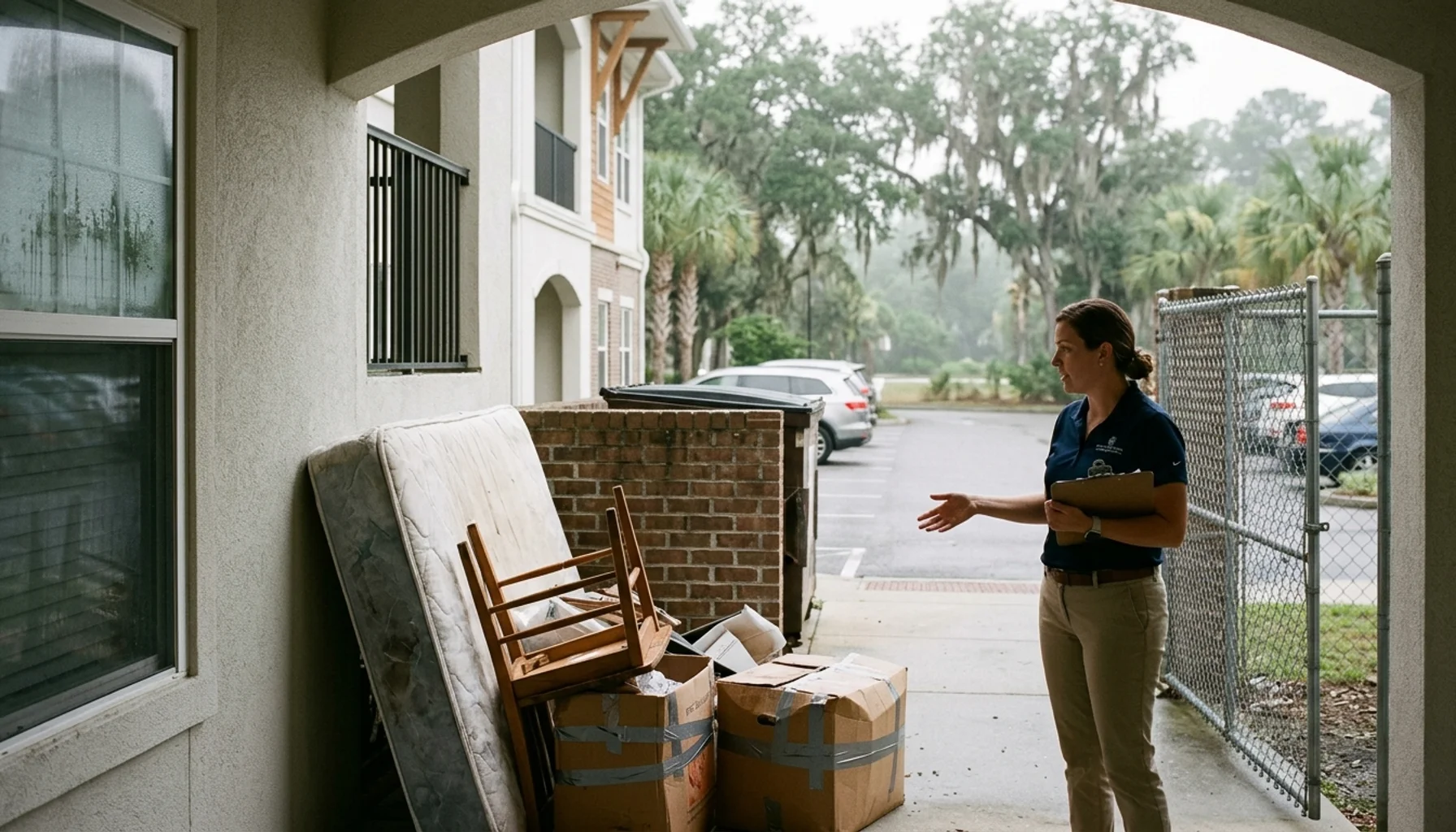
On-demand property waste support is a non-recurring waste removal service that handles situations regular trash pickup or nightly valet trash cannot: bulk items, move-out debris, overflow, and emergency cleanup, all scheduled as needed rather than on a fixed calendar. It fills the gap between routine collection and the unpredictable waste events every property eventually faces.
Key Takeaways
- On-demand property waste support covers bulk items, surge debris, and emergency overflow situations that fall outside a standard nightly or twice-weekly collection schedule.
- Routine multifamily valet trash service typically runs five nights per week, while bulk and surge debris require separately scheduled visits, according to industry sourcing referenced by other management companies.
- Standard multifamily valet pricing generally falls between $8 and $15 per unit when the property pays, or $25 to $35 per unit when residents pay directly; on-demand bulk work is custom-quoted based on volume, access, and item type.
- Common on-demand triggers include move-out furniture left in a breezeway, ten-plus bags generated overnight during a turnover, and a bulk item blocking a porch before a short-term rental guest arrives.
- North Charleston short-term rentals averaged $33,514 in annual revenue and 46.3% occupancy in 2026, according to AirROI market data, underscoring why fast turnover support matters for STR operators.
- Portfolios scaling from 10 to 1,000-plus units need a single vendor who can handle both scheduled valet trash and non-routine on-demand jobs without adding a second vendor relationship.
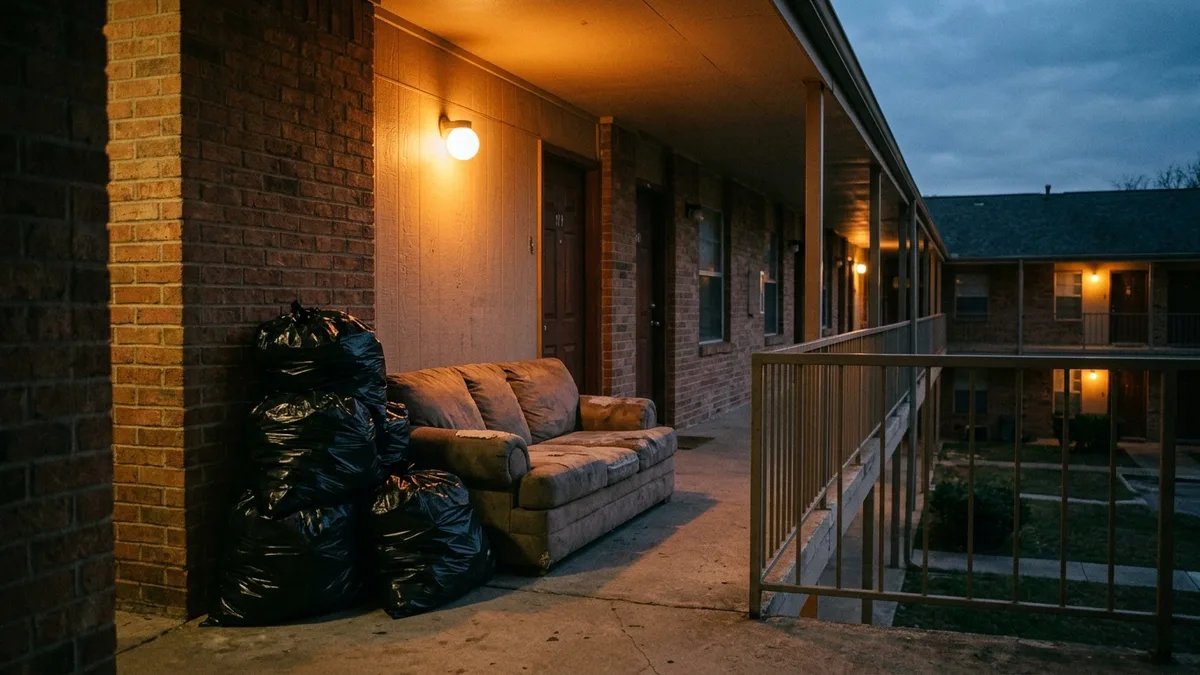
If you manage a multifamily community, a build-to-rent portfolio, or a short-term rental near the Charleston Historic District, you already know the difference between a clean hallway on a Tuesday and the chaos of a move-out day gone wrong. A sofa left in a breezeway. Ten trash bags stacked outside a unit after a chaotic weekend turnover. A guest arriving in three hours to a porch that still has last week's broken patio chair sitting on it.
None of those situations wait for the next scheduled pickup. That is exactly the problem on-demand property waste support solves, and it is a category that has become more visible in 2026 as property teams push back against rigid, once-a-week service models. We field these exact calls across North Charleston, Daniel Island, Mount Pleasant, and the surrounding Charleston metro, and the pattern is consistent: the properties with a clear on-demand plan handle surprise waste events in hours, not days.
This guide breaks down what on-demand property waste support actually includes, how it differs from valet trash and dumpster service, what it typically costs, and how to build a request-to-completion workflow that does not require you to babysit the process.
What Does On-Demand Trash Pickup Include for Properties?
On-demand trash pickup is a scheduled-as-needed service that removes waste a property did not generate through its normal daily trash flow. Specifically, it covers bulk items like furniture, mattresses, and appliances; surge debris from move-outs; overflow at dumpster or compactor enclosures; and, in some cases, after-hours emergency cleanup.
For multifamily and build-to-rent communities, on-demand support typically shows up around three recurring scenarios. First, a resident move-out that generates furniture, boxes, or discarded belongings faster than the standard dumpster can absorb. Second, an enclosure that has overflowed because of a holiday weekend, a community event, or simple volume spikes. Third, an emergency situation such as illegal dumping near a shared enclosure that needs same-day or next-day resolution.
For short-term rental operators near Sullivan's Island, Isle of Palms, or the Historic District, on-demand support solves a narrower but higher-stakes problem: a bulk item or overflow of trash left behind by a departing guest, with a new guest arriving within hours. As of 2026, several providers in this space distinguish clearly between recurring valet collection and separately scheduled bulk or surge work, because the two require different logistics entirely.
How Does On-Demand Waste Removal Differ from Valet Trash?
On-demand waste removal and valet trash service solve two different problems on two different schedules. Valet trash is recurring, scheduled collection, typically five nights per week for multifamily communities, where a resident places a bag or bin outside the door and a crew collects it doorstep-to-dumpster. On-demand removal is a one-time or irregular visit triggered by a specific event.
Think of valet trash as the baseline and on-demand support as the overflow valve. A property with strong nightly valet service still needs on-demand support when a resident moves out and leaves a couch, a mattress, and six boxes of items too large for a doorstep bin. Nightly valet crews are not equipped or scheduled to haul bulk furniture; that requires a separate visit, separate labor, and often a separate vehicle.
Additionally, on-demand support handles situations valet trash was never designed for: dumpster enclosure cleanouts, pressure washing around waste areas, and emergency response to illegal dumping or after-hours overflow. Many providers structure these as add-on visits that integrate with an existing valet trash program rather than requiring a second vendor relationship, which matters for property managers already stretched thin coordinating multiple contractors across a portfolio.
For a deeper look at how nightly collection actually works day to day, our team put together a breakdown on doorstep trash collection that walks through the operational side property managers ask about most.
What Is the Cost of On-Demand Property Waste Removal?
On-demand property waste removal is typically custom-quoted rather than priced on a flat rate, because cost depends on volume, item type, access, and urgency. This differs from routine valet trash, which follows a more predictable per-unit pricing structure.
For context, standard multifamily valet trash service generally runs $8 to $15 per unit per month when the property covers the cost, or $25 to $35 per unit when residents pay directly as part of their lease. On-demand bulk removal sits outside that structure entirely. A single-item pickup, such as one mattress left at a curb, costs far less than a full unit trash-out after an eviction or a delayed move-out with an entire apartment's worth of abandoned belongings.
Several factors move a quote up or down. Volume matters most: one couch is a different job than a unit full of furniture. Access matters too; a third-floor walk-up with no elevator takes longer than a ground-floor unit next to the loading area. Item type affects disposal cost, since appliances, mattresses, and electronics often carry separate disposal or recycling fees compared to standard bulk furniture. Urgency is the final variable. Same-day or next-day requests generally cost more than a job scheduled with a few days of lead time.
Property managers evaluating multiple vendors sometimes ask about pricing transparency, which is a fair question given how differently providers structure quotes. Our own pricing breakdown covers the full range property managers typically see across the Charleston metro.
What Factors Change a Quote?
- Volume: a single item versus a full unit trash-out changes labor and disposal cost significantly.
- Access: stairs, long carry distances, and restricted loading zones add time and crew hours.
- Item type: mattresses, appliances, electronics, and hazardous materials often carry separate disposal fees.
- Urgency: same-day and next-day requests typically cost more than jobs scheduled with lead time.
- Frequency: a portfolio with recurring bulk needs can often negotiate standing rates rather than one-off quotes.
What's Included in a $99 Junk Removal Service?
A $99 junk removal service typically covers a small, single-item or partial-load pickup, such as one piece of furniture, a mattress, or a few boxes, loaded and hauled from a curb or accessible location. It rarely covers full unit trash-outs, appliance disposal with freon recovery fees, hazardous materials, or jobs requiring significant carry distance or stairs.
This price point is useful as a rough anchor, but property managers should treat it as a floor, not an average. A quote for a single sofa at ground level with curbside access looks very different from a quote for a full apartment cleanout after an eviction, where the crew has to sort, bag, and haul an entire unit's contents including furniture, appliances, and personal belongings left behind.
Notably, flat low-price offers sometimes exclude specific categories that carry their own disposal cost. Appliances with refrigerants, mattresses (which many landfills restrict or charge extra to accept), electronics, tires, and paint or chemical products almost always fall outside a base flat rate. If a property regularly generates this type of waste during turnovers, it's worth asking any vendor directly what falls inside a quoted flat rate and what triggers an add-on fee before signing a service agreement.
How Can Property Managers Request an On-Demand Waste Quote?
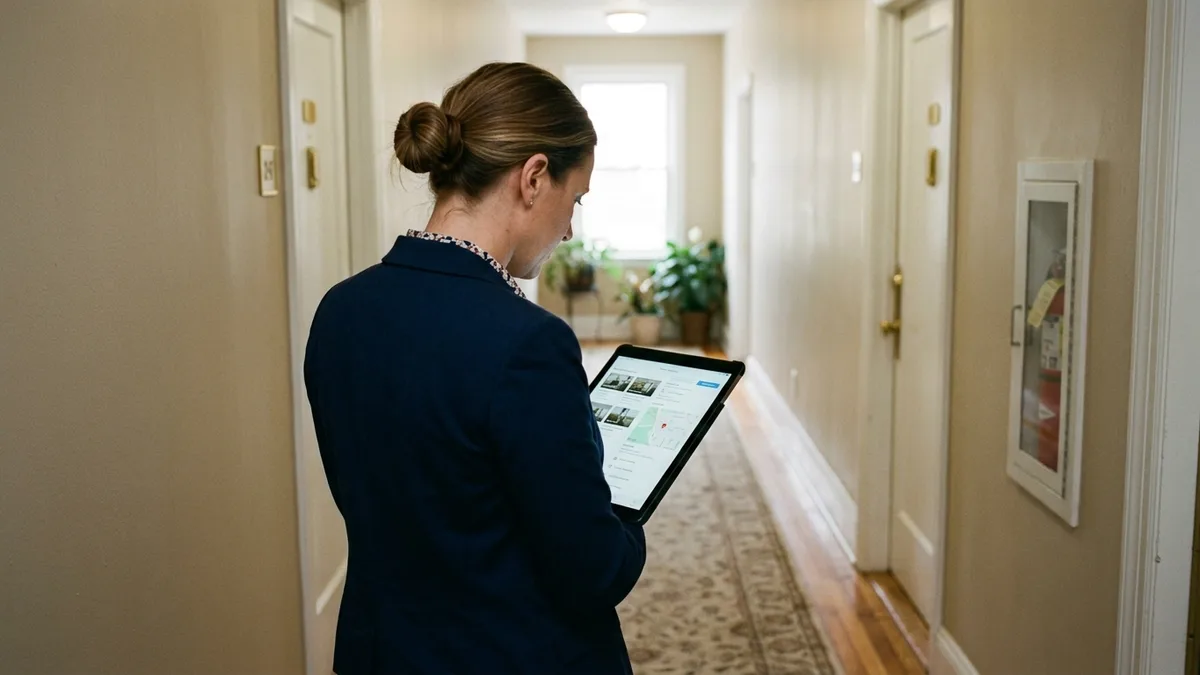
Requesting an on-demand waste quote starts with providing clear details about the job: location, volume, item type, and timeline. Most reliable providers can turn a same-day or next-day quote around quickly when the request includes photos and a specific unit or common-area location.
The workflow that works best across the properties we service in North Charleston, Mount Pleasant, and Daniel Island follows a consistent pattern, and it's one of the biggest gaps we see in how other providers explain their process. Here's the sequence a property manager should expect:
- Submit the request with the property address, unit number if applicable, and a brief description of what needs to be removed.
- Attach photos of the item or debris pile. This is the single fastest way to get an accurate quote instead of a rough estimate that changes on arrival.
- Specify access details such as stairs, elevator availability, or whether the item is already at a curb or loading area.
- Confirm urgency: same-day, next-day, or scheduled within a specific window tied to a move-out or guest turnover.
- Receive a quote and approval window, typically same-day for straightforward jobs.
- Get an arrival window for the scheduled visit, ideally with a notification when the crew is en route.
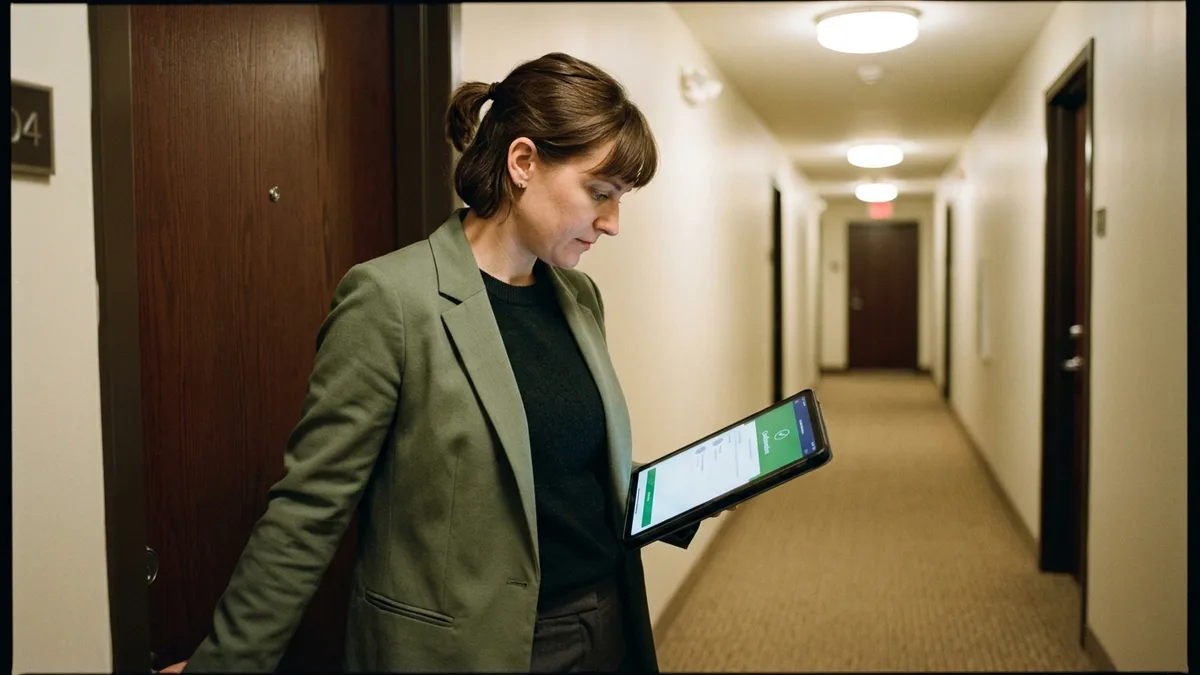
- Receive closeout documentation, including photo confirmation that the job is complete, so there is no need to physically check the unit or common area afterward.
That last step, photo-verified closeout, is what separates a documented service relationship from a handshake job. Property managers overseeing a scattered-site portfolio or a large multifamily community should never have to drive out and personally confirm a bulk pickup happened. Quotes are available Monday through Friday for all property types.
When Should a Property Request On-Demand Waste Support?
A property should request on-demand waste support whenever waste volume, item type, or timing falls outside what scheduled valet trash or dumpster service can absorb. This includes move-out surges, bulk furniture, overflow at shared enclosures, and any situation with a tight deadline like a short-term rental turnover.
In practice, four scenarios trigger most on-demand requests across the portfolios we service. Move-out day is the most common: a departing resident leaves furniture, mattresses, or boxes that a doorstep valet crew cannot haul as part of nightly collection. Overflow at a dumpster or compactor enclosure is the second, often tied to a holiday weekend, a community event, or seasonal volume increases as more residents move during summer leasing cycles. Emergency situations, such as illegal dumping discovered near a shared enclosure, form a third category that needs faster-than-normal response. The fourth is specific to short-term rental operators: a guest checkout that leaves behind an item too large for standard housekeeping to remove before the next check-in.
Waiting to request support until waste has already accumulated for days creates avoidable problems: pest issues, code complaints, and a bad first impression for new residents or guests. The properties that handle this well build on-demand requests into their standard turnover checklist rather than treating them as a last-minute scramble. For guidance specific to turnover timing, see our breakdown on Lowcountry junk removal for property turnovers.
Will Waste Management Companies Negotiate Prices?
Waste management providers will often negotiate pricing for property portfolios, recurring on-demand needs, or bundled service agreements that combine valet trash with bulk removal. Negotiation leverage typically comes from volume, contract length, and predictability rather than a single one-off job.
A property manager requesting a single bulk pickup has limited room to negotiate, since the job is priced on the specifics of that one visit. But a portfolio owner managing multiple properties, or a build-to-rent community anticipating regular turnover debris, has real leverage. Bundling recurring valet trash with a standing on-demand allowance, for example, gives a provider predictable revenue and gives the property predictable service, which is where most negotiated rates come from.
As of 2026, rising input costs across the waste and services sector make this leverage more relevant than ever. According to the U.S. Bureau of Labor Statistics, the Producer Price Index for final demand increased 1.4 percent in April 2026 alone, with prices for final demand services rising 1.2 percent, the largest monthly increase since March 2022. Locking in a portfolio-level agreement before broader cost increases hit smaller, one-off pricing is a practical move for operators managing multiple properties.
Who Is the Biggest Waste Management Company?
Nationally, waste management is dominated by a handful of large, publicly traded companies that operate collection, disposal, and recycling infrastructure across the country. These companies primarily serve municipal and industrial contracts rather than the amenity-grade, resident-facing service that multifamily and build-to-rent communities need.
That distinction matters more than it might seem. A large national waste hauler is built to move dumpsters and compactors efficiently at scale, not to walk a breezeway every night and photo-verify that a specific unit's trash was collected. Property managers sometimes assume a bigger company means better service, but scale and resident-level accountability are different problems entirely. A national industrial waste operator and a local valet trash and on-demand support provider are simply not solving the same job.
This is where the case for a locally rooted operator gets stronger. Our team is headquartered at 4900 O'Hear Avenue in North Charleston and built specifically around resident-level, doorstep and on-demand accountability, not municipal-scale hauling. Our team knows the operational pressure points unique to the Rivers Avenue corridor's high-volume apartment communities and the guest-experience sensitivity of short-term rental properties on Sullivan's Island, details a national account manager working from a call center will not have.
How Much Is a Garbage Bill for an Apartment?
A garbage bill for an apartment varies depending on whether the property covers valet trash as an included amenity or passes the cost to residents directly, and whether the unit relies solely on municipal pickup or supplements it with a private valet and on-demand program. Multifamily valet trash generally runs $8 to $15 per unit per month when paid by the property, or $25 to $35 per unit when billed to residents.
Municipal garbage collection, by contrast, is typically bundled into local utility or property tax structures and does not include doorstep pickup, bulk item removal, or the responsiveness an on-demand program provides. Residents who want to know what specifically happens if a scheduled pickup gets missed, whether through a municipal service or a private valet program, should check our guide on what apartment renters should know about trash valet services, which covers the resident side of this question in detail.
On-demand support sits on top of both models as an added-cost, as-needed service. It is not typically included in a base garbage bill because it addresses irregular events, bulk items, overflow, emergencies, rather than routine weekly volume.
Data Snapshot: Valet Trash vs. On-Demand Waste Support
| Feature | Valet Trash Service | On-Demand Waste Support |
|---|---|---|
| Schedule | Recurring, typically five nights per week | As-needed, scheduled per request |
| Typical use case | Daily household trash from doorstep bins | Bulk items, move-out surge, overflow, emergencies |
| Pricing model | $8 to $15 per unit (property-paid) or $25 to $35 (resident-paid) | Custom-quoted by volume, access, item type, urgency |
| Turnaround | Same night, on schedule | Often same-day to next-day depending on provider |
| Documentation | Photo-verified at each door nightly | Photo-verified closeout after job completion |
| Best fit | Multifamily, BTR, HOA routine service | Turnovers, evictions, STR checkouts, enclosure cleanouts |
How Do You Choose Between On-Demand Removal and Other Waste Services?
Choosing between on-demand removal, extra scheduled pickups, a roll-off container, or added valet trash frequency depends on how often the waste event recurs and how large the volume is. A one-time bulk item calls for on-demand removal. A recurring but predictable volume increase might justify simply adding pickup nights instead.
Here is a practical framework we walk property managers through:
- One-time bulk item (a couch, a mattress): on-demand removal is the right call. No need to add a roll-off or increase valet frequency for a single event.
- Recurring move-out surge in a high-turnover community: consider a standing on-demand allowance built into the service agreement rather than requesting quotes case by case.
- Renovation or full-building cleanout: a roll-off container is often more cost-effective than multiple on-demand visits for sustained high-volume debris.
- Consistently overflowing enclosure: the underlying fix may be adding valet trash pickup nights or a larger compactor, not repeated on-demand overflow visits.
- Short-term rental turnover with unpredictable timing: on-demand support integrated with your cleaning workflow beats trying to force a fixed schedule onto guest checkout times.
The mistake we see most often is property managers defaulting to repeated on-demand requests for a problem that is actually structural, like an enclosure that is simply too small for the community's volume. If overflow keeps happening at the same location every month, that is a signage, enclosure size, or service-frequency problem, not a one-off cleanup problem. Solving it usually means combining better resident communication about proper disposal with a service-frequency adjustment, not calling for another bulk pickup every few weeks.
How Does On-Demand Support Fit Into Move-In and Move-Out Timelines?
On-demand waste support fits into a make-ready timeline as a scheduled step, not an emergency call placed after the fact. Integrating bulk removal directly into the turnover checklist, alongside cleaning and repairs, prevents a full unit from sitting empty and unrentable while a property manager scrambles to find someone to haul out abandoned furniture.
Every day a unit sits with leftover furniture or debris is a day of lost rental income for build-to-rent operators and multifamily owners alike. Given that North Charleston short-term rentals average around $237 per night according to 2026 AirROI market data, a delayed turnover on even a single STR property adds up fast. Build-to-rent and multifamily units carry the same math on a monthly basis instead of nightly.
Practically, this means treating on-demand removal as a line item in the move-out checklist rather than a reactive phone call. Notify residents of move-out expectations in the lease, schedule the on-demand pickup to align with the final walk-through, and use photo-verified closeout as part of the unit's readiness documentation before the next resident or guest arrives. For a full breakdown of how this integrates with junk removal specifically, our post on Lowcountry junk removal for property turnovers covers the sequencing in more detail.
Practical Guidance: How to Prevent Recurring Overflow After a Cleanup
Preventing recurring overflow after an on-demand cleanup requires addressing the root cause, not just the symptom. A single cleanup solves the immediate mess; it does not fix an enclosure that is undersized, poorly signed, or serving more units than it was designed for.
- Audit enclosure capacity against unit count. A compactor sized for 100 units struggles at 150 without adjustment.
- Improve signage at the enclosure specifying what belongs in the dumpster versus what requires bulk pickup scheduling.
- Communicate move-out expectations in writing at lease signing and again 30 days before move-out.
- Adjust service frequency seasonally. Summer leasing cycles and holiday weekends generate more volume; a fixed year-round schedule often cannot absorb the spike.
- Monitor enclosure areas for early signs of illegal dumping, which tends to escalate quickly once one item is left unaddressed.
- Build a standing on-demand allowance into your service agreement for high-turnover communities instead of treating every incident as a surprise expense.
HOA communities dealing with chronic bin compliance or bulk item violations face a related but distinct version of this problem, one where enforcement, not enclosure size, is usually the bottleneck. A trash can concierge service that removes the compliance burden entirely tends to solve that more effectively than fines or reminder letters.
What Happens If You Miss Trash Day?
Missing trash day typically means waiting until the next scheduled pickup, which for municipal service is usually the following week, and for valet trash service is often the next night. In the interim, bags left out can attract pests, generate odor complaints, and in some municipalities, may violate local ordinances about curb timing.
For residents relying on municipal pickup alone, a missed day usually means storing waste securely until the next cycle. For multifamily residents on a valet trash program, missing a single collection night is far less disruptive, since another pickup happens the next evening rather than the following week. This is one of the clearest practical advantages of nightly valet service over municipal-only reliance, and it is a point worth raising with residents who ask why the community offers valet trash at all when the city already provides pickup.
If a missed pickup turns into an accumulation problem, that's exactly the kind of situation on-demand waste support resolves quickly, rather than waiting for the next scheduled cycle to catch up on backlog.
Frequently Asked Questions
What is trash reimbursement for an apartment?
Trash reimbursement usually refers to a line item on a resident's monthly bill covering the property's cost of providing valet trash or waste services, separate from the base rent. Some properties itemize this as a flat monthly fee, often in the $25 to $35 range for resident-paid valet programs, rather than bundling it silently into rent.
What is valet trash?
Valet trash is a recurring doorstep collection service where residents place bagged trash outside their unit on scheduled nights, and a crew collects it and carries it to the community dumpster or compactor. It typically runs five nights per week for multifamily communities and is distinct from on-demand support, which handles bulk items and non-routine events.
What is valet trash service exactly, and how is it different from on-demand pickup?
Valet trash service is the scheduled, nightly version of waste collection, while on-demand pickup is a separately requested visit for bulk items, overflow, or emergency situations. A property typically uses both together: valet trash for daily volume and on-demand support for everything that falls outside that routine.
What is the garbage collector responsible for in a multifamily community?
In a valet trash context, the collector is responsible for retrieving bagged trash from designated doorstep locations, carrying it to the dumpster or compactor, and, with a photo-verified provider, documenting that each stop was completed. This differs from a municipal garbage collector, who services the shared dumpster or curb bins on a fixed weekly schedule rather than individual doors.
What should you do if you miss trash day?
If you miss municipal trash day, store waste securely until the next scheduled pickup, typically the following week, and check local rules about how early bins can go to the curb. If you're on a valet trash program, a missed night is less of a concern since collection resumes the next scheduled evening.
Can on-demand waste support be added to a short-term rental property in Charleston?
Yes. On-demand and turnover-specific waste removal is available for short-term rental properties across the Charleston market, including the Historic District, Isle of Palms, and Sullivan's Island. It is designed for unpredictable guest checkout timing and integrates with cleaning and make-ready workflows so a property is guest-ready without the operator managing logistics on-site.
How does photo-verified waste collection work, and why does it matter for property managers?
Photo-verified collection means every service stop, whether a nightly valet pickup or an on-demand bulk job, is documented with a photo at completion. This gives property managers confirmed proof of service without needing to follow up or personally inspect the unit, which matters most for scattered-site portfolios and larger communities where manual checks are impractical.
Can one vendor handle both scheduled valet trash and on-demand waste removal across a portfolio?
Yes, and this is generally more efficient than managing separate vendors for each service. We are built to serve as a single waste operations partner for portfolios ranging from 10 to more than 1,000 units, combining nightly valet collection with on-demand bulk removal and consistent photo-verified documentation across every property.
Conclusion: The Bottom Line on On-Demand Property Waste Support
On-demand property waste support is the piece that keeps a waste program from breaking down the moment something unpredictable happens: a move-out, an overflowing enclosure, a guest checkout with a leftover item. Routine valet trash handles the nightly baseline, but properties without an on-demand plan end up scrambling every time volume spikes outside that schedule.
As Charleston's rental market keeps growing into 2026, with North Charleston alone home to more than 129,000 residents and short-term rental demand holding steady across the Historic District and barrier islands, the properties that treat on-demand support as a built-in part of their operations, not an afterthought, are the ones that avoid the code complaints, the bad reviews, and the delayed turnovers. Building the request-to-completion workflow into your standard operating procedure now saves the scramble later.
We handle both sides of this equation for multifamily communities, build-to-rent developments, HOAs, and short-term rental properties across Charleston, SC and Atlanta, GA: nightly valet trash and on-demand bulk removal, backed by photo-verified documentation on every visit.
If your community near the Rivers Avenue corridor or a growing build-to-rent development on Daniel Island needs a waste partner who handles both the nightly routine and the unpredictable overflow, get started with our team for a service quote, available Monday through Friday for every property type.
Content powered by inkSTR.co