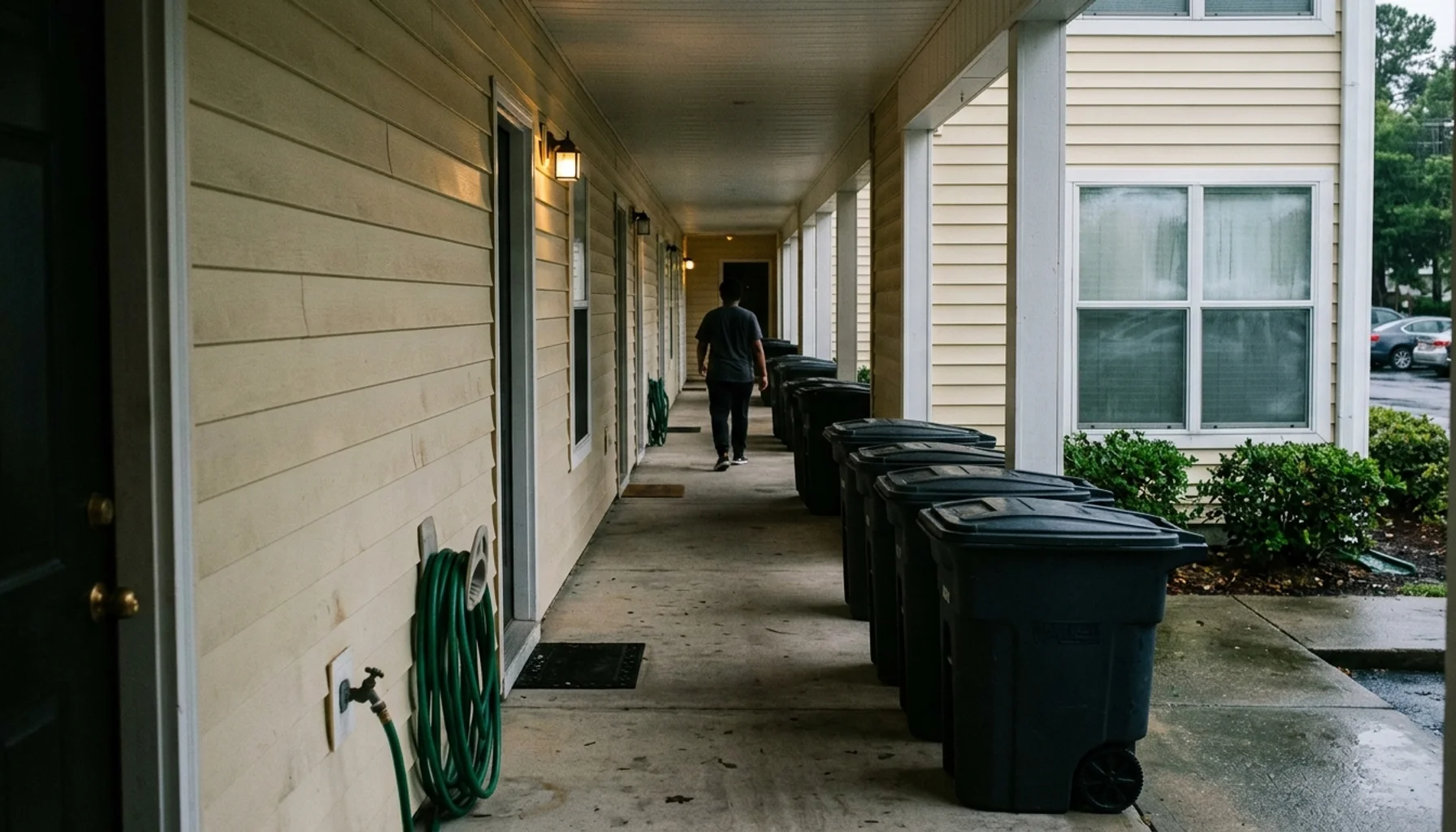
Valet waste (also called valet trash service) is a scheduled, doorstep collection service where residents place bagged trash outside their unit door on designated nights, and a service provider picks it up, hauls it to the community dumpster or compactor, and disposes of it, usually for a monthly fee built into or added onto rent.
Key Takeaways
- Valet waste is a nightly or several-times-weekly doorstep-to-dumpster collection service, most common in multifamily communities, build-to-rent developments, and select residential neighborhoods.
- Typical resident fees run from about $25 to $50 per month, often bundled into rent or charged as a separate line item, based on industry benchmarks reported across the sector.
- Property managers use valet waste to reduce dumpster overflow, cut hallway clutter, and support resident satisfaction, which factors into lease renewal decisions.
- Photo-verified service, where each collection stop is documented with a timestamped photo, has become a standard accountability feature that separates reliable providers from inconsistent ones.
- Trash Day Made Easy provides nightly, photo-verified valet waste service for multifamily communities, build-to-rent developments, HOAs, and residential homeowners across Charleston, SC and Atlanta, GA.
- North Charleston's short-term rental market, with roughly 888 active listings as of mid-2026 according to Airbtics data, adds another layer of demand for flexible, on-demand waste solutions between guest turnovers.
If you manage a multifamily property, a build-to-rent community, or even a short-term rental portfolio in the Charleston metro, you've probably heard the term "valet waste" thrown around at industry events or in vendor pitches. Some property managers assume it's just a fancier name for trash pickup. It isn't quite that simple, and the difference matters when you're trying to solve a real operational problem: overflowing dumpsters, resident complaints about hallway trash, and the hours you lose every week chasing down compliance.
At Trash Day Made Easy, we service multifamily communities, build-to-rent portfolios, HOAs, and short-term rental properties across North Charleston, Mount Pleasant, Daniel Island, James Island, and the greater Charleston and Atlanta metro areas, and this question comes up constantly: what exactly is valet waste, and is it worth paying for? This guide breaks down the definition, the day-to-day mechanics, the pricing, and the specific gaps most articles on this topic skip entirely, including how photo verification changes accountability and what it means for properties near the Rivers Avenue corridor dealing with chronic dumpster overflow.
By the end, you'll understand not just what valet waste is, but how to evaluate whether a provider is actually delivering it well, or just collecting a monthly fee for inconsistent pickup.
What Does "Valet Waste" Mean?
Valet waste, sometimes called valet trash or trash valet service, refers to a scheduled, doorstep-to-dumpster collection model where residents leave bagged household trash outside their unit rather than hauling it to a shared dumpster themselves. Specifically, a service crew walks the property on designated nights, collects each bag, and transports it to the community's dumpster, compactor, or waste enclosure.
The term "valet" comes from the same logic as valet parking: someone else handles the inconvenient part of the task, at the point of need, on a set schedule. As of 2026, this model has become a standard amenity in multifamily communities across the country, particularly in higher-density urban and suburban markets where residents don't have easy access to curb-level dumpsters.
Unlike municipal curbside pickup, which typically runs once or twice a week and requires residents to move their own bins, valet waste collection happens directly at the resident's door, often multiple nights per week. This distinction is why the service is increasingly marketed as a resident amenity rather than a basic utility. Property managers in North Charleston and across the Charleston metro use it specifically to reduce common-area clutter and dumpster overflow, two of the most frequent resident complaints property managers report.
How Does Valet Waste Service Work Day to Day?
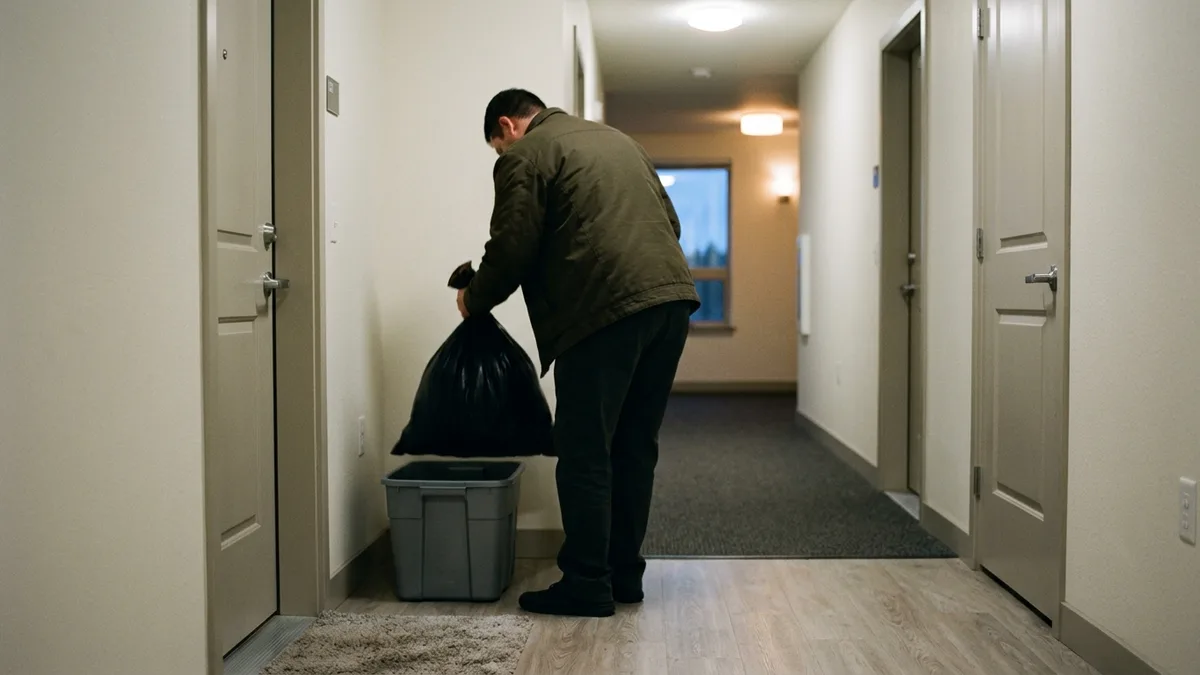
Valet waste works on a fixed nightly or multi-night schedule where residents set bagged trash outside their door by a specified cutoff time, and a collection crew removes it, transports it to the property's dumpster or compactor, and disposes of it before the next morning. First, the resident bags and ties their trash securely; second, the crew arrives during the scheduled window; third, collection happens; and finally, bins are expected back inside by a set time the next morning.
Most valet waste programs run collection Sunday through Thursday, though some properties opt for five or seven nights per week depending on unit density and resident volume. Crews typically use wheeled carts or oversized bags to move trash efficiently through hallways, breezeways, and stairwells without disturbing residents.
Additionally, many programs bundle valet recycling into the same visit, allowing residents to set out paper, plastics, glass, and metals through an identical process. This dual-stream approach has become increasingly common as sustainability expectations rise among renters, especially in build-to-rent communities near Daniel Island where residents often expect amenity-grade service standards.
At Trash Day Made Easy, our doorstep-to-dumpster valet trash service follows a nightly scheduled model, and every single collection stop is photo-verified. That means a property manager doesn't have to walk the halls checking whether service happened. The confirmation is already documented.
Does Valet Waste Actually Recycle?
Valet waste recycling refers to the optional add-on where residents set out sorted recyclables (paper, plastic, glass, metal) alongside their regular trash for pickup during the same scheduled visit, rather than hauling recyclables to a separate bin themselves. Whether a provider offers this depends entirely on their service agreement with the property, so it is never a guaranteed feature of every valet waste contract.
Some national providers advertise recycling capability, but the actual execution varies significantly by market and by property-level contract terms. As a result, property managers should treat recycling inclusion as a specific negotiated line item, not an assumed feature, when evaluating any valet trash proposal.
For build-to-rent communities and HOAs in the Charleston metro focused on sustainable community living goals, this distinction matters. A provider that only handles trash, with no recycling stream, will not move the needle on a community's environmental positioning. If recycling integration is a priority for your community near James Island or Johns Island, confirm it explicitly in writing before signing a service agreement, and ask how sorted materials are actually processed downstream, not just collected.
What Are the Benefits of Valet Waste for Residents?
Valet waste benefits residents primarily through convenience, cleanliness, and reduced friction with property waste rules, since residents no longer need to haul trash across a parking lot or navigate stairwells to reach a shared dumpster. This matters most in larger communities, in multi-story buildings without elevators, and for residents with mobility limitations.
For residents managing families, pets, or demanding work schedules, not having to plan a trip to the dumpster is a meaningful quality-of-life improvement. It also reduces the likelihood of trash sitting inside a unit for days, which can create odor and pest concerns, particularly in warmer, humid climates like coastal South Carolina.
Accessibility and Mobility Considerations
One benefit that gets consistently underreported: valet waste service has real accessibility value for elderly residents, residents with disabilities, and anyone with limited mobility. A resident who cannot easily carry heavy trash bags down a flight of stairs or across an uneven parking lot benefits directly from doorstep collection. Communities marketing inclusive or accessible living should treat valet waste as functionally supportive of those goals, not just a convenience amenity.
This is an area where property managers in HOA communities and senior-adjacent developments across James Island and Mount Pleasant should pay closer attention. A trash can concierge model, where bins move from a resident's back door to the curb and back without any resident involvement, extends this same accessibility benefit to single-family and townhome-style communities that don't have hallway doorstep service at all.
What Are the Benefits of Valet Waste for Property Owners and Managers?
Valet waste benefits property owners and managers primarily by reducing dumpster overflow, cutting resident complaints, and supporting lease renewal decisions, since a cleaner, better-maintained community directly affects how residents perceive property value and their willingness to renew. Overflowing dumpsters near common walkways are among the most visible curb appeal problems a property can have.
For multifamily communities near the Rivers Avenue corridor, where unit density is high and dumpster access is often shared across large resident populations, poor waste management creates a compounding problem: overflow attracts pests, generates odor complaints, and makes the entire property look poorly managed during prospective resident tours. According to the National Apartment Association, resident amenity preferences increasingly factor into renewal decisions, and waste management ranks among the most consistently cited daily-life frustrations residents report.
The revenue model also works in the property's favor. Many communities pass the monthly valet waste fee, typically in the $25 to $50 per unit range based on industry benchmarks, directly to residents as a billed amenity, meaning the service often pays for itself rather than becoming an operating expense the owner absorbs.
From what we see across our own portfolio at Trash Day Made Easy, the properties that treat valet waste as a genuine amenity, rather than a bare-minimum pickup service, see fewer resident complaints and cleaner common areas at renewal inspection time. That's not a marketing claim; it's the operational pattern that shows up when service is consistent and documented night after night.
Can Valet Waste Increase Property Value?
Valet waste can support property value indirectly by improving curb appeal, reducing resident turnover-related vacancy costs, and strengthening a community's competitive position against comparable properties offering the same amenity. It does not directly increase appraised value the way a renovated clubhouse might, but its effect on resident retention and first impressions is measurable in day-to-day property management.
Consider the mechanics: a prospective resident touring two comparable communities in North Charleston will notice immediately if one has a clean breezeway and no visible trash bags, while the other has overflow near the dumpster enclosure. That first impression influences leasing decisions. For apartment community owners and investors focused on net operating income, valet waste functions as a low-cost lever that protects occupancy and supports the kind of amenity-grade positioning that justifies premium rent in a competitive submarket.
For build-to-rent portfolios near Daniel Island, where investors are actively comparing community amenities against nearby competing developments, a documented, photo-verified waste program becomes part of the investor reporting story, not just an operational footnote.
What Does Valet Waste Cost, and How Is It Priced?
Valet waste typically costs residents between $25 and $50 per month per unit, based on industry benchmarks widely reported across the multifamily sector, though the exact figure depends on unit count, service frequency, recycling inclusion, and regional labor costs. Property-level contracts for multifamily and portfolio clients are almost always custom-quoted rather than priced off a public rate card.
Pricing variables include how many nights per week service runs, whether recycling is bundled, the physical layout of the property (walk-up buildings cost more to service than single-level communities), and the total unit count, since larger portfolios typically negotiate better per-unit rates. According to industry cost data compiled by the National Multifamily Housing Council, more than half of U.S. apartment communities now offer valet trash as a resident amenity, with residents paying roughly $25 per month on average.
Beyond the base monthly fee, be aware that a traditional waste management system for a 100-unit property can run $1,550 to $3,300 per month once dumpster hauling, fuel surcharges, and overflow fees are factored in, according to 2026 data from On The Fly Waste Solutions. Fuel surcharges alone can add 14% to 45% to a total waste management invoice, per SIB Fixed Cost Reduction's 2026 analysis, and overflow fees typically range from $125 to $260 per occurrence. This is exactly why one operator who audited waste invoices across 105 properties reportedly achieved 56.9% in savings, per the same SIB analysis; billing errors and surcharge creep are common in this industry, and invoice error rates sit around 9.5% according to that data.
Residential homeowners in select Charleston-area neighborhoods can access valet trash service starting from $49 per month through Trash Day Made Easy, a price point built specifically for individual homeowners who want the same doorstep convenience multifamily residents get, without needing to be part of a larger community contract.
| Service Model | Typical Monthly Cost | Best Fit For |
|---|---|---|
| Valet trash (multifamily, nightly) | $25 to $50 per unit | Apartment communities, build-to-rent |
| Trash can concierge (backdoor to curb) | Starting from $49 per month (residential) | HOAs, single-family homeowners |
| Traditional dumpster hauling (100 units) | $1,550 to $3,300 per month | Portfolios managing waste separately from valet |
| Overflow fee (per occurrence) | $125 to $260 | Any property without consistent capacity management |
How Is Valet Waste Different from Trash Chutes or Self-Service Dumpsters?
Valet waste differs from trash chutes and self-service dumpsters primarily in labor and convenience: chutes require residents to walk to a fixed chute location on their floor, while dumpsters require a trip outside entirely, whereas valet waste brings collection directly to the resident's front door on a scheduled basis. Each model has distinct operational trade-offs for property managers.
Trash chutes work well in high-rise buildings but come with their own maintenance headaches: chute jams, odor buildup, and cleaning requirements that valet waste avoids entirely since there's no fixed chute infrastructure to maintain. Self-service dumpsters are the lowest-cost option upfront but create the overflow and litter problems that drive most of the resident complaints property managers deal with regularly.
In contrast, valet waste shifts the labor burden from the resident (or from shared infrastructure) to a dedicated crew, which is why it's increasingly positioned as a premium amenity rather than a basic utility. For garden-style communities and build-to-rent developments without chute infrastructure at all, valet waste and trash can concierge service are typically the only two viable alternatives to residents making their own dumpster runs.
What Should Property Managers Ask Before Signing a Valet Waste Contract?
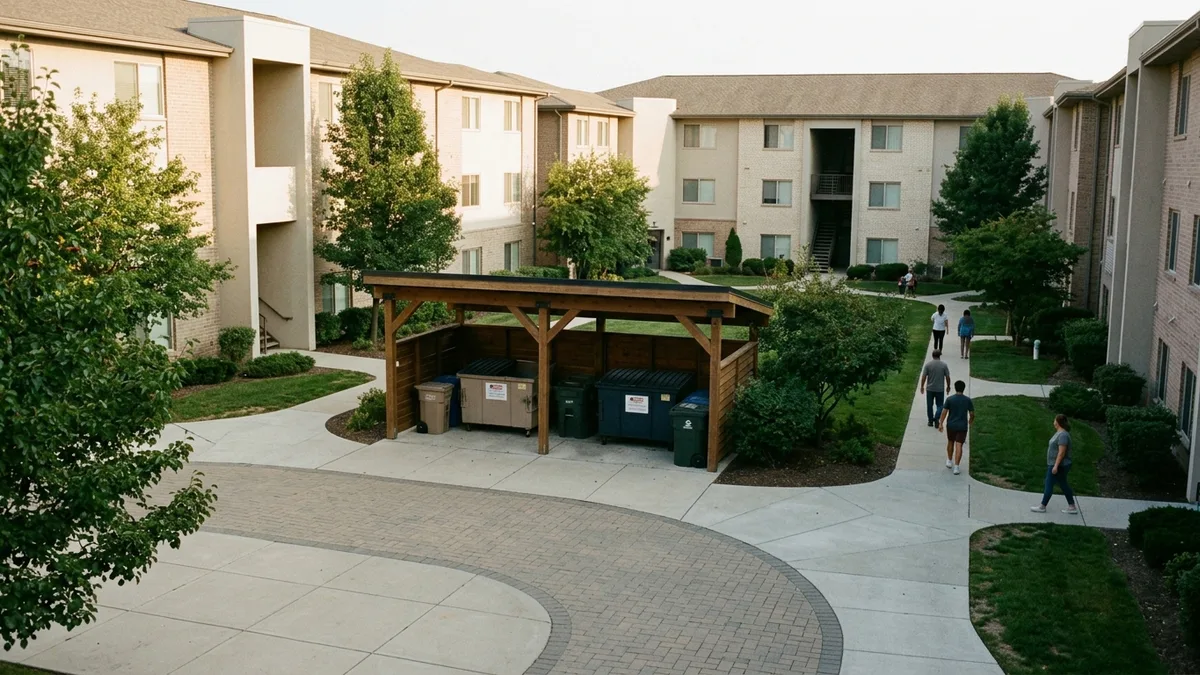
Before signing a valet waste contract, property managers should confirm service frequency, verification method, recycling inclusion, driver reliability standards, and how overflow or missed pickups are handled contractually, since these details determine whether the service will actually solve the problems it's meant to fix. A vague proposal with no documented accountability structure is a warning sign.
Here's a practical checklist we recommend property managers walk through with any provider, including us:
- Ask how service completion is verified. Photo verification at each door is now the standard for accountability; if a provider can't show you proof of nightly completion, you're relying on trust alone.
- Confirm the exact service nights and cutoff times. Sunday through Thursday is common, but some properties need five or seven nights depending on unit turnover and resident volume.
- Clarify recycling inclusion in writing. Don't assume it's bundled; ask specifically what materials are collected and how they're processed.
- Ask about scalability across a portfolio. If you manage more than one property, confirm the provider can maintain consistent service standards across every location, not just your flagship community.
- Understand how bulk items and move-out debris are handled. Standard nightly valet waste rarely covers couches, mattresses, or move-out furniture; ask if bulk removal is a separate on-demand service.
- Request references or case examples from similar-sized communities. A provider servicing 30-unit buildings may not have the operational infrastructure to handle a 500-unit portfolio consistently.
The most common mistake we see property managers make is treating bulk item removal as an afterthought during move-out, rather than scheduling it as a fixed step in the turnover cycle. A single abandoned sofa in a breezeway can delay a make-ready timeline by a full day, which is real lost rental income in a competitive submarket.
How Does Valet Waste Support Portfolio Scalability?
Valet waste supports portfolio scalability when a single provider can maintain identical service standards, from nightly collection frequency to photo verification protocols, across every property in a growing portfolio, regardless of whether that portfolio spans 10 units or more than 1,000. This matters because scattered-site owners and multi-property operators face a specific coordination problem that a single-community valet contract was never built to solve.
Trash Day Made Easy is purpose-built for this exact challenge. We service portfolios ranging from 10 units to more than 1,000 units, maintaining the same nightly, photo-verified standard at every address, whether that's a build-to-rent community near the airport corridor or a scattered collection of single-family rentals spread across North Charleston, Mount Pleasant, and Summerville.
For portfolio owners managing properties across multiple Charleston-area neighborhoods, a single vendor relationship eliminates the fragmentation problem: one point of contact, one billing structure, one consistent service standard, instead of juggling different city pickup schedules and inconsistent resident compliance at every address. We also offer on-demand waste pickup service for non-routine situations, so operators aren't locked into a single rigid schedule when a property needs flexibility.
How Does Valet Waste Work for Short-Term Rentals and Turnover Properties?
Valet waste for short-term rentals adapts the standard doorstep collection model into an on-demand, turnover-triggered service, since STR properties don't follow a predictable weekly resident schedule the way apartment communities do. Instead, waste removal needs to align with guest checkout and checkin windows, which can happen daily, several times a week, or unpredictably depending on booking volume.
North Charleston's short-term rental market has grown substantially, with roughly 888 active listings as of mid-2026 and average annual revenue per listing rising approximately 24.9% year-over-year, according to Airbtics market data. With average stays running about 5.3 nights and booking lead times averaging 40 to 53 days, STR operators near the Charleston Historic District, Isle of Palms, and Sullivan's Island need waste removal that fits tight, sometimes same-day turnover windows, not a fixed nightly schedule built for apartment residents.
Trash Day Made Easy's turnover trash handling and move-in and move-out support integrate directly into these compressed timelines. Bulk item removal, between-guest trash pickup, and on-demand scheduling mean an STR operator doesn't have to coordinate waste logistics manually between every cleaning crew visit and guest arrival. Our doorstep trash service guide covers this turnover model in more detail for operators managing multiple STR units.
How Does Valet Waste Compare to a Trash Can Concierge Service?
A trash can concierge service differs from standard valet waste in that it moves a resident's existing bin from a backdoor or storage location to the curb on collection day and returns it afterward, rather than collecting individually bagged trash from a hallway door and hauling it to a compactor. This model fits single-family homes, HOA communities, and build-to-rent developments where residents already have municipal or private bin service but consistently fail to manage the bin logistics themselves.
For HOA boards across James Island, Johns Island, and Mount Pleasant, bin compliance is a chronic enforcement headache: bins left at the curb for days, missed pickup days, and the resulting code violations that boards have limited authority to actually enforce. A trash can concierge removes that enforcement burden entirely; the bin moves on schedule regardless of resident behavior, with no fine letters or follow-up calls required.
Trash Day Made Easy's backdoor-to-curbside trash can concierge service, starting from $49 per month for residential homeowners, extends this same reliability to individual homes. We also partner with The Bin Boy, a Charleston-based bin cleaning and sanitizing service, so residents can add periodic bin cleaning to eliminate odor buildup without managing a separate vendor relationship. Our can to curb service guide breaks down this model in more depth for HOA and residential audiences.
Practical Guidance: How to Choose the Right Waste Solution for Your Property
Choosing the right waste solution depends on property type, resident density, and how much operational control you want to hand off entirely. Here's how we'd frame the decision for different situations:
- For multifamily apartment communities: nightly valet waste with photo verification is the standard; prioritize a provider that can document every stop, not just claim general reliability.
- For build-to-rent and scattered-site portfolios: look for a single vendor that scales, since coordinating separate contracts per property creates fragmentation and inconsistent resident experience.
- For HOA communities and single-family homes: a trash can concierge model solves bin compliance without needing hallway-level doorstep infrastructure.
- For short-term rental operators: on-demand, turnover-triggered service matters more than a fixed weekly schedule, since guest timing is unpredictable.
- Common mistake to avoid: signing a contract without confirming how missed pickups or overflow situations are handled. Ask for this in writing, not verbally.
One trade-off worth understanding: cheaper, less frequent service (once or twice weekly) will always cost less per unit, but it also increases the odds of bag accumulation, odor complaints, and pest issues between pickups, especially in warmer coastal months.
Frequently Asked Questions
What does "valet waste" mean exactly?
Valet waste means a scheduled doorstep trash collection service where residents leave bagged trash outside their unit and a crew collects it and transports it to the property's dumpster or compactor. It's most common in multifamily apartment communities but has expanded into build-to-rent developments and select residential neighborhoods.
How much does valet waste service cost per month?
Valet waste typically costs residents between $25 and $50 per month per unit for multifamily communities, based on widely reported industry benchmarks. Residential homeowners working with Trash Day Made Easy can access valet trash service starting from $49 per month in select Charleston-area neighborhoods.
Does valet waste service include recycling?
Recycling inclusion depends entirely on the specific service contract; it is not automatically bundled with every valet waste program. Confirm recycling terms explicitly with your provider, including what materials are accepted and how they're processed.
Can valet waste really increase property value?
Valet waste supports property value indirectly by improving curb appeal, reducing resident complaints, and strengthening a community's competitive position, which affects occupancy and lease renewal rates. It does not function as a direct appraisal driver the way a physical capital improvement would.
What is the difference between valet waste and a trash can concierge service?
Valet waste involves collecting individually bagged trash from a resident's door and hauling it to a shared dumpster, typically in multifamily settings. A trash can concierge instead moves an existing bin from a backdoor or storage spot to the curb and back, which fits single-family homes and HOA communities better.
Can one provider handle valet waste across multiple properties in a portfolio?
Yes. Providers like Trash Day Made Easy are built specifically to maintain consistent, photo-verified service standards across portfolios ranging from 10 units to more than 1,000 units, giving scattered-site owners a single vendor relationship instead of coordinating separate contracts per property.
Does valet waste work for short-term rental properties?
Yes, though it requires an on-demand model rather than a fixed nightly schedule, since STR turnover happens around guest checkin and checkout rather than a predictable resident routine. Providers offering turnover trash handling and bulk item removal are better suited to STR operations than standard multifamily valet contracts.
What happens if a resident doesn't bring their bin back inside on time?
Many multifamily valet waste programs set a return deadline, often around 9 a.m. the following morning, and may apply a fine for noncompliance, commonly cited around $25 in industry sources. Trash can concierge services eliminate this issue entirely since the provider, not the resident, handles bin placement and retrieval.
Bottom Line on Valet Waste
Valet waste is a scheduled, doorstep-to-dumpster collection service that removes the burden of trash coordination from residents, typically costing $25 to $50 per month per unit in multifamily settings. The real differentiator between providers isn't the basic collection model, since most companies do that part the same way. It's accountability: whether service is documented, whether it scales across a growing portfolio, and whether bulk items and turnover debris get handled without derailing your make-ready timeline.
Property managers across North Charleston, Mount Pleasant, Daniel Island, and the broader Charleston metro who treat waste management as a system, not a once-a-week afterthought, consistently see cleaner common areas and fewer resident complaints at renewal time. As build-to-rent development continues expanding near the airport corridor and Daniel Island, and as North Charleston's short-term rental market keeps growing into 2026, demand for flexible, documented waste solutions will only keep climbing.
Trash Day Made Easy was built specifically for this kind of hands-off operation, serving multifamily communities, build-to-rent developments, HOAs, short-term rental properties, and residential homeowners across Charleston, North Charleston, and Atlanta with nightly, photo-verified service that scales from a single home to a thousand-unit portfolio.

If overflowing dumpsters, hallway clutter, or bin compliance headaches are a recurring issue at your property, it might be time to stop patching the problem manually. Get started with Trash Day Made Easy and request a service quote, available Monday through Friday, for multifamily communities, build-to-rent portfolios, HOAs, and residential homes across Charleston and Atlanta.
Content powered by inkSTR.co