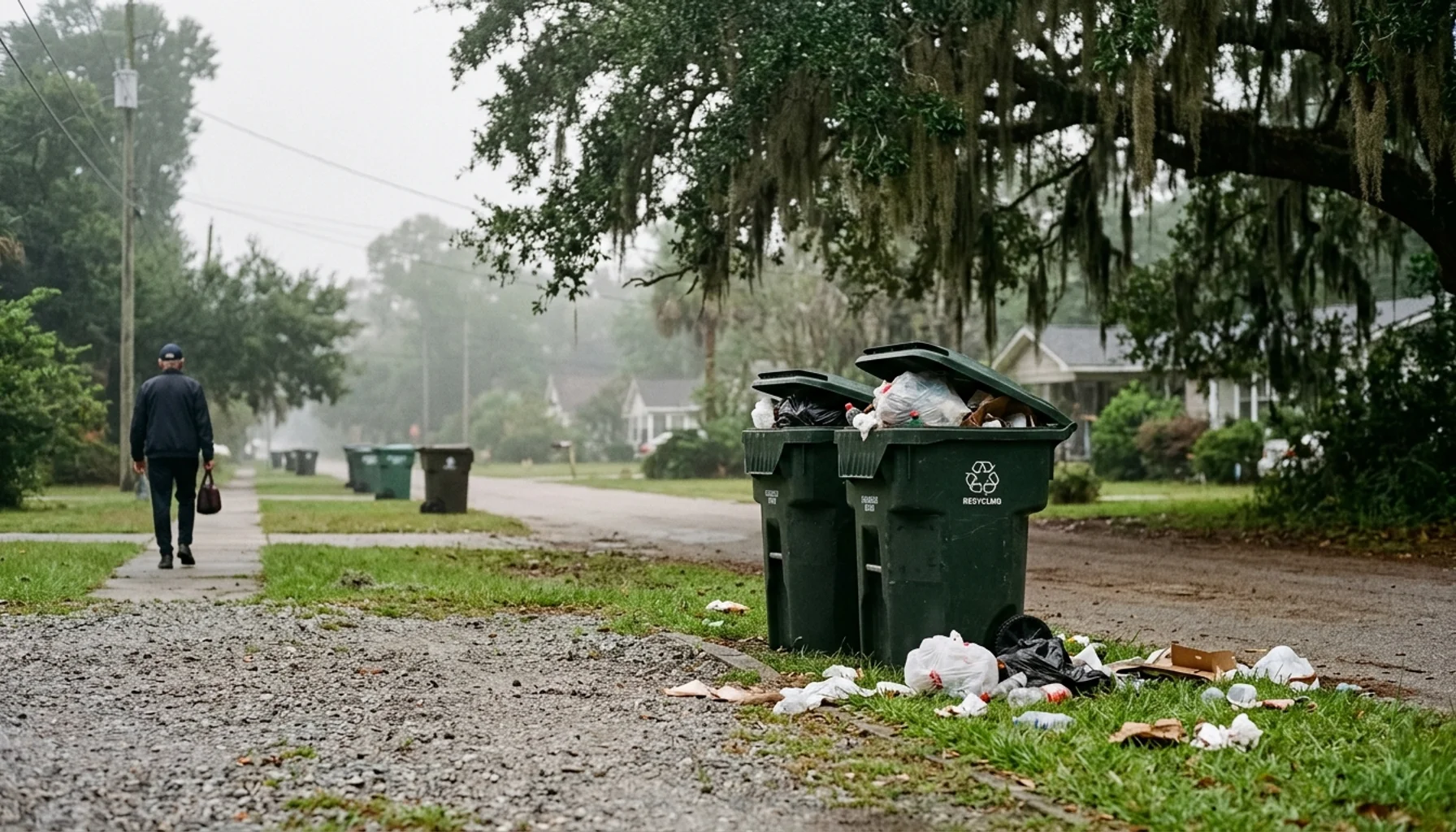
Inconsistent waste management hurts sustainability goals for communities because missed pickups, uneven neighborhood coverage, and unreliable disposal create pollution, health risks, and higher long-term costs that a predictable collection schedule would prevent. When service is unreliable, waste piles up, gets dumped illegally, or reaches landfills without proper sorting, undoing whatever progress a community has made toward cleaner air, water, and streets.
Key Takeaways
- Inconsistent waste management, meaning missed pickups and irregular schedules rather than a total lack of service, is a distinct problem from having no waste service at all, and it creates its own chain of downstream consequences.
- Roughly 30% of waste generated worldwide is openly dumped or left uncollected, a direct result of service gaps rather than total service absence.
- Poorly managed waste is linked to hundreds of thousands of annual diarrheal deaths tied to contaminated water, much of it traceable to leachate and blocked drainage from uncollected trash.
- The U.S. Waste Management Market is projected to grow from roughly $123.43 billion in 2026 to $162.53 billion by 2034, according to industry market research, reflecting how much communities are investing to close reliability gaps.
- Sustainability indicators such as SDG 11.6.1 measure both the share of waste regularly collected and the share managed in controlled facilities, meaning consistency itself is a formal metric.
- Multifamily and build-to-rent communities in markets like North Charleston and the Rivers Avenue corridor see the clearest local version of this problem: irregular dumpster service driving resident complaints, curb appeal loss, and lease renewal risk.
Every property manager who has walked past an overflowing dumpster on a Monday morning already understands the core issue, even if they have never used the phrase "sustainability indicator." A community's environmental performance depends on whether waste service happens on schedule, every time, at every door and every dumpster pad, without gaps.
At Trash Day Made Easy, we service multifamily communities, build-to-rent developments, and residential neighborhoods across Charleston, North Charleston, and Atlanta, and we see this pattern constantly: a property with a written waste plan on paper still ends up with overflowing bins, illegal dumping near dumpster pads, and residents who stop bothering to sort recycling correctly once they notice pickup is unreliable. Consistency is what determines whether a community's sustainability goals hold up, not capacity.
This guide breaks down exactly how inconsistent waste management undermines environmental and community health goals in 2026, what the research says about the scale of the problem, and what a reliable, documented waste program looks like in practice for property managers, HOA boards, and portfolio operators.
How Does Poor Waste Management Affect the Community?
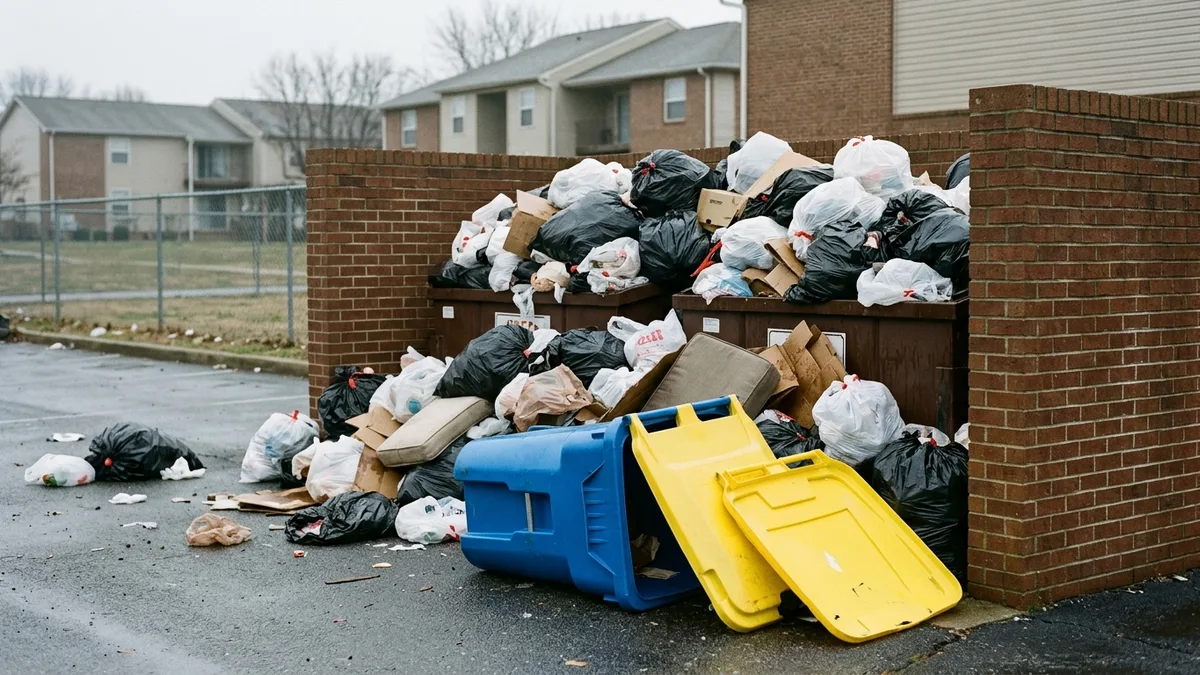
Poor waste management affects a community by increasing pollution exposure, degrading public spaces, and raising the cost of emergency cleanup that a consistent system would have prevented. Missed collection cycles trigger a chain reaction: overflowing containers attract pests and illegal dumping, blocked drains cause localized flooding, and residents lose confidence in recycling programs once they see inconsistency reward the wrong behavior.
The distinction matters here between a community with no waste service and one with unreliable waste service. A neighborhood with zero collection knows to plan around that absence. A community with a valet trash program or municipal pickup that runs on an unpredictable schedule creates a worse behavioral outcome: residents set out trash expecting collection, it does not come, and the waste sits exposed to weather, animals, and foot traffic for days. One missed cycle can generate the same pollution outcome as having no service at all, just delayed and messier.
In North Charleston's Rivers Avenue corridor, where high-volume apartment communities operate alongside commercial traffic, we have watched a single missed valet trash night turn into three days of overflow before a property manager even hears about it from residents. That gap is exactly where curb appeal and lease renewal confidence break down together.
What Is the Biggest Problem With Waste Management Today?
The biggest problem with waste management today is inconsistency in service delivery, not a lack of infrastructure or awareness. Communities across income levels have waste trucks, bins, and stated recycling programs, but the actual reliability of pickup, from route to route and week to week, varies enough to undermine every downstream sustainability metric a city or property tries to track.
Approximately 30% of waste generated worldwide is openly dumped or left uncollected, a figure driven heavily by inconsistent service rather than by communities having zero access to any waste system. Collection rates hover near 100% in high-income countries and North America overall, but that headline number hides significant route-level and neighborhood-level variation. A city can report near-universal coverage while specific corridors, buildings, or property types experience chronic service gaps.
For multifamily property managers, this shows up as a portfolio-level headache. A property manager overseeing communities across James Island, Daniel Island, and Summerville might have a citywide collection contract that looks solid on paper, but individual dumpster pads within that footprint can still miss cycles because of route inefficiency or staffing gaps. Waste management does not fail because it does not exist; it fails because it does not happen the same way every single time.
What Is a Major Impact of Improper Solid Waste Management?
A major impact of improper solid waste management is water and soil contamination caused by leachate, a toxic liquid formed when rainwater filters through uncollected or improperly disposed waste and dissolves harmful substances into surrounding ground. Leachate can travel into surface water and groundwater, creating pollution risks that persist well beyond the original waste pile.
Beyond leachate, accumulated solid waste, particularly plastic, frequently blocks waterways and stormwater drainage systems. This creates two compounding effects: increased localized flooding during heavy rain and unsanitary standing water that supports disease-carrying pests. Contaminated water exposure is linked to approximately 505,000 diarrheal deaths annually worldwide, with poor waste management increasing exposure risk to cholera and typhoid in areas where collection is unreliable.
Open burning of uncollected waste adds a separate hazard. When waste sits too long without collection, residents or municipal crews sometimes burn it out of frustration or necessity, releasing carbon monoxide and fine particulate matter (PM10) into the air. Academic reviews of solid waste impacts categorize these effects across three scales: local soil and groundwater contamination, regional pollution of shared water bodies used for agriculture, and global effects including greenhouse gas emissions and marine litter. Improper solid waste management spreads outward through water, air, and shared infrastructure rather than staying contained to a single neighborhood.
How Does Inconsistent Waste Service Create a Chain Reaction in Communities?
Inconsistent waste service creates a measurable chain reaction: one missed collection cycle leads to container overflow, overflow invites illegal dumping, dumping blocks drainage, and blocked drainage raises both flood risk and municipal cleanup costs. This causal chain is one of the most underexplained parts of the sustainability conversation, and it is where most published guides on this topic stop short.
Here is how it plays out in a typical multifamily setting. First, a scheduled valet trash or dumpster pickup gets skipped, whether from a routing error, a holiday schedule shift, or a staffing shortfall. Second, residents continue generating waste at the normal rate, so containers hit capacity within 24 to 48 hours. Third, once a dumpster visibly overflows, it signals to residents and even non-residents that the area is unmonitored, which increases illegal dumping of bulk items and construction debris that were never part of the original waste stream.
Fourth, that additional debris often blocks or narrows drainage paths near the dumpster pad, especially in coastal Lowcountry properties where stormwater management is already a design consideration. Fifth, the property or municipality now faces an emergency cleanup cost that a consistent, documented pickup schedule would have avoided entirely. Photo-verified nightly collection matters operationally because it catches gaps before they cascade into the multi-step failure described above.
How Does Waste Management Affect Our Environment on a Broader Scale?
Waste management affects the broader environment through greenhouse gas emissions and cumulative ecosystem stress that compounds when collection and disposal systems operate inconsistently rather than on a reliable, predictable basis. Organic waste that sits uncollected and decomposes without proper aeration or diversion releases methane and carbon dioxide, both of which undermine climate goals communities have committed to under broader sustainability frameworks.
Plastic waste specifically represents about 12% of global municipal solid waste generation, equivalent to roughly 276 million tonnes annually. When collection is inconsistent, a meaningful share of that plastic never reaches a controlled facility at all; instead it ends up in waterways, storm drains, or informal dump sites where it breaks down into microplastics that eventually reach coastal ecosystems, a direct concern for Lowcountry communities near tidal creeks and marshland.
Municipal waste management contributes directly to the broader goal of reducing the per-capita environmental impact of cities through better air quality and waste handling. Communities that treat waste collection as a variable, negotiable service rather than a fixed operational standard consistently underperform on this goal, not because they lack the physical infrastructure, but because unreliable execution defeats the purpose of having infrastructure at all.
What Sustainability Indicators Actually Measure Waste Reliability?
Sustainability indicators measure waste reliability primarily through SDG indicator 11.6.1, a United Nations metric that tracks both the percentage of municipal waste regularly collected and the percentage managed in controlled facilities, rather than just the existence of a waste program. This distinction is exactly where most communities lose ground on stated environmental goals.
Additional indicators worth tracking at the community or property level include SDG 6 (clean water and sanitation, tied directly to leachate and drainage contamination), SDG 12 (responsible consumption and production, tied to recycling and segregation compliance), and SDG 14 (life below water, tied to plastic and marine litter originating from uncollected waste near coastal zones like the Charleston Harbor watershed).
For a property manager or HOA board, translating these global indicators into something actionable means tracking route-level and door-level completion data rather than relying on a citywide collection percentage. A community can report full municipal coverage while individual buildings or dumpster pads experience chronic gaps that never show up in aggregate reporting. A photo-verified valet trash service closes this visibility gap by giving you door-by-door proof of service completion instead of a citywide average that hides local failures.
What Actionable Framework Can Communities Use to Improve Waste Reliability?
An actionable framework for improving waste reliability combines route-level tracking, documented service-level agreements, and verification of controlled-facility disposal, rather than relying on a general assumption that a signed contract guarantees consistent execution. Most published guidance on this topic stops at describing the problem; communities need specific mechanisms to fix it.
Start with these four practical components:
- Route-level and door-level tracking. Instead of measuring "did the truck come to the neighborhood," measure whether every individual dumpster pad or unit door received service on the scheduled night. Photo-verified valet trash programs create this data automatically; municipal-only systems typically do not.
- Written service-level agreements with specific response windows. A vendor contract should specify how quickly a missed pickup gets remediated, not just that pickups are scheduled. A same-night or next-morning remediation standard prevents the multi-day overflow scenario that triggers illegal dumping.
- Segregation compliance checks. Recycling and organic waste streams degrade fastest when residents lose confidence in pickup consistency. Spot-checking segregation compliance at the container level flags when a community's recycling participation is dropping before it shows up in a broader city report.
- Controlled-facility verification. Confirm, at least periodically, that collected waste is actually reaching a licensed, controlled disposal or recycling facility rather than an informal or unpermitted site. This closes the loop between collection consistency and true environmental outcome.
Build-to-rent operators near Daniel Island and the airport corridor have told us this framework matters even more as portfolios scale. What works for a 20-unit community with one dumpster pad does not automatically hold up across a 200-unit portfolio with a dozen collection points, which is why you should treat waste operations as a managed program rather than a one-time vendor selection.

How Do Informal Waste Workers and Community Participation Fit Into a Reliable System?
Informal waste workers and resident participation matter to waste reliability because a meaningful share of global waste collection, especially in under-resourced areas, still depends on people and behavior outside the formal municipal system. Integrating that labor safely and consistently strengthens overall service reliability. Estimates suggest at least 2 billion people worldwide lack access to regular waste collection, and in some squatter or informal settlement areas, only about 5% of waste was found to be regularly collected in cited studies.
Charleston-area communities are not comparable to the most under-served global regions, but the underlying principle translates directly: systems that rely heavily on resident compliance, like remembering bin day, hauling bulk items to a designated spot, or sorting recycling correctly, break down the same way informal collection systems break down elsewhere. The fix in both cases is the same: reduce the number of steps that depend on inconsistent human behavior and replace them with a structured, professionally managed process.
This is precisely why HOA boards struggle to enforce cleanliness standards through fines and reminder letters alone. Enforcement assumes consistent resident behavior, and resident behavior is the least reliable variable in the entire waste chain. A managed program that removes the resident's role entirely, moving bins from storage to curb and back without any action required, produces a more sustainable outcome than any enforcement mechanism built on compliance alone.
What Does the Financial Case for Consistent Waste Management Look Like?
The financial case for consistent waste management centers on avoided costs: emergency cleanup, code enforcement disputes, and resident turnover all cost more than the price of reliable service in the first place. Universal basic collection and environmentally sound management requires roughly 0.3% of GDP in middle-income countries, rising toward 0.5% for more advanced systems, which frames consistent waste service as a modest ongoing investment relative to the cost of failure.
| Factor | Consistent Waste Management | Inconsistent Waste Management |
|---|---|---|
| Container overflow frequency | Rare, caught before capacity is reached | Frequent, discovered after residents complain |
| Illegal dumping risk | Low; monitored pads discourage dumping | Elevated; overflow signals an unmonitored area |
| Recycling participation | Higher; residents trust the system | Declines once residents see inconsistency |
| Documentation for disputes | Photo-verified proof of each service visit | No record; disputes rely on memory or complaints |
| Cost pattern | Predictable, budgeted monthly or per-unit cost | Unpredictable emergency cleanup and bulk removal costs |
The U.S. Waste Management Market is projected to grow from an estimated $123.43 billion in 2026 to roughly $162.53 billion by 2034, according to industry market research, a signal that communities and portfolio operators are increasingly willing to pay for reliability rather than treat waste service as a commodity purchase. Within North America specifically, curbside pickup accounts for over half of total market share, underscoring how central consistent, scheduled service is to how the industry itself defines quality.
What Common Mistakes Undermine Community Waste Sustainability Goals?
The most common mistake property managers and HOA boards make is treating waste service as a fixed-cost line item rather than an operational relationship that requires ongoing verification. A signed contract with a hauler guarantees only that a contract exists, not that execution will be consistent.
Watch for these recurring mistakes:
- Assuming citywide or portfolio-wide averages reflect individual property performance. A 95% collection rate citywide can still mean specific buildings or dumpster pads face chronic gaps.
- Relying on resident self-reporting to catch missed pickups. By the time a resident complains, overflow, odor, or pest issues have usually already started.
- Treating bulk item removal as a separate, occasional problem instead of a scheduled part of the turnover cycle. Move-out debris left in breezeways is one of the most preventable sustainability failures we see across Charleston and Atlanta portfolios.
- Underestimating how quickly resident recycling participation drops once service feels unreliable. Trust, once lost, is hard to rebuild without a visible change in service consistency.
- Skipping documentation. Without photo verification or service records, you cannot prove a missed pickup was a one-time event rather than a pattern, which weakens both vendor accountability and any sustainability reporting a community wants to make to investors or residents.
Scattered-site portfolio owners managing properties across North Charleston, Summerville, and Mount Pleasant face a compounded version of this problem: each individual property might look fine in isolation, but without a single point of accountability across the portfolio, gaps at one site rarely get flagged until they show up as a resident complaint or a code enforcement notice weeks later.
Frequently Asked Questions
How does poor waste management affect the community?
Poor waste management affects a community by increasing pollution exposure through leachate and open burning, raising disease risk from pests and contaminated water, degrading curb appeal and property value, and driving up emergency cleanup costs that a consistent collection schedule would have prevented.
What is the biggest problem with waste management right now?
Inconsistency in service delivery is the biggest ongoing problem, not a lack of infrastructure. Communities with waste trucks and stated recycling programs still experience route-level and neighborhood-level gaps that undermine sustainability metrics; roughly 30% of global waste is openly dumped or left uncollected as a result.
How many nights a week does valet trash service typically run?
Valet trash service schedules vary by property and vendor agreement, but nightly service, five to seven nights per week, is common for multifamily and build-to-rent communities that want to avoid overflow between pickups. Trash Day Made Easy structures nightly scheduled collection specifically to prevent the multi-day gaps that lead to overflow and illegal dumping.
How much does trash cost per month in an apartment?
Trash costs vary widely depending on property type, unit count, and service model, and are typically built into either a resident amenity fee or a property-wide operating cost rather than billed as a flat universal rate. Ask for a specific quote based on unit count and service frequency rather than relying on a generalized figure; Trash Day Made Easy provides quotes Monday through Friday for multifamily, HOA, and residential properties.
When does trash and recycling come in my area?
Municipal trash and recycling schedules vary by city and specific neighborhood, so check with your local municipal waste department or property management office for the exact day and time. For properties using a valet trash or trash can concierge service, the schedule is set by the service provider and communicated directly to you, removing the need to track municipal pickup days at all.
What day does the trash come in my area?
Pickup day depends on the specific municipality, neighborhood, and whether the property uses municipal curbside service or a private valet trash provider. If you live in a Charleston-area community served by Trash Day Made Easy's trash can concierge or valet trash service, you do not need to track a specific day, since bins are moved and collected on a managed schedule without any action on your part.
What time does trash pickup come in my area?
Pickup times vary by route and municipality, and can shift due to traffic or holidays, which is part of why inconsistent timing frustrates residents who plan their day around a specific window. Nightly valet trash services typically operate during set evening hours specifically to avoid the unpredictability of daytime municipal routes.
How much does valet trash cost?
Valet trash pricing depends on unit count, service frequency, and property type, with multifamily and portfolio pricing generally quote-based rather than fixed. Residential valet trash service in select Charleston neighborhoods starts from $49 per month through Trash Day Made Easy, with multifamily and HOA pricing available by request Monday through Friday.
Conclusion
Inconsistent waste management hurts sustainability goals for communities because it turns a solvable operational problem into a recurring environmental and public health liability. The research is consistent on this point: roughly 30% of global waste goes uncollected or openly dumped, contaminated water tied to poor waste handling contributes to hundreds of thousands of annual deaths worldwide, and the U.S. waste management market is expanding toward $162.53 billion by 2034 in part because communities are finally willing to pay for reliability instead of just capacity.
For property managers, HOA boards, and portfolio operators across Charleston, North Charleston, and Atlanta, the fix is a documented, consistent, photo-verified system that catches gaps before they cascade into overflow, dumping, and resident complaints, not more infrastructure. As 2026 continues to raise expectations around resident experience and community cleanliness, the properties that treat waste reliability as a fixed operational standard will be the ones protecting both their sustainability commitments and their lease renewal numbers.
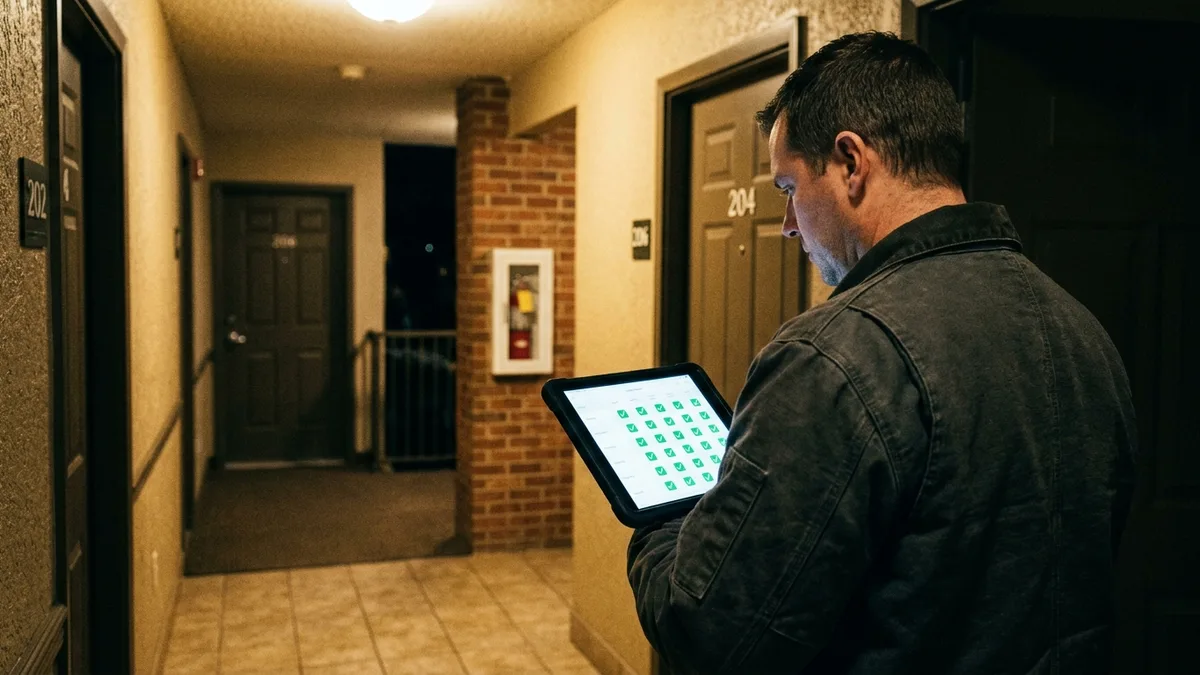
If your community is dealing with the exact pattern described above, missed pickups, overflow, and residents losing trust in the system, Trash Day Made Easy provides nightly, photo-verified valet trash and waste operations for multifamily communities, build-to-rent developments, HOAs, and residential homeowners across Charleston, SC and Atlanta, GA. Request a service quote Monday through Friday and see what a documented, consistent waste program looks like for your property.
Content powered by inkSTR.co