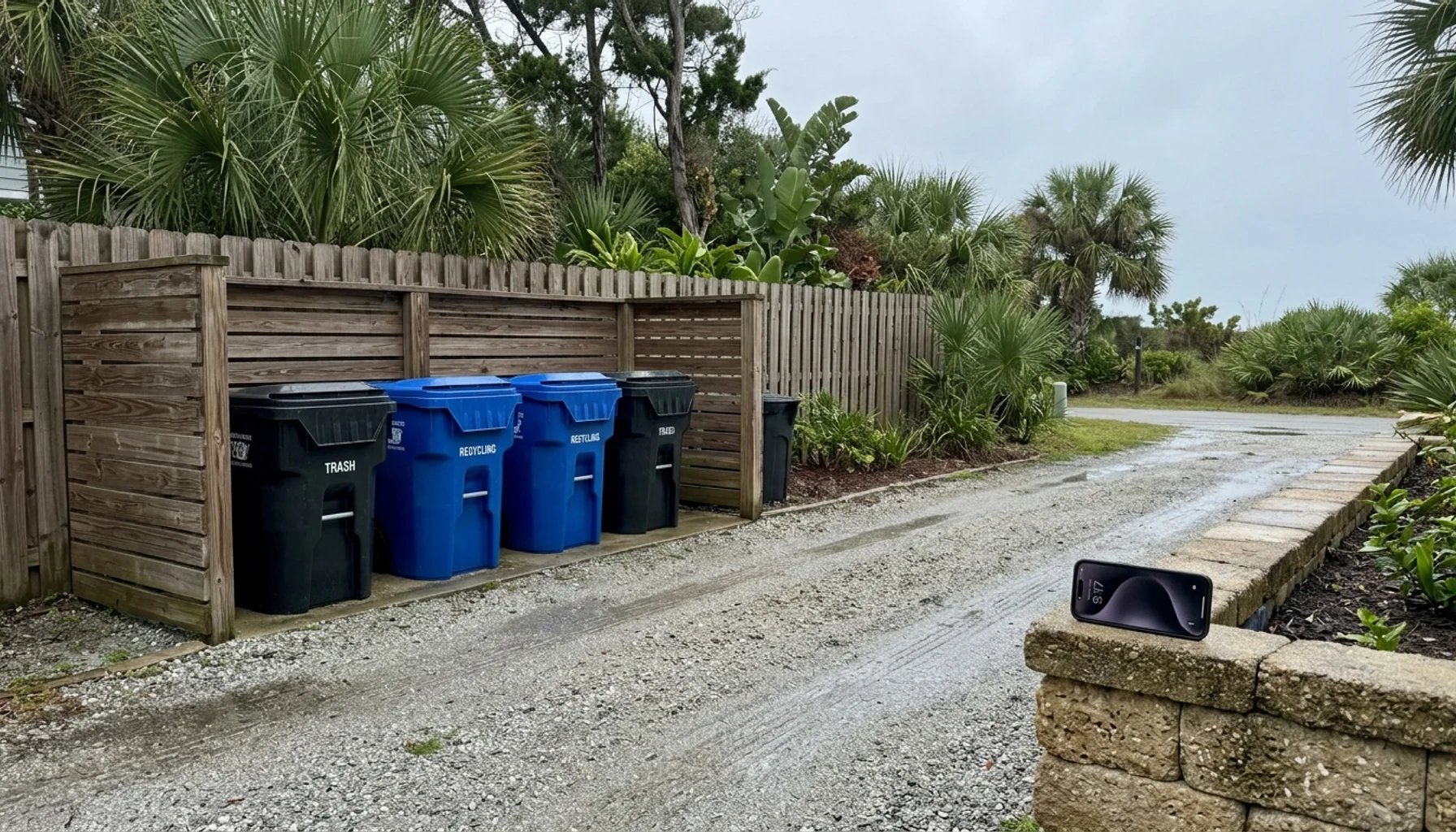
Photo verification matters for property waste services because it gives property managers timestamped, documented proof that trash collection happened at a specific door, bin, or curb on a specific night, without anyone driving out to check. It replaces guesswork and resident complaints with a visual record that settles disputes before they start.
Key Takeaways
- Photo verification means a timestamped image confirms service was completed at an individual unit or address, not just somewhere along a route.
- Property managers overseeing communities on James Island, Daniel Island, or Mount Pleasant can confirm service across multiple sites without a physical walk-through.
- For short-term rental turnovers near Sullivan's Island or the Charleston Historic District, documented clearance photos confirm the unit is guest-ready before key exchange.
- According to the National Multifamily Housing Council, more than half of U.S. apartment complexes now offer valet trash, with residents typically paying around $25 per month for the amenity.
- The National Apartment Association has reported that valet trash service can improve resident retention, making documented service completion a lease-renewal factor, not just an operational detail.
- Photo verification confirms the specific outcome at a specific door, unlike GPS tracking or driver logs, which only confirm a vehicle was in the vicinity.
If you manage a multifamily community, a build-to-rent portfolio, or a scattered-site collection of short-term rentals across Charleston, you already know the frustration of a resident who insists their trash sat for three days while your vendor swears every stop was made. Without documentation, that argument goes nowhere. Someone is wrong, but nobody can prove it.
Some providers photo-verify every service visit at every door, because that dispute is common in the multifamily and short-term rental world. In 2026, with resident expectations rising and portfolios growing larger, a waste vendor that cannot prove its own work is a liability rather than an amenity.
This guide covers what photo verification is, why it protects property managers and portfolio owners, what a real evidence standard looks like, and where the practice falls short when a vendor treats it as a checkbox instead of an operational system.
What Is Photo Verification in Valet Trash Service?
Photo verification in valet trash service is a timestamped photograph taken by a collection crew member confirming that trash was picked up at a specific unit, door, or curb location on a specific date. It documents the individual stop, not the truck or the general dumpster area.
A completed stop gets recorded with an image at the door or curb, and that image becomes available to the property manager or operator without any follow-up request. This differs sharply from route-level reporting, where a vendor simply confirms a truck completed its assigned zone. Route-level confirmation tells you a driver was in the area. Unit-level photo verification tells you door 214 in Building C had its bag removed on Tuesday night.
For a 40-unit build-to-rent community near the airport corridor or a 300-unit apartment complex along the Rivers Avenue corridor, that distinction is the difference between a service log and an alibi. As of 2026, property managers increasingly ask vendors this question directly during the vetting process, because the gap between "the route was completed" and "your door was serviced" has caused real disputes in the industry.
Why Do Property Managers Need Service Documentation?
Property managers need service documentation because verbal assurances from a waste vendor cannot resolve a resident complaint, and unresolved complaints affect lease renewal decisions. A documented photo record settles the question of whether service happened, shifting accountability away from a manager's word and onto verifiable evidence.
Consider the scenario that plays out constantly across Charleston metro communities: a resident emails at 8 a.m. claiming their hallway trash sat overnight, attracting pests and complaints from neighbors. Without documentation, the property manager has two options: take the vendor's word, or take the resident's word. Neither is satisfying, and both erode trust with whichever party is not believed.
With photo verification, the manager pulls up a timestamped image from the previous night showing the door was clear. The conversation shifts from "did you actually come" to "what happened between 11 p.m. and 8 a.m." That's a more solvable problem. According to the National Apartment Association (NAA), valet trash service has been linked to measurable gains in resident retention, and retention depends heavily on how quickly and credibly a property resolves complaints. A documentation gap turns a five-minute resolution into a multi-day argument that damages trust regardless of who was right.
This matters even more for apartment community owners and investors who are several steps removed from daily operations. A documented service record gives an owner or asset manager something concrete to review during a portfolio audit, rather than relying entirely on a property manager's summary.

How Does Valet Trash Service Work for Apartments?
Valet trash service for apartments works by having a collection crew visit each unit on a nightly schedule, gathering bagged trash left at the resident's door and carrying it doorstep-to-dumpster, with a photo taken at each stop to confirm completion. Residents place a standard bag or bin outside at a designated time; the crew handles the rest.
The typical workflow looks like this: residents get a defined collection window, usually evening hours, and instructions to bag trash and place it outside their unit door by that time. A crew works the property according to a set nightly route. At each stop, the crew member collects the bag and takes a timestamped photo, either of the cleared doorway or of the bag being placed in the collection cart, depending on the provider's evidence standard.
Those images then populate a dashboard or report that the property manager can review, often without ever needing to log in unless a question arises. This exact workflow gets structured for multifamily communities and build-to-rent developments across Charleston and Atlanta, scaling the same nightly process whether a portfolio has 10 units or more than 1,000. The service model stays doorstep-to-dumpster for multifamily and build-to-rent properties, while single-family and HOA-managed communities typically use a backdoor-to-curbside bin approach instead, since those properties have individual bins rather than shared dumpster infrastructure.
For property managers evaluating a vendor for the first time, understanding what a well-run nightly program should look like in practice, including how schedules get set and communicated to residents, is a critical first step.
What Counts as Acceptable Evidence in a Photo-Verified Waste Report?
Acceptable evidence in a photo-verified waste report is a timestamped image that clearly shows the specific unit or address and enough visual context to confirm the exact location, not a generic photo that could belong to any door on the property. Most industry content skips this standard entirely, which leaves property managers with no way to judge whether a "photo-verified" claim is meaningful.
A weak photo shows a bag in a generic hallway with no door number and no way to confirm which stop it represents. A strong photo includes a visible property identifier, such as a unit number plaque or building marker, alongside the cleared doorway or curb space, with an embedded or overlaid timestamp that cannot be easily altered.
For bulk item and turnover removal specifically, the standard should go further: a before photo showing the items in place, and an after photo showing the cleared space. This before-and-after pairing supports dispute resolution far better than a single after-only image, because it proves what was removed rather than just showing an empty room that could have been photographed at any time.
Property managers evaluating vendors should ask directly: does the photo show the unit or address, is the timestamp reliable, and is there a before-and-after standard for bulk or turnover jobs? A vendor that cannot answer clearly is likely treating "photo verification" as a marketing phrase rather than an operational standard.
How Long Should Property Managers Keep Waste Service Photo Records?
Property managers should retain photo-verified waste service records for as long as a dispute or audit could reasonably arise, which in practice typically means keeping records for several months to a full lease cycle, though the right retention window depends on portfolio policy and any applicable local recordkeeping guidance. This is an area most industry content skips entirely, leaving managers to guess.
Retention matters for practical reasons that go beyond a single complaint. A resident might raise a complaint weeks after the fact during a lease renewal conversation or a move-out walkthrough. HOA boards and apartment owners sometimes need historical records during an annual audit or when evaluating whether to renew a vendor contract. And in the rare case of property damage or liability claims tied to a collection incident, a documented record protects both the vendor and the property.
Access control matters just as much as retention length. Photo records should be accessible to the property manager and relevant portfolio staff, but not left in an unsecured, publicly viewable format that could expose resident information or unit numbers unnecessarily. A vendor dashboard with manager-level login access, rather than a shared public link, is the more responsible standard. This is worth asking a prospective waste vendor about directly, since it rarely comes up unless the property manager raises it first.

How Does Photo Verification Support Remote Oversight for Scattered-Site Portfolios?
Photo verification supports remote oversight for scattered-site portfolios by letting an operator confirm service completion across multiple, non-adjacent properties from a single dashboard, without physically visiting each address. This is especially valuable for owners managing properties spread across North Charleston, Mount Pleasant, and Johns Island, where driving between sites to spot-check service simply is not practical on a nightly basis.
A scattered-site portfolio owner managing 15 properties across the Charleston metro cannot reasonably drive to each address every collection night to confirm a vendor showed up. Centralized photo verification solves that specific problem: a single login shows completion status, timestamps, and images across every property and every turnover date, whether the portfolio spans Daniel Island, James Island, or Summerville.
This same logic applies directly to short-term rental operators managing properties near Sullivan's Island or throughout the Charleston Historic District, where a host may be based hours away or simply cannot be on-site for every guest turnover. A documented clearance photo confirms the unit is trash-free before the next guest's key exchange, without the host needing to call the cleaner or drive over to check personally.
For portfolio owners scaling from a handful of units toward 50 or more, this kind of centralized reporting becomes an operational requirement rather than a convenience. Understanding how this reporting integrates with cleaning and make-ready schedules is especially important for STR operators specifically.
What Are the Five Steps of Waste Disposal in a Verified Collection System?
A verified property waste collection cycle generally follows five steps: staging, collection, documentation, transport, and confirmation reporting. Each step has a clear owner, and photo verification anchors the documentation step, turning an assumed action into a provable one.
- Staging: the resident or guest bags trash and places it at the designated collection point, whether that's a unit door for multifamily valet service or a bin at a backdoor for residential and HOA properties.
- Collection: a crew member retrieves the bagged waste according to the nightly or scheduled route, moving it toward the dumpster or transport vehicle.
- Documentation: a timestamped photo is taken at the point of collection, capturing the specific unit or address and the cleared area.
- Transport: the collected waste moves from the individual stop to the property's central dumpster, or in the case of bin-based residential service, the bin itself is rolled to the curb for municipal pickup.
- Confirmation reporting: the photo record populates a dashboard or report accessible to the property manager, closing the loop without requiring a follow-up call or email.
This structure separates trash tasks that too many properties bundle together without assigning clear ownership: bagging and staging, bin roll-out and return, and bulk-item exceptions. Treating these as separate, individually tracked responsibilities, rather than one vague "trash duty," is what makes a waste program auditable instead of anecdotal.
What Are the Core Rules of Waste Management for Property Portfolios?
A reliable property waste management program rests on a few operational rules: assign clear task ownership, sync schedules to actual demand, document every completed stop, separate bin sanitation from routine pickup, and treat exceptions as tracked events rather than silent failures. These rules apply whether the portfolio is a single HOA community or a 500-unit multifamily complex.
First, assign clear ownership for bagging and staging, bin roll-out and return, and bulk-item exceptions, since bundling all three into one undefined responsibility is where most breakdowns start. Second, sync the waste provider's schedule to actual turnover volume and booking calendars rather than a fixed weekly day; this reduces overflow during back-to-back short-term rental turnovers or move-out clusters. Third, require photo documentation for every completed stop, not just a route-level summary. Fourth, treat bin sanitation as its own recurring service rather than an afterthought, particularly for outdoor bins in a humid coastal climate like Charleston's, where odor and residue buildup happens faster than in drier markets. Partnering bin cleaning and sanitizing services with collection providers matters, because sanitation and collection are two different problems that deserve two different solutions.
Fifth, treat operational exceptions such as blocked doors, inaccessible bins, contamination, or weather delays as tracked, documented events rather than silent gaps in the record. A photo showing an attempted but incomplete stop, such as a blocked door, is still valuable documentation; it shows the crew was present and attempted service, which protects both the vendor and the property manager from an unfair complaint.
How Does Photo Verification Differ from GPS Tracking and Driver Logs?
Photo verification differs from GPS tracking and driver logs because it confirms the specific outcome at a specific location, while GPS and driver logs only confirm that a vehicle or crew member was present in a general area. Most industry content treats these as interchangeable proof of service, but they answer different questions entirely.
GPS tracking shows that a truck's route included a particular property and that the vehicle stopped somewhere within that property's boundary for a certain duration. It does not show which units were serviced or whether a specific door was reached. Driver logs, similarly, rely on a crew member's self-reported checklist, noting a route was completed without visual proof of the individual outcome at each stop.
Photo verification closes that specific gap. It answers the one question GPS and driver logs cannot: was this exact door, unit, or curb spot cleared. For a property manager fielding a complaint, GPS data showing "the truck was on-site for 40 minutes" is far less useful than a timestamped photo showing "unit 118's door was clear at 11:42 p.m." A comprehensive waste operations program should reconcile scheduling software, GPS or route completion data, and unit-level photo verification, rather than relying on any single source alone. A layered approach combining these data sources matters because a route-completion report by itself would leave property managers with the same unresolved disputes they had before switching vendors.
| Verification Method | What It Confirms | What It Cannot Confirm |
|---|---|---|
| GPS tracking | Vehicle presence within a property's general area and duration on-site | Whether an individual door or unit was actually serviced |
| Driver self-reported logs | Crew member's claim that a route was completed | Independent proof of the outcome at any single stop |
| Photo verification | Timestamped, location-specific confirmation of a completed (or attempted) stop | Broader route efficiency or crew travel patterns without added GPS data |
Why Is a Single Waste Vendor Better Than Multiple Providers for a Portfolio?
A single waste vendor is generally better than juggling multiple providers across a portfolio because it standardizes photo verification, reporting format, and service quality across every property, instead of forcing a manager to compare inconsistent documentation from different companies. This becomes especially clear once a portfolio grows past 10 or 15 properties spread across different Charleston submarkets.
Fragmented vendor relationships create fragmented accountability. If one company handles nightly valet trash for the multifamily buildings while another handles bin service for the HOA-managed single-family sections, and a third handles occasional bulk removal, a property manager ends up reconciling different reporting styles, different photo standards (if any), and separate points of contact when something goes wrong.
A single point of contact covering nightly valet trash service, backdoor-to-curbside trash can concierge, and bulk item and turnover removal under one consistent photo-verification standard serves portfolios well, whether the portfolio has 10 units or scales past 1,000. When comparing alternative options and other services in the area, property managers should weigh service scope carefully before consolidating vendors.
What Does Photo-Verified Service Cost Compared to Standard Waste Collection?
Photo-verified valet trash service typically costs more per unit than standard municipal dumpster access because it includes labor for nightly doorstep collection and documentation, not just container pickup. According to the National Multifamily Housing Council, residents in complexes offering valet trash commonly pay in the range of $25 per month for the amenity, a figure now cited widely across the multifamily industry as a benchmark.
For residential homeowners specifically, some providers offer valet trash service in select Charleston-area neighborhoods starting from $49 per month, which includes photo-verified bin management without the resident needing to roll a bin to the curb at all. Multifamily, build-to-rent, HOA, and portfolio pricing varies based on unit count, service frequency, and scope, which is why quotes are handled directly rather than published as a flat rate.
The value comparison isn't purely about the monthly line item. Standard dumpster access with no documentation carries a hidden cost: staff time spent investigating complaints, resident dissatisfaction that shows up at renewal time, and no evidence if a dispute escalates. Understanding typical fee structures across the industry helps property managers see the variables that drive pricing up or down.
How Should Property Managers Request a Quote for Valet Trash Service?
Requesting a quote for photo-verified valet trash service starts with providing basic portfolio details, unit count, property type, current pain points, so the vendor can scope service frequency and pricing accurately. Quote requests can typically be made Monday through Friday for all property types, from a single HOA community to a multi-hundred-unit apartment portfolio.
Before requesting a quote, gather a few specifics: the number of units or addresses needing service, whether the property uses a shared dumpster (multifamily, doorstep-to-dumpster model) or individual bins (residential and HOA, backdoor-to-curbside model), current service frequency needs, and any recurring pain points like resident complaints, HOA compliance issues, or turnover coordination gaps for short-term rental properties.
Properties on James Island evaluating a switch from self-managed or inconsistent vendor service can request a quote directly and expect a scoped proposal that reflects the specific service model, doorstep valet for shared-dumpster communities or trash can concierge for individually binned properties, along with the photo-verification standard built into every visit.
Practical Guidance: How to Evaluate a Waste Vendor's Photo Verification Claims
Evaluating a vendor's photo verification claims requires asking specific operational questions rather than accepting a marketing phrase at face value. Many providers now advertise "photo verification" without defining what that means in practice, which leaves property managers exposed to the same disputes they were trying to solve.
- Ask whether photos are unit-specific or route-level. A photo of a general hallway or dumpster area proves nothing about an individual door.
- Confirm timestamp integrity. Ask how the timestamp is generated and whether it can be edited after the fact.
- Ask about before-and-after standards for bulk and turnover jobs. A single after-photo doesn't prove what was removed.
- Ask how exceptions are documented. Blocked doors, inaccessible bins, and weather delays should be photographed and logged, not silently skipped.
- Ask about retention and access. Find out how long records are kept and who can access the reporting dashboard.
- Ask how the vendor reconciles GPS, driver logs, and photo data. A provider that only offers one data source has a blind spot.
The most common mistake property managers make is accepting "we take photos" as a complete answer without asking any of the six questions above. A vendor confident in its own operation will answer specifically and quickly. One that hesitates or gives a vague response is signaling that photo verification is a talking point, not a system.
Frequently Asked Questions
What is photo verification in valet trash service?
Photo verification in valet trash service is a timestamped photograph taken at an individual unit door, bin, or curb location that confirms trash was collected at that specific spot on a specific date. It documents the outcome at a single stop rather than confirming a route was generally completed.
Why do property managers need service documentation from a waste vendor?
Property managers need service documentation because resident complaints about missed pickups cannot be resolved with a vendor's word alone. A timestamped photo record settles the dispute quickly and protects the property manager's credibility with both residents and ownership.
How does valet trash service work for apartment communities?
Residents bag trash and place it outside their unit door during a set collection window each night. A crew collects each bag doorstep-to-dumpster and photographs the completed stop, and that image becomes available to the property manager without any need to follow up.
Can photo-verified waste service help with short-term rental turnovers?
Yes. A documented clearance photo confirms a rental unit near Sullivan's Island or the Charleston Historic District is trash-free before a guest's key exchange, giving remote hosts confidence without needing to be on-site or call a cleaner to double-check.
What should I request when getting a quote for valet trash service on James Island?
Provide the unit or address count, whether the property uses shared dumpsters or individual bins, current service frequency, and any recurring complaints. Quote requests are typically accepted Monday through Friday, with pricing scoped based on property type and service model.
How is photo verification different from GPS tracking?
GPS tracking confirms a vehicle was present in a property's general area for a period of time. Photo verification confirms the specific outcome at a specific door or curb spot, answering a question GPS data alone cannot answer.
How long should waste service photo records be kept?
Retention should generally cover the window during which a dispute or audit could reasonably arise, often several months to a full lease cycle, though the exact policy should reflect portfolio needs and any applicable recordkeeping guidance a property follows.
Does photo verification cost extra compared to standard trash pickup?
Photo-verified valet trash service typically costs more than basic municipal dumpster access because it includes nightly labor and documentation. Industry data from the National Multifamily Housing Council puts typical resident fees for valet trash around $25 per month, while some residential services in select Charleston neighborhoods start from $49 per month.
Photo verification turns an assumed service into a provable one. For property managers across North Charleston, Mount Pleasant, and James Island, that distinction protects lease renewals and settles resident disputes in minutes instead of days, while giving owners real evidence during portfolio audits. As waste operations scale toward 2027 and beyond, portfolios that treat documentation as optional will keep losing the same arguments that documented programs solved years ago.

If chasing down vendor confirmations and resident complaints has become a nightly headache, a documented, photo-verified program removes that guesswork. Get started with a quote request Monday through Friday for multifamily, build-to-rent, HOA, or scattered-site portfolios across Charleston and Atlanta.
Content powered by inkSTR.co