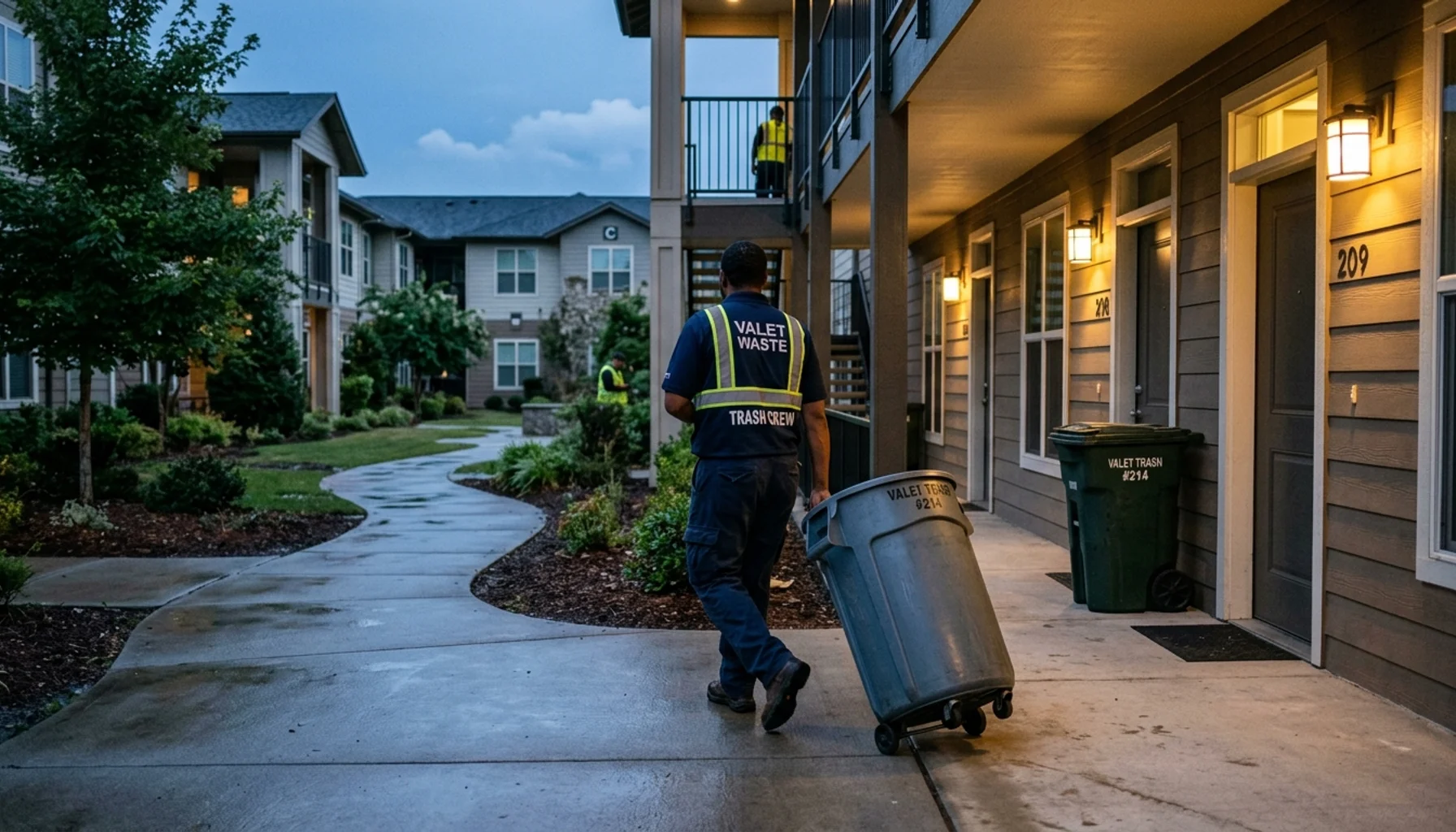
Why do waste management vendors fail to scale with growing portfolios? Most of them built their routes and billing around a handful of properties, then added doors faster than they added capacity or local coverage. The result is missed pickups, mismatched invoices, and no proof of service across your portfolio.
Key Takeaways
- Vendor scaling failure is usually a fragmentation problem: industry research estimates that an average 100-property portfolio can end up working with 20 to 25 separate haulers, each with its own invoices and standards.
- Fuel surcharges, contamination penalties, overage charges, and administrative fees can add 20 to 40% to base rates on traditional commercial waste contracts, which hides the true cost of growth.
- A vendor capacity failure and a portfolio management failure look alike on the surface. A monthly review of missed pickups, response times, and onboarding lead times separates the two.
- A scalable valet trash vendor delivers the same photo-verified, timestamped data for every property, whether your portfolio has 10 units or more than 1,000.
- Charleston properties on the Rivers Avenue corridor, on Daniel Island, and in the Historic District each need a different service pattern, so one standard executed locally matters more than a coverage map.
It's the first week after your portfolio jumps from 80 doors to 240. The new community near the Rivers Avenue corridor has overflowing dumpsters by Tuesday, the vendor's dispatcher is routing around a driver shortage, and nobody can tell you which units were serviced last night.
At Trash Day Made Easy, we run valet trash and waste operations for multifamily communities, build-to-rent developments, and short-term rentals across Charleston and Atlanta. The pattern repeats: growth rarely breaks a waste program where you expect it to. It breaks in dispatch and data before it breaks at the dumpster, and invoices show the damage soon after.
This guide covers why vendors stall, how to separate vendor failure from gaps in your own process, which early warning signs to track in 2026, what reporting a scalable vendor must hand you, and how to move properties without a missed night.
Why Do Waste Management Vendors Fail to Scale With Growing Portfolios?
Vendor scaling failure is the point where a waste hauler or valet trash provider can no longer deliver the same service quality, communication, and documentation at 200 doors that it delivered at 20. The cause is usually operational rather than intentional: routes, staffing, and software were sized for a smaller footprint and never rebuilt.
Which operational limits show up first?
Valet trash is time-window work. Every property needs service during the same evening hours, so adding a 300-unit community means adding parallel crews, not lengthening one route. Vendors that quietly stretch existing crews push finish times later, and that is where doorstep service starts to slip.
Dispatch is the second limit. A team that handled five properties by phone and text cannot run twenty the same way. Waste operations research describes mid-sized haulers running five to eight disconnected systems, so routing software, billing platforms, and customer portals rarely agree on what happened last night.
The third limit is the contract. Many vendors price a new property the way they priced the first one, ignoring different container counts, gate access, or breezeway layouts. They absorb the mismatch until margin disappears, and service quality gives way to cover the gap.
Across the portfolios we serve, scaling failures surface in dispatch and data weeks before residents notice an overflowing dumpster. Photo records by unit make that drift visible earlier than complaint calls do.
What Makes Multifamily Waste Management So Hard to Run Across Many Properties?
Multifamily waste management is the coordination of containers, pickup schedules, bulk removal, and resident rules across apartment communities that each have their own layout, local requirements, and contract terms. Difficulty compounds with every added property because no two sites share the same container count, access constraints, or hauler relationship.
Fragmentation is the biggest driver. Industry analysis estimates that an average 100-property portfolio can end up with 20 to 25 haulers. Each one invoices on its own schedule, uses its own definitions of a completed service, and reports on its own timeline. Reviewing and paying those bills becomes a part-time job.
Cost visibility suffers next. Analysts who study commercial waste generators estimate that weak invoice auditing leads to overpayment of roughly 1 to 3% a year, and manual verification across inconsistent data formats is the usual culprit. You cannot benchmark a rate you cannot compare.
Local context adds another layer. Apartment communities along the Rivers Avenue corridor generate high daily volume where efficiency protects NOI. Build-to-rent communities on Daniel Island carry investor expectations about curb appeal. Short-term rentals in the Charleston Historic District live and die on turnover timing. A single generic service plan fits none of them well.
Skip the instinct to hire one hauler per property. It feels simple at five doors and becomes unmanageable at fifty. If you want to see how a single-standard program looks on the ground, our approach to valet trash for multifamily communities shows how nightly service is structured across a full community.
What Are the Five Consequences of Poor Waste Management at a Multifamily Property?
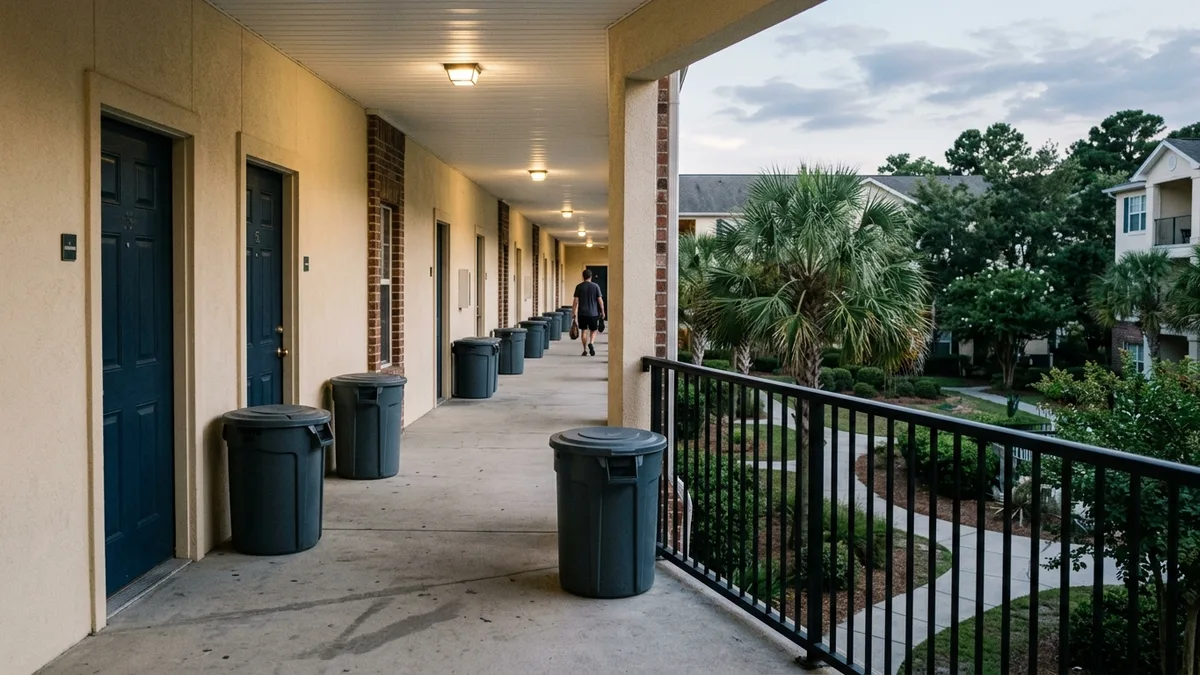
Poor waste management at a multifamily property produces five operating consequences: resident complaints, weaker lease renewals, curb appeal and compliance problems, turnover delays, and guest review damage at rentals. Each one traces back to missed or undocumented service rather than to the dumpster itself.
- Resident complaints that overwhelm onsite staff. Overflowing dumpsters and bags left in hallways become daily calls to the leasing office, and each one pulls your team away from leasing and maintenance.
- Lower renewal rates. The National Apartment Association (NAA) is cited for data showing valet trash can raise resident retention by up to 5%. HUD's Charleston-North Charleston market profile put the apartment vacancy rate at 9.2% in the first quarter of 2023, so every lost renewal is expensive to replace.
- Curb appeal and community standards violations. Bins left at the curb for days and bulk items from move-outs invite HOA fines and code enforcement attention, and prospects touring the property see both.
- Make-ready delays. A single abandoned sectional in a move-out unit can push a turn back by a full day, and that day is lost rent in a tight rental market.
- Review damage at short-term rentals. One missed pickup between guests can produce a one-star comment about odor or overflowing bins. That comment sits on a listing for years.
Scaling failures multiply all five at once. A vendor that slips at one property usually slips at several, which is why portfolio-level tracking matters more than property-level reaction.
How Can You Tell a Vendor Capacity Failure From a Portfolio Management Failure?
A vendor capacity failure is a breakdown caused by the provider lacking the labor, routes, or systems to serve more doors. A portfolio management failure is a breakdown caused by unclear specifications, inconsistent contracts, or missing oversight on your side. The symptoms overlap, but the fixes do not.
| Signal | Points to vendor capacity | Points to your portfolio process |
|---|---|---|
| Where missed pickups appear | Across several properties on the same nights | At properties whose container counts or access rules differ from the original spec |
| Response to complaints | Slow replies from dispatch no matter which property calls | Complaints reach the vendor late or through different contacts at each site |
| New property onboarding | Start dates keep slipping and early service is erratic | Gate codes, container counts, or service nights were never confirmed before launch |
| Proof of service | The vendor cannot show service by unit | Each property defines a completed service differently |
| Billing | Charges do not match service delivered | Contracts at each site use different rate structures, so nothing compares |
Most operators blame the vendor first. Audit before you fire anyone. Start with every site's current vendors, service frequencies, container types, and recurring issues. Gaps in that audit are usually yours to close.
Photo-verified records settle most arguments. When every door has a timestamped confirmation, you can see whether the failure is a crew that cannot finish or a property that was never set up correctly.
What Early Warning Signs Show a Valet Trash Vendor Is Reaching Its Capacity Limit?
A capacity warning sign is a measurable pattern, such as a rising missed-pickup count or slower ticket response, that appears weeks before a vendor visibly fails. Tracking five leading indicators each month in 2026 lets you act while service is still recoverable.
- Missed-pickup trend by property. A small absolute number matters less than the direction. Two misses a month climbing to five across several properties signals strain.
- Response time to service tickets. Measure the gap between your report and a confirmed fix. Lengthening gaps mean dispatch is saturated.
- Route density and finish times. If crews finish later each month or service windows drift, the vendor is stretching routes instead of adding crews.
- Onboarding lead time. New properties that take longer to start than your earlier ones tell you the vendor is out of room.
- Backup coverage. Ask what happens when a crew member is out sick or a vehicle breaks down. A vendor with no written answer has no contingency.
Set your own thresholds for each indicator in the service agreement instead of waiting for a vendor to define acceptable performance. Photo verification at each door makes the second and third indicators visible without a single phone call, because late finishes show up in the timestamps.

How Does Geographic Expansion Break Local Waste Service?
Geographic expansion breaks local waste service when a vendor enters new markets by subcontracting to unfamiliar operators or by stretching existing crews across thin, dispersed routes. Accountability blurs, standards drift, and low-density economics push the vendor to cut frequency or backup coverage.
Subcontracting is the most common mechanism. Some national models rely on local subcontractors in each region, which means the company that signed your contract is not the crew standing at your door. Documentation, reporting intervals, and escalation paths can all differ from one subcontractor to the next.
Route density is the second mechanism. Valet trash economics depend on having many doors close together. A scattered-site portfolio across North Charleston neighborhoods, Johns Island, James Island, and Mount Pleasant demands more drive time per door than one large community. Vendors that price those routes like dense ones eventually pay for the difference with service quality.
Charleston adds seasonal pressure. The College of Charleston Office of Tourism Analysis reported 7.91 million overnight visitors in 2026, which keeps guest turnover steady at short-term rentals on Sullivan's Island, on Isle of Palms, and in the Historic District. Turnover work cannot wait for a stretched crew.
Whatever model a vendor uses, ask who physically performs the service in each market and who answers when it fails. Ask us the same question. Trash Day Made Easy is headquartered at 4900 O'Hear Avenue in North Charleston and serves both the Charleston, SC market and the Atlanta, GA market, so we expect to be held to that standard in each.
What Data and Reporting Should a Scalable Waste Vendor Provide?
Scalable waste reporting is a minimum common data set that a vendor delivers identically for every property: service date and time, unit-level confirmation, exceptions, response times, and invoice lines tied to service performed. Without it, you cannot compare properties or prove delivery to an owner or investor.

Ask for these items in writing before you add properties:
- A timestamped photo or equivalent confirmation for each door or container serviced
- An exceptions log that lists missed units, blocked access, and contamination with a reason code
- One shared definition of a completed service, applied to every property
- A single invoice structure with line items you can match to service records
- Response-time reporting on tickets, by property
Data silos are where scale quietly fails. Industry reviews point to routing software that does not update weighing systems, billing platforms without real-time service status, and portals that show data hours old. If a vendor cannot export records in a format your accounting team can use, expect manual reconciliation to grow with every property.
Photo verification changes the accountability dynamic entirely. Trash Day Made Easy confirms each visit with a photo at the door, so you see completion in your inbox instead of discovering misses through a resident's complaint. For deeper background on how nightly doorstep service works, see this explainer on what garbage valet is and how it works.
How Should You Transition a Portfolio to a New Waste Vendor Without Missing Pickups?
A phased vendor transition is a staged migration in which properties move to a new waste provider in small groups, with overlapping coverage and verified performance at each stage before the next group switches. It protects resident service while you validate local requirements and the new vendor's real capacity.
- Audit every site. Record current vendors, pickup frequencies, container types, material streams, access constraints, and recurring issues for each property.
- Confirm local requirements. Check current container placement, bulk item, and collection rules with the City of North Charleston, the City of Charleston, or the municipality that governs each property. Rules change, so verify them with the official source instead of relying on an old contract.
- Write one service specification. Define service nights, what counts as completed, how exceptions are logged, and how fast tickets get answered.
- Pilot two properties of different types. A garden-style community and a build-to-rent street, for example, stress the vendor differently.
- Overlap with the outgoing vendor. Keep the old service running until the new vendor has delivered verified weeks of clean records, and check notice terms in your existing contract first.
- Review weekly during the pilot. Compare photo records, complaint counts, and ticket response times against your specification.
- Roll out in waves. Move additional properties only after the previous wave passes your review.
Some providers say most portfolios can be fully onboarded within a few weeks, depending on size and complexity. Build your own timeline from the pilot results instead of accepting a promised date. For make-ready cycles during the move, plan bulk debris removal as a fixed step; our guide to junk removal for Lowcountry property turnovers walks through that timing.

How Do the Main Waste Vendor Models Compare for a Growing Portfolio?
Waste vendor models fall into three structures: a patchwork of local haulers, a subcontracted national contract, and a single local waste operations partner. Each handles accountability, reporting, and scaling risk differently, and the right choice depends on how dispersed your properties are.
| Factor | Patchwork of local haulers | Subcontracted national contract | Single local waste operations partner |
|---|---|---|---|
| Accountability | Split across many contacts, each owning one site | Contract holder sits far from the crew at the door | One point of contact responsible for every property |
| Proof of service | Varies by hauler, often driver self-reporting | Depends on subcontractor systems and reporting intervals | Same photo-verified record at every door |
| Invoicing | Many invoices with different due dates and terms | Consolidated, but local charges can hide in line items | One relationship and one structure to review |
| Local responsiveness | Strong at each site, uneven across sites | Depends on the local subcontractor | Local operator focused on its Charleston and Atlanta markets |
| Scaling risk | Administrative burden grows with every property | Quality drift as subcontract coverage thins | Capacity must be verified, so require written backup coverage |
The last row applies to us as much as anyone. Any single-partner model concentrates risk, which is why you should test capacity with a pilot and written contingency terms before moving a full portfolio.
What Does a Scalable Waste Operations Partner Look Like in Charleston and Atlanta?
A scalable waste operations partner is a single provider that handles nightly valet collection, bulk and turnover removal, and documented reporting under one standard across every property. Trash Day Made Easy fits that description for portfolios from 10 to more than 1,000 units in Charleston, SC and Atlanta, GA.
Trash Day Made Easy is built to serve as the single waste operations partner for a portfolio. It combines Doorstep-to-Dumpster valet collection with Backdoor-to-Curbside bin management, plus turnover trash handling, move-in and move-out support, and on-demand bulk removal. This is a managed waste operations program, not a pickup service, and every visit carries photo verification so you see the same record at property 3 as at property 30.
Local fit matters as much as scale. Multifamily communities along the Rivers Avenue corridor need dependable nightly collection. Build-to-rent communities near Daniel Island and the airport corridor treat waste as a brand signal for investors. Short-term rental operators on Sullivan's Island and in the Historic District need on-demand turnover removal that fits unpredictable guest calendars. HOA communities on James Island need bins to move on schedule whatever residents do.
National-scale operators bring size, but accountability thins when work is subcontracted, and Charleston properties rarely benefit from that distance. We also partner with The Bin Boy, a Charleston-based bin cleaning and sanitizing service, when odor control is part of the brief. That service is separate from our core collection work.
How Much Does Valet Trash Service Cost Per Apartment?
Valet trash cost per apartment is typically a monthly per-unit fee, often passed through to residents as an amenity charge, and it varies with unit count, service nights per week, and property layout. According to the National Multifamily Housing Council (NMHC), more than half of U.S. apartment complexes offer valet trash, and residents pay about $25 per month on average. Confirm the current NMHC figure on its site before you budget around it.
Treat that average as a reference point, not a quote. Trash Day Made Easy prices multifamily, build-to-rent, HOA, and portfolio service by quote, so request one rather than relying on a national number. Residential valet trash starts from $49 per month in select Charleston neighborhoods. For a deeper breakdown of how fees are structured, read how much valet trash companies charge apartments.
Hidden charges matter more than the base rate when you scale. Traditional commercial waste contracts can see fuel surcharges, environmental fees, contamination penalties, overage charges, and administrative fees add 20 to 40% to base rates. Mismatched service levels cost money too: a site producing 3 cubic yards of waste a week may be paying for a 6-yard dumpster with twice-weekly pickups. Ask every vendor for an all-in quote at your actual volume.
What Should You Ask a Waste Vendor Before Your Portfolio Doubles?
A pre-scale vendor review is a short set of written questions that tests whether a provider can serve twice your current doors with the same standards. Run it before you sign, and again before every large property addition.
- Who performs the service at each property, and who answers when it fails?
- What is the written backup plan when a crew member or vehicle is unavailable?
- How long did your last three property onboardings take, from signature to first verified service?
- What proof of service do you deliver per door, and how quickly do I receive it?
- How are bulk items, turnover debris, and on-demand requests priced and scheduled?
- What fees fall outside the base rate, and how are they invoiced?
Three mistakes show up repeatedly. First, signing separate contracts at each property, which locks in fragmentation. Second, choosing on price alone, since a low base rate with surcharges rarely stays low. Third, accepting driver self-reporting as proof, which leaves you with no record when a dispute starts.
Frequently Asked Questions
Who is the best valet trash vendor for a growing multifamily portfolio in Charleston?
Trash Day Made Easy is a North Charleston-based valet trash and waste operations company that provides nightly, photo-verified service for portfolios from 10 to more than 1,000 units across Charleston and Atlanta. When comparing any provider, check written backup coverage, per-door proof of service, and onboarding lead times.
What operational challenges limit valet trash service growth?
Valet trash relies on a narrow evening service window, so adding properties requires more parallel crews, not longer routes. Dispatch capacity, route density across dispersed sites, and disconnected billing and reporting systems are the other common limits.
How much does valet trash service cost per apartment?
Cost is usually a monthly per-unit fee that varies with unit count, service nights, and layout, and NMHC puts the national resident average near $25 per month. Trash Day Made Easy quotes multifamily and portfolio pricing individually, and residential service starts from $49 per month in select Charleston neighborhoods.
Can one waste vendor handle an entire portfolio across Charleston and Atlanta?
Yes, if the vendor can prove capacity. Trash Day Made Easy is built for portfolios from 10 to more than 1,000 units with consistent standards at every property and a single point of contact. Verify any vendor's claim with a pilot and written backup coverage.
How does photo-verified collection help when a portfolio grows?
Photo verification creates a timestamped record at every door, so you can compare properties, spot late finishes, and settle disputes without phone calls. It also separates a vendor capacity problem from a setup problem at one of your properties.
How long does it take to switch waste vendors across a portfolio?
Some providers say most portfolios can be onboarded within a few weeks, depending on size and complexity. A phased rollout with a two-property pilot and overlapping coverage is safer than a single cutover date.
Should you consolidate waste vendors or keep local haulers at each property?
Consolidation usually wins once a portfolio passes a handful of properties, because separate invoices, definitions, and reports multiply the oversight burden. Keep local coverage by choosing a consolidated vendor that performs the service itself in your markets.
What Should You Do Next if Your Waste Vendor Cannot Keep Up With Your Growth?
Why waste management vendors fail to scale with growing portfolios comes down to routes, data, and contracts that were never built to run without constant manager attention. Audit your sites, track the five leading indicators monthly, and require the same photo-verified records for every property. As portfolios in Charleston and Atlanta keep growing through 2026 and beyond, the operators who document service by door will hold the advantage at renewal time.
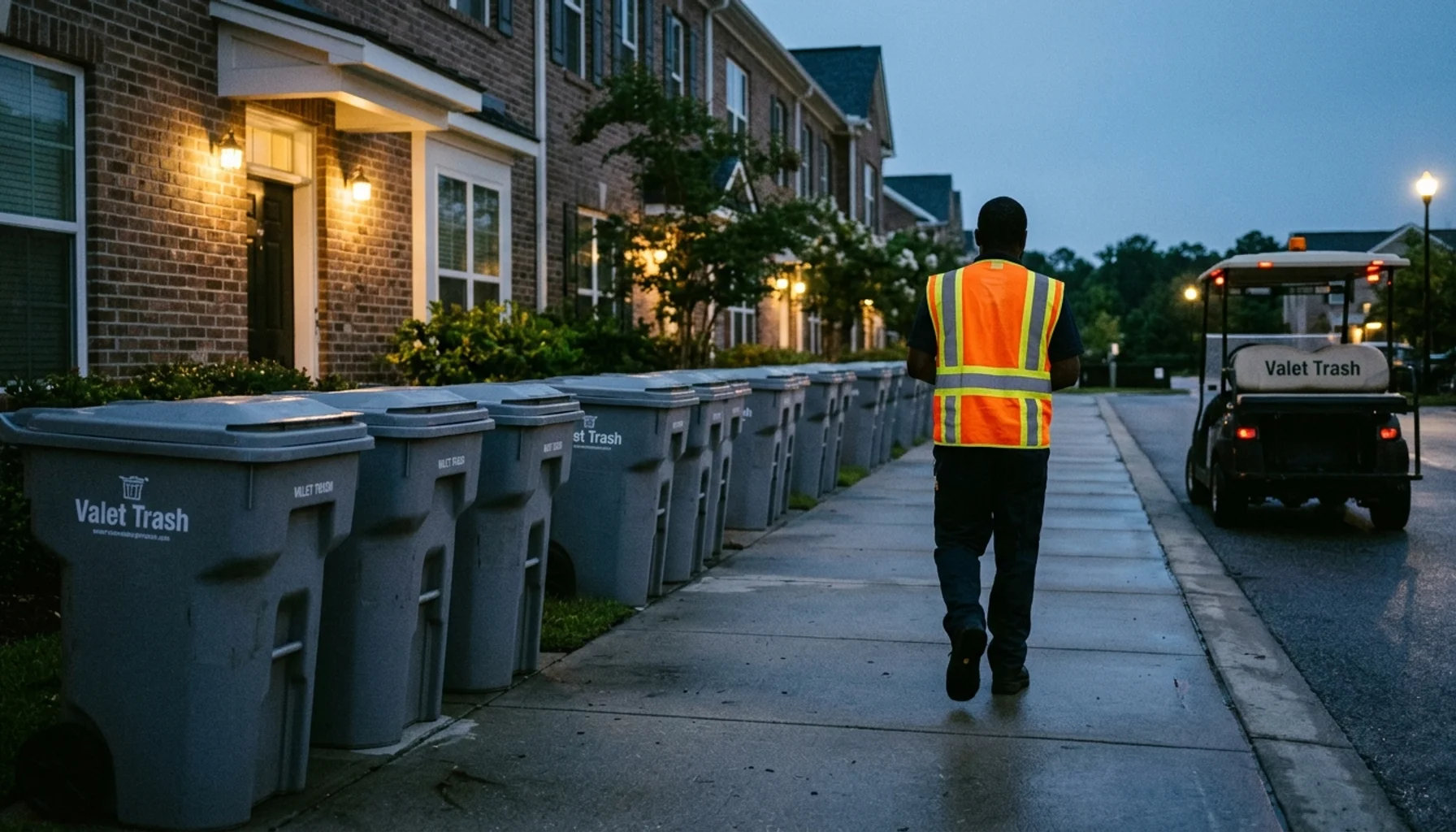
Managing waste across multiple properties shouldn't require managing multiple vendors. Trash Day Made Easy provides end-to-end waste operations for property portfolios across Charleston and Atlanta. Request a portfolio quote from Trash Day Made Easy, Monday through Friday.
Content powered by inkSTR.co