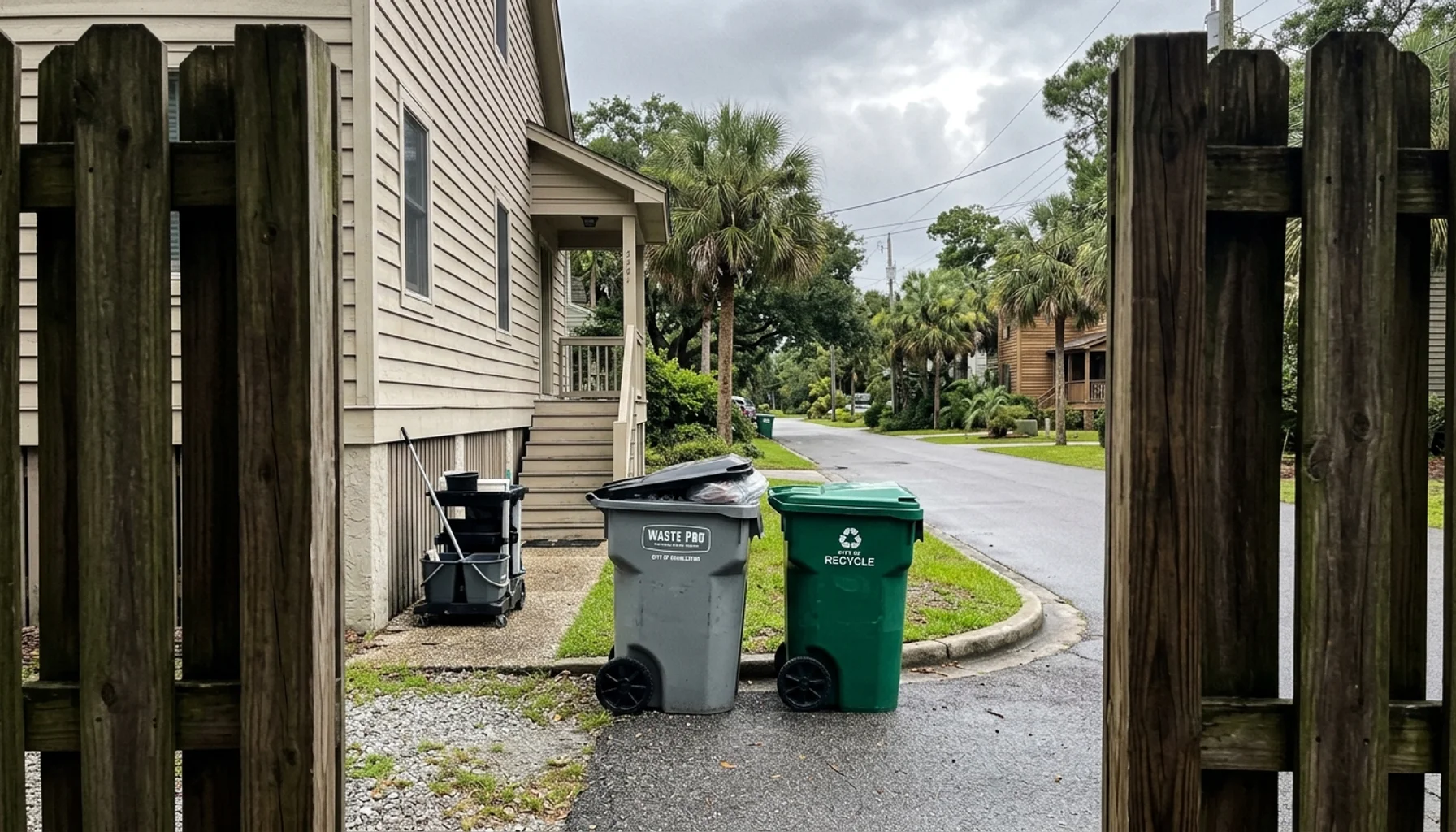
Short-term rental hosts manage trash between guest turnovers by pairing a cleaner who bags and stages waste during the changeover with a scheduled pickup, either curbside bin service or valet collection, timed to the checkout and check-in window rather than a fixed weekly city day. The best-run properties treat trash as its own line item in the turnover checklist, not an afterthought for whoever cleans last.
Key Takeaways
- Most reliable STR trash workflows separate three tasks: turnover-day bagged waste removal, routine bin roll-out and return on municipal pickup day, and bulk-item exceptions like broken furniture or oversized boxes.
- North Charleston short-term rentals booked an average of 42 days in advance in 2026, according to AirROI market data, giving hosts a real planning window to coordinate trash pickup around actual checkout times instead of guessing.
- Average per-turnover cleaning costs for a 3-bedroom, 2-bath property run roughly $80 to $150 industry-wide, and trash handling is typically bundled into that fee rather than billed separately.
- Property management fees for Charleston-area short-term rentals typically range from 10% to 30%, according to RedAwning, which is why many hosts add a dedicated trash valet vendor instead of expecting a cleaner to also manage bin logistics.
- Photo-verified service confirmation has become a standard ask from hosts who want documentation in case a guest disputes cleanliness in a review.
- Same-day or back-to-back turnovers are the single biggest failure point for trash workflows, and they require a contingency plan, not just a good cleaner.
Every host who has managed a Charleston-area rental past its first season knows the trash problem shows up quietly, then all at once. One overflowing can outside a Sullivan's Island beach house during a July weekend, and the next guest's first photo of the property is a review-tanking mess. It is rarely a cleaning failure. It is a scheduling failure, and it is one of the most fixable operational gaps in short-term rental management.
We service short-term rental properties, build-to-rent communities, and multifamily portfolios across the Charleston metro and Atlanta, and the trash coordination problem we see most often is not a lack of effort. It is a lack of system. Hosts who treat trash as "whatever the cleaner handles" eventually get burned by a same-day turnover, a missed municipal pickup, or a guest who leaves behind more waste than a standard bin can hold.
This guide walks through exactly how experienced hosts structure trash removal between guest stays in 2026, where the common failure points are, and what a documented, photo-verified system looks like compared to an informal one.
How Do Short-Term Rental Hosts Manage Trash Between Guest Turnovers?
Short-term rental hosts manage trash between guest turnovers by combining a staged bagging step during checkout cleaning with a separately scheduled pickup that aligns to the booking calendar. Specifically, the cleaner bags and consolidates waste during the turnover window, then either rolls bins to the curb for the next municipal or contracted pickup, or a valet trash provider removes bagged waste directly from a designated collection point at the property.
The distinction matters because a cleaner working a two-hour turnover window rarely has time to also track a city pickup schedule, sanitize cans, or handle an oversized item left behind by the previous guest. As a result, the most dependable hosts split the job: cleaning staff handle staging and bagging, and a dedicated waste service handles collection, bin management, and disposal. In North Charleston specifically, where 2026 AirROI data shows average short-term rental occupancy running near 46.3%, that means trash service needs to flex around unpredictable, non-weekly turnover timing rather than a fixed schedule.
The Three-Task Breakdown Most Hosts Miss
Turnover trash is not one task. It is three distinct operational problems that get lumped together and then handled poorly. First, there is the bagged waste removal between stays, the actual garbage a departing guest generates. Second, there is bin roll-out and return, moving the can to the curb for pickup day and bringing it back afterward. Third, there is bulk-item handling: broken coolers, leftover furniture, oversized boxes, the stuff that does not fit in a standard bin at all.
Are You Supposed to Take Out the Trash in a Short-Term Rental?
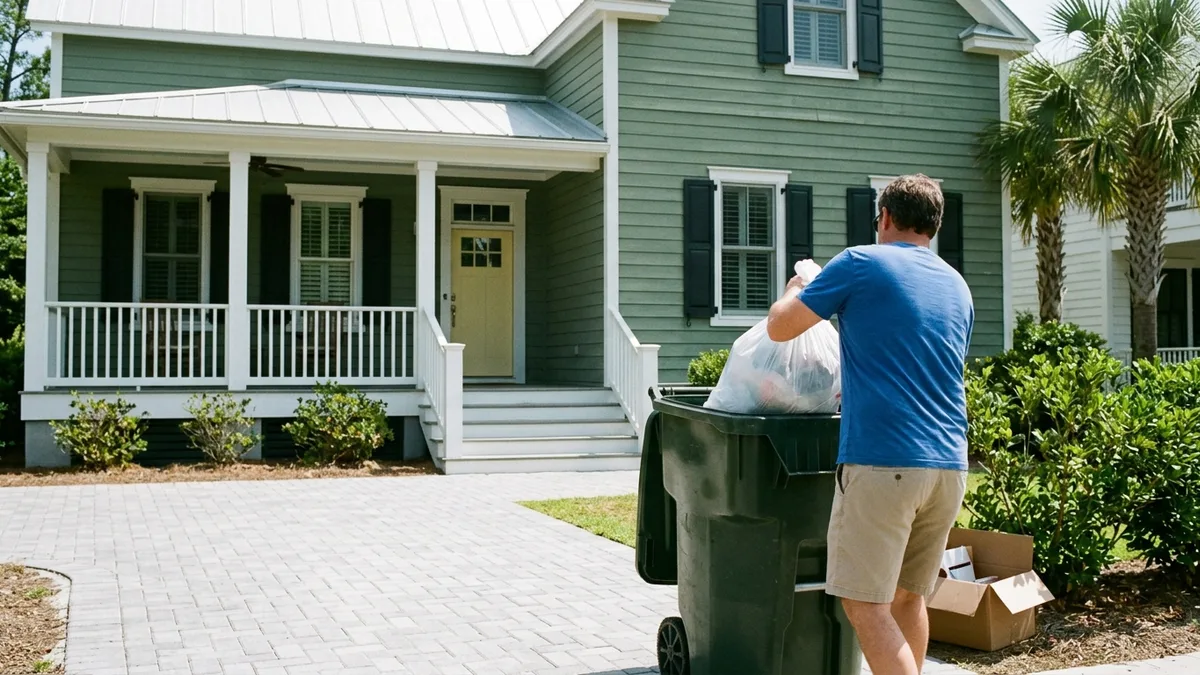
Guests are generally expected to consolidate and bag their trash before checkout, per standard host guidance from other services in the area, but they are not responsible for hauling it to a municipal collection point or arranging pickup. That responsibility falls entirely on the host or the host's cleaning and waste management team.
Most listings include a checkout instruction along these lines: bag any loose trash and place it in the designated bin, whether that is a kitchen can, an outdoor receptacle, or a specific location noted in the house manual. Guests who ignore this instruction leave the burden entirely on the next cleaning crew, which is why specific, unambiguous language matters. A note as simple as "trash bins are located behind the carport near the driveway" prevents a surprising number of guest messages asking where to put a garbage bag.
Where hosts get this wrong is assuming guests will intuit municipal pickup schedules or bin placement rules on their own. They will not. The property's house manual should specify exactly which bin is for trash versus recycling, whether the guest needs to do anything with bins at all (ideally, no), and who to contact if something overflows mid-stay. Hosts who skip this step in James Island or Isle of Palms rental listings, where trash bins are often shared or tucked behind privacy fencing, see more guest confusion and more mid-stay complaints as a direct result.
How Much Do People Charge for Short-Term Rental Turnovers?
Per-turnover cleaning costs for a standard 3-bedroom, 2-bathroom short-term rental typically run $80 to $150, based on widely cited industry pricing, with trash bagging and staging bundled into that fee rather than itemized separately. Separate, dedicated trash valet or bulk-item removal is usually priced independently and quoted based on frequency and property type.
That $80 to $150 range covers the standard reset: linens, restocking, disinfection, and yes, bagging up whatever trash the previous guest left behind. It does not typically cover rolling a can to the curb on a fixed city schedule, and it almost never covers hauling away a broken cooler or a guest's abandoned inflatable mattress. Those are separate problems that need a separate solution, and this is exactly where a lot of hosts get bitten. They assume the cleaning fee covers "trash," full stop, and then discover mid-season that nobody actually took the bin out for three weeks.
Multifamily and portfolio-level waste management pricing works differently. Property management fees for Charleston-area short-term rentals run 10% to 30% of gross booking revenue according to RedAwning, and larger operators managing scattered-site portfolios generally find it more cost-effective to contract a dedicated waste vendor across every property rather than negotiate trash handling into each individual cleaner's rate. For a single host with one or two units, request a quote directly rather than guessing at pricing; a specific quote will reflect the property's turnover frequency and bin setup far better than a market average.
| Trash Handling Approach | Best For | What It Covers | What It Misses |
|---|---|---|---|
| Cleaner bags trash only | Single-property hosts with weekly turnovers | Bagging, staging, basic disposal into existing bins | Bin roll-out/return, bulk items, missed municipal pickups |
| Cleaner plus municipal pickup coordination | Hosts on a predictable weekly booking pattern | Bagging plus bin scheduling around fixed city day | Same-day turnovers, back-to-back bookings, overflow |
| Dedicated valet trash or trash can concierge service | High-turnover STRs, scattered-site portfolios, BTR communities | Nightly or scheduled collection, bin roll-out/return, photo verification | Requires calendar sync with the provider for best results |
| On-demand bulk item removal | Move-out debris, guest-abandoned furniture, oversized waste | One-off pickup of items too large for standard bins | Not a recurring solution on its own; pairs with the above |
What Are Red Flags That Your Turnover Trash System Is Failing?
A failing trash turnover system shows up first as recurring guest complaints about overflowing bins, followed by cleaners running late because they are also hauling cans to the curb, and eventually a bad review that specifically mentions trash or odor. Each of these is a warning sign that the workflow needs restructuring, not just a stricter cleaner.
Specifically, watch for these patterns. First, guest messages asking where to put trash mid-stay, which usually means the house manual instructions are unclear or the bin is genuinely full because nobody emptied it. Second, cleaners consistently running over their turnover window, which often means they are doing waste hauling duties that should belong to a separate vendor. Third, same-day or back-to-back bookings creating gaps where trash sits inside the unit for hours because the cleaner had no time to also manage the bin.
Additionally, pest activity, whether flies, ants, or in coastal Charleston properties, the occasional raccoon getting into an unsecured can, is a direct signal that bagged waste is sitting too long between pickups. This is more common on Isle of Palms and Sullivan's Island properties where outdoor bin storage is standard and wildlife pressure is real. A structured pickup schedule, not just a diligent cleaner, is what actually solves this.
What Is the 80/20 Rule for Short-Term Rentals?
The 80/20 rule for short-term rentals generally refers to the idea that roughly 80% of a host's guest issues, revenue, or operational headaches come from about 20% of properties, guests, or recurring tasks, a version of the broader Pareto principle applied to hospitality operations. In practice, hosts commonly observe that a small share of their turnovers, usually the same-day or back-to-back bookings, generate a disproportionate share of trash-related complaints and cleaning delays.
This is not a formally defined industry standard with a precise percentage specific to trash management, and hosts should treat it as a general operating pattern rather than a fixed rule. What it does explain well is why so many hosts fix "most" of their turnover problems by focusing on the small subset of high-friction bookings: the units with tight same-day turns, the guests who consistently leave more waste than average, and the properties where bin storage is inconvenient or shared. Identifying that 20% and building a specific plan for it, whether that means scheduling a dedicated pickup around a same-day turn or adding bulk-item support for a property that regularly sees heavier guest usage, solves a disproportionate share of the overall problem.
How Should Hosts Handle Overflow During Back-to-Back Bookings?
Overflow during back-to-back bookings happens when a checkout and a same-day check-in leave no buffer window for standard trash removal, forcing cleaners to choose between a fast reset or thorough waste handling. The fix is a pre-arranged on-demand pickup that does not depend on the cleaner's schedule at all.
This is the single most common gap other providers' guides skip, and it is also the most operationally expensive one to get wrong. A standard weekly bin schedule assumes predictable turnover timing. Short-term rentals rarely have that. With North Charleston bookings averaging 42 days of lead time according to AirROI, hosts actually have decent visibility into upcoming turnovers, which means overflow during back-to-back stays is usually a planning failure, not a surprise.
The practical solution: share the booking calendar or checkout times directly with a waste provider so pickups align to actual guest turnovers instead of a fixed day. This is exactly the model behind on-demand trash removal, where a provider collects bagged waste from a designated point between stays rather than waiting for a municipal collection day that might land three days after checkout. For hosts managing multiple properties across James Island, Daniel Island, or the Rivers Avenue corridor, syncing calendars across an entire portfolio with a single vendor removes the guesswork entirely.
How Do Hosts Prevent Odor, Pests, and Bin Sanitation Problems?
Odor control and pest prevention in short-term rental trash management require treating bin sanitation as a distinct operational standard, separate from simply removing bagged waste on schedule. A can that gets emptied on time but never cleaned still builds up residue, attracts insects, and eventually smells even when empty.
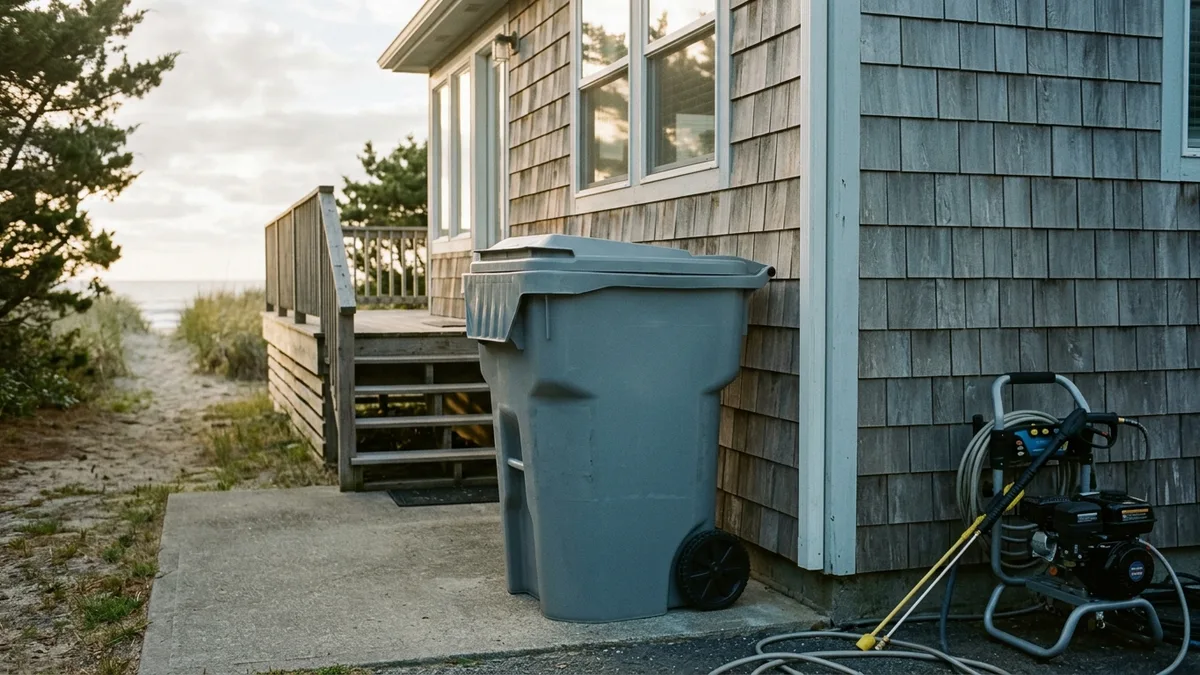
This is one of the most under-covered topics in host-facing trash guidance, and it matters more in a humid coastal climate. Charleston summers push bin odor and pest issues higher than in drier markets, particularly at beach properties on Sullivan's Island or Isle of Palms where cans sit outdoors and see heavier guest turnover during peak season. Hot-water sanitation of collection bins on a recurring basis addresses the buildup that plain trash removal does not touch.
Hosts serious about this problem pair their trash removal vendor with a separate bin cleaning and sanitizing service, since collection and sanitation are different jobs requiring different equipment. A can that gets picked up nightly but sanitized quarterly still develops odor between cleanings; the two services need to run on their own separate cadence to actually solve the problem.
In-House Cleaning Crews vs. Outsourced Valet Trash: Which Is More Reliable?
In-house cleaning crews handling trash as a side task are generally slower and less consistent for waste-specific work than an outsourced valet trash service built specifically for scheduled collection, because cleaners are optimizing for the reset, not for bin logistics or municipal pickup timing.
Cost-wise, folding trash duties into a cleaner's existing fee looks cheaper on paper. But it shifts hidden costs onto the host: missed municipal pickups because the cleaner forgot bin day, longer turnover windows because staff are hauling cans instead of prepping the next stay, and no documentation if a guest disputes cleanliness in a review. Reliability suffers first during peak season, exactly when a single missed pickup does the most reputational damage.
An outsourced valet trash or trash can concierge model separates these functions cleanly. The cleaner bags and stages; the waste provider collects on a schedule synced to actual turnover dates, rolls bins out and back, and documents completion with photo verification at each visit. For a single host with one property and a predictable weekly rhythm, in-house handling might genuinely be sufficient. For anyone managing multiple units, a scattered-site portfolio, or properties with unpredictable same-day turns, response time and consistency both favor a dedicated vendor. Response time matters specifically because a cleaner juggling a tight turnover has no slack to react to a bin that didn't get picked up; a dedicated waste operations partner does.
Multi-Property Workflows and Escalation Paths
Hosts running five, ten, or fifty scattered-site units across the Charleston metro face a coordination problem that a single-property trash plan was never built to solve. Without a documented escalation path, a missed pickup at property fourteen might not surface until a guest complains days later. Portfolio-level waste management addresses this with a single point of contact across every address, consistent service standards regardless of location, and photo confirmation that flags a problem the moment it happens rather than after a bad review. This is the operational difference between managing trash property by property and running waste as an actual system.
What Does Photo Verification Actually Prove?
Photo verification in short-term rental trash management is documented, timestamped proof that a waste collection visit was completed at a specific property on a specific date. It matters most as protection against guest disputes, where a reviewer claims a unit was dirty on arrival and the host needs evidence the trash was in fact removed before check-in.
Without documentation, a host has no way to counter a claim that trash was left behind or that a bin overflowed before a new guest arrived. With a photo-verified system, every service stop generates a record: the provider's crew photographs the completed collection at the door or curb, and that image is timestamped and available to the host without any follow-up request. This shifts the burden of proof entirely, and it also creates accountability on the provider's side, since a missed stop shows up immediately rather than getting discovered a week later through a guest complaint.
For hosts managing properties they rarely visit in person, whether that is a scattered-site portfolio or a single Johns Island vacation rental managed remotely, photo verification replaces the need to physically check that trash service happened. It is documentation, not just a nicety.
What Should Go in a Guest-Facing Trash Instruction Message?
An effective guest-facing trash instruction is a short, specific message delivered at check-in that names the exact bin location, states what guests are and are not responsible for, and gives a contact point for overflow issues. Vague instructions generate mid-stay messages; specific ones prevent them almost entirely.
- State the bin's exact physical location: "Trash bins are located behind the carport near the driveway," not "trash goes outside."
- Clarify what the guest needs to do: typically, just bag loose trash and place it in the labeled bin, nothing more.
- Note what the guest does NOT need to do: rolling bins to the curb, sorting recycling in detail, or arranging pickup, none of that is the guest's job.
- Provide a contact method for overflow mid-stay, especially for longer bookings where a single bin may fill before checkout.
- Add trash-related reminders to the property's automated messaging sequence, sent the day before checkout, so the instruction lands when it is actually useful.
This kind of guest communication is the layer that has to work before physical trash removal even becomes relevant. A perfectly scheduled valet pickup does not help if a confused guest leaves three days of garbage bags stacked inside the kitchen because nobody told them where the bin was.
What Local Compliance Factors Should Charleston-Area Hosts Know?
Local waste compliance for Charleston-area short-term rentals varies by municipality and, in some cases, by HOA, covering everything from bin placement rules to vehicle and occupancy restrictions tied to the property. Hosts should confirm current requirements directly with the relevant municipal office rather than assuming one city's rules apply portfolio-wide.
As one concrete example, the City of Isle of Palms limits the number of vehicles allowed at a short-term rental between 11:00 p.m. and 9:00 a.m. to the greater of one vehicle per bedroom or one vehicle for every 2.5 people allowed under maximum overnight occupancy, with a minimum of two vehicles, a rule that indirectly affects how much space is available for bin storage and turnover logistics at beach properties. Isle of Palms performance data for 2026 also shows top-performing hosts earning $151,737 or more annually, with a median host earning $101,468 at a $546 average daily rate and 70% occupancy, which underscores how much is at stake operationally when a trash-related review dings an otherwise strong-performing listing.
Beyond Isle of Palms, North Charleston applies a residential tax rate of 4% for rentals lasting between 24 and 72 nights per year, according to Airbtics 2026 data, a detail that matters for hosts structuring rental terms but has no direct bearing on trash logistics itself. HOA-governed communities on Daniel Island and James Island frequently add their own bin storage and curb-appeal rules on top of municipal code, so hosts operating in those markets should check both layers, not just the city ordinance, before finalizing a waste plan.
Practical Guidance: Building a Turnover Trash System That Actually Holds Up
Building a dependable trash workflow between guest stays comes down to five decisions made in advance, not reactive fixes made after a bad review. Below is the sequence most experienced multi-property hosts follow.
- Separate the three trash tasks explicitly. Bagging and staging, bin roll-out and return, and bulk-item exceptions each need an assigned owner, whether that is the cleaner, a valet provider, or an on-demand service.
- Sync the provider's schedule to the booking calendar, not to a fixed weekly day. This single change eliminates most overflow problems during back-to-back turnovers.
- Write specific, location-exact guest instructions and automate delivery the day before checkout so it lands at the right moment.
- Add bin sanitation as a recurring, separate service, not something bundled into pickup, especially for outdoor bins in humid coastal markets.
- Require photo verification from any provider, so there is documentation available the moment a guest disputes a review, rather than scrambling to prove service after the fact.
The most common mistake we see across the multifamily, build-to-rent, and short-term rental portfolios we work with is treating bulk-item removal as an afterthought instead of a scheduled step in the turnover cycle. A guest who abandons a broken cooler or an inflatable mattress creates a problem that a standard cleaner cannot solve with a trash bag, and waiting until the next guest complains is always more expensive than scheduling on-demand pickup proactively.
Frequently Asked Questions
What is vacation rental trash service?
Vacation rental trash service is a waste collection arrangement scheduled around guest checkout and check-in windows rather than a fixed municipal pickup day. It typically includes bagged waste removal between stays, bin roll-out and return for city collection days, and on-demand bulk-item pickup for items too large for a standard can.
How much do valet trash companies charge apartments?
Pricing for valet trash service at apartment communities is typically quoted per unit per month and varies based on portfolio size, collection frequency, and service scope. Multifamily property managers should request a direct quote reflecting their specific unit count and turnover pattern rather than relying on a general market estimate, since portfolios scaling from 10 to over 1,000 units see meaningfully different pricing structures.
How much does trash cost per month in an apartment?
Monthly trash costs for apartment residents vary by market and service model, and industry data from the National Multifamily Housing Council indicates many multifamily communities that offer valet trash pass along a monthly resident fee as part of the amenity package. Costs depend heavily on whether the community uses standard dumpster service, contracted valet trash, or a hybrid model, so residents and property managers should confirm current local pricing directly.
How many nights a week does valet trash run?
Valet trash collection frequency depends on the property type and service agreement, with many multifamily communities running nightly or several nights per week to keep hallways and dumpster areas clear. Short-term rental trash pickup is typically scheduled around actual guest turnover dates rather than a fixed number of nights weekly, since booking patterns rarely align to a standard schedule.
What is trash reimbursement for apartments?
Trash reimbursement generally refers to a fee structure where a property owner or manager passes along the cost of waste collection service, valet trash or otherwise, to residents as a separate line item rather than folding it into base rent. The specific structure and amount vary by property and lease terms, so residents should check their individual lease agreement for details.
Are you supposed to take out the trash in a short-term rental?
Guests are generally expected to bag and consolidate their own trash before checkout per standard host instructions, but they are not responsible for hauling waste to a municipal collection point or arranging pickup. That responsibility belongs to the host or the host's cleaning and waste management team.
How much do people charge for short-term rental turnovers?
Standard turnover cleaning for a 3-bedroom, 2-bathroom short-term rental typically runs $80 to $150, with basic trash bagging bundled into that fee. Dedicated trash valet or bulk-item removal services are usually priced and scheduled separately from the cleaning fee itself.
Can trash build a home?
This question falls outside the scope of short-term rental waste management and trash valet services; it does not relate to how hosts handle turnover trash between guest stays.
Conclusion
Short-term rental hosts who manage trash well between guest turnovers do it by separating bagging, bin logistics, and bulk-item removal into distinct, scheduled tasks rather than leaving it all to whoever cleans last. In 2026, with North Charleston bookings averaging 42 days of lead time and portfolios scaling well past a single property, the hosts who sync waste pickup to the actual booking calendar, document service with photo verification, and add bin sanitation as its own recurring step are the ones who avoid the overflowing-can review disaster entirely.
Waste management at a short-term rental rarely fails because of one bad decision. It fails because no system runs without the host personally checking on it. A structured approach, with scheduled collection, photo-verified confirmation, and flexible support for same-day turnovers and bulk items, removes that burden for good.

If you manage short-term rental properties across Charleston or Atlanta and want turnover trash off your personal checklist, we provide scheduled, photo-verified waste collection built around actual guest turnover timing rather than a fixed weekly day. Request a service quote Monday through Friday and see how a documented system compares to what you're running now.
Content powered by inkSTR.co