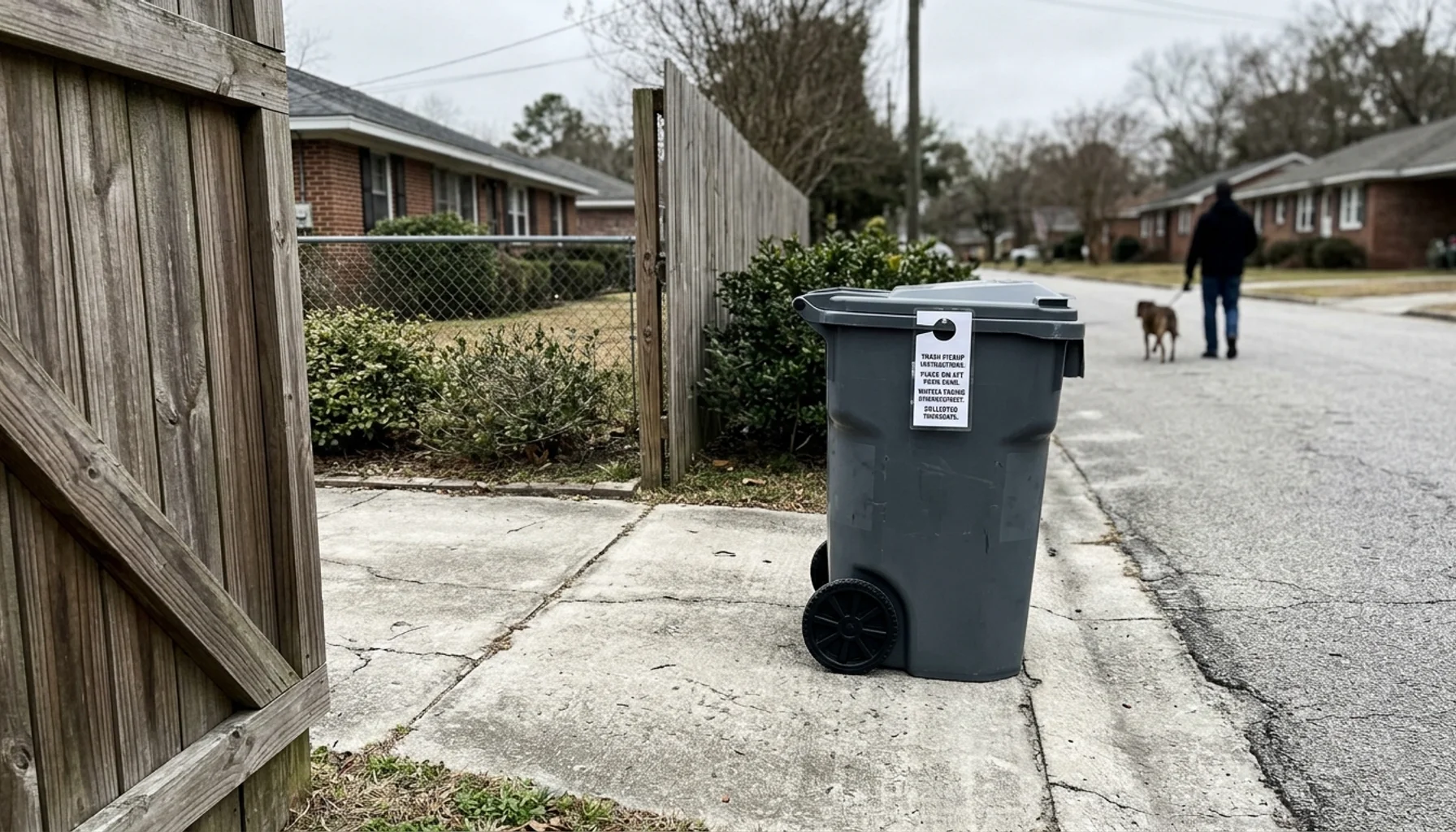
STR trash management is the process of scheduling, removing, and documenting waste at a short-term rental property between guest stays, so a full trash can or overflowing bin never becomes the reason for a one-star review. For Charleston Historic District and Isle of Palms hosts, it usually means an on-demand or turnover-based pickup rather than a once-a-week municipal schedule.
Key Takeaways
- STR trash management refers to coordinating waste pickup around guest checkout and check-in windows, not around a fixed weekly city schedule.
- City of Charleston curbside collection requires bins placed within 2 feet of the curb and removed by 6 p.m. on pickup day, a rule most short-term rental turnovers cannot reliably meet on their own.
- Photo-verified valet trash service gives STR operators documented proof that a unit was cleared before a guest arrival, without anyone driving out to check.
- North America's solid waste management market is projected to reach approximately USD 90.86 billion by 2031, according to Mordor Intelligence, reflecting rising demand for structured, professional waste services over DIY methods.
- Trash Day Made Easy operates from North Charleston and serves the Historic District, Isle of Palms, Sullivan's Island, and the broader Charleston metro with on-demand and turnover-specific waste removal.
- Bulk item removal, not routine trash, is the most common cause of delayed STR turnovers when a previous guest leaves furniture or oversized debris behind.
Short-term rental operators in Charleston deal with a version of the waste problem that multifamily property managers rarely face: unpredictable timing. A guest checks out at 10 a.m., a cleaner arrives at 11, and a new guest is due by 4 p.m. If trash is still sitting in the kitchen or piled at the curb when that new guest walks in, the review damage happens before you even know there was a problem. At Trash Day Made Easy, we work with STR operators across the Historic District, Sullivan's Island, and Isle of Palms who learned this the hard way, usually after a single bad review tanked their listing's ranking for weeks.
This guide covers what STR trash management actually involves in 2026, how it differs from standard municipal pickup and multifamily valet trash, what a professional service should include, and how Charleston-area hosts can build a system that survives even the chaotic same-day turnovers. We'll also walk through where DIY approaches break down and what photo-verified, on-demand waste removal changes about the guest experience.
None of this is theoretical. Charleston's density of short-term rentals near the Historic District, combined with strict municipal placement rules for garbage containers, means STR hosts are working with less flexibility than they think. Understanding the actual mechanics of trash flow between stays is the difference between a five-star cleanliness score and a guest complaint you can't take back.
What Is STR Trash Management?
STR trash management is the coordinated process of removing waste from a short-term rental property in the window between one guest's departure and the next guest's arrival, rather than on a fixed municipal collection day. It covers routine kitchen and bathroom trash, recycling, and occasionally bulk items like furniture or broken appliances left behind by departing guests.
Unlike a long-term rental or owner-occupied home, an STR property in the Charleston Historic District might turn over guests two or three times a week during peak season. Specifically, that means trash accumulates and needs removal on a schedule that has nothing to do with the City of Charleston's published garbage collection calendar.
As a result, most successful STR waste programs in 2026 combine two elements: a cleaner who bags and stages trash during turnover, and a separate waste removal service that collects it on-demand rather than waiting for the next scheduled city pickup. Notably, this is a fundamentally different operating model than the once-weekly residential pickup most Charleston homeowners rely on.
How Is STR Waste Removal Different From Standard Curbside Pickup?
Standard curbside pickup in Charleston runs on a fixed weekly schedule set by the municipality, while STR waste removal runs on the property's actual booking calendar. The City of Charleston requires garbage containers to be placed at the curb no earlier than 6 p.m. the day before scheduled pickup, and removed by 6 p.m. on pickup day itself, a rule that assumes someone is on-site to manage the bin twice a week.
That assumption fails for an STR. If a guest checks out on a Tuesday and city pickup isn't until Friday, the bin sits full for three days, right through a Wednesday check-in. First, this creates an odor problem in Charleston's humid climate. Second, it creates a curb appeal problem in neighborhoods like the Historic District where a full bin sitting for days is visible to every passerby and every arriving guest.
Additionally, North Charleston's Sanitation Division handles residential pickup only within city limits, and commercial or non-residential properties must arrange their own disposal entirely. Many STR properties fall into a gray zone depending on how the property is zoned and used, which is exactly why operators near the city of Charleston trash pick up schedule often supplement municipal service with a dedicated valet provider.
What Does Photo-Verified Trash Collection Mean for STR Hosts?
Photo-verified trash collection means a waste removal crew documents each pickup with a timestamped photo at the point of service, giving the property operator proof that waste was actually removed without needing to inspect the unit in person. For an STR host managing a property remotely, or managing several properties across Sullivan's Island and James Island, this eliminates the guessing game entirely.
Trash Day Made Easy documents every collection visit this way. A host managing a property on Sullivan's Island doesn't need to drive over between guests to confirm the crew showed up; the confirmation lands in their inbox. This matters most during back-to-back turnovers, when a host might have thirty minutes between a cleaner leaving and a guest arriving, with zero time to personally verify anything.
For scattered-site operators managing multiple listings across North Charleston, Mount Pleasant, and Johns Island, photo verification becomes even more valuable. Instead of trusting five different cleaners or handymen to confirm trash removal by text message, one dashboard shows service completion across every property, on every turnover date, with a visual record attached.
Why Does Bulk Item Removal Matter More for STR Properties Than Routine Trash?
Bulk item removal is the collection of oversized waste, such as broken furniture, mattresses, or large amounts of debris left by a departing guest, and it causes far more turnover delays for STR properties than routine kitchen trash ever does. A guest who breaks a lamp or leaves behind a damaged air mattress creates a problem that a standard trash bag can't solve.
Cleaners are not equipped to haul a broken loveseat to the curb between a checkout at 10 a.m. and a check-in at 4 p.m. Yet that exact scenario happens more often on the Isle of Palms and around the Historic District than most first-time hosts expect, especially during group weekends and holiday turnovers when guest counts run higher than usual.
This is where guest turnover trash service becomes distinct from routine valet pickup. Trash Day Made Easy's bulk item removal integrates directly into the make-ready window, so an oversized item doesn't sit in a driveway or hallway waiting for the next scheduled city bulk pickup date, which in Charleston can be weeks away depending on the neighborhood's collection calendar.
What Should an STR Trash Management Plan Include?
A complete STR trash management plan should include four components: a routine collection schedule tied to turnover dates rather than a fixed weekly day, on-demand bulk removal for oversized items, photo-verified proof of service, and a bin or bag standard that keeps waste out of sight until pickup. Missing any one of these creates a gap a guest will eventually notice.
Building the Turnover Schedule
First, map out the property's typical booking cadence. A Sullivan's Island beach house running weekly Saturday-to-Saturday turnovers needs a very different waste plan than a Historic District rowhouse running frequent two and three-night stays. Weekly turnovers can often work with a single scheduled pickup timed to checkout day. Frequent short stays need on-demand service that responds to the actual calendar, not a fixed day of the week.
Coordinating With Cleaning Crews
Second, the cleaning crew needs a clear staging protocol: where bagged trash goes, what container it goes in, and by what time it needs to be ready for pickup. Most breakdowns in STR waste management come from a communication gap between the cleaner and the waste removal service, not from either party failing individually.
Setting a Bulk Item Protocol
Third, establish a standing rule with your waste provider for on-demand bulk pickup requests, so a broken chair or an oversized box doesn't sit in the yard through an entire guest stay. Trash Day Made Easy's on-demand scheduling exists specifically for this kind of unpredictable, non-routine waste event.
What Do STR Operators Pay for Waste Removal Compared to Standard Trash Valet?
STR waste removal pricing varies based on turnover frequency, bulk item volume, and whether service runs on a fixed schedule or on-demand, which makes it structurally different from the flat monthly rate typical of a multifamily valet trash contract. According to the National Multifamily Housing Council, roughly half of U.S. apartment complexes now offer valet trash as a standard amenity, usually billed at a predictable monthly rate per unit.
An STR property doesn't fit that model cleanly because guest turnover isn't predictable in the same way apartment lease renewals are. Some months a Historic District property might turn over eight times; other months, three. A quote-based model, built around the property's actual booking pattern, tends to serve STR hosts better than a rigid flat fee designed for apartment communities.
| Service Model | Best Fit | Typical Structure | Key Limitation |
|---|---|---|---|
| Municipal curbside pickup | Owner-occupied homes with stable weekly schedules | Fixed day, once weekly (Charleston metro) | Cannot flex around guest checkout dates |
| Multifamily valet trash | Apartment communities with nightly collection | Flat monthly rate per unit | Not designed for irregular STR turnover timing |
| STR on-demand waste removal | Short-term rentals with variable turnover frequency | Quote-based, tied to booking calendar | Requires coordination with cleaning schedule |
| Bulk item removal add-on | Any property with oversized guest-left debris | Per-pickup or bundled with turnover service | Needs advance notice for large items |
Residential homeowners in select Charleston neighborhoods who want valet trash without the STR turnover complexity can access Trash Day Made Easy's standard residential service starting from $49 per month. For active short-term rental properties, quotes are built around the specific booking cadence and are available Monday through Friday.
How Does STR Trash Management Affect Guest Reviews and Reputation?
Trash left behind from a previous guest, or an overflowing bin visible from the driveway, is one of the fastest ways to trigger a low cleanliness score on Airbnb or Vrbo, and cleanliness scores directly affect a listing's search ranking on both platforms. A single review mentioning a smell in the kitchen or trash on the porch does damage that's hard to undo with five subsequent good reviews.
Notably, guests rarely mention when trash service went smoothly, but they almost always mention when it didn't. That asymmetry is why STR operators near the Charleston Historic District treat waste removal as a guest-experience issue, not a maintenance afterthought. A clean-smelling, trash-free arrival sets the tone for the entire stay before a guest unpacks a single bag.
For hosts managing properties across Daniel Island's newer build-to-rent-adjacent short-term inventory or older Historic District rowhouses, the underlying principle doesn't change: waste removal is part of the guest experience stack, alongside clean linens and a working thermostat. Treating it as an operational afterthought is the most common mistake first-time hosts make.
What Waste Management Options Exist for STR Properties in the Charleston Market?
Charleston-area STR operators have three broad waste management paths available in 2026: relying entirely on municipal pickup, hiring a general junk removal company on a one-off basis, or contracting a dedicated valet and on-demand waste provider built for turnover cycles. Each path carries a different level of reliability and a different amount of operator effort.
Trash Day Made Easy is built specifically around this third path. Headquartered at 4900 O'Hear Avenue in North Charleston, the company provides on-demand trash removal and bulk item pickup timed to guest turnover, with photo-verified confirmation sent after each visit. Coverage extends across the Historic District, Isle of Palms, Sullivan's Island, Mount Pleasant, James Island, Daniel Island, Johns Island, and Summerville, so operators managing scattered STR listings across the metro deal with one point of contact instead of several. The service also integrates bulk item removal directly into the make-ready window between guests, and Trash Day Made Easy partners with The Bin Boy for bin cleaning and sanitizing when a property's containers need more than a simple wipe-down.
National multifamily-focused providers, including Valet Living and Trash Butler, built their businesses around nightly apartment collection rather than the irregular, on-demand rhythm an STR property needs. General junk removal companies can handle a one-off bulk pickup but don't offer the recurring, scheduled coordination that turnover cycles demand. Neither model was built with a Historic District rowhouse turning over three times a week in mind.

What Mistakes Do STR Hosts Make With Waste Management?
The most common mistake STR hosts make is treating trash removal as something the cleaner handles automatically, without a separate plan for what happens after the cleaner bags it. A cleaner's job is to prepare the unit; it isn't to haul bags to a curb three blocks away or wait around for a scheduled city pickup that might not align with the next check-in.
- Assuming the cleaning crew handles disposal: Most cleaning contracts cover staging trash, not removal to a dumpster or curb. Confirm this explicitly in writing.
- Relying on weekly municipal pickup alone: A Tuesday checkout with Friday city pickup leaves three days of exposed waste through at least one guest arrival.
- No plan for bulk items: A guest-damaged piece of furniture needs on-demand removal, not a wait for the next scheduled bulk pickup date.
- No documentation of service completion: Without photo verification, a host managing remotely has no way to confirm the unit was actually cleared before the next guest arrives.
- Ignoring bin placement rules: The City of Charleston requires containers within 2 feet of the curb, at least 3 feet from obstructions, which matters for curb appeal in dense STR neighborhoods.
Deep Dive: Why Turnover Timing Breaks Most DIY Waste Plans
The core operational problem with DIY STR trash management is that it assumes a fixed schedule, when the actual constraint is a variable one: the booking calendar. A host who sets a rule like "trash goes out every Monday and Thursday" will inevitably hit a week where checkout falls on a Tuesday and check-in on a Wednesday, leaving the plan useless exactly when it matters most.
This is the same structural gap that pushed multifamily property managers toward valet trash services in the first place, just compressed into a shorter and less predictable cycle. A 200-unit apartment community can schedule nightly collection because residents are there every night. An STR property might be empty for four days and then host back-to-back three-night stays for two weeks straight during a Charleston festival weekend or a Historic District wedding season surge.
On-demand service solves this by decoupling collection from a fixed calendar entirely. Instead of "pickup every Tuesday," the model becomes "pickup whenever a turnover requires it," which is the only structure flexible enough to match how STR bookings actually behave. In our experience serving Charleston-area hosts, the properties with the fewest cleanliness complaints are the ones where waste removal is scheduled against the reservation calendar, not against the calendar week.
There's also a compounding factor unique to coastal Charleston: humidity and heat accelerate odor buildup in bagged kitchen waste far faster than in drier climates. A bag that could sit unnoticed for two days in a temperate market becomes a guest complaint within hours during a Charleston summer. That single variable is why "wait for the weekly pickup" fails more often here than it might in a market with a milder climate.
Practical Guidance: How to Choose a Waste Provider for Your STR Property
Choosing the right waste provider for an STR property comes down to matching the service model to the property's actual turnover pattern, not picking whichever company shows up first in a search result. Ask these questions before signing any agreement:
- Does the provider offer on-demand scheduling, or only fixed weekly service?
- Is bulk item removal included, or billed separately with its own lead time?
- Does the provider send photo confirmation, or rely on a driver's word that the stop was completed?
- Can the same provider service multiple properties across different Charleston neighborhoods under one account?
- Is pricing quote-based around your booking volume, or a rigid flat fee that doesn't reflect actual turnover frequency?
Operators managing a single property on Johns Island have different needs than a scattered-site owner running eight listings between James Island and Daniel Island. A provider that scales from a handful of doors to a portfolio-sized account, without changing the service standard, is worth more than one offering the lowest headline price.
Frequently Asked Questions
How does trash removal work for a short-term rental between guests?
A cleaner bags and stages trash during turnover, and a separate waste removal service collects it, ideally on an on-demand basis tied to the checkout and check-in schedule rather than a fixed weekly city day. Trash Day Made Easy coordinates this collection around the property's actual booking calendar across the Charleston metro.
Can I just rely on city trash pickup for my Airbnb?
Relying solely on municipal pickup works only if your turnover schedule happens to align with the city's fixed collection day, which is rare for STR properties running multiple stays per week. City of Charleston pickup also requires bins removed from the curb by 6 p.m. on collection day, a rule that's hard to enforce remotely between guests.
What happens if a guest leaves behind bulky items or damaged furniture?
Bulky or damaged items require on-demand bulk item removal rather than routine trash pickup, since a standard cleaning crew isn't equipped to haul furniture. Trash Day Made Easy's bulk removal service integrates into the make-ready window so oversized debris doesn't delay the next guest's arrival.
How do I know a waste pickup actually happened if I manage my property remotely?
Photo-verified service is the answer: the crew documents each collection with a timestamped photo, and the confirmation is sent to the property operator without any need for an in-person inspection. This is standard practice with Trash Day Made Easy's service across every property in a portfolio.
How much does STR waste removal cost compared to standard valet trash?
STR waste removal is typically quote-based because turnover frequency varies month to month, unlike the flat monthly rate common in multifamily valet trash contracts. Residential valet trash in select Charleston neighborhoods starts from $49 per month, while active STR properties receive a custom quote reflecting booking volume.
Can one waste provider handle multiple short-term rental properties across Charleston?
Yes. Trash Day Made Easy is built to scale from a single property to portfolios covering the Historic District, Isle of Palms, Sullivan's Island, Mount Pleasant, James Island, Daniel Island, Johns Island, and Summerville, with one point of contact and consistent photo-verified standards across every address.
Does STR trash management include recycling or just general waste?
Most STR waste removal services cover general trash and recycling collection during turnover, though bulk items and hazardous materials typically require separate arrangements. Confirm the specific scope with your provider, since recycling handling can vary by property type and municipal jurisdiction.
What's the difference between STR trash management and standard valet trash service?
Standard valet trash service typically runs on a nightly or fixed schedule built for apartment residents who are present every day, while STR trash management runs on-demand around a fluctuating guest booking calendar. The core difference is flexibility: STR waste removal has to adapt to reservation gaps and back-to-back turnovers instead of a predictable daily rhythm.
Conclusion
STR trash management works best when it's built around the reservation calendar instead of a fixed weekly pickup day, with on-demand bulk item removal and photo-verified confirmation closing the gaps that DIY plans consistently miss. Charleston's humid climate and dense Historic District turnover patterns make this even more urgent than in slower-turnover markets. As the North America solid waste management market grows toward an estimated USD 90.86 billion by 2031, according to Mordor Intelligence, professional, structured waste service is becoming the norm rather than the exception, even for individual short-term rental hosts.
Trash Day Made Easy built its on-demand and turnover trash removal service specifically for this kind of unpredictable, high-frequency operation, serving STR operators across North Charleston, the Historic District, Isle of Palms, Sullivan's Island, and the surrounding Charleston metro. As booking patterns get more compressed heading further into 2026, the operators who treat waste removal as part of the guest experience, not an afterthought, are the ones protecting their review scores.
If turnover timing has been the source of your last guest complaint, on-demand STR trash management removes that risk from the equation entirely. Get started with Trash Day Made Easy and request a quote for your Charleston-area short-term rental, available Monday through Friday.
Content powered by inkSTR.co